This is the content of the pop-over!

Lightning Deal Alert – 12% Off Ends at Midnight!

Strike while the savings are hot! Use promo code FlashSale at checkout for 12% off any Exam Edge test or bundle. Hurry—the clock is ticking!

CPACE (603) Practice Tests & Test Prep by Exam Edge


CPACE California Preliminary Administrative Credential Examination   product image
(4.8)
Based on 25 Reviews

  • Real Exam Simulation: Timed questions and matching content build comfort for your CPACE test day.
  • Instant, 24/7 Access: Web-based CPACE California Preliminary Administrative Credential Examination practice exams with no software needed.
  • Clear Explanations: Step-by-step answers and explanations for your CPACE exam to strengthen understanding.
  • Boosted Confidence: Reduces anxiety and improves test-taking skills to ace your CPACE California Preliminary Administrative Credential Examination (603).

Featured on

CPACE California Preliminary Administrative Credential Examination Online Practice Test Bundles

BEST VALUE
25 practice tests

$218.75

$998.75

SAVE $780

Only $8.75 per test!

  • 100% Pass Guarantee
  • 25 online practice tests
  • 70 questions + 3 essays per test
  • Bonus: 100 Flash Cards + Study Guide
  • Instant access
  • Detailed Explanations
  • Practice tests never expire
  • Timed, untimed, or study guide mode
MOST POPULAR
10 practice tests

$99.50

$399.50

SAVE $300

Only $9.95 per test!

  • 10 online practice tests
  • 70 questions + 3 essays per test
  • Bonus: 100 Flash Cards + Study Guide
  • Instant access
  • Detailed Explanations
  • Practice tests never expire
  • Timed, untimed, or study guide mode
5 practice tests

$69.75

$199.75

SAVE $130

Only $13.95 per test!

  • 5 online practice tests
  • 70 questions + 3 essays per test
  • Bonus: 100 Flash Cards
  • Instant access
  • Detailed Explanations
  • Practice tests never expire
  • Timed, untimed, or study guide mode
1 practice test

$39.95

  • 1 online practice test
  • 70 questions + 3 essays per test
  • Instant access
  • Detailed Explanations
  • Practice tests never expire
  • Timed, untimed, or study guide mode
Quick Select
Tap to choose a bundle

** All Prices are in US Dollars (USD) **


CPACE (603) Resources

Jump to the section you need most.

Understanding the exact breakdown of the CPACE California Preliminary Administrative Credential Examination test will help you know what to expect and how to most effectively prepare. The CPACE California Preliminary Administrative Credential Examination has 70 multiple-choice questions and 3 essay questions. The exam will be broken down into the sections below:

CPACE California Preliminary Administrative Credential Examination Exam Blueprint
Domain Name % Number of
Questions
Visionary Leadership 12 14
Instructional Leadership 14 17
School Improvement Leadership 12 14
Professional Learning and Growth Leadership 11 13
Organizational and Systems Leadership 10 12
Community Leadership  

CPACE California Preliminary Administrative Credential Examination Study Tips by Domain

  • Develop and communicate a shared vision grounded in equity and student outcomes; red flag: a vision statement that isn’t translated into 2–3 measurable goals with clear success indicators.
  • Align mission, core values, and strategic priorities so decisions are coherent across programs; common trap: launching initiatives that don’t map to the vision, creating “initiative fatigue” and diluted impact.
  • Use data (achievement, opportunity, climate) to set ambitious, realistic targets; priority rule: disaggregate by student group and address the largest opportunity gaps first.
  • Engage stakeholders (students, families, staff, community partners) in vision-setting with transparent decision rules; red flag: “input” processes with no feedback loop about what was adopted and why.
  • Anticipate change management needs and build buy-in through clear rationale, timelines, and roles; common trap: announcing the “what” without the “why” and supports, leading to predictable resistance.
  • Ensure the vision is operationalized through resource and policy alignment (budget, staffing, schedules); red flag: a budget that doesn’t reflect stated priorities or lacks evidence-based justification.
  • Use evidence of student learning (formative, interim, summative) to guide instructional decisions; red flag: making program or pacing changes based on anecdotes rather than disaggregated data for subgroups.
  • Ensure instruction is aligned to California content standards, adopted curriculum, and learning goals; common trap: confusing “coverage” of standards with demonstrated student mastery.
  • Conduct observation cycles (pre-conference, focused look-for, feedback, follow-up) tied to clear instructional expectations; priority rule: feedback must be specific, actionable, and anchored in evidence from the lesson.
  • Support effective differentiation (UDL, scaffolds, intervention/acceleration) for ELs, students with disabilities, and advanced learners; red flag: lowering rigor instead of providing access through supports.
  • Protect equitable access to high-quality instruction through scheduling, grouping, and resource allocation; common trap: tracking or convenience-based placements that disproportionately limit opportunities for historically underserved students.
  • Maintain a safe, inclusive learning environment that supports academic engagement (classroom management, culturally responsive practices); contraindication: relying solely on exclusionary discipline when instructional or behavioral supports are needed.
  • Use multiple measures (achievement, growth, attendance, behavior, course access) to define the problem before selecting strategies—red flag: jumping to solutions based on a single test score.
  • Root-cause with evidence (e.g., fishbone/5 Whys) and verify with site-level walkthrough data—common trap: treating symptoms (low scores) as causes (instructional practice) without proof.
  • Align the improvement plan to LCAP priorities and clearly specify goals, actions/services, and metrics—priority rule: if a metric can’t be monitored at least quarterly, it’s not a usable measure.
  • Implement a coherent MTSS/RTI system with tiered supports and documented progress monitoring—red flag: Tier 2 interventions that mirror Tier 1 instruction with no change in intensity or time.
  • Monitor implementation fidelity (who, what, when) separately from outcomes—common trap: abandoning a strategy because results haven’t moved when the strategy was never implemented as designed.
  • Engage stakeholders (families, staff, students) with structured input and transparent data-sharing—contraindication: compliance-only meetings that don’t change decisions or resource allocation.
  • Use multiple evidence sources (e.g., observation data, student work, formative results) to set professional learning priorities—red flag: choosing training topics based on anecdotes or vendor offerings rather than documented need.
  • Align professional learning goals to adopted standards, curriculum, and site/district improvement plans—common trap: launching initiatives that aren’t explicitly connected to agreed outcomes and accountability metrics.
  • Build job-embedded supports (coaching cycles, PLC protocols, demonstration lessons) with clear look-fors—priority rule: “one-and-done” workshops without practice and feedback rarely change instruction.
  • Differentiate professional learning using role, experience, and performance evidence (new teacher induction supports vs. advanced collaborative inquiry)—red flag: requiring identical training for all staff regardless of need.
  • Evaluate impact using implementation and outcome measures (fidelity checks plus student learning indicators) and adjust quickly—common trap: counting attendance or satisfaction surveys as the primary proof of effectiveness.
  • Protect time and conditions for adult learning (schedule, coverage, norms for collaboration and psychological safety)—contraindication: expecting PLC results without dedicated time, clear facilitation, and follow-through.
  • Apply California education governance correctly (CTC, SBE, LEA, site roles) and document decision authority; red flag: issuing site directives that conflict with board policy or negotiated agreements.
  • Design master schedules, staffing assignments, and duty rosters using student needs, credential/authorization rules, and contract language; common trap: placing staff outside authorization or ignoring class-size caps and prep-time provisions.
  • Manage resources with transparent budgeting tied to goals and compliance (restricted vs. unrestricted, categorical reporting); priority rule: don’t supplant restricted funds or miss required stakeholder input timelines.
  • Implement operational systems for safe, orderly schools (supervision plans, facilities, transportation, emergency procedures) and run drills as required; red flag: outdated plans that don’t align with ICS/NIMS roles or training documentation.
  • Use data systems and internal controls to protect confidentiality and integrity (records access, FERPA-aligned practices, audit trails); common trap: oversharing student information via email or unsecured platforms.
  • Lead communication and labor-relations processes with consistent protocols (complaints, discipline systems, bargaining impacts) and maintain written records; red flag: inconsistent application of policy that creates equity or due-process violations.
  • Build two-way partnerships with families, community organizations, and local agencies, aligning goals to student outcomes and LCAP priorities; red flag: stakeholder “input” that is one-way or collected after decisions are made.
  • Communicate in culturally and linguistically responsive ways (translation, interpretation, accessible formats) and document outreach; common trap: assuming bilingual staff equals compliant interpretation for high-stakes meetings.
  • Use shared decision-making structures (SSC, ELAC/DELAC, PTA/booster, community advisory groups) with clear roles and agendas; priority rule: match the forum to the decision authority to avoid procedural challenges.
  • Coordinate wraparound supports (mental health, attendance, child welfare, housing, food security) with defined referral pathways; red flag: informal “hand-offs” without consent, follow-up, or data tracking.
  • Engage in proactive, transparent crisis and safety communication with families and community partners; common trap: releasing incomplete information that erodes trust or conflicts with privacy requirements.
  • Advocate for equity by analyzing community feedback and participation data (who shows up, who doesn’t, and why) and adjusting engagement strategies; red flag: relying on a single listening session as evidence of meaningful engagement.


Built to Fit Into Your Busy Life

Everything you need to prepare with confidence—without wasting a minute.

Three Study Modes

Timed, No Time Limit, or Explanation mode.

Actionable Analytics

Heatmaps and scaled scores highlight weak areas.

High-Yield Rationales

Concise explanations emphasize key concepts.

Realistic Interface

Matches the feel of the actual exam environment.

Accessible by Design

Clean layout reduces cognitive load.

Anytime, Anywhere

Web-based access 24/7 on any device.
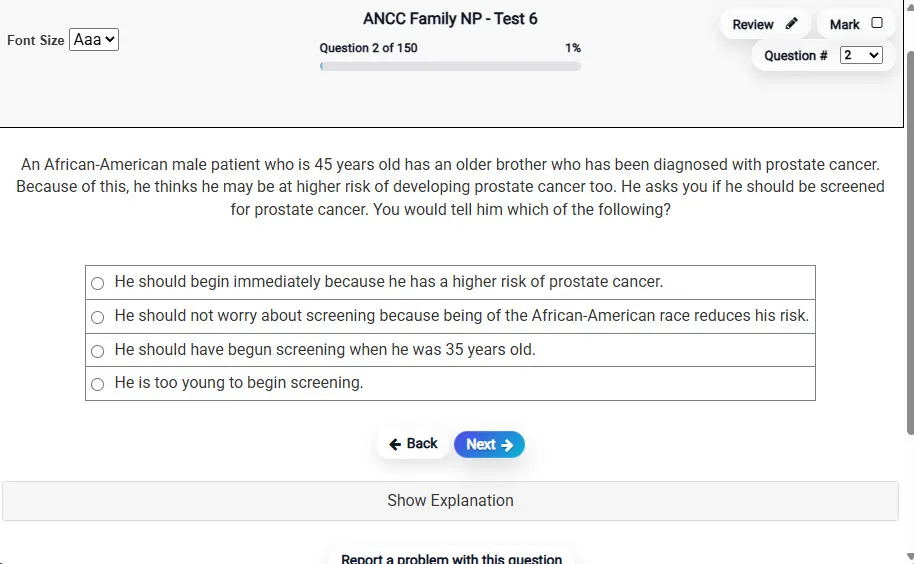
Answering a Question screen – Multiple-choice item view with navigation controls and progress tracker.
Answering a Question Multiple-choice item view with navigation controls and progress tracker.

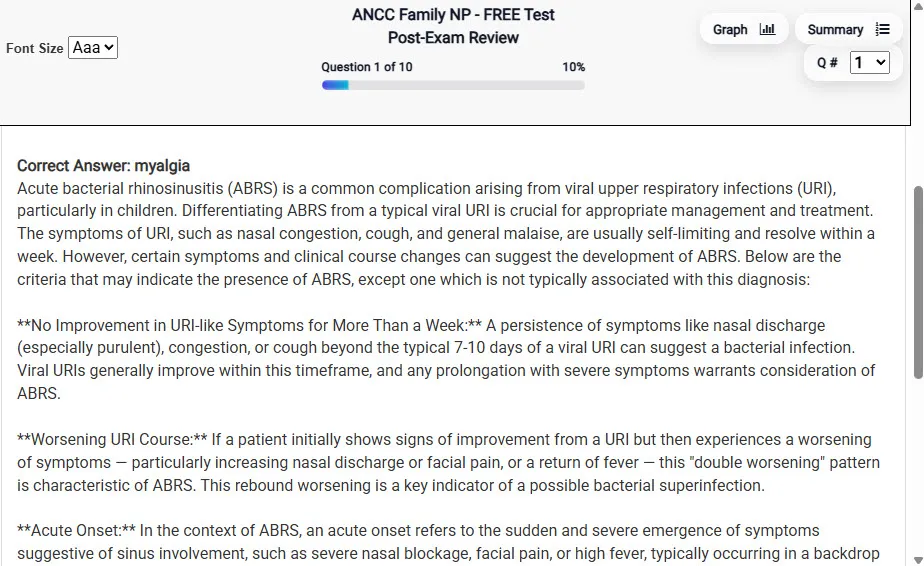
                           Detailed Explanation screen – 
                         Review mode showing chosen answer and rationale and references.
Detailed Explanation Review mode showing chosen answer and rationale and references.

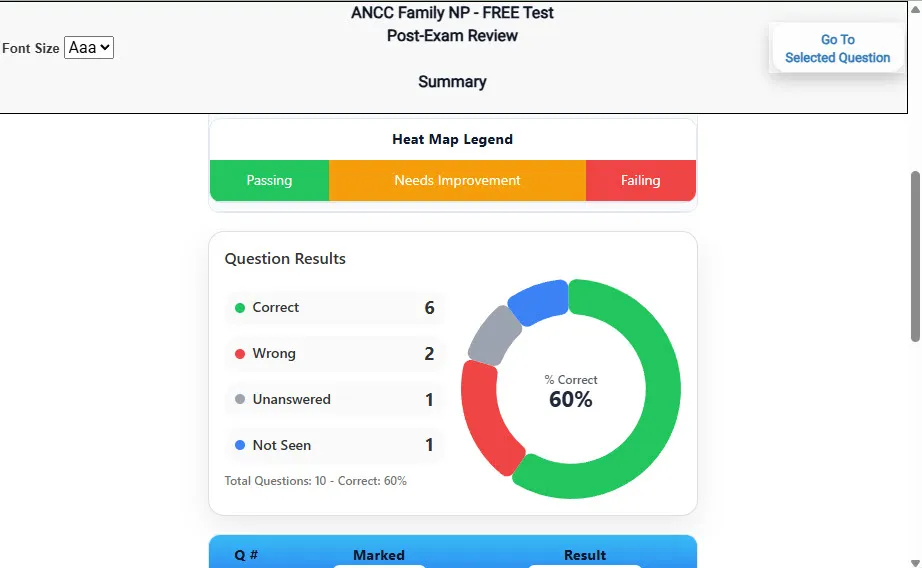
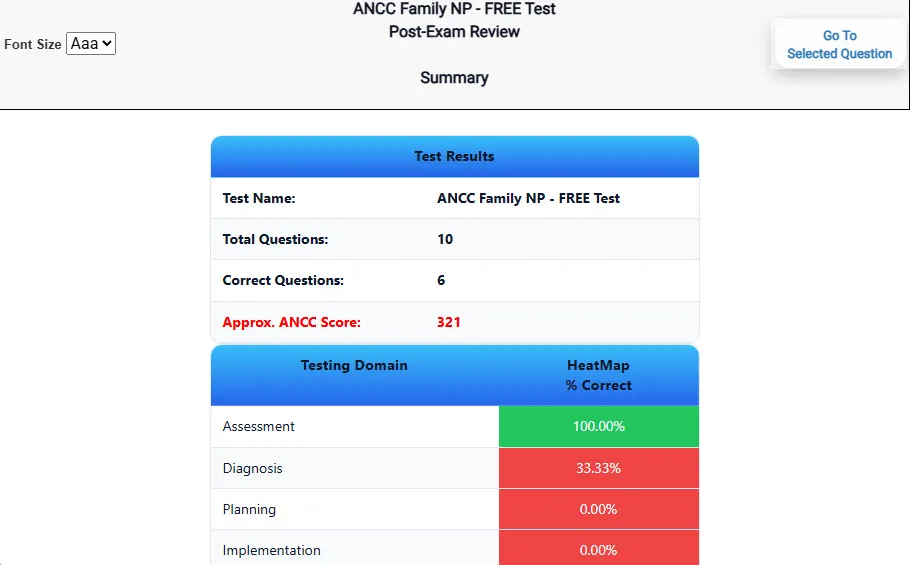
                           Review Summary 1 screen – 
                         Summary with counts for correct/wrong/unanswered and not seen items.
Review Summary 1 Summary with counts for correct/wrong/unanswered and not seen items.

                           Review Summary 2 screen – 
                         Advanced summary with category/domain breakdown and performance insights.
Review Summary 2 Advanced summary with category/domain breakdown and performance insights.

What Each Screen Shows

Answer Question Screen

  • Clean multiple-choice interface with progress bar.
  • Mark for review feature.
  • Matches real test pacing.

Detailed Explanation

  • Correct answer plus rationale.
  • Key concepts and guidelines highlighted.
  • Move between questions to fill knowledge gaps.

Review Summary 1

  • Overall results with total questions and scaled score.
  • Domain heatmap shows strengths and weaknesses.
  • Quick visual feedback on study priorities.

Review Summary 2

  • Chart of correct, wrong, unanswered, not seen.
  • Color-coded results for easy review.
  • Links back to missed items.

Top 10 Reasons to Use Exam Edge for your CPACE California Preliminary Administrative Credential Examination Exam Prep

  1. Focused on the CPACE California Preliminary Administrative Credential Examination Exam

    Our practice tests are built specifically for the CPACE exam — every question mirrors the real topics, format, and difficulty so you're studying exactly what matters.

  2. Real Exam Simulation

    We match the per-question time limits and pressure of the actual CPACE exam, so test day feels familiar and stress-free.

  3. 25 Full Practice Tests & 1,825 Unique Questions

    You'll have more than enough material to master every CPACE concept — no repeats, no fluff.

  4. Lower Cost Than a Retake

    Ordering 5 practice exams costs less than retaking the CPACE California Preliminary Administrative Credential Examination exam after a failure. One low fee could save you both time and money.

  5. Flexible Testing

    Need to step away mid-exam? Pick up right where you left off — with your remaining time intact.

  6. Instant Scoring & Feedback

    See your raw score and an estimated CPACE California Preliminary Administrative Credential Examination score immediately after finishing each practice test.

  7. Detailed Explanations for Every Question

    Review correct and incorrect answers with clear, step-by-step explanations so you truly understand each topic.

  8. Trusted & Accredited

    We're fully accredited by the Better Business Bureau and uphold the highest standards of trust and transparency.

  9. Web-Based & Always Available

    No software to install. Access your CPACE practice exams 24/7 from any computer or mobile device.

  10. Expert Support When You Need It

    Need extra help? Our specialized tutors are highly qualified and ready to support your CPACE exam prep.


Pass the CPACE California Preliminary Administrative Credential Examination Exam with Realistic Practice Tests from Exam Edge

Preparing for your upcoming CPACE California Preliminary Administrative Credential Examination (603) Certification Exam can feel overwhelming — but the right practice makes all the difference. Exam Edge gives you the tools, structure, and confidence to pass on your first try. Our online practice exams are built to match the real CPACE exam in content, format, and difficulty.

  • 📝 25 CPACE California Preliminary Administrative Credential Examination Practice Tests: Access 25 full-length exams with 73 questions each, covering every major CPACE California Preliminary Administrative Credential Examination topic in depth.
  • Instant Online Access: Start practicing right away — no software, no waiting.
  • 🧠 Step-by-Step Explanations: Understand the reasoning behind every correct answer so you can master CPACE exam concepts.
  • 🔄 Retake Each Exam Up to 4 Times: Build knowledge through repetition and track your improvement over time.
  • 🌐 Web-Based & Available 24/7: Study anywhere, anytime, on any device.
  • 🧘 Boost Your Test-Day Confidence: Familiarity with the CPACE format reduces anxiety and helps you perform under pressure.

These CPACE California Preliminary Administrative Credential Examination practice exams are designed to simulate the real testing experience by matching question types, timing, and difficulty level. This approach helps you get comfortable not just with the exam content, but also with the testing environment, so you walk into your exam day focused and confident.

Exam Edge CTC Reviews


Just wanted to let you guys know that your tests really helped me prepare for the CBEST math exam. I took it yesterday and passed with a 47! I will tell other people about your site.

Shawna M, California

I passed my cbest today! This was the second time I took the test. My first time I scored 35. This time I scored 43. Taking your practice tests helped me a great deal, because several types of questions on the real test were also on your practice tests. Thanks so much for the help!

TIm F, California

For the last year, I have been trying to pass the reading section of the CBEST. I had taken it six times and if I did not pass it this month, then I could not take my college courses in education. I went to Google and typed in practice reading tests and your website came up. I clicked on it, signed ...
Read More
Stacy S, California

Thank you so much for your reading tests. I just passed the real CBEST Reading test by 4 points! After failing it 3 other times, I thought I would have to quit. I already told everyone in my class about your site.

Sara L, Oregon

For the last year, I have been trying to pass my cset exam. I had taken it six times and was running out of hope I would ever pass. I went to Google and your website came up. I clicked on, signed up and took the free test. I knew that I would buy a couple of tests after taking that one. I ended up b ...
Read More
Stacy,

Purchased the five pack of tests this weekend. Took CBEST math today and passed! Your tests had very similar content as the actual CBEST.

Fresno , CA


CPACE California Preliminary Administrative Credential Examination Aliases Test Name

Here is a list of alternative names used for this exam.

  • CPACE California Preliminary Administrative Credential Examination
  • CPACE California Preliminary Administrative Credential Examination test
  • CPACE California Preliminary Administrative Credential Examination Certification Test
  • CPACE test
  • CTC
  • CTC 603
  • 603 test
  • CPACE California Preliminary Administrative Credential Examination (603)
  • CPACE California Preliminary Administrative Credential Examination certification