This is the content of the pop-over!

NYSTCE CST Social Studies (115) Practice Tests & Test Prep by Exam Edge


NYSTCE CST Social Studies  product image
(4.8)
Based on 40 Reviews

  • Real Exam Simulation: Timed questions and matching content build comfort for your NYSTCE CST Social Studies test day.
  • Instant, 24/7 Access: Web-based NYSTCE CST Social Studies practice exams with no software needed.
  • Clear Explanations: Step-by-step answers and explanations for your NYSTCE exam to strengthen understanding.
  • Boosted Confidence: Reduces anxiety and improves test-taking skills to ace your NYSTCE CST Social Studies (115).

Featured on

NYSTCE CST Social Studies Online Practice Test Bundles

BEST VALUE
20 practice tests

$174.00

$799.00

SAVE $625

Only $8.70 per test!

  • 100% Pass Guarantee
  • 20 online practice tests
  • 90 questions + 1 essay per test
  • Bonus: 100 Flash Cards + Study Guide
  • Instant access
  • Detailed Explanations
  • Practice tests never expire
  • Timed, untimed, or study guide mode
MOST POPULAR
10 practice tests

$99.50

$399.50

SAVE $300

Only $9.95 per test!

  • 10 online practice tests
  • 90 questions + 1 essay per test
  • Bonus: 100 Flash Cards + Study Guide
  • Instant access
  • Detailed Explanations
  • Practice tests never expire
  • Timed, untimed, or study guide mode
5 practice tests

$69.75

$199.75

SAVE $130

Only $13.95 per test!

  • 5 online practice tests
  • 90 questions + 1 essay per test
  • Bonus: 100 Flash Cards
  • Instant access
  • Detailed Explanations
  • Practice tests never expire
  • Timed, untimed, or study guide mode
1 practice test

$39.95

  • 1 online practice test
  • 90 questions + 1 essay per test
  • Instant access
  • Detailed Explanations
  • Practice tests never expire
  • Timed, untimed, or study guide mode
Quick Select
Tap to choose a bundle

** All Prices are in US Dollars (USD) **


NYSTCE CST Social Studies (115) Resources

Jump to the section you need most.

Understanding the exact breakdown of the NYSTCE CST Social Studies test will help you know what to expect and how to most effectively prepare. The NYSTCE CST Social Studies has 90 multiple-choice questions and 1 essay questions. The exam will be broken down into the sections below:

NYSTCE CST Social Studies Exam Blueprint
Domain Name % Number of
Questions
United States History 14% 13
Global History 14% 13
Geography 12% 11
Economics 12% 11
Civics - Citizenship Government 13% 12
Social Studies Literacy 15% 14
Pedagogical Content Knowledge (Constructed-Response) 20% 18

NYSTCE CST Social Studies Study Tips by Domain

  • Prioritize chronology and causation in U.S. history (e.g., colonies → Revolution → Constitution → reform → Civil War → industrialization → world wars → Cold War → post-9/11)—red flag: answers that list facts without linking cause/effect or continuity/change.
  • Know Constitution/core principles (federalism, separation of powers, checks and balances) and key amendments/cases (Bill of Rights, 13th–15th, 14th, 19th, Brown, Roe, Miranda)—common trap: confusing civil liberties (limits on government) with civil rights (equal protection/anti-discrimination).
  • For the Civil War/Reconstruction, connect slavery expansion debates (Missouri Compromise, Compromise of 1850, Kansas–Nebraska, Dred Scott) to secession and then to Reconstruction policy (Freedmen’s Bureau, Black Codes, Jim Crow)—priority rule: identify whether a development expanded or restricted federal power and rights.
  • In industrialization/Progressive Era, tie immigration/urbanization, labor-capital conflicts, and reform (muckrakers, antitrust, regulation, suffrage) to specific policies—red flag: treating “Progressivism” as purely social reform and ignoring economic regulation.
  • For 20th-century foreign policy, distinguish isolationism, internationalism, containment, and detente across WWI/WWII/Cold War eras—common trap: misplacing the Truman Doctrine/Marshall Plan (early Cold War) into WWII context.
  • Use primary-source cues (author, audience, purpose, historical context) to anchor interpretations of movements (civil rights, women’s rights, Great Society, conservative resurgence)—red flag: quoting a document without explaining what it reveals about its time period.
  • Use a clear periodization frame (e.g., classical, post-classical, early modern, industrial, contemporary) and tie events to continuity/change; red flag: treating eras as isolated “lists” instead of connected processes.
  • Trace major belief systems (Hinduism, Buddhism, Judaism, Christianity, Islam, Confucianism) to political and social structures; common trap: mixing up core concepts like dharma/karma, sharia, or the Mandate of Heaven.
  • Explain empire-building patterns (administration, military tech, trade routes, legitimation) across regions; priority rule: always name both a method of control and a consequence (e.g., cultural diffusion, resistance, syncretism).
  • Connect trade networks (Silk Roads, Indian Ocean, trans-Saharan, Atlantic) to exchange of goods, ideas, and disease; red flag: describing “trade” without identifying at least one specific commodity and one impact.
  • Compare revolutions and reform movements (French, Haitian, Latin American, Meiji, decolonization) using causes, ideologies, and outcomes; common trap: confusing Enlightenment ideals with later nationalist or socialist goals.
  • Analyze 20th-century global conflicts and their aftermath (World Wars, Cold War, genocide, human rights) with attention to alliances and decolonization; threshold cue: if you mention a war, include at least one turning point and one postwar settlement or institution (e.g., Versailles, UN).
  • Distinguish absolute, relative, and perceived location using coordinates and physical/cultural landmarks; red flag: confusing latitude/longitude order or hemispheres when interpreting maps.
  • Analyze spatial patterns with scale and region (formal, functional, perceptual); common trap: treating political borders as the only valid regions and ignoring economic/cultural linkages.
  • Interpret physical geography processes (plate tectonics, weathering/erosion, climate systems) and connect them to human settlement; priority rule: if a question asks “why there,” look first for water access, climate, and terrain constraints.
  • Use population and migration concepts (push/pull, population density, urbanization, demographic transition); red flag: assuming high density always means high development or prosperity.
  • Evaluate human–environment interaction (resource use, pollution, hazards, sustainability) with concrete examples; common trap: proposing solutions that ignore trade-offs or local carrying capacity limits.
  • Read and critique maps/visuals (choropleth, dot, flow maps; GIS/remote sensing data) for bias and validity; contraindication: drawing causal claims from a single thematic map without checking scale, classification, or time frame.
  • Use supply-and-demand shifts (not just movement along curves) to predict price/quantity changes; red flag: attributing a change in demand to a change in price alone.
  • Compare market structures (perfect competition, monopoly, oligopoly, monopolistic competition) by price-setting power and barriers to entry; common trap: assuming all firms are price takers.
  • Apply elasticity (price, income, cross-price) to real outcomes like tax incidence and revenue; threshold cue: inelastic demand means consumers bear more of a tax and total revenue rises when price increases.
  • Distinguish fiscal vs. monetary policy tools and likely short-run macro effects on inflation, unemployment, and GDP; red flag: mixing up the Fed’s interest-rate tools with Congress’s tax/spending decisions.
  • Interpret key macro indicators (CPI, GDP, unemployment rate, real vs. nominal) and what they do and don’t measure; common trap: treating GDP growth as proof that living standards rose for all groups.
  • Analyze international trade (comparative advantage, tariffs/quotas, exchange rates) and winners/losers; priority rule: tariffs protect domestic producers but typically raise consumer prices and invite retaliation.
  • Know core constitutional principles (popular sovereignty, separation of powers, federalism, checks and balances) and apply them to scenarios; red flag: confusing reserved powers (states) with delegated powers (federal).
  • Distinguish civil liberties (1st, 4th, 5th, 6th, 8th, 14th) from civil rights protections (14th Equal Protection, Civil Rights Acts); common trap: treating due process and equal protection as interchangeable.
  • Identify powers and limits of each branch (e.g., judicial review, veto/override, advice and consent, impeachment); priority rule: always ask which branch has the constitutional authority to act in the prompt.
  • Analyze landmark Supreme Court cases and the constitutional question they address (e.g., Marbury v. Madison, McCulloch v. Maryland, Brown v. Board, Gideon v. Wainwright, Miranda v. Arizona); red flag: citing the outcome without naming the specific right or clause.
  • Compare citizen participation channels (voting, lobbying, protests, petitions, civic organizations) and election mechanics (primaries, general elections, Electoral College); common trap: assuming the popular vote alone determines the presidency.
  • Understand New York State and local government structures (governor/legislature/courts, counties, municipalities, school districts) and policy responsibilities; threshold cue: match services to level (e.g., education often local/state, immigration federal) to avoid misattribution.
  • Evaluate sources for credibility by separating claim, evidence, and reasoning; red flag: treating an opinion piece or advocacy site as a neutral primary source without corroboration.
  • Use sourcing heuristics (author, purpose, audience, time/place) before close reading; common trap: ignoring historical context and misreading a document’s intent or tone.
  • Interpret quantitative information (tables, graphs, maps) by checking units, scale, and baseline; priority rule: verify what the y-axis starts at to avoid overstating change.
  • Corroborate across multiple texts to resolve contradictions; red flag: relying on a single excerpt and missing that another source provides limiting conditions or counterevidence.
  • Write evidence-based arguments using precise citations and topic sentences; common trap: summary-only paragraphs that do not explicitly link evidence to the claim.
  • Teach disciplinary vocabulary (e.g., “federalism,” “opportunity cost,” “push-pull”) with context clues and morphology; contraindication: pre-teaching long word lists without using them in authentic analysis tasks.
  • Start constructed responses with a clear claim aligned to the task and back it with specific evidence (e.g., document details, content facts); red flag: summarizing sources without an argument earns limited credit.
  • Explicitly name the social studies skill you are using (sourcing, contextualization, corroboration, cause-and-effect, compare/contrast) and show it in action; common trap: describing the skill without applying it to the prompt.
  • Write measurable lesson objectives and match them to an assessment that truly checks the objective; priority rule: if the objective says “analyze,” a recall quiz is misaligned.
  • Plan instruction with appropriate scaffolds for multilingual learners and students with disabilities (sentence frames, chunked texts, visuals) while keeping the same learning target; red flag: lowering rigor by changing the target rather than the support.
  • Anticipate misconceptions and include a corrective move (e.g., guided questioning, counterexample, map/graph check) tied to the content; common trap: offering generic “review” with no targeted fix.
  • Cite responsible use of primary/secondary sources and address bias and perspective; priority rule: teach students to evaluate author, purpose, and context before using a document as “proof.”


Built to Fit Into Your Busy Life

Everything you need to prepare with confidence—without wasting a minute.

Three Study Modes

Timed, No Time Limit, or Explanation mode.

Actionable Analytics

Heatmaps and scaled scores highlight weak areas.

High-Yield Rationales

Concise explanations emphasize key concepts.

Realistic Interface

Matches the feel of the actual exam environment.

Accessible by Design

Clean layout reduces cognitive load.

Anytime, Anywhere

Web-based access 24/7 on any device.
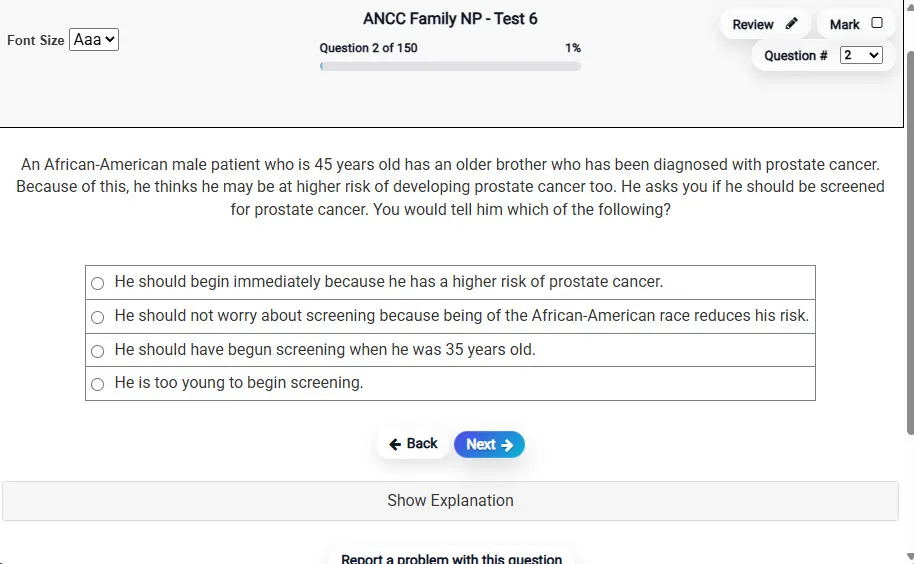
Answering a Question screen – Multiple-choice item view with navigation controls and progress tracker.
Answering a Question Multiple-choice item view with navigation controls and progress tracker.

                           Detailed Explanation screen – 
                         Review mode showing chosen answer and rationale and references.
Detailed Explanation Review mode showing chosen answer and rationale and references.

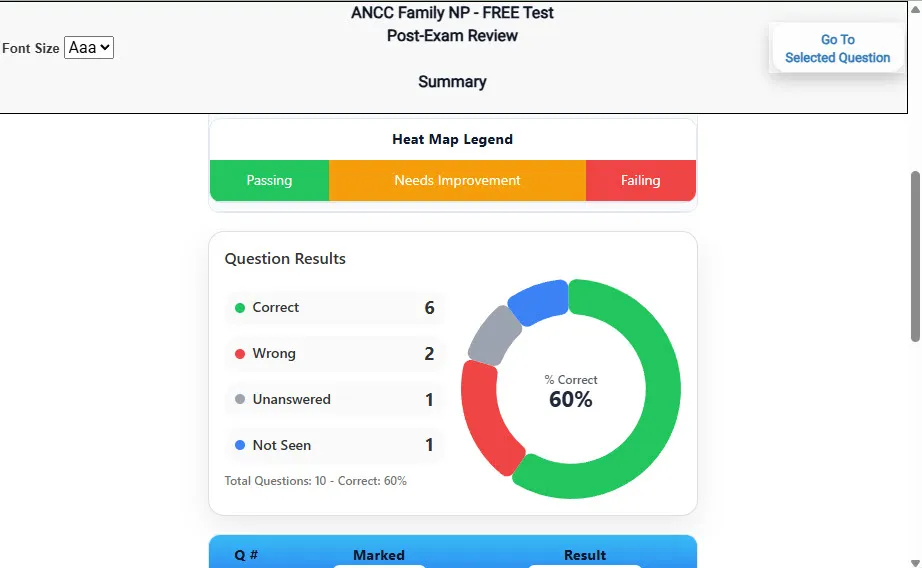
                           Review Summary 1 screen – 
                         Summary with counts for correct/wrong/unanswered and not seen items.
Review Summary 1 Summary with counts for correct/wrong/unanswered and not seen items.

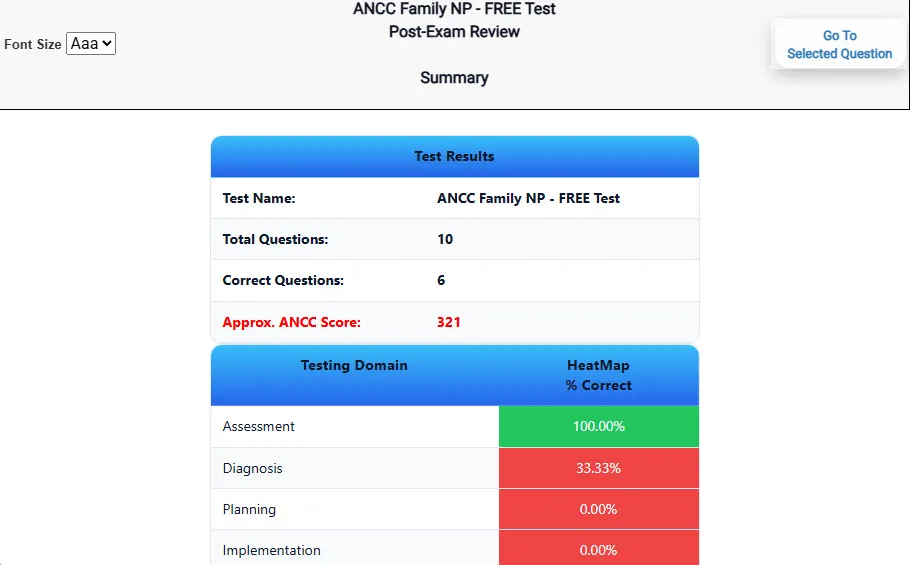
                           Review Summary 2 screen – 
                         Advanced summary with category/domain breakdown and performance insights.
Review Summary 2 Advanced summary with category/domain breakdown and performance insights.

What Each Screen Shows

Answer Question Screen

  • Clean multiple-choice interface with progress bar.
  • Mark for review feature.
  • Matches real test pacing.

Detailed Explanation

  • Correct answer plus rationale.
  • Key concepts and guidelines highlighted.
  • Move between questions to fill knowledge gaps.

Review Summary 1

  • Overall results with total questions and scaled score.
  • Domain heatmap shows strengths and weaknesses.
  • Quick visual feedback on study priorities.

Review Summary 2

  • Chart of correct, wrong, unanswered, not seen.
  • Color-coded results for easy review.
  • Links back to missed items.

Top 10 Reasons to Use Exam Edge for your NYSTCE CST Social Studies Exam Prep

  1. Focused on the NYSTCE CST Social Studies Exam

    Our practice tests are built specifically for the NYSTCE CST Social Studies exam — every question mirrors the real topics, format, and difficulty so you're studying exactly what matters.

  2. Real Exam Simulation

    We match the per-question time limits and pressure of the actual NYSTCE exam, so test day feels familiar and stress-free.

  3. 20 Full Practice Tests & 1,820 Unique Questions

    You'll have more than enough material to master every NYSTCE CST Social Studies concept — no repeats, no fluff.

  4. Lower Cost Than a Retake

    Ordering 5 practice exams costs less than retaking the NYSTCE CST Social Studies exam after a failure. One low fee could save you both time and money.

  5. Flexible Testing

    Need to step away mid-exam? Pick up right where you left off — with your remaining time intact.

  6. Instant Scoring & Feedback

    See your raw score and an estimated NYSTCE CST Social Studies score immediately after finishing each practice test.

  7. Detailed Explanations for Every Question

    Review correct and incorrect answers with clear, step-by-step explanations so you truly understand each topic.

  8. Trusted & Accredited

    We're fully accredited by the Better Business Bureau and uphold the highest standards of trust and transparency.

  9. Web-Based & Always Available

    No software to install. Access your NYSTCE CST Social Studies practice exams 24/7 from any computer or mobile device.

  10. Expert Support When You Need It

    Need extra help? Our specialized tutors are highly qualified and ready to support your NYSTCE exam prep.


Pass the NYSTCE CST Social Studies Exam with Realistic Practice Tests from Exam Edge

Preparing for your upcoming NYSTCE CST Social Studies (115) Certification Exam can feel overwhelming — but the right practice makes all the difference. Exam Edge gives you the tools, structure, and confidence to pass on your first try. Our online practice exams are built to match the real NYSTCE CST Social Studies exam in content, format, and difficulty.

  • 📝 20 NYSTCE CST Social Studies Practice Tests: Access 20 full-length exams with 91 questions each, covering every major NYSTCE CST Social Studies topic in depth.
  • Instant Online Access: Start practicing right away — no software, no waiting.
  • 🧠 Step-by-Step Explanations: Understand the reasoning behind every correct answer so you can master NYSTCE CST Social Studies exam concepts.
  • 🔄 Retake Each Exam Up to 4 Times: Build knowledge through repetition and track your improvement over time.
  • 🌐 Web-Based & Available 24/7: Study anywhere, anytime, on any device.
  • 🧘 Boost Your Test-Day Confidence: Familiarity with the NYSTCE format reduces anxiety and helps you perform under pressure.

These NYSTCE CST Social Studies practice exams are designed to simulate the real testing experience by matching question types, timing, and difficulty level. This approach helps you get comfortable not just with the exam content, but also with the testing environment, so you walk into your exam day focused and confident.


Exam Edge NYSTCE Reviews


Not a user friendly experience

Amelia , Rochester, New York

Didn't really reflect the questions that were on the test for the most part. Also, they totally got the format of the constructed response question wrong, which never changes. Overall OK if you have nothing else, but definitely not worth the price they charge in my opinion.

Randy , Queens, New York

It was a good test run. Now I know what to expect and what I need to study.

Timothy , Eden, New York

The experience was very practical and I did well.

Trina , Silver Spring , MD

Very easy to navigate.

Collene , Silver Spring , MD

Exam Edge was terrific. Even better than I hoped. Just completing and reviewing the tests are a great learning experience. I can't wait to take the certification test. Tom S.

Thomas , Port Washington, NY


NYSTCE CST Social Studies Aliases Test Name

Here is a list of alternative names used for this exam.

  • NYSTCE CST Social Studies
  • NYSTCE CST Social Studies test
  • NYSTCE CST Social Studies Certification Test
  • NYSTCE
  • NYSTCE 115
  • 115 test
  • NYSTCE CST Social Studies (115)
  • CST Social Studies certification