This is the content of the pop-over!

Safety Net Multi-Subject (902) Practice Tests & Test Prep by Exam Edge


NYSTCE Safety Net Multi-Subject CST  product image
(4.8)
Based on 34 Reviews

  • Real Exam Simulation: Timed questions and matching content build comfort for your Safety Net Multi-Subject test day.
  • Instant, 24/7 Access: Web-based NYSTCE Safety Net Multi-Subject CST practice exams with no software needed.
  • Clear Explanations: Step-by-step answers and explanations for your NYSTCE exam to strengthen understanding.
  • Boosted Confidence: Reduces anxiety and improves test-taking skills to ace your NYSTCE Safety Net Multi-Subject CST (902).

Featured on

NYSTCE Safety Net Multi-Subject CST Online Practice Test Bundles

BEST VALUE
30 practice tests

$238.50

$1,198.50

SAVE $960

Only $7.95 per test!

  • 100% Pass Guarantee
  • 30 online practice tests
  • 90 questions + 1 essay per test
  • Bonus: 100 Flash Cards + Study Guide
  • Instant access
  • Detailed Explanations
  • Practice tests never expire
  • Timed, untimed, or study guide mode
MOST POPULAR
15 practice tests

$149.25

$599.25

SAVE $450

Only $9.95 per test!

  • 15 online practice tests
  • 90 questions + 1 essay per test
  • Bonus: 100 Flash Cards + Study Guide
  • Instant access
  • Detailed Explanations
  • Practice tests never expire
  • Timed, untimed, or study guide mode
5 practice tests

$69.75

$199.75

SAVE $130

Only $13.95 per test!

  • 5 online practice tests
  • 90 questions + 1 essay per test
  • Bonus: 100 Flash Cards
  • Instant access
  • Detailed Explanations
  • Practice tests never expire
  • Timed, untimed, or study guide mode
1 practice test

$39.95

  • 1 online practice test
  • 90 questions + 1 essay per test
  • Instant access
  • Detailed Explanations
  • Practice tests never expire
  • Timed, untimed, or study guide mode
Quick Select
Tap to choose a bundle

** All Prices are in US Dollars (USD) **


Safety Net Multi-Subject (902) Resources

Jump to the section you need most.

Understanding the exact breakdown of the NYSTCE Safety Net Multi-Subject CST test will help you know what to expect and how to most effectively prepare. The NYSTCE Safety Net Multi-Subject CST has 90 multiple-choice questions and 1 essay questions. The exam will be broken down into the sections below:

NYSTCE Safety Net Multi-Subject CST Exam Blueprint
Domain Name % Number of
Questions
English Language Arts 21% 19
Mathematics 18% 16
Science and Technology 13% 12
Social Studies 15% 14
The Fine Arts 8% 7
Health and Fitness 8% 7
Family and Consumer Science and Career Development 7% 6
Foundations of Reading: Constructed-Response Assignment 10% 9

NYSTCE Safety Net Multi-Subject CST Study Tips by Domain

  • Identify an author’s central idea and track how it develops across paragraphs; red flag: choosing a detail that is repeated but doesn’t explain the text’s overall point.
  • Distinguish summary from analysis by keeping summaries objective and text-based; common trap: inserting opinions or interpretations when the prompt asks for a summary.
  • Use context clues (syntax, tone, and nearby examples) to determine word meaning and connotation; priority rule: verify that the inferred meaning fits every occurrence in the passage.
  • Analyze how a literary element (e.g., characterization, setting, conflict) shapes theme; red flag: naming the device without explaining its effect on meaning.
  • Evaluate an argument by checking claim, reasons, and evidence quality; common trap: treating anecdotes or emotional language as sufficient evidence.
  • Apply standard English conventions to revise for clarity and coherence (sentence boundaries, agreement, pronoun reference); threshold cue: if a pronoun could refer to more than one noun, revise for unmistakable antecedent.
  • Use place value and properties of operations to estimate and check reasonableness; red flag: an exact-looking answer that contradicts the scale of the numbers (e.g., 0.3 × 50 should not be 150).
  • Translate between fractions, decimals, and percents and justify equivalence; common trap: confusing percent of change with percent of the original (e.g., 20% increase then 20% decrease does not return to the starting value).
  • Set up ratios/rates and proportional relationships correctly with units; priority rule: always label units and confirm “per” means division (mi/hr), because unit mismatches are a frequent NYSTCE-style error.
  • Solve and interpret linear equations/inequalities in context; red flag: reversing the inequality when multiplying/dividing by a negative number (the sign must flip).
  • Analyze functions and graphs (slope, intercepts, rate of change) and connect representations; common trap: confusing slope with y-intercept or reading rise/run in the wrong order.
  • Apply measurement, geometry, and basic statistics/probability with attention to constraints; priority rule: keep consistent units and report results with appropriate precision (e.g., area in square units, probability between 0 and 1).
  • Apply the scientific method by identifying testable hypotheses, variables, and controls; red flag: conclusions that imply causation from correlation or lack a control group.
  • Interpret data displays (tables/graphs) using units, scale, and trends; common trap: confusing slope with y-intercept or misreading a non-zero baseline on the axis.
  • Use measurement and SI units correctly, including converting within metric and reporting appropriate significant digits; priority rule: keep units through calculations to catch setup errors.
  • Explain energy transformations and conservation (e.g., kinetic/potential, heat transfer, simple circuits); red flag: claiming energy is “used up” rather than transformed or dissipated as thermal energy.
  • Describe Earth/space patterns (rock cycle, plate tectonics, weather vs. climate, seasons); common trap: attributing seasons to Earth’s distance from the Sun rather than axial tilt and solar angle.
  • Connect technology/design to constraints and impacts by defining criteria, constraints, and iterative testing; priority rule: a solution isn’t “best” unless it meets constraints (cost, safety, materials) and evidence from tests supports it.
  • Build timelines that link cause-and-effect across eras (e.g., Revolution → Constitution → reform movements); red flag: answers that list events without explaining how one led to another.
  • Use primary sources to identify author, purpose, audience, and historical context before interpreting; common trap: treating a source as fully reliable without noting bias or limitations.
  • For U.S. government questions, distinguish powers (enumerated, reserved, concurrent) and check the 10th Amendment logic; priority rule: if it’s not delegated to the federal level, look to state authority unless prohibited.
  • In economics, apply scarcity → choice → opportunity cost and interpret supply/demand shifts correctly; red flag: confusing a change in quantity demanded with a shift in demand.
  • For New York State and local civics, connect policy issues to levels of government and civic participation methods; common trap: attributing municipal responsibilities (e.g., zoning, local services) to the federal government.
  • When addressing geography and global studies, use spatial vocabulary (region, diffusion, interdependence) and read maps/graphs carefully; red flag: ignoring scale, legend, or time period when drawing conclusions.
  • Know the elements/principles of art (e.g., line, shape, color; balance, contrast, emphasis) and use correct vocabulary—common trap: describing a work with opinion words (“pretty”) instead of observable evidence.
  • For music, connect notation to sound (rhythm values, meter, key signatures, tempo/dynamics) and identify basic forms (AB, ABA, rondo)—red flag: confusing tempo markings with dynamics (e.g., allegro vs. forte).
  • For theatre, distinguish the roles in production (actor, director, stage manager, designers) and basic stage geography (upstage/downstage, stage left/right)—priority rule: stage directions are from the actor’s perspective, not the audience’s.
  • For dance, recognize core elements (body, space, time, energy) and common structures (canon, unison, motif development)—common trap: mixing up locomotor (traveling) and nonlocomotor (in place) movements.
  • Align arts instruction with NYS learning standards and inclusive practice (differentiation, multiple entry points) while maintaining safety—red flag: planning activities that require unsafe spacing, costumes/props, or materials without clear procedures.
  • Use assessment that matches the art form (performance rubrics, process portfolios, critique protocols) and ties criteria to objectives—contraindication: grading solely on talent/effort instead of defined criteria like accuracy, craftsmanship, or expressive intent.
  • Use FITT (Frequency, Intensity, Time, Type) to design age-appropriate activity plans; red flag: prescribing adult intensity (e.g., maximal lifting or long high-intensity intervals) for younger students.
  • Know training principles (overload, progression, specificity, recovery) and include warm-up/cool-down; common trap: increasing volume and intensity simultaneously, which elevates overuse injury risk.
  • Apply basic nutrition guidance (balance, hydration, reading labels, limiting added sugars) and distinguish nutrient roles; priority rule: treat extreme diets, supplements, or rapid weight-loss claims as a health-risk red flag.
  • Identify signs of heat illness, dehydration, concussion, and asthma exacerbation and follow emergency response steps; contraindication cue: remove from play immediately for suspected concussion—“when in doubt, sit them out.”
  • Promote wellness skills (stress management, sleep hygiene, refusal/decision skills, communication) and recognize risk factors for substance use; common trap: assuming “talking about drugs” increases use—evidence-based prevention emphasizes skills and norms.
  • Use safe practices and inclusive adaptations in PE (equipment checks, space management, universal design); red flag: grading solely on performance metrics rather than effort, improvement, and safe participation.
  • Apply child development milestones to classroom scenarios (physical, cognitive, social-emotional) and flag a red rule: persistent regression or missed major milestones warrants referral per school protocol rather than “waiting it out.”
  • Use nutrition basics (MyPlate, macro/micronutrients, hydration) to evaluate meals; common trap: assuming “low-fat” or “gluten-free” automatically means healthy or appropriate without checking added sugar, fiber, and medical need.
  • Demonstrate kitchen and lab safety (sanitation, cross-contamination prevention, tool/equipment use); priority rule: treat allergens as a life-safety issue—avoid shared utensils/surfaces and follow documented student health plans.
  • Connect consumer economics to real choices (budgeting, credit, saving, insurance) and watch a red flag: confusing APR with interest rate or ignoring fees can flip the “best deal” in comparison problems.
  • Address career development skills (career clusters, employability, resumes/interviews) with a practical cue: measurable, behavior-based examples beat vague claims—use STAR-style responses and quantify outcomes when possible.
  • Integrate family systems and interpersonal skills (communication, conflict resolution, decision-making) and note a compliance cue: suspected abuse/neglect indicators require mandated reporting procedures, not private investigation or promises of confidentiality.
  • Open with a 1–2 sentence claim that answers the prompt, then cite 2–3 specific data points (e.g., error patterns, miscues, spelling features) as evidence—red flag: describing the student generally without quoting or naming exact skills.
  • Diagnose the primary reading need using precise terminology (phonemic awareness, phonics, fluency, vocabulary, comprehension, morphology) and state the likely cause—common trap: listing every weakness instead of prioritizing the biggest barrier to meaning.
  • Recommend one targeted instructional focus and an explicit routine (I do–We do–You do) aligned to the diagnosed need—priority rule: choose skills at the student’s instructional level, not frustration level.
  • Include at least two concrete, research-aligned strategies (e.g., Elkonin boxes for phoneme segmentation, continuous blending, repeated reading with feedback, morphemic analysis) and connect each to the student data—red flag: naming a strategy with no “because” link to evidence.
  • Specify how you will monitor progress (brief measure, frequency, and success criterion such as ≥90% accuracy or increased correct words per minute) and what you will adjust if growth stalls—common trap: vague assessment plans like “observe” or “give a quiz.”
  • Address scaffolds and access (multisensory supports, decodable/controlled text, preteach key vocabulary, sentence frames) while maintaining high expectations—contraindication: relying on leveled text alone when the issue is weak decoding/word recognition.


Built to Fit Into Your Busy Life

Everything you need to prepare with confidence—without wasting a minute.

Three Study Modes

Timed, No Time Limit, or Explanation mode.

Actionable Analytics

Heatmaps and scaled scores highlight weak areas.

High-Yield Rationales

Concise explanations emphasize key concepts.

Realistic Interface

Matches the feel of the actual exam environment.

Accessible by Design

Clean layout reduces cognitive load.

Anytime, Anywhere

Web-based access 24/7 on any device.
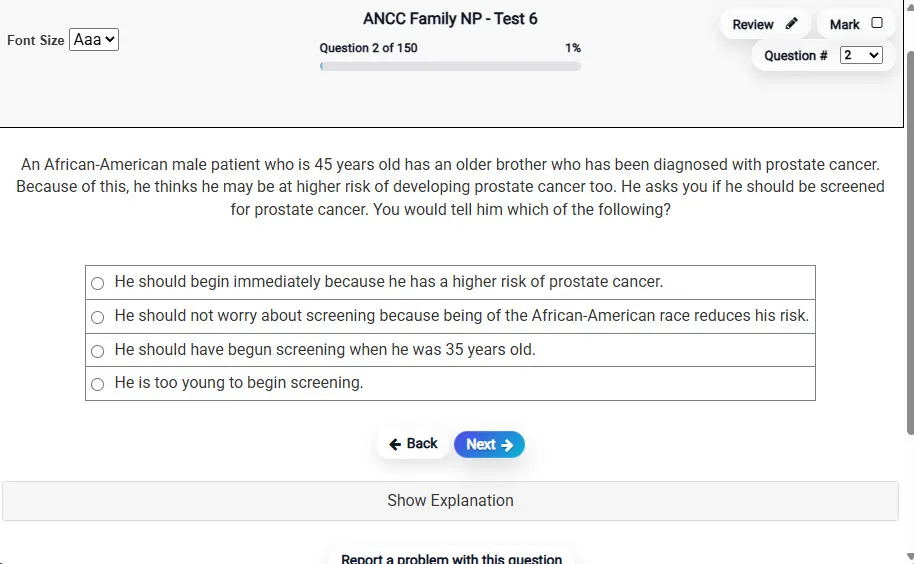
Answering a Question screen – Multiple-choice item view with navigation controls and progress tracker.
Answering a Question Multiple-choice item view with navigation controls and progress tracker.

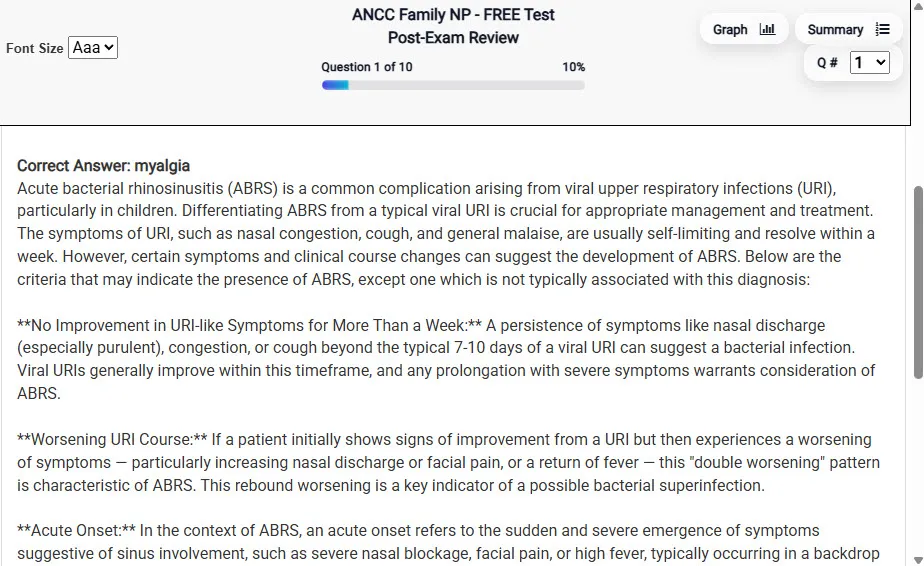
                           Detailed Explanation screen – 
                         Review mode showing chosen answer and rationale and references.
Detailed Explanation Review mode showing chosen answer and rationale and references.

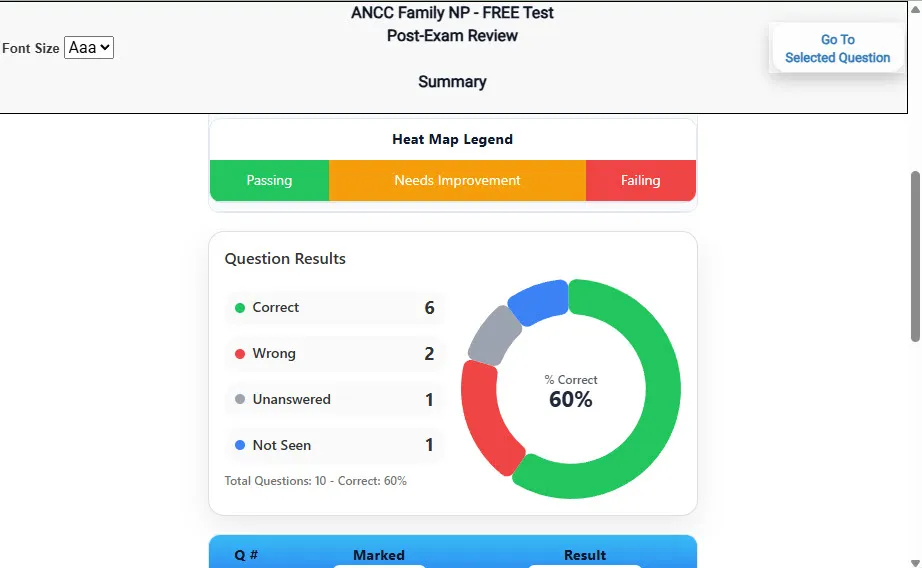
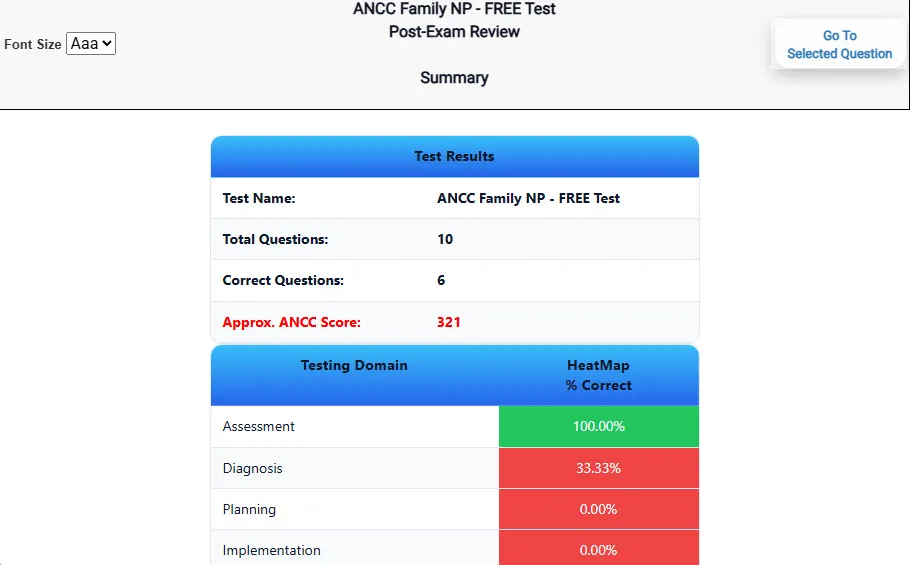
                           Review Summary 1 screen – 
                         Summary with counts for correct/wrong/unanswered and not seen items.
Review Summary 1 Summary with counts for correct/wrong/unanswered and not seen items.

                           Review Summary 2 screen – 
                         Advanced summary with category/domain breakdown and performance insights.
Review Summary 2 Advanced summary with category/domain breakdown and performance insights.

What Each Screen Shows

Answer Question Screen

  • Clean multiple-choice interface with progress bar.
  • Mark for review feature.
  • Matches real test pacing.

Detailed Explanation

  • Correct answer plus rationale.
  • Key concepts and guidelines highlighted.
  • Move between questions to fill knowledge gaps.

Review Summary 1

  • Overall results with total questions and scaled score.
  • Domain heatmap shows strengths and weaknesses.
  • Quick visual feedback on study priorities.

Review Summary 2

  • Chart of correct, wrong, unanswered, not seen.
  • Color-coded results for easy review.
  • Links back to missed items.

Top 10 Reasons to Use Exam Edge for your NYSTCE Safety Net Multi-Subject CST Exam Prep

  1. Focused on the NYSTCE Safety Net Multi-Subject CST Exam

    Our practice tests are built specifically for the Safety Net Multi-Subject exam — every question mirrors the real topics, format, and difficulty so you're studying exactly what matters.

  2. Real Exam Simulation

    We match the per-question time limits and pressure of the actual NYSTCE exam, so test day feels familiar and stress-free.

  3. 30 Full Practice Tests & 2,730 Unique Questions

    You'll have more than enough material to master every Safety Net Multi-Subject concept — no repeats, no fluff.

  4. Lower Cost Than a Retake

    Ordering 5 practice exams costs less than retaking the NYSTCE Safety Net Multi-Subject CST exam after a failure. One low fee could save you both time and money.

  5. Flexible Testing

    Need to step away mid-exam? Pick up right where you left off — with your remaining time intact.

  6. Instant Scoring & Feedback

    See your raw score and an estimated NYSTCE Safety Net Multi-Subject CST score immediately after finishing each practice test.

  7. Detailed Explanations for Every Question

    Review correct and incorrect answers with clear, step-by-step explanations so you truly understand each topic.

  8. Trusted & Accredited

    We're fully accredited by the Better Business Bureau and uphold the highest standards of trust and transparency.

  9. Web-Based & Always Available

    No software to install. Access your Safety Net Multi-Subject practice exams 24/7 from any computer or mobile device.

  10. Expert Support When You Need It

    Need extra help? Our specialized tutors are highly qualified and ready to support your NYSTCE exam prep.


Pass the NYSTCE Safety Net Multi-Subject CST Exam with Realistic Practice Tests from Exam Edge

Preparing for your upcoming NYSTCE Safety Net Multi-Subject CST (902) Certification Exam can feel overwhelming — but the right practice makes all the difference. Exam Edge gives you the tools, structure, and confidence to pass on your first try. Our online practice exams are built to match the real Safety Net Multi-Subject exam in content, format, and difficulty.

  • 📝 30 NYSTCE Safety Net Multi-Subject CST Practice Tests: Access 30 full-length exams with 91 questions each, covering every major NYSTCE Safety Net Multi-Subject CST topic in depth.
  • Instant Online Access: Start practicing right away — no software, no waiting.
  • 🧠 Step-by-Step Explanations: Understand the reasoning behind every correct answer so you can master Safety Net Multi-Subject exam concepts.
  • 🔄 Retake Each Exam Up to 4 Times: Build knowledge through repetition and track your improvement over time.
  • 🌐 Web-Based & Available 24/7: Study anywhere, anytime, on any device.
  • 🧘 Boost Your Test-Day Confidence: Familiarity with the NYSTCE format reduces anxiety and helps you perform under pressure.

These NYSTCE Safety Net Multi-Subject CST practice exams are designed to simulate the real testing experience by matching question types, timing, and difficulty level. This approach helps you get comfortable not just with the exam content, but also with the testing environment, so you walk into your exam day focused and confident.

Exam Edge NYSTCE Reviews


Not a user friendly experience

Amelia , Rochester, New York

Didn't really reflect the questions that were on the test for the most part. Also, they totally got the format of the constructed response question wrong, which never changes. Overall OK if you have nothing else, but definitely not worth the price they charge in my opinion.

Randy , Queens, New York

It was a good test run. Now I know what to expect and what I need to study.

Timothy , Eden, New York

The experience was very practical and I did well.

Trina , Silver Spring , MD

Very easy to navigate.

Collene , Silver Spring , MD

Exam Edge was terrific. Even better than I hoped. Just completing and reviewing the tests are a great learning experience. I can't wait to take the certification test. Tom S.

Thomas , Port Washington, NY


NYSTCE Safety Net Multi-Subject CST Aliases Test Name

Here is a list of alternative names used for this exam.

  • NYSTCE Safety Net Multi-Subject CST
  • NYSTCE Safety Net Multi-Subject CST test
  • NYSTCE Safety Net Multi-Subject CST Certification Test
  • Safety Net Multi-Subject test
  • NYSTCE
  • NYSTCE 902
  • 902 test
  • NYSTCE Safety Net Multi-Subject CST (902)
  • Safety Net Multi-Subject CST certification