This is the content of the pop-over!

Safety Net English Language Arts CST (903) Practice Tests & Test Prep by Exam Edge


NYSTCE Safety Net English Language Arts CST   product image
(4.6)
Based on 20 Reviews

  • Real Exam Simulation: Timed questions and matching content build comfort for your Safety Net English Language Arts CST test day.
  • Instant, 24/7 Access: Web-based NYSTCE Safety Net English Language Arts CST practice exams with no software needed.
  • Clear Explanations: Step-by-step answers and explanations for your NYSTCE exam to strengthen understanding.
  • Boosted Confidence: Reduces anxiety and improves test-taking skills to ace your NYSTCE Safety Net English Language Arts CST (903).

Featured on

NYSTCE Safety Net English Language Arts CST Online Practice Test Bundles

BEST VALUE
20 practice tests

$174.00

$799.00

SAVE $625

Only $8.70 per test!

  • 100% Pass Guarantee
  • 20 online practice tests
  • 90 questions + 1 essay per test
  • Bonus: 100 Flash Cards + Study Guide
  • Instant access
  • Detailed Explanations
  • Practice tests never expire
  • Timed, untimed, or study guide mode
MOST POPULAR
10 practice tests

$99.50

$399.50

SAVE $300

Only $9.95 per test!

  • 10 online practice tests
  • 90 questions + 1 essay per test
  • Bonus: 100 Flash Cards + Study Guide
  • Instant access
  • Detailed Explanations
  • Practice tests never expire
  • Timed, untimed, or study guide mode
5 practice tests

$69.75

$199.75

SAVE $130

Only $13.95 per test!

  • 5 online practice tests
  • 90 questions + 1 essay per test
  • Bonus: 100 Flash Cards
  • Instant access
  • Detailed Explanations
  • Practice tests never expire
  • Timed, untimed, or study guide mode
1 practice test

$39.95

  • 1 online practice test
  • 90 questions + 1 essay per test
  • Instant access
  • Detailed Explanations
  • Practice tests never expire
  • Timed, untimed, or study guide mode
Quick Select
Tap to choose a bundle

** All Prices are in US Dollars (USD) **


Safety Net English Language Arts CST (903) Resources

Jump to the section you need most.

Understanding the exact breakdown of the NYSTCE Safety Net English Language Arts CST test will help you know what to expect and how to most effectively prepare. The NYSTCE Safety Net English Language Arts CST has 90 multiple-choice questions and 1 essay questions. The exam will be broken down into the sections below:

NYSTCE Safety Net English Language Arts CST Exam Blueprint
Domain Name % Number of
Questions
Listening and Speaking 14% 13
Writing 22% 20
Reading 14% 13
Fundamentals of Literature 22% 20
Language and Literature 18% 16
Fundamentals of Literature: 10% 9

NYSTCE Safety Net English Language Arts CST Study Tips by Domain

  • Plan and deliver structured discussions (e.g., Socratic seminar, literature circles) using explicit norms and accountable-talk stems; red flag: allowing a few voices to dominate without a participation protocol.
  • Teach active listening skills (paraphrasing, clarifying questions, summarizing) and assess them with observable criteria; common trap: grading “participation” without defining what effective listening looks like.
  • Differentiate oral language supports for multilingual learners and students with disabilities (sentence frames, visuals, AAC, extended wait time); priority rule: accommodations should reduce language/output barriers without lowering the cognitive demand of the task.
  • Use speaking tasks that require evidence-based claims from texts or media (cite, quote, or reference specifics); red flag: students offering opinions without textual or source-based support.
  • Align listening assessments to purpose and context (informational, persuasive, literary audio) and check comprehension with targeted prompts; common trap: relying only on multiple-choice recall instead of inference and synthesis questions.
  • Teach audience, tone, and register for formal vs. informal settings (presentations, debates, interviews) and include rehearsal with feedback; red flag: not explicitly addressing volume, pacing, and clarity when scoring oral presentations.
  • Plan writing with a clear purpose, audience, and task—red flag: the thesis is implied but not stated, which often leads to summary instead of argument.
  • Build coherent organization (intro, body, conclusion) with logical progression—common trap: paragraphs lack topic sentences and drift from the controlling idea.
  • Use appropriate development (evidence, examples, analysis) matched to genre—priority rule: don’t drop quotations without commentary; explain how each detail supports the claim.
  • Maintain sentence clarity and variety while avoiding grammar errors—red flag: sentence fragments or comma splices, especially when combining independent clauses.
  • Apply standard conventions (usage, mechanics, punctuation, spelling) consistently—common trap: shifting verb tense or pronoun reference ambiguity that makes the antecedent unclear.
  • Revise and edit strategically—threshold: after revision, each paragraph should pass a “so what?” test (clear point + support + link back to thesis).
  • Teach close reading by requiring students to cite specific textual evidence for claims; red flag: answers that rely on personal opinion or vague “I think” without line-based support.
  • Differentiate literal vs inferential comprehension and verify inferences with multiple details; common trap: over-inferring from a single clue or ignoring conflicting evidence elsewhere in the text.
  • Use context clues, morphology (roots/affixes), and reference tools to determine word meaning and nuance; priority rule: if the word is pivotal to theme/argument, confirm with surrounding sentences before choosing a definition.
  • Analyze text structure (chronology, cause/effect, compare/contrast, problem/solution) and how it shapes meaning; red flag: students summarizing content without naming how the organization drives emphasis or logic.
  • Evaluate author’s purpose, point of view, and rhetorical choices, especially in informational texts; common trap: confusing topic with purpose or treating bias as automatic invalidity instead of assessing evidence and reasoning.
  • Support comprehension with strategic annotation and monitoring (predict, question, clarify, summarize) tailored to text complexity; contraindication: over-annotating every line—set a threshold (e.g., mark only claims, key evidence, and unfamiliar terms) to maintain fluency.
  • Distinguish major genres (poetry, drama, fiction, nonfiction) by their defining conventions; red flag: treating an essay or memoir as “fiction” because it uses scenes and dialogue.
  • Identify and interpret core literary elements (plot, setting, characterization, conflict, theme, point of view) and how they interact; common trap: confusing theme (a claim) with topic (a subject).
  • Recognize literary devices and figurative language (metaphor, symbol, irony, imagery, tone) and connect them to meaning; priority rule: cite the specific words or details that create the effect, not just the label.
  • Analyze structure and form (stanza, meter, dramatic structure, narrative structure, chronology) and explain how structure shapes interpretation; red flag: assuming first-person narration automatically makes the narrator reliable.
  • Place texts in historical, cultural, and authorial context without reducing meaning to biography; common trap: using context to replace textual evidence rather than to clarify it.
  • Use basic critical approaches (e.g., formalist, historical, reader-response) appropriately; contraindication: mixing approaches mid-analysis without stating the lens or changing the claim to fit the lens.
  • Distinguish denotation vs. connotation and explain how diction shapes tone and voice; red flag: calling a word “negative” without citing the specific connotative nuance in context.
  • Analyze figurative language (metaphor, symbolism, irony, imagery) for function, not just identification; common trap: labeling a device correctly but failing to connect it to meaning or theme.
  • Track how syntax and sentence patterns (parallelism, periodic sentences, fragments) influence emphasis and pacing; priority rule: tie any syntax claim to a concrete effect on clarity, tone, or persuasion.
  • Evaluate coherence using transitions, pronoun reference, and logical progression of ideas; red flag: vague pronouns (this/that/it) with unclear antecedents that obscure meaning.
  • Interpret how context (historical, cultural, rhetorical situation) influences language choices; common trap: projecting modern meanings onto older texts without accounting for period usage.
  • Identify and correct common grammar/usage issues (agreement, tense consistency, modifiers, parallel structure) while preserving intended meaning; threshold cue: if a revision changes meaning, it’s not an acceptable “correction.”
  • Identify major literary genres and subgenres (e.g., tragedy, satire, bildungsroman) and justify your choice with at least two text-based features—red flag: naming a genre without pointing to structure, tone, or conventions.
  • Analyze how plot, conflict, and structure (exposition to resolution; episodic vs. linear) shape meaning—common trap: summarizing events instead of explaining how sequencing or pacing creates impact.
  • Distinguish character types and methods of characterization (direct/indirect; dynamic/static; foil) and connect them to theme—priority rule: cite a specific action, decision, or contradiction rather than a general trait.
  • Interpret setting and context (time, place, culture) as functional elements that constrain choices or symbolize ideas—red flag: treating setting as mere backdrop with no link to conflict, mood, or theme.
  • Recognize and analyze literary devices (imagery, symbolism, irony, allusion, motif, figurative language) for their effect on meaning and tone—common trap: defining the device but not explaining what it reveals or changes.
  • Evaluate narrator and point of view (first-person, third-person limited/omniscient, unreliable narrator) and how perspective shapes credibility and bias—threshold: any claim about reliability should be supported by a concrete inconsistency or self-contradiction in the text.


Built to Fit Into Your Busy Life

Everything you need to prepare with confidence—without wasting a minute.

Three Study Modes

Timed, No Time Limit, or Explanation mode.

Actionable Analytics

Heatmaps and scaled scores highlight weak areas.

High-Yield Rationales

Concise explanations emphasize key concepts.

Realistic Interface

Matches the feel of the actual exam environment.

Accessible by Design

Clean layout reduces cognitive load.

Anytime, Anywhere

Web-based access 24/7 on any device.
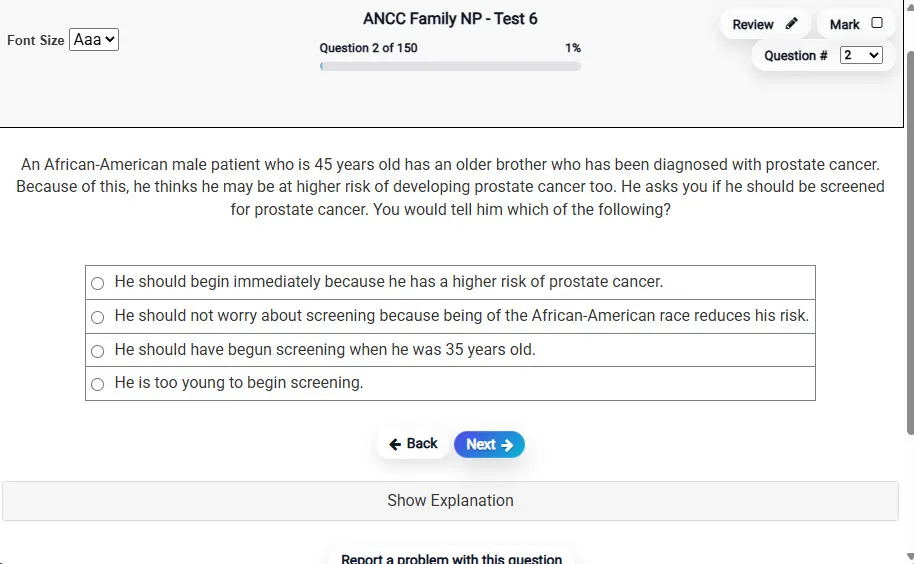
Answering a Question screen – Multiple-choice item view with navigation controls and progress tracker.
Answering a Question Multiple-choice item view with navigation controls and progress tracker.

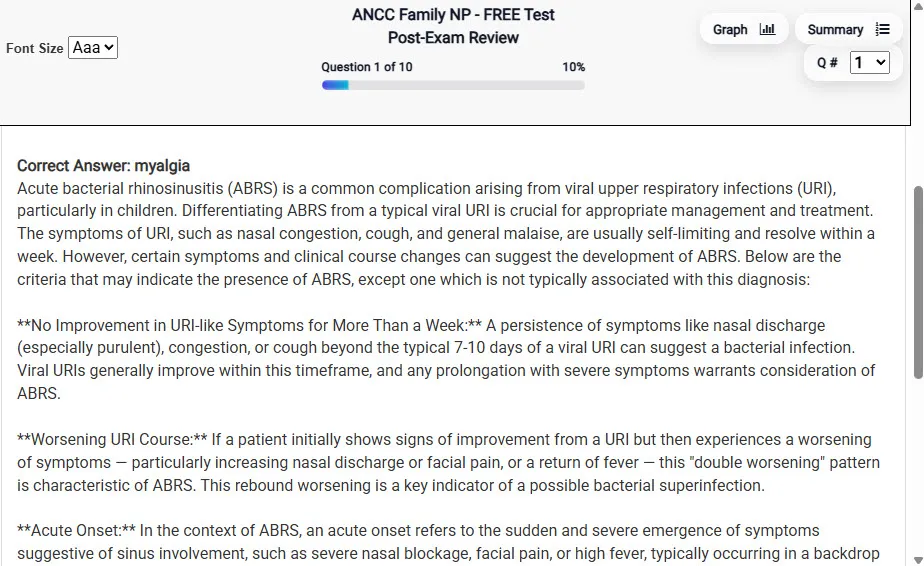
                           Detailed Explanation screen – 
                         Review mode showing chosen answer and rationale and references.
Detailed Explanation Review mode showing chosen answer and rationale and references.

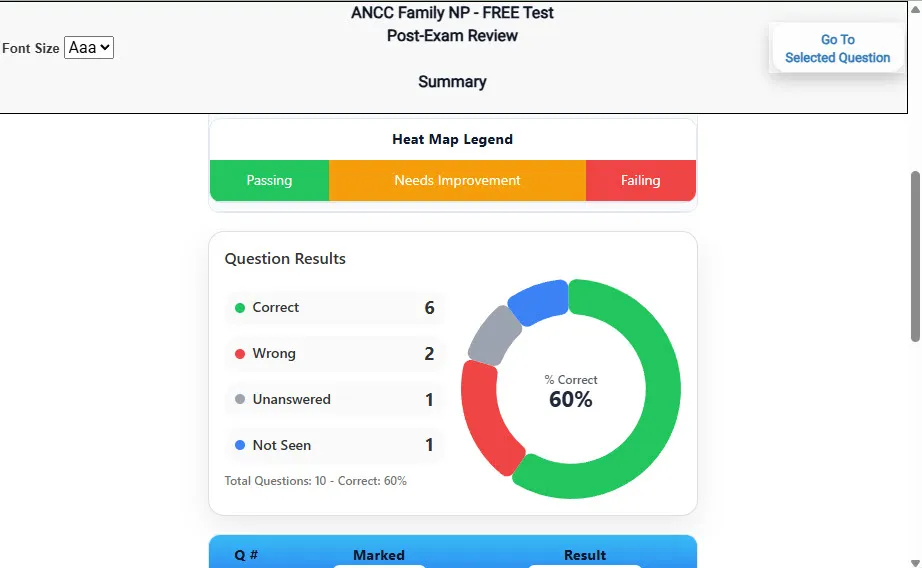
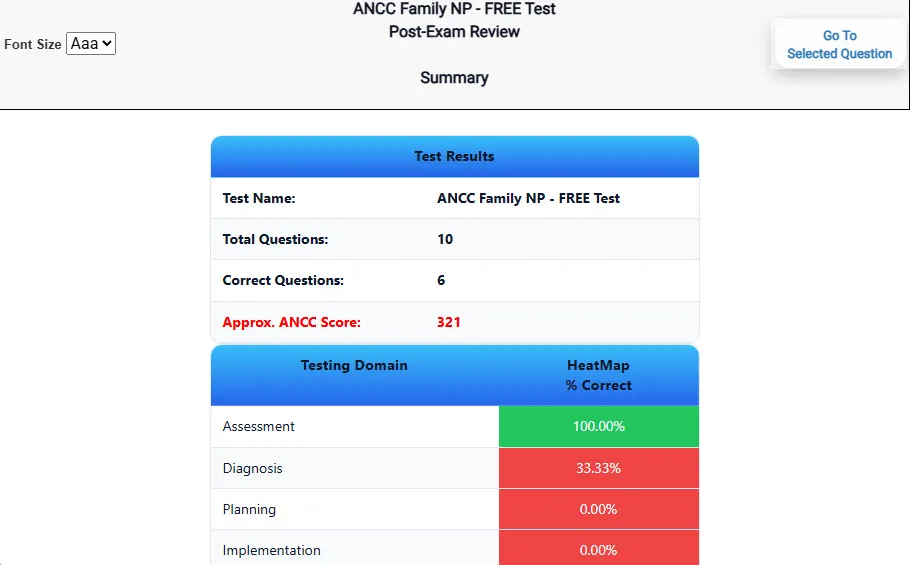
                           Review Summary 1 screen – 
                         Summary with counts for correct/wrong/unanswered and not seen items.
Review Summary 1 Summary with counts for correct/wrong/unanswered and not seen items.

                           Review Summary 2 screen – 
                         Advanced summary with category/domain breakdown and performance insights.
Review Summary 2 Advanced summary with category/domain breakdown and performance insights.

What Each Screen Shows

Answer Question Screen

  • Clean multiple-choice interface with progress bar.
  • Mark for review feature.
  • Matches real test pacing.

Detailed Explanation

  • Correct answer plus rationale.
  • Key concepts and guidelines highlighted.
  • Move between questions to fill knowledge gaps.

Review Summary 1

  • Overall results with total questions and scaled score.
  • Domain heatmap shows strengths and weaknesses.
  • Quick visual feedback on study priorities.

Review Summary 2

  • Chart of correct, wrong, unanswered, not seen.
  • Color-coded results for easy review.
  • Links back to missed items.

Top 10 Reasons to Use Exam Edge for your NYSTCE Safety Net English Language Arts CST Exam Prep

  1. Focused on the NYSTCE Safety Net English Language Arts CST Exam

    Our practice tests are built specifically for the Safety Net English Language Arts CST exam — every question mirrors the real topics, format, and difficulty so you're studying exactly what matters.

  2. Real Exam Simulation

    We match the per-question time limits and pressure of the actual NYSTCE exam, so test day feels familiar and stress-free.

  3. 20 Full Practice Tests & 1,820 Unique Questions

    You'll have more than enough material to master every Safety Net English Language Arts CST concept — no repeats, no fluff.

  4. Lower Cost Than a Retake

    Ordering 5 practice exams costs less than retaking the NYSTCE Safety Net English Language Arts CST exam after a failure. One low fee could save you both time and money.

  5. Flexible Testing

    Need to step away mid-exam? Pick up right where you left off — with your remaining time intact.

  6. Instant Scoring & Feedback

    See your raw score and an estimated NYSTCE Safety Net English Language Arts CST score immediately after finishing each practice test.

  7. Detailed Explanations for Every Question

    Review correct and incorrect answers with clear, step-by-step explanations so you truly understand each topic.

  8. Trusted & Accredited

    We're fully accredited by the Better Business Bureau and uphold the highest standards of trust and transparency.

  9. Web-Based & Always Available

    No software to install. Access your Safety Net English Language Arts CST practice exams 24/7 from any computer or mobile device.

  10. Expert Support When You Need It

    Need extra help? Our specialized tutors are highly qualified and ready to support your NYSTCE exam prep.


Pass the NYSTCE Safety Net English Language Arts CST Exam with Realistic Practice Tests from Exam Edge

Preparing for your upcoming NYSTCE Safety Net English Language Arts CST (903) Certification Exam can feel overwhelming — but the right practice makes all the difference. Exam Edge gives you the tools, structure, and confidence to pass on your first try. Our online practice exams are built to match the real Safety Net English Language Arts CST exam in content, format, and difficulty.

  • 📝 20 NYSTCE Safety Net English Language Arts CST Practice Tests: Access 20 full-length exams with 91 questions each, covering every major NYSTCE Safety Net English Language Arts CST topic in depth.
  • Instant Online Access: Start practicing right away — no software, no waiting.
  • 🧠 Step-by-Step Explanations: Understand the reasoning behind every correct answer so you can master Safety Net English Language Arts CST exam concepts.
  • 🔄 Retake Each Exam Up to 4 Times: Build knowledge through repetition and track your improvement over time.
  • 🌐 Web-Based & Available 24/7: Study anywhere, anytime, on any device.
  • 🧘 Boost Your Test-Day Confidence: Familiarity with the NYSTCE format reduces anxiety and helps you perform under pressure.

These NYSTCE Safety Net English Language Arts CST practice exams are designed to simulate the real testing experience by matching question types, timing, and difficulty level. This approach helps you get comfortable not just with the exam content, but also with the testing environment, so you walk into your exam day focused and confident.


Exam Edge NYSTCE Reviews


Not a user friendly experience

Amelia , Rochester, New York

Didn't really reflect the questions that were on the test for the most part. Also, they totally got the format of the constructed response question wrong, which never changes. Overall OK if you have nothing else, but definitely not worth the price they charge in my opinion.

Randy , Queens, New York

It was a good test run. Now I know what to expect and what I need to study.

Timothy , Eden, New York

The experience was very practical and I did well.

Trina , Silver Spring , MD

Very easy to navigate.

Collene , Silver Spring , MD

Exam Edge was terrific. Even better than I hoped. Just completing and reviewing the tests are a great learning experience. I can't wait to take the certification test. Tom S.

Thomas , Port Washington, NY


NYSTCE Safety Net English Language Arts CST Aliases Test Name

Here is a list of alternative names used for this exam.

  • NYSTCE Safety Net English Language Arts CST
  • NYSTCE Safety Net English Language Arts CST test
  • NYSTCE Safety Net English Language Arts CST Certification Test
  • Safety Net English Language Arts CST test
  • NYSTCE
  • NYSTCE 903
  • 903 test
  • NYSTCE Safety Net English Language Arts CST (903)
  • Safety Net English Language Arts CST certification