This is the content of the pop-over!

Safety Net Business and Marketing (969) Practice Tests & Test Prep by Exam Edge


NYSTCE Safety Net Business and Marketing CST  product image
(4.8)
Based on 37 Reviews

  • Real Exam Simulation: Timed questions and matching content build comfort for your Safety Net Business and Marketing test day.
  • Instant, 24/7 Access: Web-based NYSTCE Safety Net Business and Marketing CST practice exams with no software needed.
  • Clear Explanations: Step-by-step answers and explanations for your NYSTCE exam to strengthen understanding.
  • Boosted Confidence: Reduces anxiety and improves test-taking skills to ace your NYSTCE Safety Net Business and Marketing CST (969).

Featured on

NYSTCE Safety Net Business and Marketing CST Online Practice Test Bundles

BEST VALUE
30 practice tests

$238.50

$1,198.50

SAVE $960

Only $7.95 per test!

  • 100% Pass Guarantee
  • 30 online practice tests
  • 90 questions per test
  • Bonus: 100 Flash Cards + Study Guide
  • Instant access
  • Detailed Explanations
  • Practice tests never expire
  • Timed, untimed, or study guide mode
MOST POPULAR
15 practice tests

$149.25

$599.25

SAVE $450

Only $9.95 per test!

  • 15 online practice tests
  • 90 questions per test
  • Bonus: 100 Flash Cards + Study Guide
  • Instant access
  • Detailed Explanations
  • Practice tests never expire
  • Timed, untimed, or study guide mode
5 practice tests

$69.75

$199.75

SAVE $130

Only $13.95 per test!

  • 5 online practice tests
  • 90 questions per test
  • Bonus: 100 Flash Cards
  • Instant access
  • Detailed Explanations
  • Practice tests never expire
  • Timed, untimed, or study guide mode
1 practice test

$39.95

  • 1 online practice test
  • 90 questions per test
  • Instant access
  • Detailed Explanations
  • Practice tests never expire
  • Timed, untimed, or study guide mode
Quick Select
Tap to choose a bundle

** All Prices are in US Dollars (USD) **


Safety Net Business and Marketing (969) Resources

Jump to the section you need most.

Understanding the exact breakdown of the NYSTCE Safety Net Business and Marketing CST test will help you know what to expect and how to most effectively prepare. The NYSTCE Safety Net Business and Marketing CST has 90 multiple-choice questions and 1 essay questions. The exam will be broken down into the sections below:

NYSTCE Safety Net Business and Marketing CST Exam Blueprint
Domain Name % Number of
Questions
Business Management 15% 15
Marketing 19% 19
Accounting 15% 15
Business Technology and Information Systems 19% 19
Economics - Entrepreneurship International Business 11% 11
Quantitative Analysis - Consumer Economics Career Development 11% 11

NYSTCE Safety Net Business and Marketing CST Study Tips by Domain

  • Apply core management functions (planning, organizing, leading, controlling) with SMART goals and KPIs; red flag: objectives stated without measurable targets or timelines.
  • Use appropriate leadership style (directive, coaching, participative, delegative) based on task and staff readiness; common trap: using one style for every situation and ignoring motivation factors.
  • Design organizational structures (functional, divisional, matrix, flat) and clarify authority, responsibility, and delegation; priority rule: authority can be delegated, accountability cannot.
  • Manage operations and quality (process mapping, bottlenecks, TQM/continuous improvement) and track cycle time/defect rates; red flag: “fixes” that add steps without addressing the constraint.
  • Handle human resources legally and ethically (hiring, evaluation, discipline, documentation, confidentiality); common trap: inconsistent discipline or missing written records when performance issues arise.
  • Make decisions using data (cost-benefit, break-even, risk analysis) and evaluate alternatives; threshold cue: break-even occurs when total revenue equals total costs (don’t confuse contribution margin with profit).
  • Apply STP (segmentation, targeting, positioning) by matching segments to measurable criteria (size, accessibility, responsiveness) — red flag: targeting a segment you can’t reach through available channels.
  • Use the marketing mix (4Ps/7Ps) to align product decisions with customer needs — common trap: cutting price without adjusting value (features, service, quality), which can damage positioning.
  • Interpret market research methods (surveys, focus groups, observation) and sampling — priority rule: check for bias and nonresponse before trusting percentages from a small or convenience sample.
  • Analyze product life cycle strategies (intro, growth, maturity, decline) — cue: in maturity, differentiation and promotion efficiency matter more than adding costly features with minimal perceived value.
  • Evaluate promotion and advertising for ethics and compliance — red flag: claims that are unverifiable or omit material limitations (e.g., “free” with required purchase) can be deceptive.
  • Use metrics (conversion rate, CAC, CLV, ROI) to assess campaign performance — common trap: optimizing for impressions or clicks while ignoring profitability and customer retention.
  • Record transactions using debits/credits and the accounting equation (Assets = Liabilities + Equity); red flag: reversing normal balances (e.g., debiting revenue or crediting expenses) usually signals an error.
  • Apply accrual concepts (revenue recognition and matching) to adjusting entries; common trap: expensing supplies/equipment immediately instead of recording an asset and then recognizing usage via adjusting entries or depreciation.
  • Prepare and interpret the core financial statements (income statement, balance sheet, statement of cash flows); priority rule: don’t confuse profit with cash—noncash expenses (depreciation) and working-capital changes explain many cash-flow mismatches.
  • Handle receivables and inventory with appropriate valuation methods; threshold cue: record allowance for doubtful accounts when loss is probable/estimable (not only when accounts are written off) and watch for FIFO/LIFO effects on COGS and taxes.
  • Distinguish between current vs. noncurrent items and capital vs. revenue expenditures; contraindication: capitalizing routine repairs overstates assets and understates expenses, which is a frequent reporting misclassification.
  • Use basic ratio analysis (liquidity, solvency, profitability) to assess financial health; red flag: a strong current ratio can be misleading if inventory is obsolete or receivables are uncollectible—check the quality of current assets.
  • Know core network and Internet concepts (LAN/WAN, IP, DNS, Wi-Fi security) and the cue: any system handling student or customer data should use encrypted connections (e.g., HTTPS/VPN) rather than open public Wi-Fi.
  • Understand database basics (tables, keys, queries, forms, reports) with the red flag: if a table lacks a primary key, duplicates and update anomalies are likely and reporting accuracy will suffer.
  • Apply cybersecurity hygiene (strong passwords, MFA, patching, least privilege) and the priority rule: grant users only the minimum access needed—shared logins are a common compliance and audit trap.
  • Use spreadsheet functions and data tools (relative vs. absolute references, IF, VLOOKUP/XLOOKUP, pivot tables) and the cue: wrong cell anchoring ($) can silently break financial models when formulas are filled down.
  • Address data privacy, records retention, and acceptable-use expectations in school/business settings with the red flag: storing PII on unsecured personal devices or unapproved cloud services is a frequent policy violation.
  • Match technologies to business needs (ERP/CRM, e-commerce, collaboration tools, backups) and the priority rule: follow the 3-2-1 backup approach—one copy on the same device is not a real recovery plan.
  • Differentiate core economic indicators (GDP, CPI, unemployment) and how they drive business decisions; red flag: confusing nominal vs. real values when discussing growth or pricing power.
  • Apply supply-and-demand shifts using clear causes (input costs, taxes, substitutes, expectations) and predict price/quantity direction; common trap: treating a change in quantity demanded as a shift in demand.
  • Compare market structures (perfect competition, monopoly, monopolistic competition, oligopoly) with implications for pricing and entry; priority rule: in oligopoly, anticipate strategic interdependence rather than assuming firms act independently.
  • Identify entrepreneurship fundamentals (opportunity recognition, business model, financing options, risk management) and match them to venture stage; red flag: mixing cash flow with profit when assessing startup viability.
  • Explain international trade rationales (comparative advantage, specialization, trade barriers) and predict effects on domestic consumers and producers; common trap: assuming tariffs always increase domestic welfare without acknowledging higher consumer prices.
  • Recognize foreign exchange basics (spot rates, appreciation/depreciation) and how currency moves affect imports/exports; threshold cue: if the domestic currency appreciates, imports tend to get cheaper while exports become less price-competitive abroad.
  • Use quantitative tools (mean/median/mode, range, standard deviation) to summarize business/consumer data; red flag: choosing mean when outliers skew results (median is often the better cue).
  • Compute and interpret percent change, markup/markdown, sales tax, and discount series; common trap: applying discounts in the wrong order (successive discounts aren’t additive).
  • Apply time value of money basics (simple vs. compound interest, APR vs. APY) for savings/credit decisions; priority rule: convert rates to the same compounding period before comparing offers.
  • Analyze consumer credit costs (finance charge, total of payments, utilization) and compare loans; red flag: focusing only on monthly payment instead of total cost and APR/term.
  • Build and read budgets and cash-flow plans (fixed vs. variable expenses, emergency fund targets); common trap: ignoring irregular/seasonal expenses that break the plan.
  • Use quantitative career-planning metrics (hourly vs. salary conversions, overtime, commissions, benefits value, effective wage); priority rule: compare total compensation and after-tax take-home, not just posted salary.


Built to Fit Into Your Busy Life

Everything you need to prepare with confidence—without wasting a minute.

Three Study Modes

Timed, No Time Limit, or Explanation mode.

Actionable Analytics

Heatmaps and scaled scores highlight weak areas.

High-Yield Rationales

Concise explanations emphasize key concepts.

Realistic Interface

Matches the feel of the actual exam environment.

Accessible by Design

Clean layout reduces cognitive load.

Anytime, Anywhere

Web-based access 24/7 on any device.
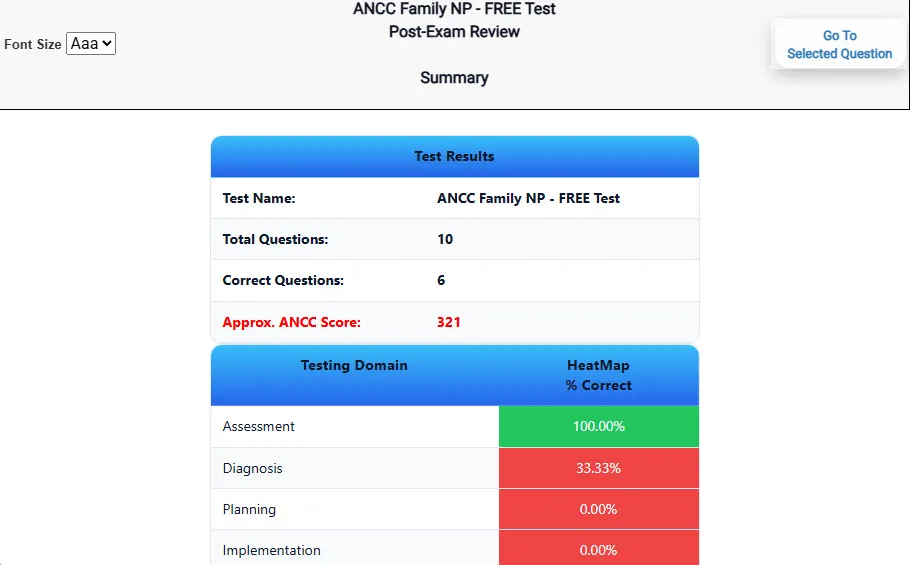
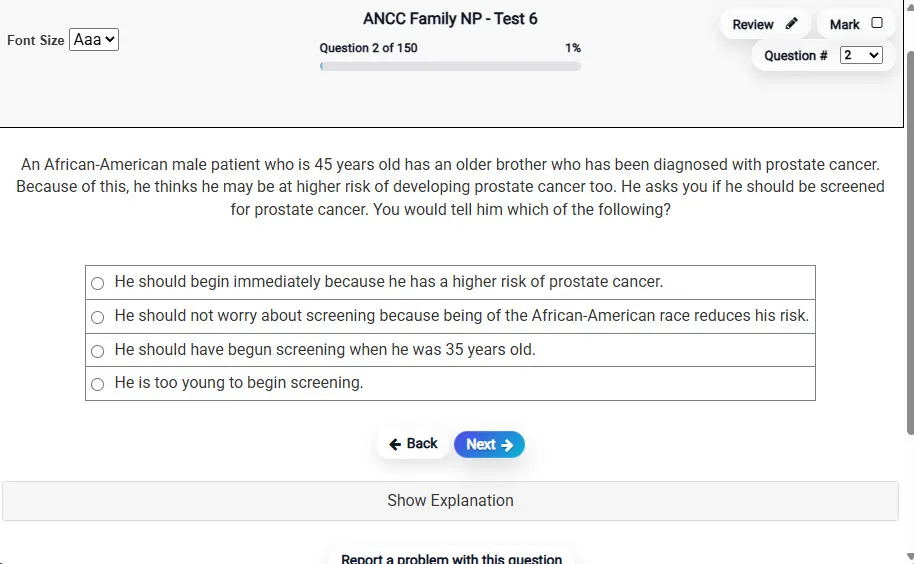
Answering a Question screen – Multiple-choice item view with navigation controls and progress tracker.
Answering a Question Multiple-choice item view with navigation controls and progress tracker.

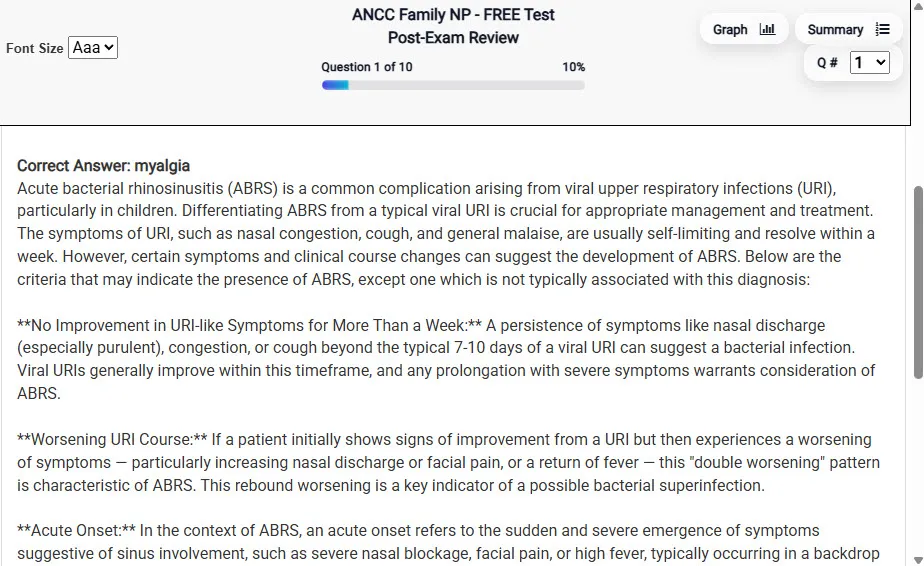
                           Detailed Explanation screen – 
                         Review mode showing chosen answer and rationale and references.
Detailed Explanation Review mode showing chosen answer and rationale and references.

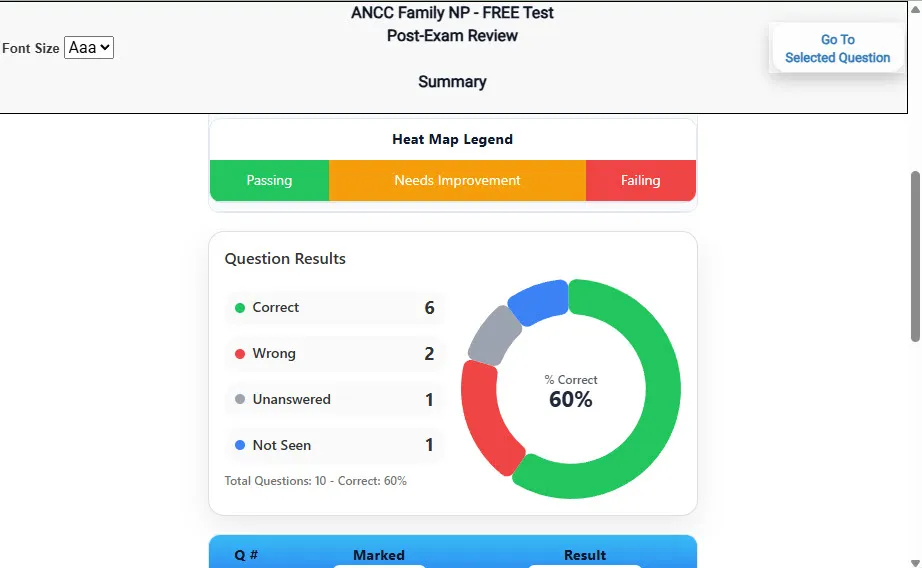
                           Review Summary 1 screen – 
                         Summary with counts for correct/wrong/unanswered and not seen items.
Review Summary 1 Summary with counts for correct/wrong/unanswered and not seen items.

                           Review Summary 2 screen – 
                         Advanced summary with category/domain breakdown and performance insights.
Review Summary 2 Advanced summary with category/domain breakdown and performance insights.

What Each Screen Shows

Answer Question Screen

  • Clean multiple-choice interface with progress bar.
  • Mark for review feature.
  • Matches real test pacing.

Detailed Explanation

  • Correct answer plus rationale.
  • Key concepts and guidelines highlighted.
  • Move between questions to fill knowledge gaps.

Review Summary 1

  • Overall results with total questions and scaled score.
  • Domain heatmap shows strengths and weaknesses.
  • Quick visual feedback on study priorities.

Review Summary 2

  • Chart of correct, wrong, unanswered, not seen.
  • Color-coded results for easy review.
  • Links back to missed items.

Top 10 Reasons to Use Exam Edge for your NYSTCE Safety Net Business and Marketing CST Exam Prep

  1. Focused on the NYSTCE Safety Net Business and Marketing CST Exam

    Our practice tests are built specifically for the Safety Net Business and Marketing exam — every question mirrors the real topics, format, and difficulty so you're studying exactly what matters.

  2. Real Exam Simulation

    We match the per-question time limits and pressure of the actual NYSTCE exam, so test day feels familiar and stress-free.

  3. 30 Full Practice Tests & 2,700 Unique Questions

    You'll have more than enough material to master every Safety Net Business and Marketing concept — no repeats, no fluff.

  4. Lower Cost Than a Retake

    Ordering 5 practice exams costs less than retaking the NYSTCE Safety Net Business and Marketing CST exam after a failure. One low fee could save you both time and money.

  5. Flexible Testing

    Need to step away mid-exam? Pick up right where you left off — with your remaining time intact.

  6. Instant Scoring & Feedback

    See your raw score and an estimated NYSTCE Safety Net Business and Marketing CST score immediately after finishing each practice test.

  7. Detailed Explanations for Every Question

    Review correct and incorrect answers with clear, step-by-step explanations so you truly understand each topic.

  8. Trusted & Accredited

    We're fully accredited by the Better Business Bureau and uphold the highest standards of trust and transparency.

  9. Web-Based & Always Available

    No software to install. Access your Safety Net Business and Marketing practice exams 24/7 from any computer or mobile device.

  10. Expert Support When You Need It

    Need extra help? Our specialized tutors are highly qualified and ready to support your NYSTCE exam prep.


Pass the NYSTCE Safety Net Business and Marketing CST Exam with Realistic Practice Tests from Exam Edge

Preparing for your upcoming NYSTCE Safety Net Business and Marketing CST (969) Certification Exam can feel overwhelming — but the right practice makes all the difference. Exam Edge gives you the tools, structure, and confidence to pass on your first try. Our online practice exams are built to match the real Safety Net Business and Marketing exam in content, format, and difficulty.

  • 📝 30 NYSTCE Safety Net Business and Marketing CST Practice Tests: Access 30 full-length exams with 90 questions each, covering every major NYSTCE Safety Net Business and Marketing CST topic in depth.
  • Instant Online Access: Start practicing right away — no software, no waiting.
  • 🧠 Step-by-Step Explanations: Understand the reasoning behind every correct answer so you can master Safety Net Business and Marketing exam concepts.
  • 🔄 Retake Each Exam Up to 4 Times: Build knowledge through repetition and track your improvement over time.
  • 🌐 Web-Based & Available 24/7: Study anywhere, anytime, on any device.
  • 🧘 Boost Your Test-Day Confidence: Familiarity with the NYSTCE format reduces anxiety and helps you perform under pressure.

These NYSTCE Safety Net Business and Marketing CST practice exams are designed to simulate the real testing experience by matching question types, timing, and difficulty level. This approach helps you get comfortable not just with the exam content, but also with the testing environment, so you walk into your exam day focused and confident.

Exam Edge NYSTCE Reviews


Not a user friendly experience

Amelia , Rochester, New York

Didn't really reflect the questions that were on the test for the most part. Also, they totally got the format of the constructed response question wrong, which never changes. Overall OK if you have nothing else, but definitely not worth the price they charge in my opinion.

Randy , Queens, New York

It was a good test run. Now I know what to expect and what I need to study.

Timothy , Eden, New York

The experience was very practical and I did well.

Trina , Silver Spring , MD

Very easy to navigate.

Collene , Silver Spring , MD

Exam Edge was terrific. Even better than I hoped. Just completing and reviewing the tests are a great learning experience. I can't wait to take the certification test. Tom S.

Thomas , Port Washington, NY


NYSTCE Safety Net Business and Marketing CST Aliases Test Name

Here is a list of alternative names used for this exam.

  • NYSTCE Safety Net Business and Marketing CST
  • NYSTCE Safety Net Business and Marketing CST test
  • NYSTCE Safety Net Business and Marketing CST Certification Test
  • Safety Net Business and Marketing test
  • NYSTCE
  • NYSTCE 969
  • 969 test
  • NYSTCE Safety Net Business and Marketing CST (969)
  • Safety Net Business and Marketing CST certification