This is the content of the pop-over!

NYSTCE CST Multi-subject: Teachers Of Early Childhood EC-2 (211/212/245) Practice Tests & Test Prep by Exam Edge


NYSTCE CST Multi-subject Teachers Of  Early Childhood EC-2  product image
(4.7)
Based on 29 Reviews

  • Real Exam Simulation: Timed questions and matching content build comfort for your NYSTCE CST Multi-subject: Teachers Of Early Childhood EC-2 test day.
  • Instant, 24/7 Access: Web-based NYSTCE CST Multi-subject Teachers Of Early Childhood EC-2 practice exams with no software needed.
  • Clear Explanations: Step-by-step answers and explanations for your NYSTCE exam to strengthen understanding.
  • Boosted Confidence: Reduces anxiety and improves test-taking skills to ace your NYSTCE CST Multi-subject Teachers Of Early Childhood EC-2 (211/212/245).

Featured on

NYSTCE CST Multi-subject Teachers Of Early Childhood EC-2 Online Practice Test Bundles

BEST VALUE
10 practice tests

$99.50

$399.50

SAVE $300

Only $9.95 per test!

  • 100% Pass Guarantee
  • 10 online practice tests
  • 120 questions + 2 essays per test
  • Bonus: 100 Flash Cards + Study Guide
  • Instant access
  • Detailed Explanations
  • Practice tests never expire
  • Timed, untimed, or study guide mode
5 practice tests

$69.75

$199.75

SAVE $130

Only $13.95 per test!

  • 5 online practice tests
  • 120 questions + 2 essays per test
  • Bonus: 100 Flash Cards + Study Guide
  • Instant access
  • Detailed Explanations
  • Practice tests never expire
  • Timed, untimed, or study guide mode
1 practice test

$39.95

  • 1 online practice test
  • 120 questions + 2 essays per test
  • Instant access
  • Detailed Explanations
  • Practice tests never expire
  • Timed, untimed, or study guide mode
Quick Select
Tap to choose a bundle

** All Prices are in US Dollars (USD) **


NYSTCE CST Multi-subject: Teachers Of Early Childhood EC-2 (211/212/245) Resources

Jump to the section you need most.

Understanding the exact breakdown of the NYSTCE CST Multi-subject Teachers Of Early Childhood EC-2 test will help you know what to expect and how to most effectively prepare. The NYSTCE CST Multi-subject Teachers Of Early Childhood EC-2 has 120 multiple-choice questions and 2 essay questions. The exam will be broken down into the sections below:

NYSTCE CST Multi-subject Teachers Of Early Childhood EC-2 Exam Blueprint
Domain Name % Number of
Questions
Literacy and English Language Arts  
     Knowledge of Literacy Language Arts 30% 12
     Instruction in Foundational Literacy Skills 30% 12
     Instruction in English Language Arts 10% 4
     Analysis - Synthesis Application 30% 12
Mathematics  
     Number and Operations 20% 8
     Operations and Algebraic Thinking 30% 12
     Measurement - Geometry Data 20% 8
     Instruction in Mathematics 10% 4
     Analysis - Synthesis Application 20% 8
Arts and Sciences  
     Science and Technology 40% 16
     Social Studies 40% 16
     Fine Arts - Health and Fitness - Family and Consumer Science Career Development 20% 8

NYSTCE CST Multi-subject Teachers Of Early Childhood EC-2 Study Tips by Domain

  • Align instruction to NYS Early Learning Standards by planning around reading, writing, speaking/listening, and language goals—red flag: lesson objectives that only name activities (e.g., “do a worksheet”) instead of measurable literacy outcomes.
  • Teach vocabulary with child-friendly definitions, multiple exposures, and oral rehearsal in context—common trap: relying on copying definitions or isolated word lists for EC–2 students.
  • Build comprehension through interactive read-alouds (think-alouds, text-dependent questions, retellings) and explicit story structure work—priority rule: ask more “why/how” questions than yes/no questions.
  • Develop early writing by moving from dictation/interactive writing to independent composition with planning and revising support—red flag: grading primarily for spelling/handwriting rather than meaning, organization, and use of details.
  • Integrate language conventions (capitalization, punctuation, grammar) in authentic reading/writing rather than decontextualized drills—common trap: teaching rules without immediate application in student sentences and drafts.
  • Use ongoing, developmentally appropriate assessments (running records, writing samples, oral language checks) to drive grouping and next steps—threshold cue: if a student can decode but cannot retell key events, intervene for comprehension, not phonics.
  • Know core components of language (phonology, morphology, syntax, semantics, pragmatics) and link each to observable child behaviors; red flag: confusing phonemic awareness (oral) with phonics (print).
  • Understand stages of emergent literacy (concepts of print, letter knowledge, invented spelling) and what is developmentally appropriate in EC–2; common trap: expecting conventional spelling before solid phoneme segmentation.
  • Use assessment literacy—screening vs diagnostic vs progress monitoring—and match results to instruction; priority rule: use multiple measures (e.g., running records plus phonemic tasks), not a single score.
  • Know vocabulary and oral language development (Tier 1–3 words, rich talk, read-alouds) and how to scaffold; red flag: teaching long word lists without repeated, meaningful exposure.
  • Understand comprehension foundations (background knowledge, text structure, monitoring, retelling) across narrative and informational texts; common trap: overusing worksheets instead of modeling and guided practice with actual texts.
  • Know English conventions (capitalization, punctuation, grammar/usage) and writing development (planning, drafting, revising) for young children; contraindication: marking every error—focus feedback on one or two high-leverage targets aligned to the lesson.
  • Teach phonological awareness in a clear progression (words → syllables → onset-rime → phonemes); red flag: jumping straight to phonics when a child cannot segment/blend sounds orally.
  • Use explicit, systematic phonics with cumulative review (e.g., introduce a pattern, model, guided practice, then decodable text); common trap: relying on leveled texts and picture cues instead of decoding practice.
  • Link phonemic awareness to print by teaching letter–sound correspondences and using multisensory routines; priority rule: correct errors immediately with a brief reteach rather than letting approximations become habits.
  • Build automaticity through repeated readings of decodable and controlled texts, phrasing practice, and timed but low-stakes fluency checks; red flag: measuring speed only—accuracy and prosody must be monitored too.
  • Teach vocabulary and oral language daily (read-alouds, explicit word instruction, conversation scaffolds) to support later comprehension; common trap: treating vocabulary as memorizing definitions instead of using words in varied contexts.
  • Use ongoing, skills-based assessment (letter-name/sound, phoneme segmentation, nonsense-word decoding, high-frequency word accuracy) to target intervention; threshold cue: if a student consistently guesses words, shift to diagnostic decoding and phoneme-level practice.
  • Plan ELA instruction around clear, standards-aligned outcomes (e.g., comprehension, writing, speaking/listening) with evidence of learning—red flag: activities (crafts/worksheets) that don’t map to a stated objective.
  • Use interactive read-alouds and shared reading to model comprehension strategies (predict, question, retell) and text features—common trap: asking only literal recall questions.
  • Teach writing through a process (plan, draft, revise, edit, publish) with explicit modeling and exemplars—priority rule: feedback should target one or two high-impact goals (e.g., organization, details) rather than marking every error.
  • Differentiate ELA for multilingual learners and diverse needs using visuals, sentence frames, and structured talk—red flag: simplifying the task so much that the language or literacy objective disappears.
  • Integrate speaking and listening (turn-and-talk, academic conversation norms, oral storytelling) to build language and comprehension—common trap: unstructured discussion without roles, prompts, or accountable talk expectations.
  • Assess ELA with multiple measures (running records, rubrics, anecdotal notes, student work) and use results to adjust instruction—threshold: if data show weak comprehension, prioritize oral retell/think-alouds before increasing text difficulty.
  • Read the prompt for the actual task verb (analyze vs. synthesize vs. apply)—a common trap is summarizing when the question asks for cause/effect, comparison, or justification.
  • For analysis, identify the key evidence in the scenario (student work, running record notes, behavior data) and tie each claim to a specific detail; red flag: making inferences about ability without citing observable data.
  • For synthesis, combine at least two sources (e.g., developmental theory + classroom data) into one coherent conclusion; priority rule: reconcile contradictions rather than ignoring the data point that doesn’t fit.
  • For application, select an action that directly matches the diagnosed need and age range (EC–2) and state the immediate next instructional step; trap: choosing a generic strategy not aligned to the identified skill gap.
  • When recommending supports, ensure they are legally and instructionally appropriate (e.g., accommodations vs. modifications) and feasible in a classroom routine; red flag: proposing an intervention that changes the learning target without indicating it is a modification.
  • Always include a quick check for understanding or progress-monitoring method tied to the goal (exit ticket, observational checklist, brief probe); trap: listing activities without a measurable criterion for success.
  • Prioritize early-number sense and base-ten understanding (e.g., composing/decomposing 10 and teen numbers) before procedures; red flag: students can recite counting but can’t match one-to-one or explain “how many.”
  • Treat place value as the core for comparing, rounding, and multi-digit operations; common trap: teaching the standard algorithm without connecting to units (ones/tens) or models (ten-frames, bundles, number lines).
  • Use multiple representations and require explanation (pictures, manipulatives, equations, words) aligned to NYSTCE-style prompts; priority rule: if a student can’t justify with a model, they likely don’t understand the concept.
  • Build fluency through strategies (make-10, doubles/near-doubles, decomposing) rather than timed drills alone; red flag: speed improves but error patterns persist, indicating weak strategy knowledge.
  • Attend to early fraction foundations as equal shares and fair partitioning (halves/thirds/fourths) with concrete contexts; common trap: students think “bigger denominator means bigger piece” because they don’t link to the whole.
  • Embed math in real routines (calendar, games, measurement experiences) with clear learning targets; contraindication: worksheets as the primary instruction for EC–2, especially when language demands mask the math.
  • Prioritize place value and base-ten structure (bundling into tens/hundreds) to justify comparisons and operations; red flag: students relying on digit-by-digit comparison (e.g., thinking 402 > 39 because 4 > 3).
  • Connect addition/subtraction to part–whole and the number line (counting on/back, making ten) rather than only memorized facts; common trap: teaching subtraction only as “take away” and ignoring “difference/compare” contexts.
  • Use concrete models (ten-frames, linking cubes, base-ten blocks) to show composing/decomposing in multi-digit operations; priority rule: insist students explain regrouping as trading 1 ten for 10 ones (not a “borrow” trick).
  • Develop early multiplication/division meanings through equal groups, arrays, and fair shares; contraindication: introducing the algorithm or fact drills before students can model 3 groups of 4 and explain what the 12 represents.
  • Represent and compare fractions as numbers (unit fractions, equal partitions, number line) and link to fair-sharing; red flag: students thinking a larger denominator means a larger fraction (e.g., 1/8 > 1/4).
  • Emphasize estimation and reasonableness (benchmarks like 0, 1/2, 1, 10, 100) to check results; common trap: accepting an exact-looking answer that violates magnitude (e.g., sum smaller than an addend).
  • Model early operations with concrete contexts (join, separate, part–part–whole, compare) before symbols; red flag: giving only worksheets without manipulatives or story situations.
  • Teach the meanings of the equal sign as “the same as” using true/false and open equations (e.g., 3+4=__+5); common trap: reinforcing “answer goes after =” with only 3+4=__.
  • Build fluency for addition/subtraction within 20 through strategies (make 10, doubles/near doubles, count on, decomposing); NYSTCE cue: assess strategy use—not just speed—and watch for reliance on finger counting as the only method.
  • Use properties (commutative, associative) and the relationship between addition and subtraction to justify mental strategies; red flag: students who can compute but cannot explain why a strategy works.
  • Introduce early multiplicative thinking via equal groups and repeated addition (skip counting, arrays) without requiring formal multiplication facts; contraindication: pushing standard algorithms or timed fact drills too early for EC–2.
  • Teach patterns and simple function rules (AB/AAB, growing patterns, input–output) and connect them to algebraic thinking; common trap: focusing only on copying patterns rather than identifying and stating the rule.
  • Use nonstandard units before standard ones (e.g., paper clips then inches) to build the idea of iterating a unit; red flag: letting children “measure” with gaps/overlaps between units.
  • For direct comparisons, teach align-to-zero and same-start-point routines with rulers/number lines; common trap: students compare based on the endpoint only when objects start at different positions.
  • Emphasize attribute vs. tool (length, weight, capacity, time, temperature) and choose appropriate instruments; priority rule: match the unit/tool to the attribute or the data will be invalid.
  • Develop geometry through composing/decomposing shapes (triangles, rectangles, circles) and describing position (above/below, next to, in front of); red flag: expecting correct names without also using attributes (sides, corners) to justify.
  • Introduce symmetry, congruence, and simple transformations with manipulatives and pattern blocks; common trap: confusing congruent shapes with shapes that are merely the same orientation or color.
  • Build data skills by having children sort/classify, tally, and represent results in picture graphs/bar graphs with clear labels; red flag: unequal picture values or missing titles/keys that make the graph misleading.
  • Plan instruction with clear learning targets and success criteria aligned to NY standards, using manipulatives and representations before symbols; red flag: jumping to the algorithm when students can’t explain the “why” with models.
  • Use concrete–representational–abstract (CRA) progressions (e.g., ten-frames, number lines, base-ten blocks) and revisit them across lessons; common trap: treating manipulatives as “toys” rather than tools tied to specific math language and goals.
  • Differentiate through scaffolds (sentence frames for math talk, worked examples, visual supports) and extensions (multiple strategies, justify/generalize); priority rule: adjust the task demand without changing the standard’s core concept.
  • Embed purposeful math discourse (turn-and-talk, explain/compare strategies, justify with evidence) and explicitly teach vocabulary (e.g., more/less, equal, compose/decompose); red flag: students can answer but cannot defend their reasoning.
  • Use frequent formative checks (hinge questions, exit tickets, quick interviews) to diagnose misconceptions and reteach immediately; common trap: grading for speed/accuracy only and missing conceptual errors like place-value confusion.
  • Select and sequence problems from simple to complex, connecting to real contexts and multiple representations; contraindication: using word problems that overload reading demands without supports for ELLs and early readers.
  • Use close reading of the prompt to identify exactly what is being asked (e.g., “most appropriate” vs. “best next step”)—common trap: choosing a true statement that doesn’t answer the question.
  • When given student work or assessment data, look for patterns and error types before selecting an intervention—red flag: jumping to reteaching without diagnosing whether the error is conceptual, procedural, or language-related.
  • Synthesize across domains (language, math, science, social studies) by prioritizing developmentally appropriate practice for EC–2—common trap: selecting strategies better suited to older grades (e.g., lengthy independent research or abstract lecture).
  • Apply NYSTCE-style decision rules: choose responses that are safe, inclusive, and instructionally focused rather than punitive—red flag: answers emphasizing punishment, public shaming, or withholding recess as a primary behavior strategy.
  • In scenarios involving multilingual learners or diverse backgrounds, select supports that maintain high expectations while providing access (visuals, modeling, sentence frames)—common trap: lowering the cognitive demand instead of scaffolding.
  • For classroom management and family communication prompts, choose actions that document, collaborate, and follow school protocols—priority rule: when safety or mandated reporting is implicated, escalate per policy rather than handling privately.
  • Emphasize integrated Arts and Sciences instruction through play-based, inquiry routines (observe–ask–test–explain) aligned to NYS early learning standards; red flag: lessons that isolate facts without hands-on exploration.
  • Use safe, developmentally appropriate science investigations (magnifiers, ramps, water tables) with explicit safety rules; common trap: allowing open access to small parts or liquids without supervision and clear procedures.
  • Connect social studies concepts (community helpers, rules, maps/globes, holidays) to children’s lived experiences while remaining culturally responsive; priority rule: avoid stereotyping or treating traditions as “the” norm.
  • Plan art, music, dance, and dramatic play to build observation and communication (e.g., drawing what you see, rhythm patterns, role-play); red flag: grading on product neatness rather than process, effort, and expression.
  • Interpret simple data from class investigations (tally marks, picture graphs) and use it to make claims; common trap: asking for conclusions that don’t match the evidence children collected.
  • Differentiate for multilingual learners and students with disabilities using visuals, gestures, sentence frames, and accessible materials; contraindication: reducing cognitive demand by removing inquiry and replacing it with worksheets.
  • Distinguish science process skills (observe, classify, predict, infer) from science content; red flag: treating a child’s inference as an observation.
  • Use simple investigations with one variable changed at a time and a fair comparison; common trap: changing multiple variables (e.g., light and water) and calling it an experiment.
  • Prioritize safety in early childhood labs—no tasting, careful handwashing, and appropriate tool use; contraindication: using small objects (choking hazards) for sorting or measurement.
  • Build accurate physical science ideas through hands-on experiences (push/pull, magnetism, sound, light) rather than definitions; red flag: implying heavier objects always fall faster.
  • Teach life science with attention to basic needs and life cycles while avoiding anthropomorphism; common trap: stating plants “eat” soil instead of using water, air, and light to make food.
  • Integrate technology as tools for learning (simple digital media, assistive tech, data recording) with a purpose; priority rule: choose age-appropriate, task-aligned tech rather than screen time without a clear learning objective.
  • Use inquiry with primary sources (photos, letters, simple maps) and ask “Who made it and why?”—red flag: treating any source as automatically true without discussing perspective.
  • Build chronology with visual timelines and sequencing words (first/next/then) tied to classroom routines—common trap: expecting EC–2 students to use exact dates instead of before/after and past/present.
  • Teach geography through spatial language and simple map features (title, symbols, legend, compass rose) using school/community examples—priority rule: always connect maps to real places children know.
  • Civics should emphasize rules, roles, and fairness (classroom, family, community helpers) and how decisions are made—red flag: confusing rights with responsibilities or skipping why rules exist.
  • Integrate economics via needs vs. wants, goods vs. services, and simple choices with consequences—common trap: framing wants as needs or ignoring opportunity cost (“if you choose this, you give up that”).
  • Teach culture and history with multiple voices and inclusive examples while avoiding stereotypes—contraindication: single-story portrayals (e.g., one holiday equals an entire group’s culture).
  • Plan integrated arts experiences (music, movement, visual art, drama) that are process-focused and developmentally appropriate; red flag: grading on artistic “product” quality rather than effort, exploration, and child choice.
  • Use safe materials and explicit routines for tools, allergens, and cleanup in art/cooking centers; common trap: providing scissors, small objects, or hot appliances without close supervision and clear safety rules.
  • Design daily physical activity with fundamental motor skills (locomotor, balance, manipulative) and inclusive adaptations; priority rule: avoid elimination games and compare-to-peers fitness tests that can shame young children.
  • Teach health concepts through routines (handwashing, toothbrushing, sleep, nutrition) and accurate body-safety language; red flag: using fear-based messages or misinformation (e.g., “sugar makes kids hyper” as a fact).
  • Embed family and consumer science in real-life classroom tasks (simple food prep, caring for belongings, basic budgeting with play money) and align with developmental readiness; common trap: expecting EC–2 students to manage complex multistep recipes or unsafe chores.
  • Support early career development via community-helper play, classroom jobs, and discussing interests and strengths; priority rule: avoid stereotypes (gender/race/ability) when assigning roles or presenting occupations.


Built to Fit Into Your Busy Life

Everything you need to prepare with confidence—without wasting a minute.

Three Study Modes

Timed, No Time Limit, or Explanation mode.

Actionable Analytics

Heatmaps and scaled scores highlight weak areas.

High-Yield Rationales

Concise explanations emphasize key concepts.

Realistic Interface

Matches the feel of the actual exam environment.

Accessible by Design

Clean layout reduces cognitive load.

Anytime, Anywhere

Web-based access 24/7 on any device.
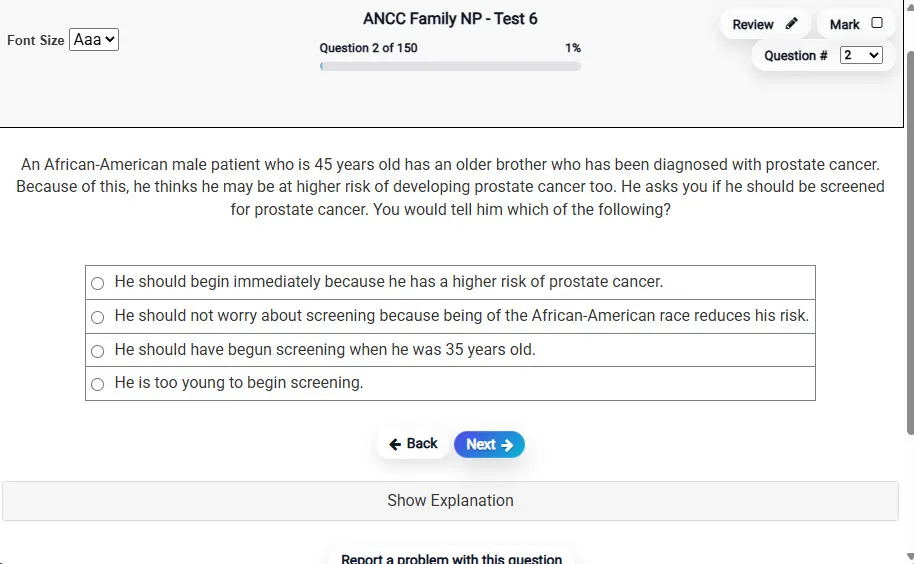
Answering a Question screen – Multiple-choice item view with navigation controls and progress tracker.
Answering a Question Multiple-choice item view with navigation controls and progress tracker.

                           Detailed Explanation screen – 
                         Review mode showing chosen answer and rationale and references.
Detailed Explanation Review mode showing chosen answer and rationale and references.

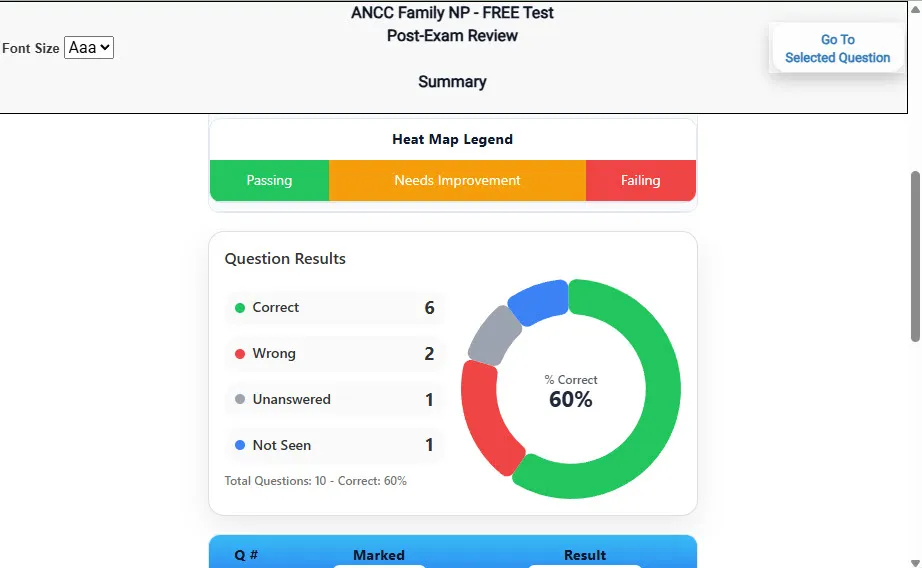
                           Review Summary 1 screen – 
                         Summary with counts for correct/wrong/unanswered and not seen items.
Review Summary 1 Summary with counts for correct/wrong/unanswered and not seen items.

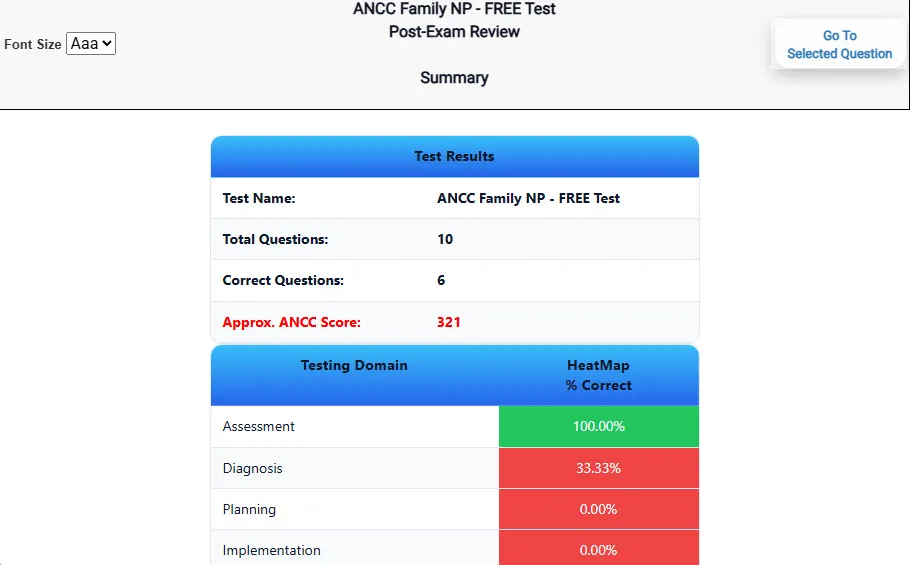
                           Review Summary 2 screen – 
                         Advanced summary with category/domain breakdown and performance insights.
Review Summary 2 Advanced summary with category/domain breakdown and performance insights.

What Each Screen Shows

Answer Question Screen

  • Clean multiple-choice interface with progress bar.
  • Mark for review feature.
  • Matches real test pacing.

Detailed Explanation

  • Correct answer plus rationale.
  • Key concepts and guidelines highlighted.
  • Move between questions to fill knowledge gaps.

Review Summary 1

  • Overall results with total questions and scaled score.
  • Domain heatmap shows strengths and weaknesses.
  • Quick visual feedback on study priorities.

Review Summary 2

  • Chart of correct, wrong, unanswered, not seen.
  • Color-coded results for easy review.
  • Links back to missed items.

Top 10 Reasons to Use Exam Edge for your NYSTCE CST Multi-subject Teachers Of Early Childhood EC-2 Exam Prep

  1. Focused on the NYSTCE CST Multi-subject Teachers Of Early Childhood EC-2 Exam

    Our practice tests are built specifically for the NYSTCE CST Multi-subject: Teachers Of Early Childhood EC-2 exam — every question mirrors the real topics, format, and difficulty so you're studying exactly what matters.

  2. Real Exam Simulation

    We match the per-question time limits and pressure of the actual NYSTCE exam, so test day feels familiar and stress-free.

  3. 10 Full Practice Tests & 1,220 Unique Questions

    You'll have more than enough material to master every NYSTCE CST Multi-subject: Teachers Of Early Childhood EC-2 concept — no repeats, no fluff.

  4. Lower Cost Than a Retake

    Ordering 5 practice exams costs less than retaking the NYSTCE CST Multi-subject Teachers Of Early Childhood EC-2 exam after a failure. One low fee could save you both time and money.

  5. Flexible Testing

    Need to step away mid-exam? Pick up right where you left off — with your remaining time intact.

  6. Instant Scoring & Feedback

    See your raw score and an estimated NYSTCE CST Multi-subject Teachers Of Early Childhood EC-2 score immediately after finishing each practice test.

  7. Detailed Explanations for Every Question

    Review correct and incorrect answers with clear, step-by-step explanations so you truly understand each topic.

  8. Trusted & Accredited

    We're fully accredited by the Better Business Bureau and uphold the highest standards of trust and transparency.

  9. Web-Based & Always Available

    No software to install. Access your NYSTCE CST Multi-subject: Teachers Of Early Childhood EC-2 practice exams 24/7 from any computer or mobile device.

  10. Expert Support When You Need It

    Need extra help? Our specialized tutors are highly qualified and ready to support your NYSTCE exam prep.


Pass the NYSTCE CST Multi-subject Teachers Of Early Childhood EC-2 Exam with Realistic Practice Tests from Exam Edge

Preparing for your upcoming NYSTCE CST Multi-subject Teachers Of Early Childhood EC-2 (211/212/245) Certification Exam can feel overwhelming — but the right practice makes all the difference. Exam Edge gives you the tools, structure, and confidence to pass on your first try. Our online practice exams are built to match the real NYSTCE CST Multi-subject: Teachers Of Early Childhood EC-2 exam in content, format, and difficulty.

  • 📝 10 NYSTCE CST Multi-subject Teachers Of Early Childhood EC-2 Practice Tests: Access 10 full-length exams with 122 questions each, covering every major NYSTCE CST Multi-subject Teachers Of Early Childhood EC-2 topic in depth.
  • Instant Online Access: Start practicing right away — no software, no waiting.
  • 🧠 Step-by-Step Explanations: Understand the reasoning behind every correct answer so you can master NYSTCE CST Multi-subject: Teachers Of Early Childhood EC-2 exam concepts.
  • 🔄 Retake Each Exam Up to 4 Times: Build knowledge through repetition and track your improvement over time.
  • 🌐 Web-Based & Available 24/7: Study anywhere, anytime, on any device.
  • 🧘 Boost Your Test-Day Confidence: Familiarity with the NYSTCE format reduces anxiety and helps you perform under pressure.

These NYSTCE CST Multi-subject Teachers Of Early Childhood EC-2 practice exams are designed to simulate the real testing experience by matching question types, timing, and difficulty level. This approach helps you get comfortable not just with the exam content, but also with the testing environment, so you walk into your exam day focused and confident.

Exam Edge NYSTCE Reviews


Not a user friendly experience

Amelia , Rochester, New York

Didn't really reflect the questions that were on the test for the most part. Also, they totally got the format of the constructed response question wrong, which never changes. Overall OK if you have nothing else, but definitely not worth the price they charge in my opinion.

Randy , Queens, New York

It was a good test run. Now I know what to expect and what I need to study.

Timothy , Eden, New York

The experience was very practical and I did well.

Trina , Silver Spring , MD

Very easy to navigate.

Collene , Silver Spring , MD

Exam Edge was terrific. Even better than I hoped. Just completing and reviewing the tests are a great learning experience. I can't wait to take the certification test. Tom S.

Thomas , Port Washington, NY


NYSTCE CST Multi-subject Teachers Of Early Childhood EC-2 Aliases Test Name

Here is a list of alternative names used for this exam.

  • NYSTCE CST Multi-subject Teachers Of Early Childhood EC-2
  • NYSTCE CST Multi-subject Teachers Of Early Childhood EC-2 test
  • NYSTCE CST Multi-subject Teachers Of Early Childhood EC-2 Certification Test
  • NYSTCE CST Multi-subject: Teachers Of Early Childhood EC-2 test
  • NYSTCE
  • NYSTCE 211/212/245
  • 211/212/245 test
  • NYSTCE CST Multi-subject Teachers Of Early Childhood EC-2 (211/212/245)
  • CST Multi-subject Teachers Of Early Childhood EC-2 certification