This is the content of the pop-over!

NYSTCE CST Multi-subject: Teachers Of Students with Disabilities Practice Tests & Test Prep by Exam Edge


NYSTCE CST Multi-subject Teachers Of Students with Disabilities  product image
(4.8)
Based on 34 Reviews

  • Real Exam Simulation: Timed questions and matching content build comfort for your NYSTCE CST Multi-subject: Teachers Of Students with Disabilities test day.
  • Instant, 24/7 Access: Web-based NYSTCE CST Multi-subject Teachers Of Students with Disabilities practice exams with no software needed.
  • Clear Explanations: Step-by-step answers and explanations for your NYSTCE exam to strengthen understanding.
  • Boosted Confidence: Reduces anxiety and improves test-taking skills to ace your NYSTCE CST Multi-subject Teachers Of Students with Disabilities .

Featured on

NYSTCE CST Multi-subject Teachers Of Students with Disabilities Online Practice Test Bundles

BEST VALUE
20 practice tests

$174.00

$799.00

SAVE $625

Only $8.70 per test!

  • 100% Pass Guarantee
  • 20 online practice tests
  • 120 questions + 2 essays per test
  • Bonus: 100 Flash Cards + Study Guide
  • Instant access
  • Detailed Explanations
  • Practice tests never expire
  • Timed, untimed, or study guide mode
MOST POPULAR
10 practice tests

$99.50

$399.50

SAVE $300

Only $9.95 per test!

  • 10 online practice tests
  • 120 questions + 2 essays per test
  • Bonus: 100 Flash Cards + Study Guide
  • Instant access
  • Detailed Explanations
  • Practice tests never expire
  • Timed, untimed, or study guide mode
5 practice tests

$69.75

$199.75

SAVE $130

Only $13.95 per test!

  • 5 online practice tests
  • 120 questions + 2 essays per test
  • Bonus: 100 Flash Cards
  • Instant access
  • Detailed Explanations
  • Practice tests never expire
  • Timed, untimed, or study guide mode
1 practice test

$39.95

  • 1 online practice test
  • 120 questions + 2 essays per test
  • Instant access
  • Detailed Explanations
  • Practice tests never expire
  • Timed, untimed, or study guide mode
Quick Select
Tap to choose a bundle

** All Prices are in US Dollars (USD) **


NYSTCE CST Multi-subject: Teachers Of Students with Disabilities () Resources

Jump to the section you need most.

Understanding the exact breakdown of the NYSTCE CST Multi-subject Teachers Of Students with Disabilities test will help you know what to expect and how to most effectively prepare. The NYSTCE CST Multi-subject Teachers Of Students with Disabilities has multiple-choice questions . The exam will be broken down into the sections below:

NYSTCE CST Multi-subject Teachers Of Students with Disabilities Exam Blueprint
Domain Name % Number of
Questions
Literacy and English Language Arts  
     Knowledge of Literacy Language Arts 30% 12
     Instruction in Foundational Literacy Skills 30% 12
     Instruction in English Language Arts 10% 4
     Analysis - Synthesis Application 30% 12
Mathematics  
     Number and Quantity 10% 4
     Algebra and Functions 35% 14
     Geometry and Statistics 35% 14
     Analysis - Synthesis Application 20% 8
Arts and Sciences  
     Science and Technology 40% 16
     Social Studies 40% 16
     Fine Arts - Health and Fitness - Family and Consumer Science Career Development 20% 8

NYSTCE CST Multi-subject Teachers Of Students with Disabilities Study Tips by Domain

  • Use IEP-driven, explicit instruction (model → guided practice → independent practice) aligned to grade-level standards; red flag: goals that list activities (e.g., “will complete worksheets”) instead of measurable reading/writing outcomes.
  • Plan accommodations vs. modifications correctly (e.g., text-to-speech supports access; lowering text complexity changes the target); common trap: confusing “read-aloud of the reading test” with an allowed accommodation when it alters the construct being measured.
  • Teach vocabulary with multiple exposures (morphology, context, and semantic mapping) and track generalization across settings; priority rule: don’t rely on dictionary-copying as the main vocabulary intervention.
  • Strengthen comprehension using explicit strategy instruction (previewing, questioning, summarizing, graphic organizers) with progress monitoring; red flag: asking only literal recall questions and calling it comprehension instruction.
  • Support writing through structured routines (planning frames, sentence combining, SRSD-style self-regulation) and targeted feedback; common trap: grading mechanics heavily when the goal is organization/idea development per the rubric.
  • Address communication and language needs (pragmatics, discourse, and AAC supports) within ELA tasks; contraindication: removing students from meaningful reading/writing to do isolated drills that don’t transfer to classroom performance.
  • Know the five components of reading (phonemic awareness, phonics, fluency, vocabulary, comprehension) and match each to an assessment and intervention—red flag: proposing “more reading practice” without identifying the specific deficit.
  • Use the “Simple View of Reading” (decoding × language comprehension) to diagnose why a student struggles—trap: attributing weak comprehension to decoding when oral language is the primary need (or vice versa).
  • Differentiate phonological awareness from phonics and orthography—priority rule: isolate sound skills (e.g., segmentation/blending) before expecting accurate decoding and spelling patterns.
  • Apply vocabulary principles (Tier 1/2/3, morphology, context, multiple meanings) in instruction—red flag: teaching only dictionary definitions without repeated exposure and word-learning strategies.
  • Understand text complexity and comprehension supports (background knowledge, text structure, questioning, summarizing, graphic organizers)—trap: lowering the text level instead of providing access supports aligned to the purpose.
  • Know conventions of English (syntax, semantics, pragmatics, discourse) and their role in reading/writing—contraindication: correcting surface errors only when the student’s main barrier is sentence structure or cohesive devices.
  • Teach phonological awareness in a continuum (word → syllable → onset-rime → phoneme) and link it to print; red flag: skipping phoneme manipulation (blend/segment/delete) and jumping straight to phonics worksheets.
  • Provide explicit, systematic phonics with cumulative review (e.g., short vowels before vowel teams) and include decodable text aligned to taught patterns; common trap: using predictable/leveled texts too early so students guess from pictures.
  • Use error patterns from running records or dictation to target instruction (e.g., b/d reversals vs. vowel confusions vs. weak blending) and document progress frequently; NYSTCE priority: don’t rely on a single measure when making instructional decisions.
  • Build automaticity through repeated, brief practice (high-frequency irregular words, timed decoding/fluency, phrase-cued reading) while keeping accuracy first; threshold cue: if accuracy is below ~90–95%, slow down and reteach rather than increase rate.
  • Teach morphology (inflectional endings, common prefixes/suffixes, base words) to support decoding and spelling as texts get more complex; red flag: treating spelling as memorization instead of mapping sounds to letters and meaningful word parts.
  • Differentiate for students with disabilities using multisensory routines, assistive technology when appropriate, and accommodations that don’t reduce the reading construct; contraindication: giving audio for decoding tasks when the goal is word-reading accuracy.
  • Plan ELA lessons with explicit, measurable IEP-aligned objectives (e.g., cite textual evidence, use transition words) and specify the accommodation vs. modification—red flag: writing “extra time” without changing access to the standard.
  • Teach comprehension with modeling (think-alouds) and gradual release (I do–We do–You do); common trap: assigning independent reading tasks before students can use the strategy with scaffolds.
  • Differentiate reading materials using text complexity supports (audio, chunking, guided notes) while keeping the same key idea/standard—priority rule: don’t lower the cognitive demand when the goal is comprehension, not decoding.
  • Provide structured writing instruction (sentence frames, graphic organizers, exemplars, rubrics) and target one or two focus skills per draft; red flag: grading content, conventions, and organization equally when the IEP goal targets only one area.
  • Use evidence-based vocabulary instruction (morphology, multiple exposures, student-friendly definitions) and preteach critical terms; common trap: relying on copying dictionary definitions as the primary vocabulary strategy.
  • Monitor progress with frequent, brief checks (retell, constructed response, writing probes) and adjust instruction based on data; threshold cue: if data show no improvement across multiple probes, change the intervention rather than repeating the same lesson.
  • Use data from multiple sources (work samples, CBM/progress monitoring, observations, FBA) to identify skill deficits vs performance deficits; red flag: recommending services before establishing a clear present level of performance.
  • Align goals, accommodations, and specially designed instruction to NYS learning standards and the student’s IEP needs; common trap: listing accommodations that don’t match the documented barrier (e.g., extended time for a decoding deficit).
  • Apply least restrictive environment (LRE) decision-making by starting with supports in general education and justifying removal with evidence; priority rule: placement follows services—not the other way around.
  • Synthesize behavior information by linking antecedents, function, and replacement behaviors to a concrete behavior plan; red flag: using punishment-only responses without teaching a functionally equivalent skill.
  • Choose assessment and grading adaptations that preserve the construct being measured; common trap: modifying an ELA assessment so heavily (e.g., reading the passage aloud) that it invalidates what is being assessed.
  • When collaborating with families and related-service providers, document decisions with clear rationales and measurable outcomes; contraindication: vague IEP language (e.g., “will improve”) that can’t be monitored or defended.
  • Use assessment data to set a measurable math goal and align it to present levels (e.g., “Given 10 fraction problems, Student will solve 8/10 correctly”) — red flag: goals that describe activities (“will practice”) instead of observable performance.
  • Prioritize explicit instruction with concrete–representational–abstract (CRA) progression and frequent checks for understanding — common trap: moving to symbols before the student demonstrates mastery with manipulatives/visual models.
  • Teach problem-solving with consistent routines (read–plan–solve–check) and require unit/estimate checks — priority rule: if an answer is unreasonable (e.g., 3 buses for 120 students), treat it as an error even if computation is correct.
  • Build math vocabulary and language supports (sentence frames, multiple representations, clarified key terms like “difference” vs. “distance”) — red flag: penalizing language errors when the barrier is comprehension rather than math reasoning.
  • Implement accommodations with fidelity (extended time, calculator when permitted, reduced distraction) while keeping the construct intact — common trap: modifying the task so much that it no longer measures the intended standard/skill.
  • Address behavior/executive function barriers during math (chunking, visual schedules, timed breaks, errorless learning when appropriate) — contraindication: repeated independent drill after repeated failure, which can increase avoidance and reduce learning.
  • Use place value to interpret and compare rational numbers (including negatives) on a number line; red flag: forgetting that “more negative” means a smaller value.
  • Fluently convert among fractions, decimals, and percents and justify equivalence; common trap: treating 0.4 as 4% instead of 40%.
  • Apply ratio and proportional reasoning (unit rates, scale factors) to solve real contexts; priority rule: check units and label rates to avoid inverted ratios.
  • Compute with integers and rational numbers using properties (commutative, associative, distributive) and order of operations; red flag: sign errors when distributing a negative.
  • Model real-world problems with quantities and estimates (rounding, compatible numbers, bounds) and judge reasonableness; common trap: choosing an estimate that changes the problem’s magnitude (e.g., rounding 0.49 to 1).
  • For NYSTCE-style scenarios, connect number concepts to accessibility (manipulatives, visual models, stepwise prompts) while preserving rigor; contraindication: over-scaffolding that removes the quantitative decision (student never chooses the operation or rate).
  • Solve and interpret linear equations and inequalities, including checking solutions in context; red flag: forgetting to reverse the inequality sign when multiplying or dividing by a negative number.
  • Work with functions (notation, domain/range, evaluating, and interpreting function values) and connect multiple representations (table, graph, equation); common trap: using x- and y-intercepts without confirming the domain restriction in the problem.
  • Analyze proportional relationships and distinguish them from general linear relationships; priority rule: a proportional relationship must pass through (0,0) and have constant unit rate.
  • Manipulate expressions (distribute, factor, combine like terms) and recognize structure (e.g., difference of squares, common factors); red flag: canceling terms across addition (you can only cancel common factors).
  • Model and solve systems of linear equations (graphing, substitution, elimination) and interpret number of solutions; common trap: concluding “no solution” without verifying whether lines are parallel (same slope, different intercept) versus coincident (infinitely many solutions).
  • Use arithmetic and geometric sequences as functions (explicit and recursive forms) and interpret rate of change; threshold cue: constant difference implies arithmetic, constant ratio implies geometric—mixing these leads to wrong predictions.
  • Distinguish and use key geometric definitions (point, line, segment, ray, angle types, parallel/perpendicular) to justify conclusions; red flag: stating a result (e.g., “these lines are parallel”) without a property-based reason.
  • Apply triangle congruence/similarity (SSS, SAS, ASA, AAS; AA similarity) to solve for missing measures; common trap: using SSA as a congruence criterion or mixing up corresponding sides/angles.
  • Use coordinate geometry to compute slope, distance, midpoint, and equation of a line; priority rule: if slopes are equal → parallel, negative reciprocals → perpendicular (unless a line is vertical/horizontal).
  • Solve perimeter/area/volume problems for common figures (triangles, rectangles, circles, prisms, cylinders) and interpret units; red flag: reporting area in linear units or forgetting to square/cube units.
  • Interpret and create data displays (dot plots, histograms, box plots, scatterplots) and match appropriate measures of center/spread; contraindication: using the mean with strong outliers or skew (median/IQR is usually preferred).
  • Compute and interpret probability and basic statistics (simple events, experimental vs. theoretical probability, mean/median/mode, range/IQR) and describe correlation; common trap: confusing correlation with causation or ignoring sample size when judging variability.
  • Analyze present levels of performance (PLOP) with multiple data sources (work samples, CBM, observations) and translate them into measurable annual goals; red flag: goals that are not observable or lack a criterion (e.g., “will improve reading”).
  • Synthesize patterns across settings to identify function and maintaining variables before selecting interventions; common trap: assuming “noncompliance” is the behavior rather than defining a specific, countable target behavior.
  • Apply evidence-based instruction using explicit modeling, guided practice, and frequent checks for understanding; priority rule: increase opportunities to respond (OTR) before increasing task difficulty or length.
  • Use accommodation vs. modification correctly when planning instruction and assessment; red flag: changing the skill being measured (modification) while documenting it as an accommodation.
  • Apply progress-monitoring cycles (baseline → intervention → weekly data → adjust) and make data-based decisions; common trap: waiting for grading periods instead of using trend data to revise instruction promptly.
  • Synthesize legal/ethical requirements into practice during IEP implementation (services, frequency, setting) and documentation; red flag: informal changes to services without an IEP team meeting and prior written notice.
  • Prioritize equitable access to grade-level Arts and Sciences content by applying UDL and explicit scaffolds (e.g., vocabulary pre-teach, visuals, guided notes); red flag: “watering down” to only functional skills when standards require academic content.
  • Use a systematic data cycle (screening → diagnostic → progress monitoring) to adjust instruction and IEP supports; common trap: making placement or service decisions from a single score or one-time observation.
  • Align present levels, measurable annual goals, and specially designed instruction to the same Arts and Sciences skill deficit (content + access skill); priority rule: if you can’t measure it, it isn’t a compliant goal.
  • Plan accommodations versus modifications correctly for instruction and assessments; red flag: changing what is being measured (modification) when the intent is to remove barriers (accommodation).
  • Implement positive behavior supports that maintain access to science labs, social studies discussions, and arts participation; contraindication: using exclusionary discipline or repeated removal as the default response without a functional approach.
  • Ensure safety and participation in hands-on activities (lab materials, tools, movement, sensory needs) with explicit routines and supervision; common trap: ignoring contraindications such as allergies, seizure plans, or adaptive equipment needs during activities.
  • Prioritize safety and access first: identify required precautions (PPE, allergy/asthma triggers, safe handling of heat/chemicals) and document student-specific supports in the IEP—red flag if a lab is planned without explicit safety and supervision steps.
  • Use the scientific method as an instructional routine (question, hypothesis, variables, data, conclusion) and directly teach vocabulary like “independent/dependent variable”—common trap is asking students to “do an experiment” without defining the variable being changed.
  • Align accommodations to the construct: allow extended time, simplified language, visuals, or assistive tech while keeping the science reasoning demand intact—priority rule is do not reduce the task to copying facts if the goal is analyzing data.
  • Teach data literacy explicitly (tables, graphs, measurement, units, and error) and require conclusions tied to evidence—red flag when students make claims without citing data or when graph axes lack labels/units.
  • Integrate technology purposefully (data collection tools, simulations, communication devices) with a clear instructional objective—common trap is using tech as a reward/activity without assessing the targeted skill.
  • Embed real-world applications (environment, health, engineering design) and use step-by-step problem solving with checks for understanding—contraindication is presenting multi-step procedures without chunking, modeling, and frequent comprehension checks for students with disabilities.
  • Center instruction on key social studies practices (sourcing, contextualizing, corroborating) and explicitly teach these as steps; red flag: treating primary sources as “facts” without author, purpose, or audience.
  • Design UDL-aligned access to complex texts (adapted readings, visuals, audio, vocabulary frontloading) while keeping the same learning target; common trap: lowering the standard by switching to unrelated “easier” activities.
  • For IEP-aligned assessment, use clear rubrics and multiple response modes (oral, graphic organizer, assisted writing) to measure the intended construct; red flag: grading handwriting/spelling when the target is historical reasoning.
  • Teach civics with concrete routines (roles, rules, rights/responsibilities) and structured discussion protocols; priority rule: pre-teach discussion norms and sentence frames to reduce behavior/communication barriers.
  • Use timelines, maps, and cause-and-effect chains to address time, continuity, and change; common trap: expecting students with executive-function needs to infer chronology without visual supports.
  • Ensure culturally responsive and legally appropriate content selection (avoid stereotypes, include multiple perspectives) and handle sensitive topics with clear objectives; red flag: using simulations/role-plays that may retraumatize or single out students.
  • Fine arts adaptations should preserve the artistic intent while providing access (e.g., alternative tools, enlarged grips, switch-activated media); red flag: reducing the task to “coloring” or eliminating creative decision-making.
  • In health and fitness, prioritize safety and legal compliance in physical activity participation (medical clearances, contraindications, seizure/asthma plans); common trap: assuming “opt out” is the only accommodation instead of modifying intensity, equipment, or rules.
  • Teach personal hygiene and puberty/sexual health with explicit boundaries, consent, and privacy protections aligned to IEP goals; red flag: discussing sensitive topics in front of peers or documenting medical details inappropriately.
  • For family and consumer science (food labs, sewing, tools), use task analyses, visual supports, and hazard controls (knife/heat/chemical safety); priority rule: supervise highest-risk steps and never assume a student “learned it” without repeated generalization checks.
  • Career development instruction should include transition-aligned goals (self-advocacy, workplace behaviors, job exploration) and measurable outcomes; common trap: focusing only on “soft skills” without linking activities to postsecondary/independent living objectives.
  • Use community-based instruction and vocational experiences with informed consent and dignity-of-risk safeguards; red flag: placements that are segregated or unpaid “work” without educational purpose, documentation, and appropriate supports.


Built to Fit Into Your Busy Life

Everything you need to prepare with confidence—without wasting a minute.

Three Study Modes

Timed, No Time Limit, or Explanation mode.

Actionable Analytics

Heatmaps and scaled scores highlight weak areas.

High-Yield Rationales

Concise explanations emphasize key concepts.

Realistic Interface

Matches the feel of the actual exam environment.

Accessible by Design

Clean layout reduces cognitive load.

Anytime, Anywhere

Web-based access 24/7 on any device.
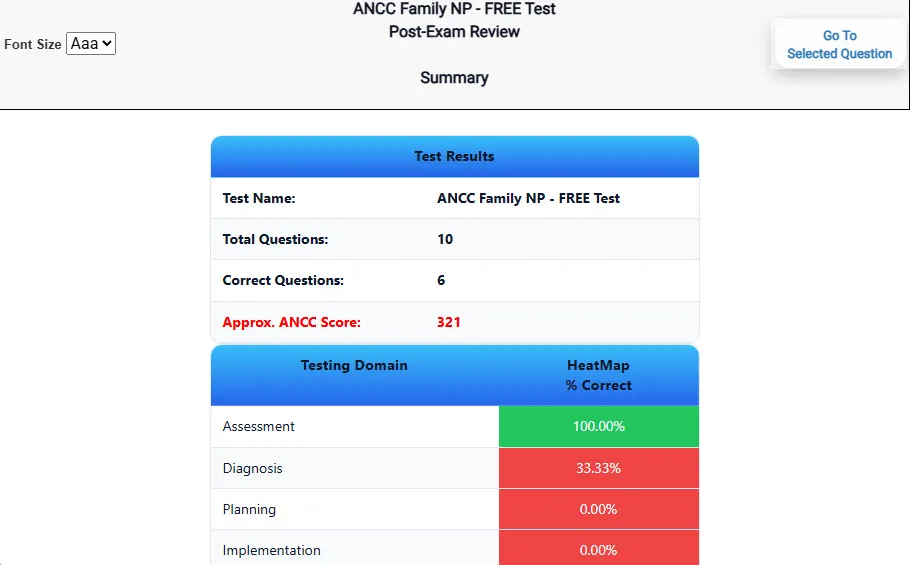
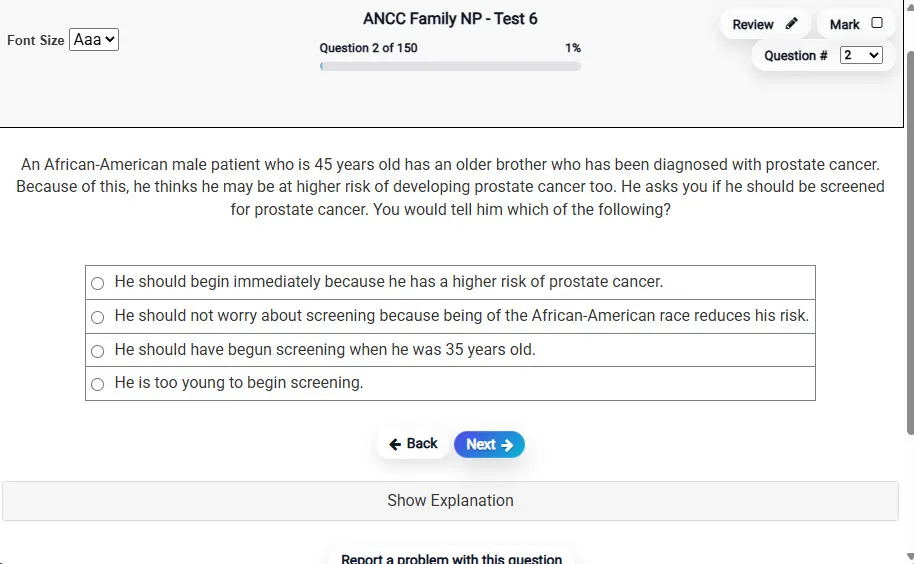
Answering a Question screen – Multiple-choice item view with navigation controls and progress tracker.
Answering a Question Multiple-choice item view with navigation controls and progress tracker.

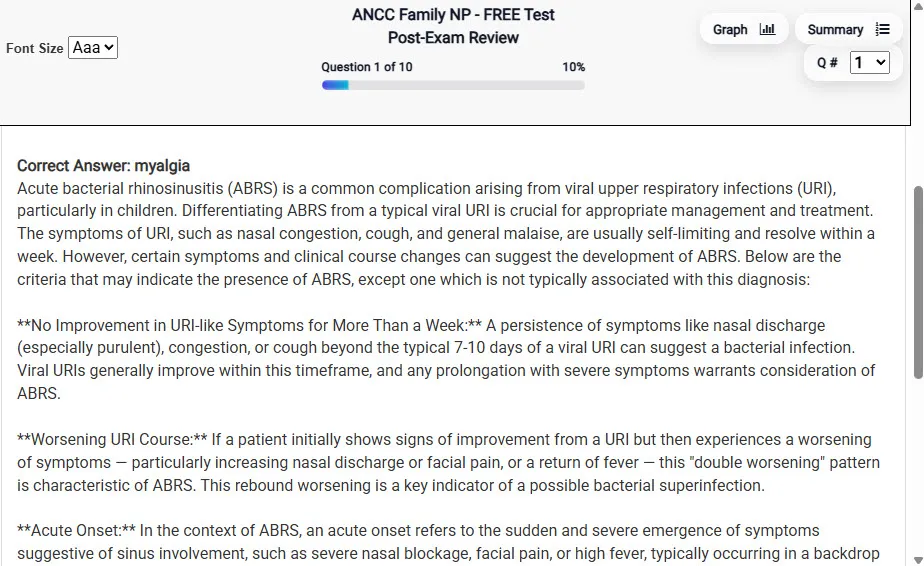
                           Detailed Explanation screen – 
                         Review mode showing chosen answer and rationale and references.
Detailed Explanation Review mode showing chosen answer and rationale and references.

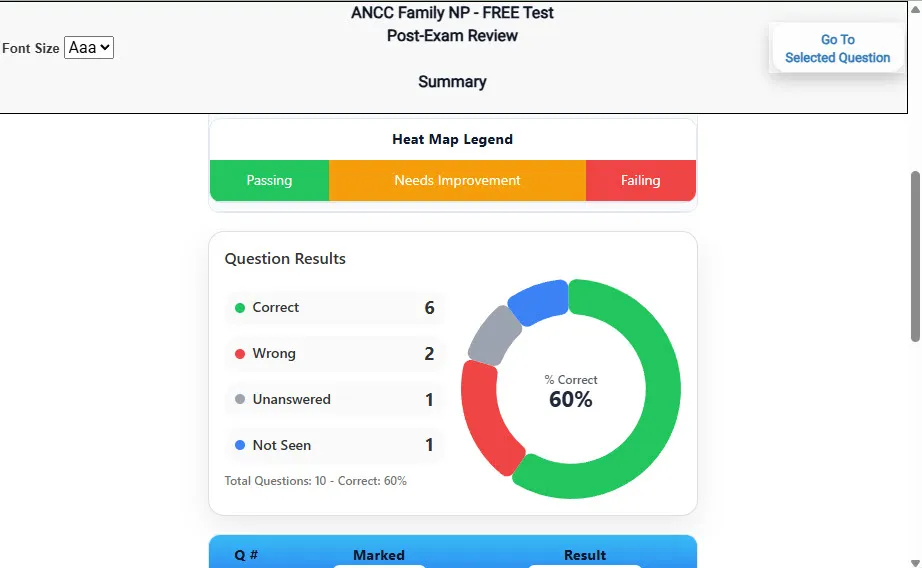
                           Review Summary 1 screen – 
                         Summary with counts for correct/wrong/unanswered and not seen items.
Review Summary 1 Summary with counts for correct/wrong/unanswered and not seen items.

                           Review Summary 2 screen – 
                         Advanced summary with category/domain breakdown and performance insights.
Review Summary 2 Advanced summary with category/domain breakdown and performance insights.

What Each Screen Shows

Answer Question Screen

  • Clean multiple-choice interface with progress bar.
  • Mark for review feature.
  • Matches real test pacing.

Detailed Explanation

  • Correct answer plus rationale.
  • Key concepts and guidelines highlighted.
  • Move between questions to fill knowledge gaps.

Review Summary 1

  • Overall results with total questions and scaled score.
  • Domain heatmap shows strengths and weaknesses.
  • Quick visual feedback on study priorities.

Review Summary 2

  • Chart of correct, wrong, unanswered, not seen.
  • Color-coded results for easy review.
  • Links back to missed items.

Top 10 Reasons to Use Exam Edge for your NYSTCE CST Multi-subject Teachers Of Students with Disabilities Exam Prep

  1. Focused on the NYSTCE CST Multi-subject Teachers Of Students with Disabilities Exam

    Our practice tests are built specifically for the NYSTCE CST Multi-subject: Teachers Of Students with Disabilities exam — every question mirrors the real topics, format, and difficulty so you're studying exactly what matters.

  2. Real Exam Simulation

    We match the per-question time limits and pressure of the actual NYSTCE exam, so test day feels familiar and stress-free.

  3. 20 Full Practice Tests & 2,440 Unique Questions

    You'll have more than enough material to master every NYSTCE CST Multi-subject: Teachers Of Students with Disabilities concept — no repeats, no fluff.

  4. Lower Cost Than a Retake

    Ordering 5 practice exams costs less than retaking the NYSTCE CST Multi-subject Teachers Of Students with Disabilities exam after a failure. One low fee could save you both time and money.

  5. Flexible Testing

    Need to step away mid-exam? Pick up right where you left off — with your remaining time intact.

  6. Instant Scoring & Feedback

    See your raw score and an estimated NYSTCE CST Multi-subject Teachers Of Students with Disabilities score immediately after finishing each practice test.

  7. Detailed Explanations for Every Question

    Review correct and incorrect answers with clear, step-by-step explanations so you truly understand each topic.

  8. Trusted & Accredited

    We're fully accredited by the Better Business Bureau and uphold the highest standards of trust and transparency.

  9. Web-Based & Always Available

    No software to install. Access your NYSTCE CST Multi-subject: Teachers Of Students with Disabilities practice exams 24/7 from any computer or mobile device.

  10. Expert Support When You Need It

    Need extra help? Our specialized tutors are highly qualified and ready to support your NYSTCE exam prep.


Pass the NYSTCE CST Multi-subject Teachers Of Students with Disabilities Exam with Realistic Practice Tests from Exam Edge

Preparing for your upcoming NYSTCE CST Multi-subject Teachers Of Students with Disabilities () Certification Exam can feel overwhelming — but the right practice makes all the difference. Exam Edge gives you the tools, structure, and confidence to pass on your first try. Our online practice exams are built to match the real NYSTCE CST Multi-subject: Teachers Of Students with Disabilities exam in content, format, and difficulty.

  • 📝 20 NYSTCE CST Multi-subject Teachers Of Students with Disabilities Practice Tests: Access 20 full-length exams with 122 questions each, covering every major NYSTCE CST Multi-subject Teachers Of Students with Disabilities topic in depth.
  • Instant Online Access: Start practicing right away — no software, no waiting.
  • 🧠 Step-by-Step Explanations: Understand the reasoning behind every correct answer so you can master NYSTCE CST Multi-subject: Teachers Of Students with Disabilities exam concepts.
  • 🔄 Retake Each Exam Up to 4 Times: Build knowledge through repetition and track your improvement over time.
  • 🌐 Web-Based & Available 24/7: Study anywhere, anytime, on any device.
  • 🧘 Boost Your Test-Day Confidence: Familiarity with the NYSTCE format reduces anxiety and helps you perform under pressure.

These NYSTCE CST Multi-subject Teachers Of Students with Disabilities practice exams are designed to simulate the real testing experience by matching question types, timing, and difficulty level. This approach helps you get comfortable not just with the exam content, but also with the testing environment, so you walk into your exam day focused and confident.

Exam Edge NYSTCE Reviews


Didn't really reflect the questions that were on the test for the most part. Also, they totally got the format of the constructed response question wrong, which never changes. Overall OK if you have nothing else, but definitely not worth the price they charge in my opinion.

Randy , Queens, New York

Not a user friendly experience

Amelia , Rochester, New York

It was a good test run. Now I know what to expect and what I need to study.

Timothy , Eden, New York

The experience was very practical and I did well.

Trina , Silver Spring , MD

Very easy to navigate.

Collene , Silver Spring , MD

Exam Edge was terrific. Even better than I hoped. Just completing and reviewing the tests are a great learning experience. I can't wait to take the certification test. Tom S.

Thomas , Port Washington, NY


NYSTCE CST Multi-subject Teachers Of Students with Disabilities Aliases Test Name

Here is a list of alternative names used for this exam.

  • NYSTCE CST Multi-subject Teachers Of Students with Disabilities
  • NYSTCE CST Multi-subject Teachers Of Students with Disabilities test
  • NYSTCE CST Multi-subject Teachers Of Students with Disabilities Certification Test
  • NYSTCE CST Multi-subject: Teachers Of Students with Disabilities test
  • NYSTCE
  • NYSTCE
  • test
  • NYSTCE CST Multi-subject Teachers Of Students with Disabilities ()
  • CST Multi-subject Teachers Of Students with Disabilities certification