This is the content of the pop-over!

NYSTCE CST Multi-Subject: Grade 7-Grade 12 (241/242/245) Practice Tests & Test Prep by Exam Edge


NYSTCE CST Multi-Subject Secondary Teachers (Grade 7-Grade 12)   product image
(4.6)
Based on 20 Reviews

  • Real Exam Simulation: Timed questions and matching content build comfort for your NYSTCE CST Multi-Subject: Grade 7-Grade 12 test day.
  • Instant, 24/7 Access: Web-based NYSTCE CST Multi-Subject Secondary Teachers (Grade 7-Grade 12) practice exams with no software needed.
  • Clear Explanations: Step-by-step answers and explanations for your NYSTCE exam to strengthen understanding.
  • Boosted Confidence: Reduces anxiety and improves test-taking skills to ace your NYSTCE CST Multi-Subject Secondary Teachers (Grade 7-Grade 12) (241/242/245).

Featured on

NYSTCE CST Multi-Subject Secondary Teachers (Grade 7-Grade 12) Online Practice Test Bundles

BEST VALUE
20 practice tests

$174.00

$799.00

SAVE $625

Only $8.70 per test!

  • 100% Pass Guarantee
  • 20 online practice tests
  • 120 questions + 2 essays per test
  • Bonus: 100 Flash Cards + Study Guide
  • Instant access
  • Detailed Explanations
  • Practice tests never expire
  • Timed, untimed, or study guide mode
MOST POPULAR
10 practice tests

$99.50

$399.50

SAVE $300

Only $9.95 per test!

  • 10 online practice tests
  • 120 questions + 2 essays per test
  • Bonus: 100 Flash Cards + Study Guide
  • Instant access
  • Detailed Explanations
  • Practice tests never expire
  • Timed, untimed, or study guide mode
5 practice tests

$69.75

$199.75

SAVE $130

Only $13.95 per test!

  • 5 online practice tests
  • 120 questions + 2 essays per test
  • Bonus: 100 Flash Cards
  • Instant access
  • Detailed Explanations
  • Practice tests never expire
  • Timed, untimed, or study guide mode
1 practice test

$39.95

  • 1 online practice test
  • 120 questions + 2 essays per test
  • Instant access
  • Detailed Explanations
  • Practice tests never expire
  • Timed, untimed, or study guide mode
Quick Select
Tap to choose a bundle

** All Prices are in US Dollars (USD) **


NYSTCE CST Multi-Subject: Grade 7-Grade 12 (241/242/245) Resources

Jump to the section you need most.

Understanding the exact breakdown of the NYSTCE CST Multi-Subject Secondary Teachers (Grade 7-Grade 12) test will help you know what to expect and how to most effectively prepare. The NYSTCE CST Multi-Subject Secondary Teachers (Grade 7-Grade 12) has 120 multiple-choice questions and 2 essay questions. The exam will be broken down into the sections below:

NYSTCE CST Multi-Subject Secondary Teachers (Grade 7-Grade 12) Exam Blueprint
Domain Name % Number of
Questions
Literacy and English Language Arts  
     Knowledge of Literacy & Language Arts 30% 12
     Instruction in Foundational Literacy Skills 30% 12
     Instruction in English Language Arts 10% 4
     Analysis - Synthesis Application (Constructed-Response) 20% 8
Mathematics  
     Number and Quantity 10% 4
     Algebra and Functions 40% 17
     Geometry and Statistics 30% 12
     Analysis - Synthesis Application (Constructed-Response) 20% 8
Arts and Sciences  
     Science and Technology 40% 17
     Social Studies 40% 17
     Fine Arts - Health and Fitness - Family and Consumer Science Career Development 20% 8

NYSTCE CST Multi-Subject Secondary Teachers (Grade 7-Grade 12) Study Tips by Domain

  • Prioritize close reading of complex texts by citing the strongest, most relevant evidence for claims; red flag: answers that summarize without quoting/paraphrasing precise textual support.
  • Analyze how an author’s choices (structure, tone, diction, figurative language) shape meaning and impact; common trap: identifying a device without explaining its effect on the passage’s central idea or purpose.
  • Compare multiple texts or media on the same topic by tracking claim–reason–evidence and point of view; priority rule: explicitly address agreements, contradictions, and what each source adds or omits.
  • Evaluate arguments for validity and sufficiency of evidence (data, examples, expert testimony) and identify fallacies; red flag: treating emotional appeal or anecdote as adequate proof of a broad claim.
  • Apply vocabulary and language knowledge using context clues, morphology (roots/affixes), and nuance among synonyms; common trap: choosing a definition that fits the word in isolation but not the sentence’s tone or logic.
  • Use standard English conventions and effective composition (coherence, transitions, sentence variety) to revise for clarity; contraindication: edits that “correct” grammar but introduce pronoun-antecedent shifts or change intended meaning.
  • Differentiate reading stances and purposes: close reading for evidence vs skimming for gist; red flag: choosing a strategy that doesn’t match the stated task (e.g., analyzing tone but only summarizing plot).
  • Analyze how author’s craft builds meaning (diction, imagery, syntax, figurative language, and tone); common trap: naming a device without explaining its effect on meaning or theme.
  • Evaluate arguments by separating claims, reasons, evidence, and assumptions; priority rule: evidence must be relevant and sufficient—watch for anecdotes presented as proof.
  • Use academic vocabulary and morphology (roots, affixes) to infer meaning in context; red flag: selecting a definition that fits the word alone but not the sentence context.
  • Apply grammar and usage to improve clarity (agreement, pronoun reference, modifiers, parallelism, and punctuation); common trap: “fixing” style but introducing new errors or changing meaning.
  • Compare genres and text structures (narrative, expository, argumentative; chronological, problem–solution, cause–effect); red flag: confusing topic with central idea or mixing theme with summary.
  • Plan explicit, systematic phonics and word-study instruction (e.g., scope-and-sequence with cumulative review) rather than “incidental” decoding; red flag: students guess from pictures/context instead of mapping sounds to letters.
  • Teach phonological awareness in a clear progression (word → syllable → onset-rime → phoneme) and verify with quick oral checks; common trap: spending too long on rhyming when phoneme blending/segmenting is the bottleneck.
  • Use diagnostic screening plus progress monitoring (CBM/fluency probes) to regroup instruction promptly; priority rule: if growth stalls for 2–3 data points, intensify intervention rather than waiting for end-of-unit tests.
  • Build fluency (accuracy, rate, prosody) through repeated reading with feedback and appropriate-level texts; red flag: pushing speed targets when accuracy is low, which typically worsens comprehension.
  • Explicitly teach vocabulary and morphology (prefixes, roots, suffixes) to support multisyllabic decoding and meaning; common trap: treating vocabulary as only definitions instead of word parts and usage in context.
  • Address spelling/encoding as reciprocal to decoding using the same phonics patterns; contraindication: relying on weekly memorization lists that aren’t connected to taught sound-spelling correspondences.
  • Plan instruction around NYS learning standards with clear daily objectives and aligned checks for understanding; red flag: activities that are engaging but don’t measure the stated reading/writing skill.
  • Teach close reading using text-dependent questions that progress from literal to inferential to analytical; common trap: asking opinion questions before students cite evidence.
  • Use explicit academic vocabulary and language structures (e.g., sentence frames, morphology) within authentic texts; priority rule: don’t isolate word lists without repeated use in speaking/writing.
  • Differentiate for multilingual learners and students with IEPs using scaffolds (chunking, guided notes, alternative output) while keeping the same grade-level text goal; red flag: lowering the cognitive demand instead of adjusting supports.
  • Teach writing as a process (planning–drafting–revising–editing) with genre-specific criteria and models; common trap: grading only the final draft without feedback tied to a rubric.
  • Assess formatively and summatively with rubrics anchored to claims, evidence, organization, and conventions; threshold cue: if students can’t explain the rubric in their own words, scoring consistency and revisions will suffer.
  • Start by restating the prompt as a defensible claim and answer every subpart; red flag: a correct explanation that never actually addresses the question asked.
  • Show your reasoning with the minimum necessary math/logic and label steps (e.g., define variables, state assumptions); common trap: skipping justification and giving only an answer.
  • Use evidence from the given scenario/data/text and cite it explicitly (e.g., “from the table”, “given that”); red flag: introducing outside facts or examples not supported by the prompt.
  • When asked to analyze or compare, make a clear criterion and conclusion (similarities/differences, cause/effect, strengths/limits); common trap: listing facts without synthesizing into a judgment.
  • If interpretation is required, check units, scale, and reasonableness (estimate or back-check); priority rule: include a quick verification step to catch arithmetic or logic errors.
  • Write in a grader-friendly format with complete sentences and correct terminology; red flag: ambiguous pronouns like “it” or unlabeled quantities that make the response unscorable.
  • Know the major 7–12 content strands (Number & Quantity, Algebra/Functions, Geometry, Statistics/Probability) and how they connect; red flag: treating strands as isolated instead of using multiple representations (symbolic, graphical, numerical, verbal).
  • Apply function thinking (domain/range, composition, inverses, transformations) across contexts; common trap: assuming “inverse” exists without checking one-to-one or restricting the domain.
  • Reason with proof and justification (definitions, counterexamples, conditional statements) rather than just computation; priority rule: one valid counterexample disproves a universal claim.
  • Model real situations with equations/inequalities and interpret parameters and units; red flag: giving a mathematically correct answer that ignores units, constraints, or reasonable magnitude.
  • Use statistics to compare groups and interpret association vs. causation; common trap: concluding causation from correlation or from non-random samples.
  • Plan instruction and assessment aligned to NYS learning goals with attention to misconceptions (e.g., slope vs. y-intercept, area vs. perimeter); red flag: reteaching procedures without diagnosing the underlying misconception.
  • Work fluently with rational numbers in all forms (fractions, decimals, percents) and apply order of operations; red flag: sign errors when distributing a negative or subtracting a quantity in parentheses.
  • Use exponent rules correctly, including negative and zero exponents and scientific notation; common trap: treating (a+b)2 as a2+b2.
  • Reason about absolute value as distance on the number line and interpret inequalities accordingly; priority rule: when multiplying/dividing an inequality by a negative, reverse the inequality sign.
  • Perform operations with radicals and rational exponents (simplify, add/subtract like radicals, rationalize when needed); red flag: adding unlike radicals (e.g., √2 + √8) without simplifying first.
  • Model and solve ratio/proportion and rate problems with unit analysis; common trap: mismatched units (e.g., minutes vs hours) that invalidate a proportion.
  • Interpret and compare quantities using appropriate precision and rounding; threshold cue: rounding mid-calculation can change the final result—round at the end unless directions specify otherwise.
  • Translate among representations of functions (equation, table, graph, verbal) and state domain/range; red flag: assuming domain is all real numbers when a denominator, even root, or context restricts it.
  • Solve and analyze equations/inequalities (linear, quadratic, rational, radical) including extraneous-solution checks; common trap: forgetting to test solutions after squaring or clearing denominators.
  • Work fluently with function notation, composition, and inverses; priority rule: an inverse exists only when the function is one-to-one on the stated domain (use a horizontal line test or domain restriction).
  • Interpret parameters in families of functions (e.g., vertex form, exponential growth/decay, absolute value) as transformations; red flag: confusing the sign/direction of horizontal shifts (e.g., f(x−h) shifts right by h).
  • Model with algebraic functions and interpret key features (intercepts, zeros, maxima/minima, rate of change) in context; common trap: giving a negative value for a quantity that context requires to be nonnegative.
  • Simplify and manipulate expressions using exponent rules, factoring, and algebraic identities; red flag: canceling terms across addition (you may only cancel common factors, not addends).
  • Know core geometry facts cold (triangle congruence, similarity, special right triangles, circle theorems) and justify with a named theorem—red flag if you rely on a diagram that is not guaranteed to be drawn to scale.
  • Coordinate geometry is fair game: use distance, midpoint, slope, and point-slope/standard form to prove parallel/perpendicular lines—common trap is mixing up slope rules (perpendicular slopes are negative reciprocals, not just negatives).
  • Area/volume/surface area problems often hinge on unit consistency—priority rule: convert units before squaring/cubing (e.g., inches to feet) to avoid factor-of-12 or factor-of-144 errors.
  • For transformations (translations, rotations, reflections, dilations), track what is preserved—red flag if a dilation changes angle measures or if you claim congruence when scale factor ≠ 1.
  • In statistics, distinguish between describing data and making inferences—common trap is concluding causation from correlation or from an observational study rather than a randomized experiment.
  • Interpret and choose appropriate measures (mean/median, IQR/standard deviation) based on distribution shape—threshold cue: use median and IQR when outliers/skew are present, not the mean and standard deviation.
  • Answer both parts of the prompt and use a clear claim->evidence->reasoning structure; red flag: writing a general essay that never explicitly addresses the task verbs (e.g., “analyze,” “synthesize,” “apply”).
  • Ground your response in the provided stimulus (data, passage, scenario) and cite specific details; common trap: relying on outside knowledge without tying it back to what is given.
  • When synthesizing, connect at least two sources/ideas with an explicit relationship (cause/effect, comparison, trend, implication); red flag: summarizing each source separately with no integrated conclusion.
  • Show your work or reasoning steps for any quantitative or logical claim; common trap: stating an answer with no justification, which can lose credit even if the final answer is right.
  • Apply concepts to the scenario with an actionable, context-appropriate recommendation and a brief rationale; red flag: proposing a strategy that ignores constraints (grade level, time, resources, safety, policy) implied in the prompt.
  • Prioritize clarity and completeness over length—define key terms as you use them and keep to the prompt; common trap: adding extra tangents that introduce contradictions or factual errors.
  • Align Arts and Sciences instruction to New York State Learning Standards and grade-band progressions—red flag: lessons that are “interesting” but lack a clear, assessable standard-based objective.
  • Use disciplinary literacy routines (e.g., sourcing, close reading of primary/secondary texts, data interpretation) across subjects—common trap: treating reading/writing skills as separate from science/social studies/art content.
  • Plan for culturally responsive, historically accurate representation in texts, examples, and artifacts—priority rule: avoid tokenism by pairing diverse voices with explicit context and analysis expectations.
  • Design assessments that match the claim (knowledge vs. reasoning vs. performance) and include clear criteria—red flag: “project” grades without a rubric tied to content standards and skills.
  • Integrate inquiry and evidence (claim-evidence-reasoning; document-based questions; critique and revision in arts) with explicit modeling—common trap: assuming students know how to justify conclusions without sentence frames or exemplars.
  • Differentiate for Multilingual Learners and students with IEPs using accessible materials and language supports while keeping the cognitive demand—contraindication: reducing rigor by simplifying the task instead of scaffolding the language/process.
  • Differentiate core features of experimental vs. observational studies—red flag: claiming causation from correlation without controlling confounders or using random assignment.
  • Use SI units, significant figures, and dimensional analysis correctly—common trap: mixing grams and kilograms or reporting more precision than the measurement device allows.
  • Apply Newton’s laws, energy, and momentum to real situations—priority rule: always start with a free-body diagram before choosing equations.
  • Analyze chemical reactions, bonding, and conservation of mass—red flag: balancing equations by changing subscripts instead of coefficients.
  • Connect cell processes, genetics, evolution, and ecology to evidence—common trap: confusing mitosis with meiosis or describing evolution as individuals “adapting” within a lifetime.
  • Interpret Earth/space systems (plate tectonics, weather/climate, seasons) and evaluate technology impacts—red flag: attributing seasons to Earth’s distance from the Sun instead of axial tilt.
  • Use a tight chronology for U.S. and global history (e.g., Reconstruction → industrialization → Progressive Era) and flag anachronisms as a red flag when an answer links effects to a cause that occurs later.
  • For civics, distinguish powers: Congress makes laws, the President executes, courts interpret—common trap is confusing judicial review with executive veto or impeachment with criminal conviction.
  • In economics, separate fiscal policy (taxing/spending) from monetary policy (interest rates/money supply via the Fed)—red flag if a policy tool is assigned to the wrong institution.
  • In geography, interpret maps/graphs using scale, projection, and latitude/longitude; a frequent trap is treating the Mercator projection as area-accurate for comparing regions.
  • For historical thinking, prioritize primary-source sourcing (author, audience, purpose, context) before using it as evidence—red flag when a document is quoted without accounting for bias or time/place.
  • When evaluating social science data, watch for correlation vs. causation and sampling issues; a common trap is generalizing from a small or nonrandom sample to an entire population.
  • Fine Arts: Apply NYS learning standards to critique or create a work using correct vocabulary (e.g., elements/principles, genre, style)—red flag: describing “I like it” without citing specific artistic evidence.
  • Health and Fitness: Use risk-reduction priorities (abstinence/contraception, substance-use prevention, injury prevention, mental health supports) and follow mandated reporting—common trap: offering confidentiality to a minor when self-harm/abuse is disclosed.
  • Physical Education: Design developmentally appropriate instruction that addresses safety, skill progression, and inclusive participation—priority rule: stop activity for heat illness signs (confusion, cessation of sweating) and follow emergency action protocols.
  • Family and Consumer Science: Interpret nutrition labels and dietary guidelines to plan balanced meals while accounting for allergies and cultural needs—contraindication: ignoring anaphylaxis risks or cross-contamination in food labs.
  • Career Development: Connect career clusters, employability skills, and postsecondary pathways using measurable student goals—common trap: giving advice that violates equity/anti-bias expectations (e.g., steering students by gender stereotypes).
  • Program planning and classroom management: Choose assessments and learning experiences that are safe, ethical, and compliant (equipment checks, lab safety, CPR/AED awareness where applicable)—red flag: assessing physical performance without accommodations for documented needs.


Built to Fit Into Your Busy Life

Everything you need to prepare with confidence—without wasting a minute.

Three Study Modes

Timed, No Time Limit, or Explanation mode.

Actionable Analytics

Heatmaps and scaled scores highlight weak areas.

High-Yield Rationales

Concise explanations emphasize key concepts.

Realistic Interface

Matches the feel of the actual exam environment.

Accessible by Design

Clean layout reduces cognitive load.

Anytime, Anywhere

Web-based access 24/7 on any device.
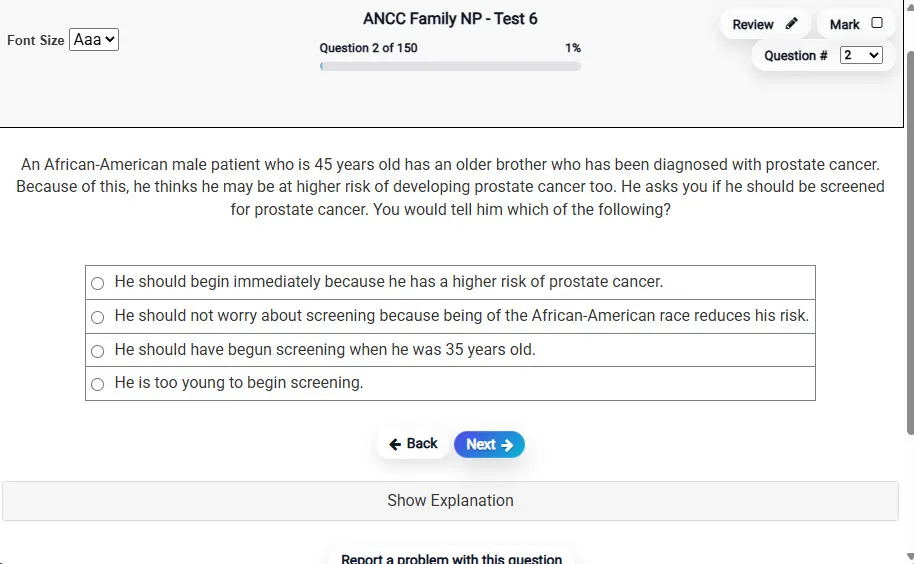
Answering a Question screen – Multiple-choice item view with navigation controls and progress tracker.
Answering a Question Multiple-choice item view with navigation controls and progress tracker.

                           Detailed Explanation screen – 
                         Review mode showing chosen answer and rationale and references.
Detailed Explanation Review mode showing chosen answer and rationale and references.

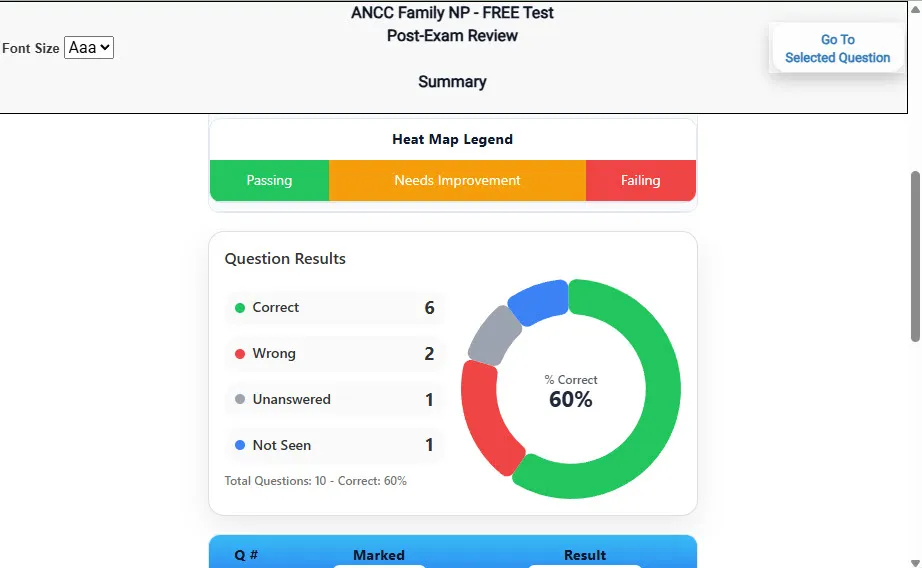
                           Review Summary 1 screen – 
                         Summary with counts for correct/wrong/unanswered and not seen items.
Review Summary 1 Summary with counts for correct/wrong/unanswered and not seen items.

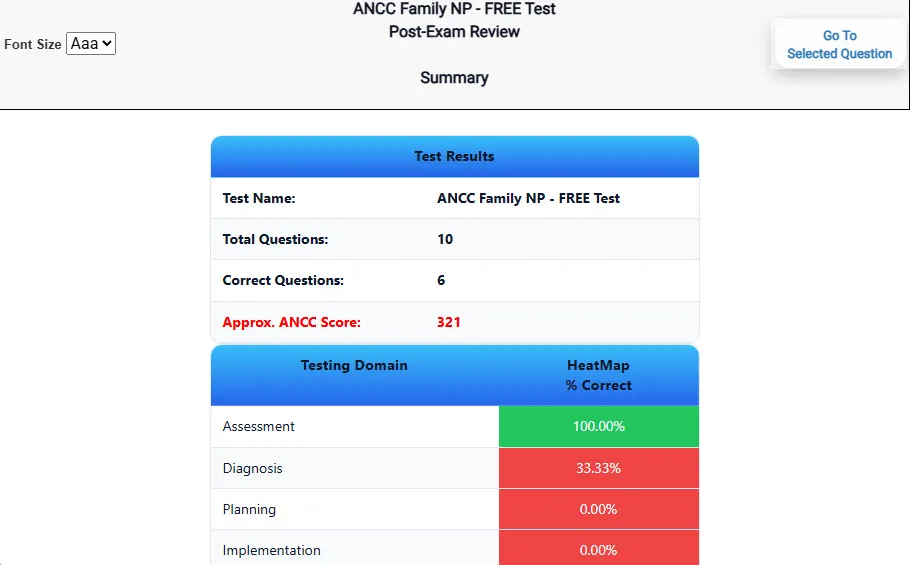
                           Review Summary 2 screen – 
                         Advanced summary with category/domain breakdown and performance insights.
Review Summary 2 Advanced summary with category/domain breakdown and performance insights.

What Each Screen Shows

Answer Question Screen

  • Clean multiple-choice interface with progress bar.
  • Mark for review feature.
  • Matches real test pacing.

Detailed Explanation

  • Correct answer plus rationale.
  • Key concepts and guidelines highlighted.
  • Move between questions to fill knowledge gaps.

Review Summary 1

  • Overall results with total questions and scaled score.
  • Domain heatmap shows strengths and weaknesses.
  • Quick visual feedback on study priorities.

Review Summary 2

  • Chart of correct, wrong, unanswered, not seen.
  • Color-coded results for easy review.
  • Links back to missed items.

Top 10 Reasons to Use Exam Edge for your NYSTCE CST Multi-Subject Secondary Teachers (Grade 7-Grade 12) Exam Prep

  1. Focused on the NYSTCE CST Multi-Subject Secondary Teachers (Grade 7-Grade 12) Exam

    Our practice tests are built specifically for the NYSTCE CST Multi-Subject: Grade 7-Grade 12 exam — every question mirrors the real topics, format, and difficulty so you're studying exactly what matters.

  2. Real Exam Simulation

    We match the per-question time limits and pressure of the actual NYSTCE exam, so test day feels familiar and stress-free.

  3. 20 Full Practice Tests & 2,440 Unique Questions

    You'll have more than enough material to master every NYSTCE CST Multi-Subject: Grade 7-Grade 12 concept — no repeats, no fluff.

  4. Lower Cost Than a Retake

    Ordering 5 practice exams costs less than retaking the NYSTCE CST Multi-Subject Secondary Teachers (Grade 7-Grade 12) exam after a failure. One low fee could save you both time and money.

  5. Flexible Testing

    Need to step away mid-exam? Pick up right where you left off — with your remaining time intact.

  6. Instant Scoring & Feedback

    See your raw score and an estimated NYSTCE CST Multi-Subject Secondary Teachers (Grade 7-Grade 12) score immediately after finishing each practice test.

  7. Detailed Explanations for Every Question

    Review correct and incorrect answers with clear, step-by-step explanations so you truly understand each topic.

  8. Trusted & Accredited

    We're fully accredited by the Better Business Bureau and uphold the highest standards of trust and transparency.

  9. Web-Based & Always Available

    No software to install. Access your NYSTCE CST Multi-Subject: Grade 7-Grade 12 practice exams 24/7 from any computer or mobile device.

  10. Expert Support When You Need It

    Need extra help? Our specialized tutors are highly qualified and ready to support your NYSTCE exam prep.


Pass the NYSTCE CST Multi-Subject Secondary Teachers (Grade 7-Grade 12) Exam with Realistic Practice Tests from Exam Edge

Preparing for your upcoming NYSTCE CST Multi-Subject Secondary Teachers (Grade 7-Grade 12) (241/242/245) Certification Exam can feel overwhelming — but the right practice makes all the difference. Exam Edge gives you the tools, structure, and confidence to pass on your first try. Our online practice exams are built to match the real NYSTCE CST Multi-Subject: Grade 7-Grade 12 exam in content, format, and difficulty.

  • 📝 20 NYSTCE CST Multi-Subject Secondary Teachers (Grade 7-Grade 12) Practice Tests: Access 20 full-length exams with 122 questions each, covering every major NYSTCE CST Multi-Subject Secondary Teachers (Grade 7-Grade 12) topic in depth.
  • Instant Online Access: Start practicing right away — no software, no waiting.
  • 🧠 Step-by-Step Explanations: Understand the reasoning behind every correct answer so you can master NYSTCE CST Multi-Subject: Grade 7-Grade 12 exam concepts.
  • 🔄 Retake Each Exam Up to 4 Times: Build knowledge through repetition and track your improvement over time.
  • 🌐 Web-Based & Available 24/7: Study anywhere, anytime, on any device.
  • 🧘 Boost Your Test-Day Confidence: Familiarity with the NYSTCE format reduces anxiety and helps you perform under pressure.

These NYSTCE CST Multi-Subject Secondary Teachers (Grade 7-Grade 12) practice exams are designed to simulate the real testing experience by matching question types, timing, and difficulty level. This approach helps you get comfortable not just with the exam content, but also with the testing environment, so you walk into your exam day focused and confident.

Exam Edge NYSTCE Reviews


Thank you! The best investment ever! I used Exam Edge to successfully pass the CST Multi-subject parts 1 and 2!  

Beverley , Queens, New York

Not a user friendly experience

Amelia , Rochester, New York

Didn't really reflect the questions that were on the test for the most part. Also, they totally got the format of the constructed response question wrong, which never changes. Overall OK if you have nothing else, but definitely not worth the price they charge in my opinion.

Randy , Queens, New York

It was a good test run. Now I know what to expect and what I need to study.

Timothy , Eden, New York

The experience was very practical and I did well.

Trina , Silver Spring , MD

Very easy to navigate.

Collene , Silver Spring , MD


NYSTCE CST Multi-Subject Secondary Teachers (Grade 7-Grade 12) Aliases Test Name

Here is a list of alternative names used for this exam.

  • NYSTCE CST Multi-Subject Secondary Teachers (Grade 7-Grade 12)
  • NYSTCE CST Multi-Subject Secondary Teachers (Grade 7-Grade 12) test
  • NYSTCE CST Multi-Subject Secondary Teachers (Grade 7-Grade 12) Certification Test
  • NYSTCE CST Multi-Subject: Grade 7-Grade 12 test
  • NYSTCE
  • NYSTCE 241/242/245
  • 241/242/245 test
  • NYSTCE CST Multi-Subject Secondary Teachers (Grade 7-Grade 12) (241/242/245)
  • CST Multi-Subject Secondary Teachers (Grade 7-Grade 12) certification