This is the content of the pop-over!

CST Multi-subject: Teachers Of Middle Childhood 5-9 (231/232/245) Practice Tests & Test Prep by Exam Edge


NYSTCE CST Multi-subject Teachers of Middle Childhood 5-9  product image
(4.8)
Based on 32 Reviews

  • Real Exam Simulation: Timed questions and matching content build comfort for your CST Multi-subject: Teachers Of Middle Childhood 5-9 test day.
  • Instant, 24/7 Access: Web-based NYSTCE CST Multi-subject Teachers of Middle Childhood 5-9 practice exams with no software needed.
  • Clear Explanations: Step-by-step answers and explanations for your NYSTCE exam to strengthen understanding.
  • Boosted Confidence: Reduces anxiety and improves test-taking skills to ace your NYSTCE CST Multi-subject Teachers of Middle Childhood 5-9 (331/232/245).

Featured on

NYSTCE CST Multi-subject Teachers of Middle Childhood 5-9 Online Practice Test Bundles

BEST VALUE
20 practice tests

$174.00

$799.00

SAVE $625

Only $8.70 per test!

  • 100% Pass Guarantee
  • 20 online practice tests
  • 120 questions + 2 essays per test
  • Bonus: 100 Flash Cards + Study Guide
  • Instant access
  • Detailed Explanations
  • Practice tests never expire
  • Timed, untimed, or study guide mode
MOST POPULAR
10 practice tests

$99.50

$399.50

SAVE $300

Only $9.95 per test!

  • 10 online practice tests
  • 120 questions + 2 essays per test
  • Bonus: 100 Flash Cards + Study Guide
  • Instant access
  • Detailed Explanations
  • Practice tests never expire
  • Timed, untimed, or study guide mode
5 practice tests

$69.75

$199.75

SAVE $130

Only $13.95 per test!

  • 5 online practice tests
  • 120 questions + 2 essays per test
  • Bonus: 100 Flash Cards
  • Instant access
  • Detailed Explanations
  • Practice tests never expire
  • Timed, untimed, or study guide mode
1 practice test

$39.95

  • 1 online practice test
  • 120 questions + 2 essays per test
  • Instant access
  • Detailed Explanations
  • Practice tests never expire
  • Timed, untimed, or study guide mode
Quick Select
Tap to choose a bundle

** All Prices are in US Dollars (USD) **


CST Multi-subject: Teachers Of Middle Childhood 5-9 (331/232/245) Resources

Jump to the section you need most.

Understanding the exact breakdown of the NYSTCE CST Multi-subject Teachers of Middle Childhood 5-9 test will help you know what to expect and how to most effectively prepare. The NYSTCE CST Multi-subject Teachers of Middle Childhood 5-9 has 120 multiple-choice questions and 2 essay questions. The exam will be broken down into the sections below:

NYSTCE CST Multi-subject Teachers of Middle Childhood 5-9 Exam Blueprint
Domain Name % Number of
Questions
Literacy and English Language Arts  
     Knowledge of Literacy Language Arts 30% 12
     Instruction in Foundational Literacy Skills 30% 12
     Instruction in English Language Arts 10% 4
     Analysis - Synthesis Application 30% 12
Mathematics  
     Number Systems 15% 6
     Algebra and Functions 35% 14
     Measurement - Geometry - Statistics Probability 30% 12
     Analysis - Synthesis Application 20% 8
Arts and Sciences  
     Science and Technology 40% 16
     Social Studies 40% 16
     Fine Arts - Health and Fitness - Family and Consumer Science Career Development 20% 8

NYSTCE CST Multi-subject Teachers of Middle Childhood 5-9 Study Tips by Domain

  • Align instruction to NY learning standards by unpacking the task demands (reading, writing, speaking/listening, language) and matching them to a measurable objective—red flag: activities listed without an explicit skill/standard and success criteria.
  • Use text-dependent questions that move from key details to craft/structure to integration of knowledge/ideas—common trap: asking opinion or personal-connection questions before students have cited evidence.
  • Teach academic vocabulary with morphology (roots/affixes), context clues, and multiple exposures—priority rule: explicitly teach Tier 2 words that transfer across texts/content rather than only domain-specific terms.
  • Plan writing instruction around purpose and audience (argument, informative/explanatory, narrative) with clear organization and evidence—red flag: grading “neatness” or length more than claim, reasoning, and text evidence.
  • Differentiate for multilingual learners and diverse readers using scaffolds (sentence frames, chunking, modeled think-alouds) while keeping grade-level text complexity central—common trap: lowering the text level instead of supporting access to complex text.
  • Use formative assessment to adjust instruction (exit tickets, quick writes, running notes on discussion) and reteach targeted skills—priority rule: reteach the specific breakdown (e.g., citing evidence, inference) rather than repeating the same lesson.
  • Differentiate the five components of reading (phonemic awareness, phonics, fluency, vocabulary, comprehension) and match each to an appropriate assessment and intervention—red flag: treating phonics and phonemic awareness as interchangeable.
  • Use knowledge of text complexity (quantitative, qualitative, and reader-task factors) to choose texts for grades 5–9; common trap: relying only on Lexile/word count while ignoring structure, knowledge demands, and meaning.
  • Apply vocabulary principles (Tier 1/2/3; morphology with roots/affixes) to support comprehension across content areas; priority rule: teach high-utility Tier 2 words explicitly and revisit them in multiple contexts.
  • Distinguish narrative vs. informational text structures and associated comprehension strategies (e.g., story elements vs. compare/contrast, cause/effect); red flag: asking generic “main idea” questions without teaching how structure signals meaning.
  • Know grammar and conventions in service of meaning (syntax, punctuation, sentence combining) and connect them to reading and writing tasks; common trap: isolating grammar drills that don’t transfer to editing or clarity.
  • Interpret common literacy assessment data (screeners, running records, fluency rates, comprehension measures) to identify the likely barrier; threshold cue: accuracy problems suggest decoding/word recognition, while adequate accuracy with poor comprehension points to language/vocabulary/background knowledge.
  • Teach print concepts and book handling explicitly (front/back, directionality, one-to-one word tracking); red flag: students can “read” from memory but can’t point to each word as it’s spoken.
  • Build phonological awareness from larger to smaller units (sentence → word → syllable → onset-rime → phoneme); common trap: jumping straight to phoneme manipulation before students can reliably blend and segment syllables.
  • Provide systematic, cumulative phonics with frequent decoding practice in connected text; priority rule: introduce one new pattern at a time and require mastery before adding another.
  • Teach high-frequency words using a mix of phonics mapping and limited irregular-word memorization; red flag: relying only on rote flashcards for words with regular spellings students could decode.
  • Develop fluency through repeated reading with modeling and feedback (accuracy first, then rate and prosody); threshold cue: if accuracy is below about 90–95%, reduce text difficulty rather than pushing speed.
  • Use quick progress monitoring (e.g., letter-sound fluency, nonsense-word decoding, oral reading fluency) to adjust groups and instruction; common trap: waiting for unit tests instead of using weekly data to reteach specific skill gaps.
  • Plan reading and writing lessons with explicit, measurable objectives aligned to the text’s complexity and purpose; red flag: activities (e.g., projects) that aren’t tied to a stated standard/skill.
  • Use text-dependent questions that move from literal understanding to analysis of author’s craft and evidence-based claims; common trap: asking opinion-only prompts that students can answer without citing the text.
  • Teach academic vocabulary and language structures in context (morphology, syntax, figurative language) and require use in speaking/writing; priority rule: assess vocabulary through application, not just matching definitions.
  • Provide structured writing instruction (planning, drafting, revising, editing) with genre-specific criteria and models; red flag: grading primarily on mechanics when the task is argument/explanatory development and evidence.
  • Integrate speaking and listening routines (discussion norms, accountable talk, presentations) and evaluate with clear rubrics; common trap: counting participation without checking accuracy, reasoning, and evidence.
  • Differentiate ELA instruction with scaffolds (chunked texts, guided notes, sentence frames, strategic grouping) while maintaining grade-level expectations; contraindication: lowering the text/task rigor instead of supporting access.
  • Use full problem-solving cycles: interpret the context, choose a strategy, execute accurately, then verify reasonableness; red flag: stopping after getting an answer without checking units, magnitude, or constraints.
  • Translate among representations (verbal descriptions, tables, graphs, equations) and state what each feature means in context; common trap: treating correlation on a graph as causation or misreading the scale/axes.
  • Justify conclusions with evidence and clear reasoning (e.g., why a method works, not just that it works); NYSTCE-style pitfall: giving procedures without explaining the underlying logic or assumptions.
  • Identify relevant information and discard distractors before calculating; priority rule: write down given values, what is asked, and any constraints to avoid using extra numbers that do not apply.
  • Compare and evaluate multiple solution methods for efficiency and appropriateness (estimation, algebraic, numeric, graphical); red flag: using an advanced technique when a simpler method better matches the task and reduces error.
  • Analyze errors and misconceptions from student work and propose targeted corrections; common trap: correcting the final answer without addressing the specific faulty step (e.g., sign error, incorrect operation order, or incorrect generalization).
  • Prioritize number sense and proportional reasoning (fractions, decimals, percents, ratios) because NYSTCE items often test whether you can justify equivalence—red flag: treating percent change as the same as percent of.
  • Translate between representations (verbal, table, graph, equation) for functions and relationships; common trap: confusing the slope with the y-intercept when reading a graph quickly.
  • Use algebraic reasoning to solve multi-step equations/inequalities and interpret solutions in context; priority rule: always check for extraneous solutions created by squaring or clearing denominators.
  • Apply geometry and measurement accurately with units and conversions; red flag: mixing area and perimeter (or volume and surface area) when a question switches contexts mid-stem.
  • Interpret statistical displays (center, spread, variability) and basic probability; common trap: assuming correlation implies causation or ignoring outliers when choosing mean vs. median.
  • Plan instruction with clear learning targets, mathematical discourse, and error analysis; priority cue: require students to explain “why” with a model or property, not just compute an answer.
  • Fluently convert among forms (fractions, decimals, percents, ratios) and check reasonableness—red flag: moving the decimal the wrong direction when converting a percent (e.g., 0.4 vs 40%).
  • Apply integer and rational number operations with correct sign rules and order of operations—common trap: treating subtraction as commutative or forgetting that a negative times a negative is positive.
  • Use properties of operations (commutative, associative, distributive, identity, inverse) to simplify and justify steps—priority rule: only distribute over addition/subtraction, not over multiplication.
  • Work with place value and exponents (including powers of 10 and scientific notation) to compare magnitudes—red flag: confusing 10-3 with “negative” numbers rather than “small” numbers.
  • Compute and interpret factors, multiples, primes, GCF, and LCM in context—common trap: using GCF when the problem asks for “least number that fits all cycles” (LCM).
  • Classify numbers (natural, whole, integers, rational, irrational, real) and locate them on a number line—red flag: assuming a non-terminating decimal is irrational (repeating decimals are rational).
  • Translate between representations (verbal, table, graph, equation) and check reasonableness; red flag: confusing slope (rate) with y-intercept (starting value) in linear contexts.
  • Identify and use function notation and domain/range appropriately; common trap: including extraneous solutions after algebraic manipulation (e.g., squaring or clearing denominators) without verification.
  • Compare linear vs. nonlinear patterns and justify with constant first differences (linear) or constant ratios/second differences (exponential/quadratic); priority rule: use multiple points to confirm a pattern, not a single interval.
  • Solve and interpret systems of equations/inequalities in context (intersection as solution set); red flag: writing the system correctly but misreading the solution due to swapped axes or units.
  • Work fluently with expressions (factoring, distributing, combining like terms) to create equivalent forms; common trap: incorrect factoring of trinomials or sign errors when factoring out a negative.
  • Model with and analyze key functions (linear, quadratic, exponential) including transformations; contraindication: applying linear growth assumptions to exponential situations (or vice versa) when the context indicates percent change.
  • Convert and compare measurements within and across systems (customary/metric) using ratios and unit analysis; red flag: adding or subtracting quantities with mismatched units without converting first.
  • Apply geometric formulas for perimeter, area, surface area, and volume and justify them conceptually (e.g., decomposing shapes); common trap: confusing area vs. perimeter or using linear units for area/volume.
  • Use properties of angles, triangles, and parallel lines (including similarity and congruence criteria) to solve multi-step problems; priority rule: verify whether figures are similar before scaling lengths or areas.
  • Interpret and construct graphs (dot plots, histograms, box plots, scatterplots) and choose appropriate measures of center and spread; red flag: using the mean with strong outliers when the median and IQR are more defensible.
  • Compute and interpret probability (theoretical/experimental), including compound events with organized counting; common trap: treating dependent events as independent and multiplying probabilities without checking replacement/conditioning.
  • Differentiate correlation from causation and interpret variability and sampling; red flag: drawing population conclusions from small, biased samples or misreading a trend line as proof of cause.
  • Translate a real-world situation into a mathematical model (equations, inequalities, tables, or graphs) and check reasonableness; red flag: accepting an answer with impossible units or a value outside the stated constraints.
  • Analyze patterns and relationships to form and test conjectures using examples and counterexamples; common trap: assuming a rule is true because it works for a few cases.
  • Synthesize information from multiple representations (graph, table, verbal description, symbolic form) and ensure they match; priority rule: any mismatch means at least one representation is misread or mis-scaled.
  • Select and justify an efficient strategy (e.g., estimation, algebraic manipulation, logical reasoning) rather than brute-force computation; red flag: doing lengthy arithmetic when a simple comparison or bound settles the question.
  • Evaluate solutions by substituting back into the original condition(s) and interpreting the result in context; common trap: forgetting extraneous solutions created by squaring, multiplying by a variable expression, or clearing denominators.
  • Communicate reasoning with clear steps and appropriate precision, including stating assumptions; NYSTCE-style cue: if a response lacks justification (why the method works), it is often scored lower even when the final answer is correct.
  • Know the NYS Learning Standards framing for Arts and Sciences and be ready to select evidence-aligned instructional choices; red flag: choosing “fun” activities without a stated objective, success criteria, and assessment evidence.
  • Differentiate valid sources from opinion in student materials (primary vs. secondary, credible vs. biased); common trap: treating a single website excerpt as sufficient corroboration without cross-checking author, date, and purpose.
  • Apply scientific inquiry and engineering design appropriately (question/hypothesis, variables/controls, data interpretation, iteration); red flag: claiming causation from correlational patterns or from an uncontrolled investigation.
  • Use quantitative reasoning in context (units, scale, graphs, percent/ratio) to support conclusions across science and social studies; common trap: misreading axes or ignoring units when comparing datasets or trends.
  • Plan instruction that supports diverse learners (ELLs, students with disabilities, advanced learners) through scaffolds and accommodations while preserving rigor; priority rule: accommodations change access, not the construct being measured.
  • Emphasize safety, ethics, and responsible practices in labs and fieldwork (PPE, material handling, supervision, humane treatment, digital citizenship); contraindication: allowing open-ended procedures with hazardous materials or unvetted online research tools.
  • Plan investigations that control variables and use repeated trials; red flag: changing more than one factor at a time makes cause-and-effect claims invalid.
  • Interpret data with appropriate graphs/tables and attend to units; common trap: confusing correlation with causation or ignoring outliers without justification.
  • Apply core physical science ideas (forces, energy transfer, circuits) to real scenarios; priority rule: always check conservation principles (energy/mass) before choosing an answer.
  • Use life science concepts (cells, heredity, ecosystems) to explain patterns and interactions; red flag: mixing up levels of organization (organism vs population vs community) leads to wrong conclusions.
  • Connect Earth/space systems (rock cycle, weather, climate, seasons) to evidence; common trap: attributing seasons to Earth’s distance from the Sun instead of axial tilt.
  • Evaluate technology design constraints and impacts (safety, cost, environment) using a design cycle; priority rule: in NYSTCE-style scenarios, choose the option that balances criteria with measurable performance tests.
  • Use NYS learning standards and the inquiry arc: pose a compelling question, analyze sources, and support a claim with evidence—red flag: a “report” with facts but no argument.
  • Teach historical thinking skills (sourcing, contextualization, corroboration) with primary sources—common trap: treating a primary source as automatically accurate rather than biased or perspective-limited.
  • Prioritize geography skills (scale, region, human-environment interaction) and map literacy—threshold cue: students must interpret legends/coordinates, not just locate places.
  • Embed civics and government (rights/responsibilities, federalism, checks and balances) in real scenarios—red flag: confusing “rights” with “responsibilities” or mixing local/state/federal roles.
  • Integrate economics (scarcity, opportunity cost, incentives, supply/demand) using everyday examples—common trap: labeling every price change as “inflation” instead of a shift in supply/demand.
  • Plan culturally responsive, inclusive instruction (multiple perspectives, accurate terminology, respectful discourse norms)—priority rule: address bias and stereotypes explicitly to prevent harm and strengthen evidence-based discussion.
  • Fine Arts: Prioritize process and critique (creating, performing/presenting, responding) over product; red flag is grading solely on “talent” rather than stated criteria and growth.
  • Health Education: Teach decision-making and refusal skills with accurate, age-appropriate information; common trap is using fear-based tactics or sharing personal anecdotes that blur professional boundaries.
  • Physical Education: Plan for moderate-to-vigorous physical activity with clear safety routines; priority rule is “stop activity immediately” for pain, dizziness, heat illness signs, or unsafe equipment.
  • Family and Consumer Science: Emphasize safety and sanitation in food labs (handwashing, cross-contamination prevention, proper temperatures); red flag is ignoring allergy plans or allowing unlabeled shared foods.
  • Career Development: Use interest inventories and goal-setting tied to coursework and workplace skills; common trap is tracking students into narrow paths or making career recommendations based on stereotypes.
  • Integration and Equity: Connect arts, wellness, and career skills to real-world tasks while providing accommodations; red flag is excluding students from labs/PE/performances instead of modifying tasks and documenting supports.


Built to Fit Into Your Busy Life

Everything you need to prepare with confidence—without wasting a minute.

Three Study Modes

Timed, No Time Limit, or Explanation mode.

Actionable Analytics

Heatmaps and scaled scores highlight weak areas.

High-Yield Rationales

Concise explanations emphasize key concepts.

Realistic Interface

Matches the feel of the actual exam environment.

Accessible by Design

Clean layout reduces cognitive load.

Anytime, Anywhere

Web-based access 24/7 on any device.
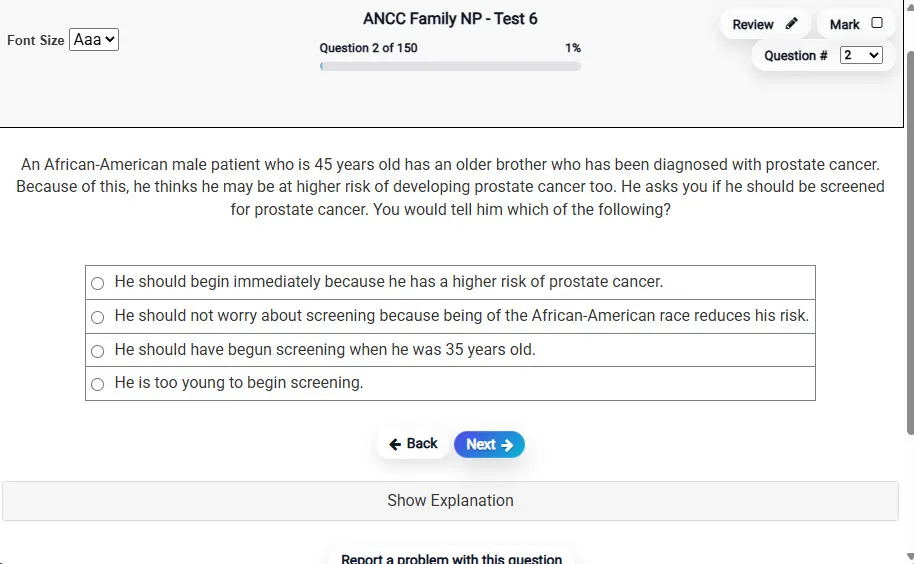
Answering a Question screen – Multiple-choice item view with navigation controls and progress tracker.
Answering a Question Multiple-choice item view with navigation controls and progress tracker.

                           Detailed Explanation screen – 
                         Review mode showing chosen answer and rationale and references.
Detailed Explanation Review mode showing chosen answer and rationale and references.

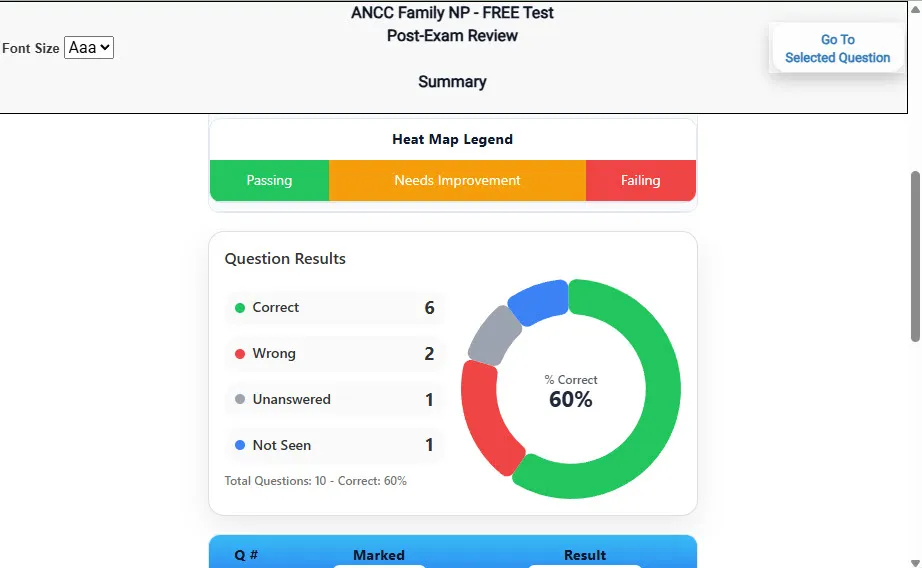
                           Review Summary 1 screen – 
                         Summary with counts for correct/wrong/unanswered and not seen items.
Review Summary 1 Summary with counts for correct/wrong/unanswered and not seen items.

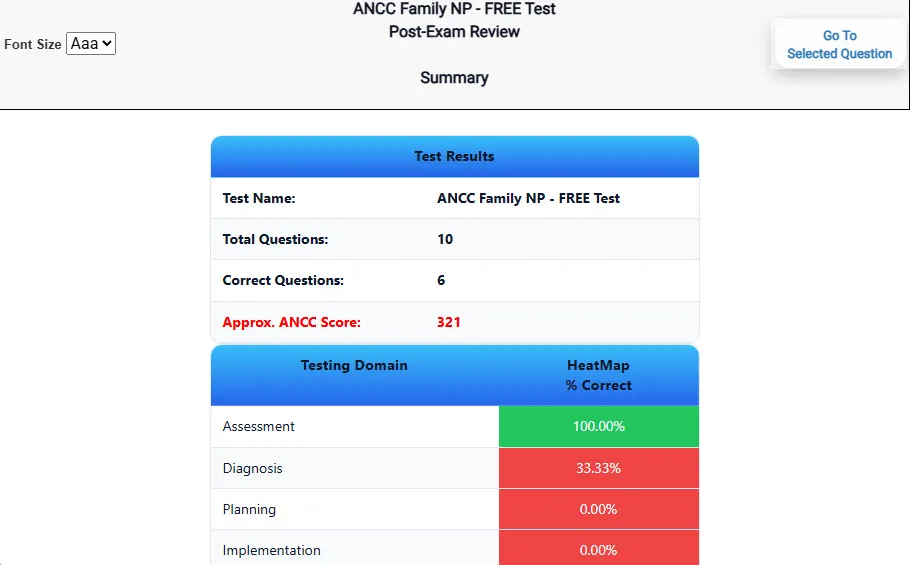
                           Review Summary 2 screen – 
                         Advanced summary with category/domain breakdown and performance insights.
Review Summary 2 Advanced summary with category/domain breakdown and performance insights.

What Each Screen Shows

Answer Question Screen

  • Clean multiple-choice interface with progress bar.
  • Mark for review feature.
  • Matches real test pacing.

Detailed Explanation

  • Correct answer plus rationale.
  • Key concepts and guidelines highlighted.
  • Move between questions to fill knowledge gaps.

Review Summary 1

  • Overall results with total questions and scaled score.
  • Domain heatmap shows strengths and weaknesses.
  • Quick visual feedback on study priorities.

Review Summary 2

  • Chart of correct, wrong, unanswered, not seen.
  • Color-coded results for easy review.
  • Links back to missed items.

Top 10 Reasons to Use Exam Edge for your NYSTCE CST Multi-subject Teachers of Middle Childhood 5-9 Exam Prep

  1. Focused on the NYSTCE CST Multi-subject Teachers of Middle Childhood 5-9 Exam

    Our practice tests are built specifically for the CST Multi-subject: Teachers Of Middle Childhood 5-9 exam — every question mirrors the real topics, format, and difficulty so you're studying exactly what matters.

  2. Real Exam Simulation

    We match the per-question time limits and pressure of the actual NYSTCE exam, so test day feels familiar and stress-free.

  3. 20 Full Practice Tests & 2,440 Unique Questions

    You'll have more than enough material to master every CST Multi-subject: Teachers Of Middle Childhood 5-9 concept — no repeats, no fluff.

  4. Lower Cost Than a Retake

    Ordering 5 practice exams costs less than retaking the NYSTCE CST Multi-subject Teachers of Middle Childhood 5-9 exam after a failure. One low fee could save you both time and money.

  5. Flexible Testing

    Need to step away mid-exam? Pick up right where you left off — with your remaining time intact.

  6. Instant Scoring & Feedback

    See your raw score and an estimated NYSTCE CST Multi-subject Teachers of Middle Childhood 5-9 score immediately after finishing each practice test.

  7. Detailed Explanations for Every Question

    Review correct and incorrect answers with clear, step-by-step explanations so you truly understand each topic.

  8. Trusted & Accredited

    We're fully accredited by the Better Business Bureau and uphold the highest standards of trust and transparency.

  9. Web-Based & Always Available

    No software to install. Access your CST Multi-subject: Teachers Of Middle Childhood 5-9 practice exams 24/7 from any computer or mobile device.

  10. Expert Support When You Need It

    Need extra help? Our specialized tutors are highly qualified and ready to support your NYSTCE exam prep.


Pass the NYSTCE CST Multi-subject Teachers of Middle Childhood 5-9 Exam with Realistic Practice Tests from Exam Edge

Preparing for your upcoming NYSTCE CST Multi-subject Teachers of Middle Childhood 5-9 (331/232/245) Certification Exam can feel overwhelming — but the right practice makes all the difference. Exam Edge gives you the tools, structure, and confidence to pass on your first try. Our online practice exams are built to match the real CST Multi-subject: Teachers Of Middle Childhood 5-9 exam in content, format, and difficulty.

  • 📝 20 NYSTCE CST Multi-subject Teachers of Middle Childhood 5-9 Practice Tests: Access 20 full-length exams with 122 questions each, covering every major NYSTCE CST Multi-subject Teachers of Middle Childhood 5-9 topic in depth.
  • Instant Online Access: Start practicing right away — no software, no waiting.
  • 🧠 Step-by-Step Explanations: Understand the reasoning behind every correct answer so you can master CST Multi-subject: Teachers Of Middle Childhood 5-9 exam concepts.
  • 🔄 Retake Each Exam Up to 4 Times: Build knowledge through repetition and track your improvement over time.
  • 🌐 Web-Based & Available 24/7: Study anywhere, anytime, on any device.
  • 🧘 Boost Your Test-Day Confidence: Familiarity with the NYSTCE format reduces anxiety and helps you perform under pressure.

These NYSTCE CST Multi-subject Teachers of Middle Childhood 5-9 practice exams are designed to simulate the real testing experience by matching question types, timing, and difficulty level. This approach helps you get comfortable not just with the exam content, but also with the testing environment, so you walk into your exam day focused and confident.

Exam Edge NYSTCE Reviews


Not a user friendly experience

Amelia , Rochester, New York

Didn't really reflect the questions that were on the test for the most part. Also, they totally got the format of the constructed response question wrong, which never changes. Overall OK if you have nothing else, but definitely not worth the price they charge in my opinion.

Randy , Queens, New York

It was a good test run. Now I know what to expect and what I need to study.

Timothy , Eden, New York

The experience was very practical and I did well.

Trina , Silver Spring , MD

Very easy to navigate.

Collene , Silver Spring , MD

Exam Edge was terrific. Even better than I hoped. Just completing and reviewing the tests are a great learning experience. I can't wait to take the certification test. Tom S.

Thomas , Port Washington, NY


NYSTCE CST Multi-subject Teachers of Middle Childhood 5-9 Aliases Test Name

Here is a list of alternative names used for this exam.

  • NYSTCE CST Multi-subject Teachers of Middle Childhood 5-9
  • NYSTCE CST Multi-subject Teachers of Middle Childhood 5-9 test
  • NYSTCE CST Multi-subject Teachers of Middle Childhood 5-9 Certification Test
  • CST Multi-subject: Teachers Of Middle Childhood 5-9 test
  • NYSTCE
  • NYSTCE 331/232/245
  • 331/232/245 test
  • NYSTCE CST Multi-subject Teachers of Middle Childhood 5-9 (331/232/245)
  • CST Multi-subject Teachers of Middle Childhood 5-9 certification