This is the content of the pop-over!

LAST - liberal arts and sciences (001) Practice Tests & Test Prep by Exam Edge


NYSTCE LAST -  liberal arts and sciences  product image
(4.7)
Based on 28 Reviews

  • Real Exam Simulation: Timed questions and matching content build comfort for your LAST - liberal arts and sciences test day.
  • Instant, 24/7 Access: Web-based NYSTCE LAST - liberal arts and sciences practice exams with no software needed.
  • Clear Explanations: Step-by-step answers and explanations for your NYSTCE exam to strengthen understanding.
  • Boosted Confidence: Reduces anxiety and improves test-taking skills to ace your NYSTCE LAST - liberal arts and sciences (001).

Featured on

NYSTCE LAST - liberal arts and sciences Online Practice Test Bundles

BEST VALUE
30 practice tests

$238.50

$1,198.50

SAVE $960

Only $7.95 per test!

  • 100% Pass Guarantee
  • 30 online practice tests
  • 80 questions per test
  • Bonus: 100 Flash Cards + Study Guide
  • Instant access
  • Detailed Explanations
  • Practice tests never expire
  • Timed, untimed, or study guide mode
MOST POPULAR
15 practice tests

$149.25

$599.25

SAVE $450

Only $9.95 per test!

  • 15 online practice tests
  • 80 questions per test
  • Bonus: 100 Flash Cards + Study Guide
  • Instant access
  • Detailed Explanations
  • Practice tests never expire
  • Timed, untimed, or study guide mode
5 practice tests

$69.75

$199.75

SAVE $130

Only $13.95 per test!

  • 5 online practice tests
  • 80 questions per test
  • Bonus: 100 Flash Cards
  • Instant access
  • Detailed Explanations
  • Practice tests never expire
  • Timed, untimed, or study guide mode
1 practice test

$39.95

  • 1 online practice test
  • 80 questions per test
  • Instant access
  • Detailed Explanations
  • Practice tests never expire
  • Timed, untimed, or study guide mode
Quick Select
Tap to choose a bundle

** All Prices are in US Dollars (USD) **


LAST - liberal arts and sciences (001) Resources

Jump to the section you need most.

Understanding the exact breakdown of the NYSTCE LAST - liberal arts and sciences test will help you know what to expect and how to most effectively prepare. The NYSTCE LAST - liberal arts and sciences has multiple-choice questions . The exam will be broken down into the sections below:

NYSTCE LAST - liberal arts and sciences Exam Blueprint
Domain Name % Number of
Questions
Scientific - Mathematical Technological Processes 23% 18
Historical and Social Scientific Awareness 19% 15
Artistic Expression and the Humanities 19% 15
Communication and Research Skills 19% 15
Written Analysis and Expression 20% 16

NYSTCE LAST - liberal arts and sciences Study Tips by Domain

  • Use dimensional analysis to check units on every calculation (e.g., m/s vs. mph)—red flag: an answer with impossible units (like adding meters to seconds) is automatically suspect.
  • In linear relationships, identify slope and intercept from tables/graphs; common trap: confusing slope with y-intercept or using “rise over run” backwards when axes are reversed.
  • Apply basic probability rules (independent vs. mutually exclusive) and use complements when easier; red flag: adding probabilities for independent events instead of multiplying.
  • Interpret scientific data displays (scatterplots, error bars, significant figures) and distinguish correlation from causation; common trap: claiming causation from a trend without a controlled comparison group.
  • Know core physical science principles (Newton’s laws, energy conservation, basic circuits); priority rule: if no net external force, velocity stays constant—red flag: assuming motion requires a continuing force.
  • Understand the scientific method and experimental design (variables, controls, reliability/validity) plus basic tech concepts like algorithms and data privacy; contraindication: changing more than one independent variable at a time makes conclusions weak.
  • Differentiate primary vs. secondary sources and judge credibility by author, purpose, audience, and context; red flag: treating a textbook summary as a primary source or ignoring bias in a firsthand account.
  • Read maps, charts, and timelines accurately (scale, legend, axes, time spans) and confirm what is actually being compared; common trap: confusing correlation with causation when two trends move together.
  • Use chronological and geographic reasoning to connect events (turning points, continuity/change, diffusion); priority rule: anchor claims with specific time/place evidence rather than broad generalizations.
  • Apply core civics concepts (separation of powers, federalism, rights, due process) to scenarios; red flag: mixing up state vs. federal authority or assuming “rights” are unlimited in all contexts.
  • Interpret basic economics (scarcity, opportunity cost, supply/demand shifts, incentives, inflation/unemployment) using the right directional logic; common trap: saying demand decreases when price rises without considering whether supply moved instead.
  • Recognize key social-science methods and terms (sample, variable, reliability/validity, confounding) and identify design flaws; red flag: conclusions drawn from small, biased, or self-selected samples.
  • Identify defining features of major art periods (e.g., Renaissance perspective, Baroque drama, Romantic emotion) and tie them to historical context; red flag: choosing answers based only on subject matter (e.g., “religious scene”) rather than style and technique.
  • In music, distinguish texture and structure (monophonic/polyphonic/homophonic; binary/ternary/sonata) and instrument families; common trap: confusing tempo markings (allegro/adagio) with dynamics (forte/piano).
  • For literature, recognize common forms and devices (sonnet, epic, drama; metaphor, irony, allusion) and interpret how they shape meaning; priority rule: support interpretations with specific textual evidence rather than author biography.
  • In philosophy and ethics, separate descriptive claims from normative claims and apply core frameworks (utilitarianism, deontology, virtue ethics); red flag: treating a popular opinion or legal rule as automatically “ethical.”
  • Analyze theater and film elements (staging, lighting, camera angle, montage) and how they influence audience perception; common trap: ignoring medium-specific cues (e.g., editing in film vs. blocking in theater).
  • For world religions and cultural traditions, compare beliefs, practices, and sacred texts with attention to internal diversity; red flag: overgeneralizing a tradition as monolithic or assuming one sect represents the whole.
  • Identify an author’s purpose and audience early; red flag: confusing a persuasive claim with a neutral report when tone is subtle.
  • Distinguish main idea from supporting details by tracking repeated concepts and topic sentences; common trap: selecting an interesting example as the central point.
  • Evaluate source credibility using author qualifications, publication type, and evidence quality; priority rule: prefer peer-reviewed or primary documents over anonymous or unsourced web content.
  • Use a focused research question to guide keywords and database searching; red flag: a topic that is too broad to support a defensible thesis in limited time.
  • Integrate paraphrases and quotations accurately and attribute them; common trap: patchwriting (minor word changes) that still counts as plagiarism.
  • Apply basic logic in arguments by checking for assumptions and fallacies; red flag: correlation presented as causation or an overgeneralization from a small sample.
  • Write a thesis that answers the prompt with a specific, defensible claim; red flag: a “topic statement” that only announces the subject without taking a position.
  • Organize by clear logic (e.g., claim → evidence → explanation) and use transitions to show relationships; common trap: listing points without explaining how they support the thesis.
  • Use evidence precisely (quoted/paraphrased) and analyze it rather than summarizing; priority rule: every body paragraph should include at least one sentence explaining why the evidence matters.
  • Maintain formal, consistent tone and point of view; contraindication: first-person opinion (“I think”) when the task calls for objective analysis.
  • Control grammar and mechanics—especially sentence boundaries and pronoun reference; red flag: run-ons/comma splices and vague pronouns (“this,” “it,” “they”) with unclear antecedents.
  • Revise for concision and clarity by cutting filler and strengthening verbs; common trap: wordy, passive constructions that obscure who did what (e.g., “It was decided that…”).


Built to Fit Into Your Busy Life

Everything you need to prepare with confidence—without wasting a minute.

Three Study Modes

Timed, No Time Limit, or Explanation mode.

Actionable Analytics

Heatmaps and scaled scores highlight weak areas.

High-Yield Rationales

Concise explanations emphasize key concepts.

Realistic Interface

Matches the feel of the actual exam environment.

Accessible by Design

Clean layout reduces cognitive load.

Anytime, Anywhere

Web-based access 24/7 on any device.
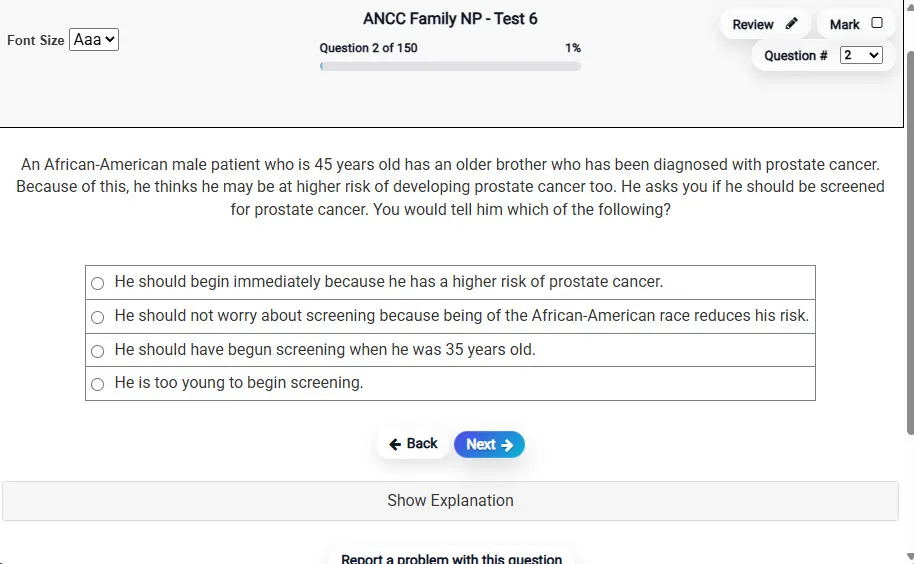
Answering a Question screen – Multiple-choice item view with navigation controls and progress tracker.
Answering a Question Multiple-choice item view with navigation controls and progress tracker.

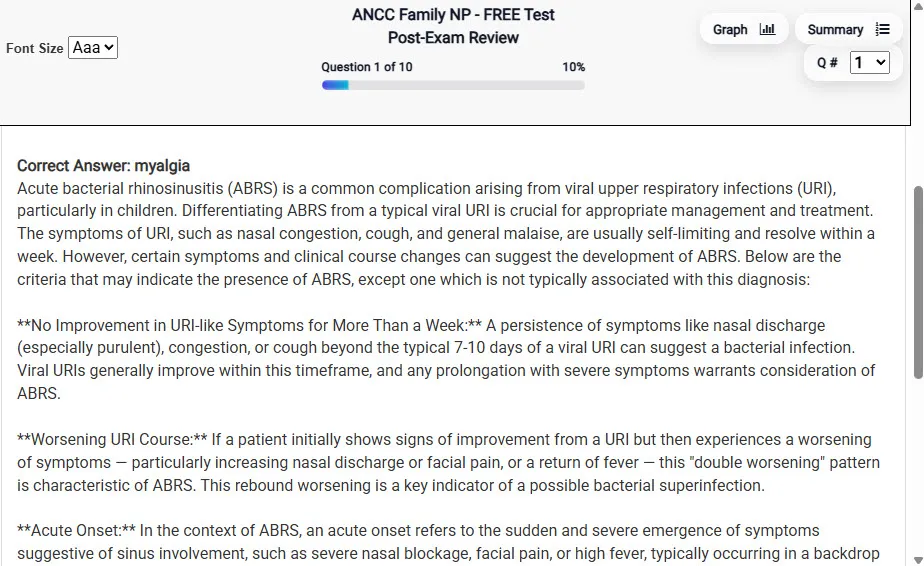
                           Detailed Explanation screen – 
                         Review mode showing chosen answer and rationale and references.
Detailed Explanation Review mode showing chosen answer and rationale and references.

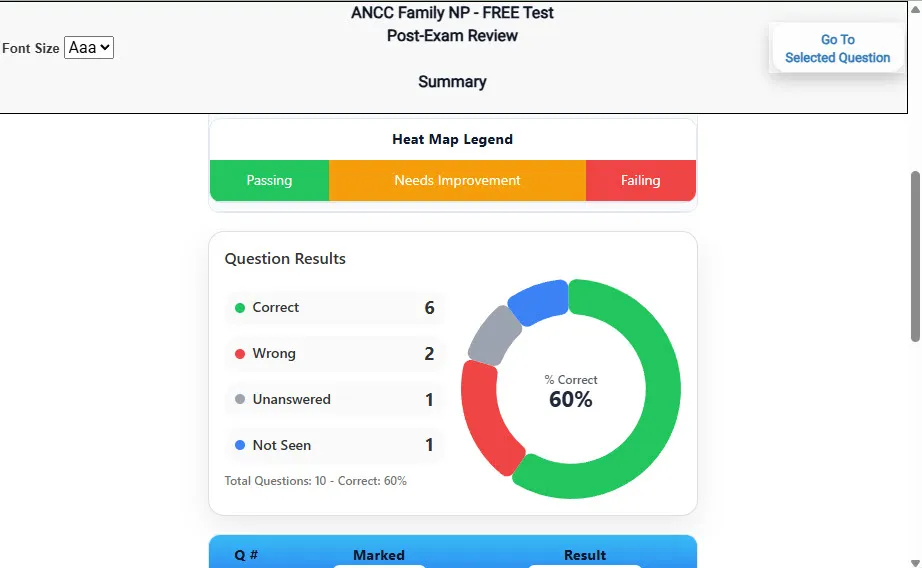
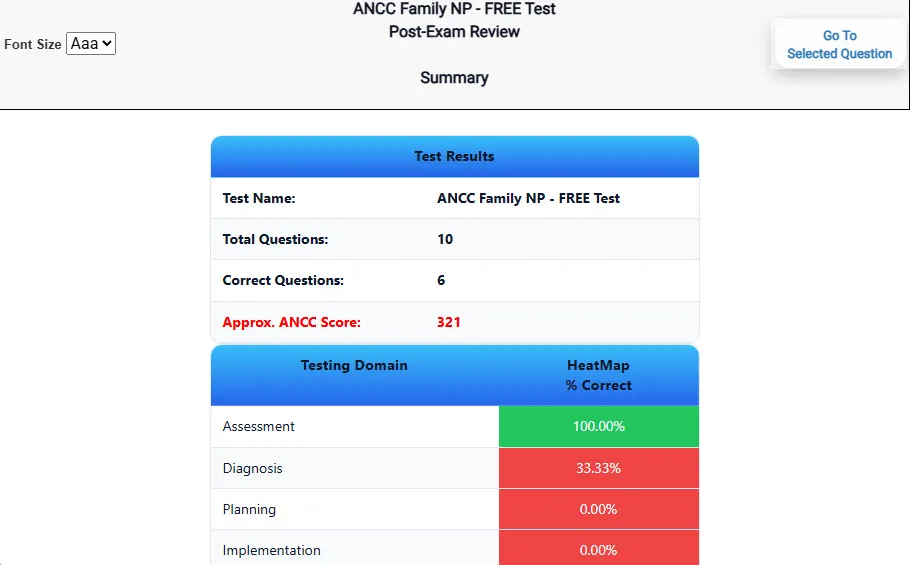
                           Review Summary 1 screen – 
                         Summary with counts for correct/wrong/unanswered and not seen items.
Review Summary 1 Summary with counts for correct/wrong/unanswered and not seen items.

                           Review Summary 2 screen – 
                         Advanced summary with category/domain breakdown and performance insights.
Review Summary 2 Advanced summary with category/domain breakdown and performance insights.

What Each Screen Shows

Answer Question Screen

  • Clean multiple-choice interface with progress bar.
  • Mark for review feature.
  • Matches real test pacing.

Detailed Explanation

  • Correct answer plus rationale.
  • Key concepts and guidelines highlighted.
  • Move between questions to fill knowledge gaps.

Review Summary 1

  • Overall results with total questions and scaled score.
  • Domain heatmap shows strengths and weaknesses.
  • Quick visual feedback on study priorities.

Review Summary 2

  • Chart of correct, wrong, unanswered, not seen.
  • Color-coded results for easy review.
  • Links back to missed items.

Top 10 Reasons to Use Exam Edge for your NYSTCE LAST - liberal arts and sciences Exam Prep

  1. Focused on the NYSTCE LAST - liberal arts and sciences Exam

    Our practice tests are built specifically for the LAST - liberal arts and sciences exam — every question mirrors the real topics, format, and difficulty so you're studying exactly what matters.

  2. Real Exam Simulation

    We match the per-question time limits and pressure of the actual NYSTCE exam, so test day feels familiar and stress-free.

  3. 30 Full Practice Tests & 2,400 Unique Questions

    You'll have more than enough material to master every LAST - liberal arts and sciences concept — no repeats, no fluff.

  4. Lower Cost Than a Retake

    Ordering 5 practice exams costs less than retaking the NYSTCE LAST - liberal arts and sciences exam after a failure. One low fee could save you both time and money.

  5. Flexible Testing

    Need to step away mid-exam? Pick up right where you left off — with your remaining time intact.

  6. Instant Scoring & Feedback

    See your raw score and an estimated NYSTCE LAST - liberal arts and sciences score immediately after finishing each practice test.

  7. Detailed Explanations for Every Question

    Review correct and incorrect answers with clear, step-by-step explanations so you truly understand each topic.

  8. Trusted & Accredited

    We're fully accredited by the Better Business Bureau and uphold the highest standards of trust and transparency.

  9. Web-Based & Always Available

    No software to install. Access your LAST - liberal arts and sciences practice exams 24/7 from any computer or mobile device.

  10. Expert Support When You Need It

    Need extra help? Our specialized tutors are highly qualified and ready to support your NYSTCE exam prep.


Pass the NYSTCE LAST - liberal arts and sciences Exam with Realistic Practice Tests from Exam Edge

Preparing for your upcoming NYSTCE LAST - liberal arts and sciences (001) Certification Exam can feel overwhelming — but the right practice makes all the difference. Exam Edge gives you the tools, structure, and confidence to pass on your first try. Our online practice exams are built to match the real LAST - liberal arts and sciences exam in content, format, and difficulty.

  • 📝 30 NYSTCE LAST - liberal arts and sciences Practice Tests: Access 30 full-length exams with 80 questions each, covering every major NYSTCE LAST - liberal arts and sciences topic in depth.
  • Instant Online Access: Start practicing right away — no software, no waiting.
  • 🧠 Step-by-Step Explanations: Understand the reasoning behind every correct answer so you can master LAST - liberal arts and sciences exam concepts.
  • 🔄 Retake Each Exam Up to 4 Times: Build knowledge through repetition and track your improvement over time.
  • 🌐 Web-Based & Available 24/7: Study anywhere, anytime, on any device.
  • 🧘 Boost Your Test-Day Confidence: Familiarity with the NYSTCE format reduces anxiety and helps you perform under pressure.

These NYSTCE LAST - liberal arts and sciences practice exams are designed to simulate the real testing experience by matching question types, timing, and difficulty level. This approach helps you get comfortable not just with the exam content, but also with the testing environment, so you walk into your exam day focused and confident.

Exam Edge NYSTCE Reviews


Not a user friendly experience

Amelia , Rochester, New York

Didn't really reflect the questions that were on the test for the most part. Also, they totally got the format of the constructed response question wrong, which never changes. Overall OK if you have nothing else, but definitely not worth the price they charge in my opinion.

Randy , Queens, New York

It was a good test run. Now I know what to expect and what I need to study.

Timothy , Eden, New York

The experience was very practical and I did well.

Trina , Silver Spring , MD

Very easy to navigate.

Collene , Silver Spring , MD

Exam Edge was terrific. Even better than I hoped. Just completing and reviewing the tests are a great learning experience. I can't wait to take the certification test. Tom S.

Thomas , Port Washington, NY


NYSTCE LAST - liberal arts and sciences Aliases Test Name

Here is a list of alternative names used for this exam.

  • NYSTCE LAST - liberal arts and sciences
  • NYSTCE LAST - liberal arts and sciences test
  • NYSTCE LAST - liberal arts and sciences Certification Test
  • LAST - liberal arts and sciences test
  • NYSTCE
  • NYSTCE 001
  • 001 test
  • NYSTCE LAST - liberal arts and sciences (001)
  • LAST - liberal arts and sciences certification