This is the content of the pop-over!

NYSTCE CST Deaf and Hard of Hearing (063) Practice Tests & Test Prep by Exam Edge


NYSTCE CST Deaf and Hard of Hearing  product image
(4.8)
Based on 34 Reviews

  • Real Exam Simulation: Timed questions and matching content build comfort for your NYSTCE CST Deaf and Hard of Hearing test day.
  • Instant, 24/7 Access: Web-based NYSTCE CST Deaf and Hard of Hearing practice exams with no software needed.
  • Clear Explanations: Step-by-step answers and explanations for your NYSTCE exam to strengthen understanding.
  • Boosted Confidence: Reduces anxiety and improves test-taking skills to ace your NYSTCE CST Deaf and Hard of Hearing (063).

Featured on

NYSTCE CST Deaf and Hard of Hearing Online Practice Test Bundles

BEST VALUE
5 practice tests

$69.75

$199.75

SAVE $130

Only $13.95 per test!

  • 100% Pass Guarantee
  • 5 online practice tests
  • 100 questions per test
  • Bonus: 100 Flash Cards + Study Guide
  • Instant access
  • Detailed Explanations
  • Practice tests never expire
  • Timed, untimed, or study guide mode
1 practice test

$39.95

  • 1 online practice test
  • 100 questions per test
  • Instant access
  • Detailed Explanations
  • Practice tests never expire
  • Timed, untimed, or study guide mode
Quick Select
Tap to choose a bundle

** All Prices are in US Dollars (USD) **


NYSTCE CST Deaf and Hard of Hearing (063) Resources

Jump to the section you need most.

Understanding the exact breakdown of the NYSTCE CST Deaf and Hard of Hearing test will help you know what to expect and how to most effectively prepare. The NYSTCE CST Deaf and Hard of Hearing has 90 multiple-choice questions and 1 essay questions. The exam will be broken down into the sections below:

NYSTCE CST Deaf and Hard of Hearing Exam Blueprint
Domain Name % Number of
Questions
Foundations of Deaf Education 13% 15
Knowledge of Students Who Are Deaf or Hard of Hearing 13% 15
Assessment and Individual Program Planning 13% 15
Strategies for Planning and Managing the Learning Environment and for Providing Behavioral Interventions 13% 15
Instructional Planning and Delivery to Promote Students' Success in the General Curriculum 14% 16
Strategies for Teaching Language - Communication Social Skills 14% 16

NYSTCE CST Deaf and Hard of Hearing Study Tips by Domain

  • Know the historical milestones in Deaf education (e.g., Manualism vs. Oralism, Milan 1880, rise of Total Communication and bilingual-bicultural models) and be ready to connect each to today’s placement and communication decisions—trap: treating these as isolated facts rather than drivers of practice.
  • Differentiate major educational philosophies (auditory-oral, auditory-verbal, Total Communication, ASL/English bilingual) and match them to student profiles—red flag: assuming one approach is universally appropriate regardless of language access and family goals.
  • Apply IDEA/Part B and NYS requirements to Deaf/HH services (LRE, FAPE, IEP team membership, related services) with attention to communication needs—common trap: writing goals/accommodations without specifying how the student will access auditory/visual information.
  • Understand Section 504/ADA implications for accessibility (effective communication, equal access, auxiliary aids like interpreters/CART) and distinguish them from IDEA special education entitlements—priority rule: accommodations must be timely and comparable in effectiveness.
  • Use audiology foundations to interpret basic hearing data (degree/configuration of loss, amplification/CI considerations) for educational impact—red flag: confusing medical diagnosis with functional listening needs in classroom conditions (noise, distance, reverberation).
  • Recognize Deaf culture and identity (Deaf community norms, language as culture, family/child perspectives) as central to ethical practice—trap: framing Deafness solely as a deficit rather than considering cultural-linguistic needs and student self-advocacy.
  • Differentiate degree/configuration of hearing loss (conductive, sensorineural, mixed; unilateral vs. bilateral) and anticipate educational impact—red flag: assuming identical access needs for students with the same audiogram.
  • Interpret audiograms functionally for speech access (especially 250–4000 Hz) and plan supports accordingly—common trap: focusing on pure-tone averages while missing high-frequency loss that reduces consonant intelligibility.
  • Know typical effects of hearing loss on language, literacy, and incidental learning, and identify when gaps reflect access vs. disability—priority rule: first verify consistent access to instruction before attributing delays to cognition.
  • Recognize communication profiles (ASL, spoken English, bilingual-bimodal, AAC) and match instruction and assessment language—red flag: using an interpreter or amplification as a substitute for direct language development.
  • Understand assistive listening technology and classroom acoustics (hearing aids, cochlear implants, FM/DM, loop; noise/reverberation/distance) and monitor daily function—common trap: not performing a daily device check and assuming devices are working.
  • Consider psychosocial and cultural-linguistic factors (Deaf culture/identity, family communication choices, peer access) when planning supports—contraindication: isolating the student or limiting opportunities for Deaf/HoH peer interaction and role models.
  • Use multiple measures (audiology, language samples, curriculum-based measures, classroom observation) to avoid a single-test decision; red flag: interpreting low English scores as low cognition without considering language access.
  • Ensure assessments are linguistically accessible (ASL/Manually Coded English/spoken language with supports) and document accommodations vs. modifications; common trap: invalidating results by changing the construct (e.g., “reading test” administered in ASL).
  • Differentiate language difference from disorder with targeted tools and dynamic assessment; priority rule: confirm performance across contexts before labeling (home language, classroom discourse, pragmatics).
  • Write IEP goals that are measurable with clear criteria, conditions, and timelines and align to present levels; red flag: vague goals like “will improve communication” without a baseline and mastery threshold.
  • Plan services and supports based on access needs (interpreting, captioning, FM/DM, visual supports) and specify who provides them and when; common trap: listing accommodations without implementation details or monitoring.
  • Use progress monitoring data to adjust instruction and IEP components (frequency, setting, communication mode) at defined intervals; contraindication: waiting for annual review when data show the student is not making expected progress.
  • Use a proactive classroom management plan (clear routines, visual schedules, explicitly taught expectations) and check comprehension via signed/visual confirmation—red flag: giving only spoken directions and assuming access.
  • Optimize the visual and auditory environment (lighting on faces, reduce glare, seating for sightlines, manage noise, verify assistive technology daily)—common trap: placing a student where they must constantly shift gaze between interpreter, teacher, and materials.
  • Implement evidence-based behavioral supports (PBIS, explicit teaching of replacement behaviors, frequent behavior-specific feedback) and avoid punishment-only approaches—priority rule: reinforce the behavior you want to see, not just suppress the one you don’t.
  • Conduct a Functional Behavioral Assessment and write a Behavior Intervention Plan that matches function and includes data collection—red flag: consequences that accidentally reinforce escape/avoidance or attention-seeking behavior.
  • Plan safety and emergency procedures with accessible communication (visual alarms, pre-taught signals, role assignments) and practice them regularly—contraindication: relying on verbal announcements during drills.
  • Support social-emotional and self-advocacy skills (repair strategies, requesting clarification, turn-taking norms) within group work and transitions—common trap: interpreting off-task behavior as “noncompliance” when it reflects missed information or lagging communication access.
  • Plan lessons using grade-level NYS learning standards while explicitly mapping accommodations/modifications (e.g., interpreter, captioning, preferential seating)—red flag: lowering the cognitive demand instead of improving access.
  • Pre-teach and revisit academic vocabulary and concepts with multiple representations (print, visuals, signed/spoken models)—common trap: assuming incidental learning from classroom talk will fill gaps.
  • Deliver instruction with clear communication access (visual supports, checked sightlines, structured turn-taking, wait time for interpreting)—priority rule: if the student can’t see/hear the message consistently, the lesson isn’t accessible.
  • Use ongoing formative checks (quick writes, visuals, exit tickets, signed responses) and adjust instruction immediately—red flag: relying only on verbal Q&A, which can mask comprehension barriers.
  • Differentiate tasks and grouping (small-group reteach, guided notes, scaffolded reading/writing) while keeping grade-level targets—common trap: over-supporting with adult paraphrasing that replaces student language production.
  • Coordinate with general educators and related service providers to ensure consistent use of supports across settings—contraindication: changing accommodations day-to-day without documenting and communicating the plan.
  • Differentiate and match communication modalities (ASL, PSE, cued speech, oral/aural, AAC) to the student’s language access profile—red flag: assuming amplification alone guarantees access to spoken instruction.
  • Target pragmatic language explicitly (turn-taking, topic maintenance, repair strategies, register) using modeling and role-play; common trap: grading behavior when the underlying deficit is a missing conversational rule.
  • Teach vocabulary and syntax through visual supports (signing space, classifiers, concept mapping, captioned media) with repeated, contextualized practice; priority rule: preteach key terms before a new unit to prevent “vocabulary debt.”
  • Build literacy via the ASL–English bridge (print awareness, fingerspelling for orthographic mapping, morphology, and text structures); red flag: overreliance on isolated word lists instead of connecting meaning to print.
  • Plan peer-mediated communication supports (structured partner talk, cooperative roles, conversation prompts) to generalize social skills; common trap: placing a student with an interpreter but not training peers on how to interact directly with the student.
  • Use ongoing, language-focused progress monitoring (language samples, pragmatic checklists, comprehension probes) and adjust goals when plateau occurs; red flag: measuring only content grades and missing stalled language growth.


Built to Fit Into Your Busy Life

Everything you need to prepare with confidence—without wasting a minute.

Three Study Modes

Timed, No Time Limit, or Explanation mode.

Actionable Analytics

Heatmaps and scaled scores highlight weak areas.

High-Yield Rationales

Concise explanations emphasize key concepts.

Realistic Interface

Matches the feel of the actual exam environment.

Accessible by Design

Clean layout reduces cognitive load.

Anytime, Anywhere

Web-based access 24/7 on any device.
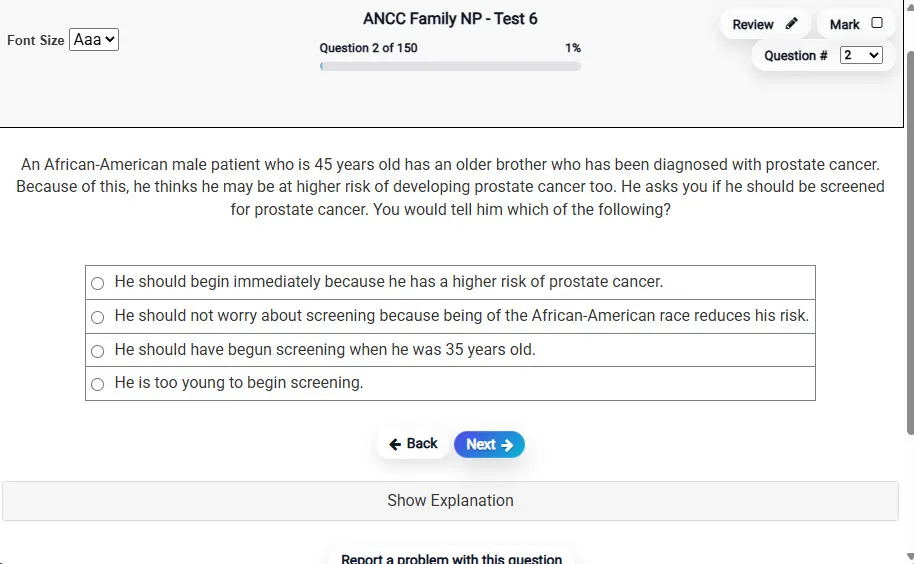
Answering a Question screen – Multiple-choice item view with navigation controls and progress tracker.
Answering a Question Multiple-choice item view with navigation controls and progress tracker.

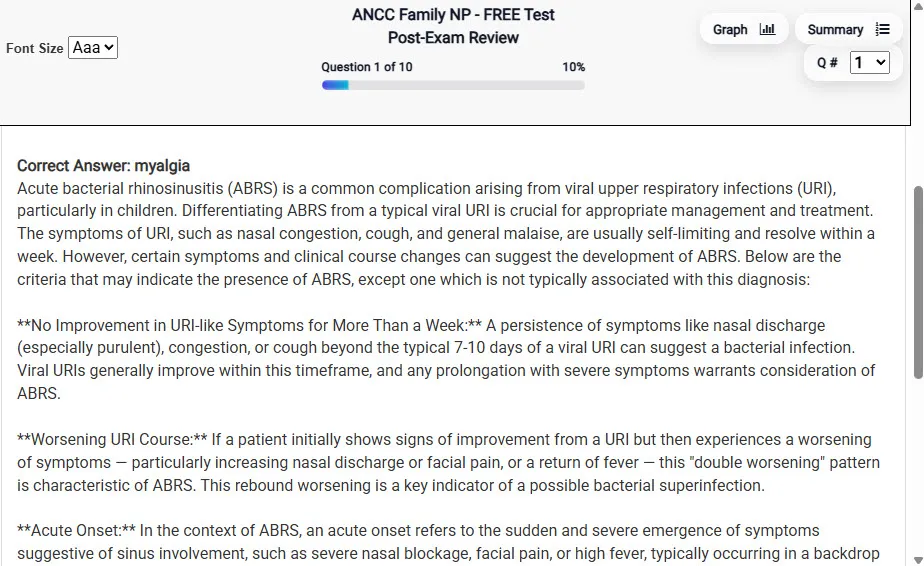
                           Detailed Explanation screen – 
                         Review mode showing chosen answer and rationale and references.
Detailed Explanation Review mode showing chosen answer and rationale and references.

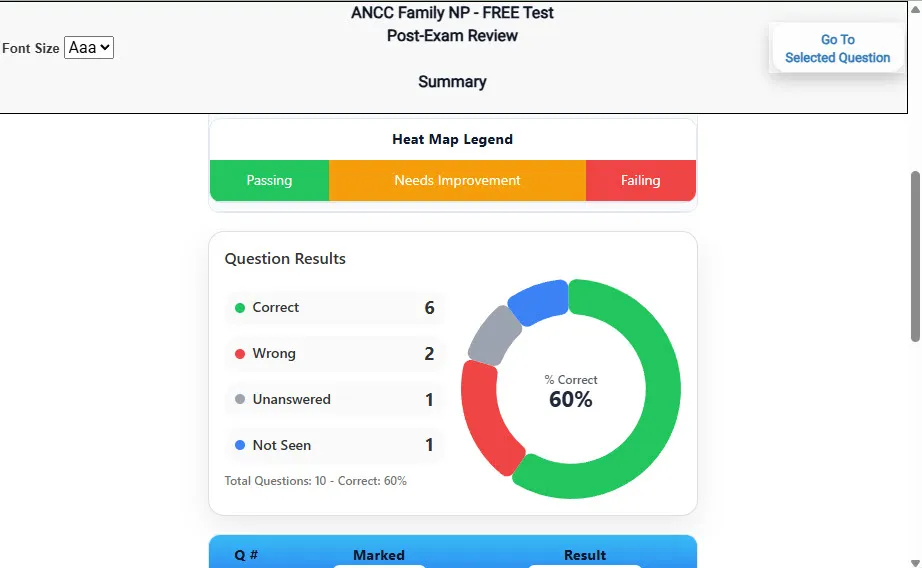
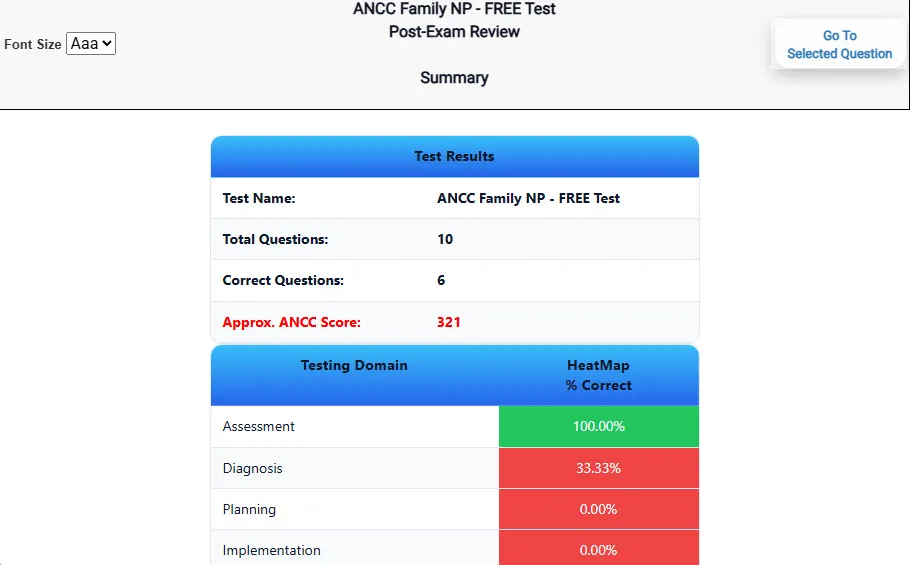
                           Review Summary 1 screen – 
                         Summary with counts for correct/wrong/unanswered and not seen items.
Review Summary 1 Summary with counts for correct/wrong/unanswered and not seen items.

                           Review Summary 2 screen – 
                         Advanced summary with category/domain breakdown and performance insights.
Review Summary 2 Advanced summary with category/domain breakdown and performance insights.

What Each Screen Shows

Answer Question Screen

  • Clean multiple-choice interface with progress bar.
  • Mark for review feature.
  • Matches real test pacing.

Detailed Explanation

  • Correct answer plus rationale.
  • Key concepts and guidelines highlighted.
  • Move between questions to fill knowledge gaps.

Review Summary 1

  • Overall results with total questions and scaled score.
  • Domain heatmap shows strengths and weaknesses.
  • Quick visual feedback on study priorities.

Review Summary 2

  • Chart of correct, wrong, unanswered, not seen.
  • Color-coded results for easy review.
  • Links back to missed items.

Top 10 Reasons to Use Exam Edge for your NYSTCE CST Deaf and Hard of Hearing Exam Prep

  1. Focused on the NYSTCE CST Deaf and Hard of Hearing Exam

    Our practice tests are built specifically for the NYSTCE CST Deaf and Hard of Hearing exam — every question mirrors the real topics, format, and difficulty so you're studying exactly what matters.

  2. Real Exam Simulation

    We match the per-question time limits and pressure of the actual NYSTCE exam, so test day feels familiar and stress-free.

  3. 5 Full Practice Tests & 500 Unique Questions

    You'll have more than enough material to master every NYSTCE CST Deaf and Hard of Hearing concept — no repeats, no fluff.

  4. Lower Cost Than a Retake

    Ordering 5 practice exams costs less than retaking the NYSTCE CST Deaf and Hard of Hearing exam after a failure. One low fee could save you both time and money.

  5. Flexible Testing

    Need to step away mid-exam? Pick up right where you left off — with your remaining time intact.

  6. Instant Scoring & Feedback

    See your raw score and an estimated NYSTCE CST Deaf and Hard of Hearing score immediately after finishing each practice test.

  7. Detailed Explanations for Every Question

    Review correct and incorrect answers with clear, step-by-step explanations so you truly understand each topic.

  8. Trusted & Accredited

    We're fully accredited by the Better Business Bureau and uphold the highest standards of trust and transparency.

  9. Web-Based & Always Available

    No software to install. Access your NYSTCE CST Deaf and Hard of Hearing practice exams 24/7 from any computer or mobile device.

  10. Expert Support When You Need It

    Need extra help? Our specialized tutors are highly qualified and ready to support your NYSTCE exam prep.


Pass the NYSTCE CST Deaf and Hard of Hearing Exam with Realistic Practice Tests from Exam Edge

Preparing for your upcoming NYSTCE CST Deaf and Hard of Hearing (063) Certification Exam can feel overwhelming — but the right practice makes all the difference. Exam Edge gives you the tools, structure, and confidence to pass on your first try. Our online practice exams are built to match the real NYSTCE CST Deaf and Hard of Hearing exam in content, format, and difficulty.

  • 📝 5 NYSTCE CST Deaf and Hard of Hearing Practice Tests: Access 5 full-length exams with 100 questions each, covering every major NYSTCE CST Deaf and Hard of Hearing topic in depth.
  • Instant Online Access: Start practicing right away — no software, no waiting.
  • 🧠 Step-by-Step Explanations: Understand the reasoning behind every correct answer so you can master NYSTCE CST Deaf and Hard of Hearing exam concepts.
  • 🔄 Retake Each Exam Up to 4 Times: Build knowledge through repetition and track your improvement over time.
  • 🌐 Web-Based & Available 24/7: Study anywhere, anytime, on any device.
  • 🧘 Boost Your Test-Day Confidence: Familiarity with the NYSTCE format reduces anxiety and helps you perform under pressure.

These NYSTCE CST Deaf and Hard of Hearing practice exams are designed to simulate the real testing experience by matching question types, timing, and difficulty level. This approach helps you get comfortable not just with the exam content, but also with the testing environment, so you walk into your exam day focused and confident.


Exam Edge NYSTCE Reviews


Not a user friendly experience

Amelia , Rochester, New York

Didn't really reflect the questions that were on the test for the most part. Also, they totally got the format of the constructed response question wrong, which never changes. Overall OK if you have nothing else, but definitely not worth the price they charge in my opinion.

Randy , Queens, New York

It was a good test run. Now I know what to expect and what I need to study.

Timothy , Eden, New York

The experience was very practical and I did well.

Trina , Silver Spring , MD

Very easy to navigate.

Collene , Silver Spring , MD

Exam Edge was terrific. Even better than I hoped. Just completing and reviewing the tests are a great learning experience. I can't wait to take the certification test. Tom S.

Thomas , Port Washington, NY


NYSTCE CST Deaf and Hard of Hearing Aliases Test Name

Here is a list of alternative names used for this exam.

  • NYSTCE CST Deaf and Hard of Hearing
  • NYSTCE CST Deaf and Hard of Hearing test
  • NYSTCE CST Deaf and Hard of Hearing Certification Test
  • NYSTCE
  • NYSTCE 063
  • 063 test
  • NYSTCE CST Deaf and Hard of Hearing (063)
  • CST Deaf and Hard of Hearing certification