This is the content of the pop-over!

NYSTCE CST Multi-subject: Teachers Of Childhood 1-6 (221/222/245) Practice Tests & Test Prep by Exam Edge


NYSTCE CST Multi-subject Teachers Of Childhood 1-6  product image
(4.7)
Based on 28 Reviews

  • Real Exam Simulation: Timed questions and matching content build comfort for your NYSTCE CST Multi-subject: Teachers Of Childhood 1-6 test day.
  • Instant, 24/7 Access: Web-based NYSTCE CST Multi-subject Teachers Of Childhood 1-6 practice exams with no software needed.
  • Clear Explanations: Step-by-step answers and explanations for your NYSTCE exam to strengthen understanding.
  • Boosted Confidence: Reduces anxiety and improves test-taking skills to ace your NYSTCE CST Multi-subject Teachers Of Childhood 1-6 (221/222/245).

Featured on

NYSTCE CST Multi-subject Teachers Of Childhood 1-6 Online Practice Test Bundles

BEST VALUE
20 practice tests

$174.00

$799.00

SAVE $625

Only $8.70 per test!

  • 100% Pass Guarantee
  • 20 online practice tests
  • 120 questions + 2 essays per test
  • Bonus: 100 Flash Cards + Study Guide
  • Instant access
  • Detailed Explanations
  • Practice tests never expire
  • Timed, untimed, or study guide mode
MOST POPULAR
10 practice tests

$99.50

$399.50

SAVE $300

Only $9.95 per test!

  • 10 online practice tests
  • 120 questions + 2 essays per test
  • Bonus: 100 Flash Cards + Study Guide
  • Instant access
  • Detailed Explanations
  • Practice tests never expire
  • Timed, untimed, or study guide mode
5 practice tests

$69.75

$199.75

SAVE $130

Only $13.95 per test!

  • 5 online practice tests
  • 120 questions + 2 essays per test
  • Bonus: 100 Flash Cards
  • Instant access
  • Detailed Explanations
  • Practice tests never expire
  • Timed, untimed, or study guide mode
1 practice test

$39.95

  • 1 online practice test
  • 120 questions + 2 essays per test
  • Instant access
  • Detailed Explanations
  • Practice tests never expire
  • Timed, untimed, or study guide mode
Quick Select
Tap to choose a bundle

** All Prices are in US Dollars (USD) **


NYSTCE CST Multi-subject: Teachers Of Childhood 1-6 (221/222/245) Resources

Jump to the section you need most.

Understanding the exact breakdown of the NYSTCE CST Multi-subject Teachers Of Childhood 1-6 test will help you know what to expect and how to most effectively prepare. The NYSTCE CST Multi-subject Teachers Of Childhood 1-6 has 120 multiple-choice questions and 2 essay questions. The exam will be broken down into the sections below:

NYSTCE CST Multi-subject Teachers Of Childhood 1-6 Exam Blueprint
Domain Name % Number of
Questions
Literacy and English Language Arts  
     Knowledge of Literacy Language Arts 30% 12
     Instruction in Foundational Literacy Skills 30% 12
     Instruction in English Language Arts 10% 4
     Analysis - Synthesis Application 30% 12
Mathematics  
     Number and Operations 5% 2
     Ratios and Proportional Relationships and Number Systems 30% 12
     Algebra - Measurement - Geometry Data 35% 14
     Instruction in Mathematics 10% 4
     Analysis - Synthesis Application 20% 8
Arts and Sciences  
     Science and Technology 40% 16
     Social Studies 40% 16
     Fine Arts - Health and Fitness - Family and Consumer Science Career Development 20% 8

NYSTCE CST Multi-subject Teachers Of Childhood 1-6 Study Tips by Domain

  • Align reading and writing tasks to a clear standard-based objective and success criteria; red flag: an activity-focused lesson (“do a worksheet”) with no measurable literacy outcome.
  • Use text-dependent questions that move from literal to inferential to evaluative with evidence; common trap: asking opinion questions that can be answered without citing the text.
  • Select appropriately complex texts (including informational) and scaffold access without replacing the text; priority rule: supports should preserve grade-level meaning rather than summarizing it for students.
  • Teach academic vocabulary and morphology in context (roots, affixes, multiple-meaning words); red flag: isolated word lists with no repeated reading, discussion, or writing using the words.
  • Strengthen writing by planning, drafting, revising, and editing with explicit genre expectations (opinion/argument, informative, narrative); common trap: scoring only conventions and ignoring organization, evidence, and purpose.
  • Integrate speaking, listening, and language conventions through structured discussion and presentation; red flag: “turn-and-talk” with no accountable talk stems, roles, or criteria for citing evidence.
  • Distinguish the five components of reading (phonemic awareness, phonics, fluency, vocabulary, comprehension) and match each to an appropriate assessment; red flag: prescribing phonics for a deficit that is actually phonemic awareness.
  • Know grade-appropriate text complexity (quantitative, qualitative, and reader/task factors) and choose texts accordingly; common trap: relying only on Lexile/level and ignoring knowledge demands and structure.
  • Apply explicit academic vocabulary instruction (morphology, context, and multiple-meaning words) to improve comprehension; priority rule: teach high-utility Tier 2 words before low-frequency Tier 3 terms unless the unit requires them.
  • Analyze comprehension strategies (monitoring, summarizing, questioning, inference, text structure) and select one that targets the specific breakdown; red flag: asking only literal “right there” questions for an inference problem.
  • Use writing knowledge (planning, drafting, revising, editing) with genre features and evidence expectations; common trap: focusing feedback on conventions when the main weakness is organization or use of textual evidence.
  • Interpret assessment results (running records, miscues, CBM, rubrics) to plan next instruction; red flag: making placement decisions from a single data point instead of a pattern across measures.
  • Teach phonological awareness in a clear progression (word → syllable → onset-rime → phoneme); red flag: expecting decoding success when a student cannot consistently blend or segment phonemes.
  • Provide explicit, systematic phonics aligned to English spelling patterns (CVC, consonant blends, digraphs, vowel teams, r-controlled vowels); common trap: assigning “word lists” without teaching the specific pattern and decoding routine.
  • Build automatic word recognition using high-frequency words plus decoding-by-pattern; priority rule: do not treat most high-frequency words as purely “sight words”—map sounds to letters (orthographic mapping) whenever possible.
  • Develop fluency with repeated reading, phrasing, and accuracy supports (e.g., echo/choral reading, timed rereads); threshold cue: focus first on accuracy if miscues exceed about 5% of words (below ~95% accuracy indicates text is too hard for independent reading).
  • Teach vocabulary and morphology (prefixes, suffixes, roots) to support word learning and decoding of longer words; red flag: relying only on context clues when a word can be unlocked with a taught morpheme or syllable pattern.
  • Use screening and progress monitoring data (phonemic awareness, phonics, fluency) to target small-group intervention; common NYSTCE trap: choosing a comprehension-only strategy when the data point to a foundational deficit (e.g., weak decoding or slow, inaccurate oral reading).
  • Use text-dependent questions that require evidence from the passage (quote or paraphrase with page/line support); red flag: questions that can be answered from personal experience alone.
  • Teach comprehension strategies explicitly (e.g., previewing text features, monitoring meaning, summarizing) and then release responsibility; common trap: assigning independent reading tasks without modeling or guided practice.
  • Align instruction to purpose and audience for writing (narrative, informative/explanatory, opinion) with clear criteria; priority rule: require a thesis/claim or controlling idea plus evidence, not just “more details.”
  • Integrate vocabulary instruction using context clues, morphology (prefix/root/suffix), and reference tools; red flag: relying only on copying definitions without applying words in speaking/writing.
  • Address language conventions through targeted mini-lessons based on patterns in student work, followed by immediate practice; common trap: correcting every error in a draft rather than focusing on high-impact, repeated issues.
  • Differentiate ELA instruction using scaffolds (sentence frames, graphic organizers, chunked texts) while maintaining grade-level goals; contraindication: lowering text complexity or expectations instead of increasing supports.
  • Read the question stem first to identify the task (analyze vs. synthesize vs. apply); red flag: choosing a detail-recall option when the prompt asks what should be done next.
  • For analysis items, separate claim, evidence, and reasoning and check whether evidence actually supports the claim; common trap: picking an option that restates the claim without citing observable data.
  • For synthesis items, combine information from two or more sources (e.g., student work + observation + assessment) into one coherent conclusion; red flag: answers that rely on only one data point.
  • For application items, select the action that directly follows from the given context and constraints (grade level, IEP/ELL needs, time, materials); common trap: choosing a “best practice” strategy that doesn’t fit the scenario.
  • Prioritize NYSTCE-style instructional decisions that are measurable and aligned to a stated objective; red flag: options with vague goals like “increase understanding” without a way to verify learning.
  • When multiple answers seem plausible, eliminate those that introduce unnecessary complexity or skip prerequisite skills; priority rule: choose the option that addresses the most immediate barrier to progress first.
  • Prioritize conceptual understanding before procedures (e.g., place value, equivalence, properties of operations); red flag: choosing an algorithmic answer that contradicts the meaning of the quantities.
  • Interpret and create representations (number lines, arrays, area models, graphs, tables) and translate among them; common trap: treating the picture as decoration instead of evidence for the claim.
  • Attend to units, scale, and reasonableness in measurement contexts; priority rule: always state and check units because a correct computation with the wrong unit is scored as wrong.
  • Use precise mathematical language and definitions (e.g., polygon, factor, multiple, prime, perpendicular) when justifying; red flag: informal definitions that fail in edge cases (like calling all quadrilaterals “squares”).
  • Analyze student work and error patterns to select targeted feedback or a next instructional step; common trap: reteaching the same procedure instead of addressing the misconception (e.g., adding denominators when adding fractions).
  • Select assessments and tasks aligned to grade-level expectations and multiple entry points; contraindication: using problems that are above grade level or that measure reading complexity more than mathematics.
  • Demonstrate place value and base-ten reasoning with whole numbers and decimals, including rounding and estimation to judge reasonableness; red flag: choosing an exact operation when the prompt is clearly asking for an estimate.
  • Use properties of operations (commutative, associative, distributive) to compute and to justify mental math or alternative algorithms; common trap: misapplying the distributive property across addition (e.g., (a+b)c as ac+bc is correct, but a+(bc) is not distributive).
  • Model and compare fractions (equivalence, ordering, benchmarks like 0, 1/2, 1), including mixed numbers and improper fractions; priority rule: when comparing, use common denominators or number lines—don’t rely on numerator/denominator size alone.
  • Perform fraction operations conceptually (especially multiplication/division) using visual models and unit fractions; common trap: “invert and multiply” without interpreting what division by a fraction means in context.
  • Work fluently with integers (opposites, absolute value, ordering, and operations) and connect to real contexts (temperature, elevation, debt); red flag: sign errors when subtracting negatives or interpreting distance vs. direction.
  • Reason about factors, multiples, prime/composite, GCF/LCM, and divisibility to solve word problems (grouping, schedules, simplifying fractions); threshold cue: if the question implies “largest equal group size” think GCF, if it implies “first time together” think LCM.
  • Distinguish part-to-part vs. part-to-whole ratios and write them in multiple forms (a:b, a/b, “a to b”)—red flag: students often treat ratios as fractions that must be simplified even when context requires a specific unit rate.
  • Use unit rates to compare situations (e.g., miles per hour, cost per item) and state the comparison in context—common trap: computing a correct number but labeling the wrong “per 1” unit.
  • Identify proportional relationships by constant of proportionality k (y = kx) using tables, graphs (through the origin), and equations—priority rule: if the graph doesn’t pass through (0,0), it’s not proportional.
  • Solve percent problems (discount, tax, percent increase/decrease) using equations or proportional reasoning—red flag: mixing up “percent of” vs. “percent increase” leads to using the wrong base (original vs. new amount).
  • Operate with rational numbers (integers, fractions, decimals) and interpret negative values in real contexts (temperature, elevation, debt)—common trap: sign errors when subtracting negatives (e.g., a − (−b) = a + b).
  • Apply number system properties and place value (including absolute value and ordering) to justify comparisons—threshold cue: always use a common denominator or common scale when ordering fractions/decimals, not just numerator/denominator size.
  • Translate word problems into expressions/equations and check reasonableness; red flag: mixing up the unknown (e.g., writing 3x + 5 when the situation is 5 + 3 times a quantity).
  • Use equivalence to solve one-step and multi-step equations/inequalities, including using inverse operations and maintaining equality/inequality; common trap: forgetting to reverse the inequality sign when multiplying/dividing by a negative.
  • Work with measurement units (customary/metric), conversions, and derived measures (area, volume, rate); priority rule: align units before computing or comparing (e.g., convert all lengths to inches or centimeters first).
  • Apply geometric properties (angles, parallel lines, triangles, quadrilaterals) and coordinate geometry basics; red flag: assuming figures are special (e.g., “rectangle”) without stated properties (right angles, parallel sides).
  • Interpret and create data displays (line plots, bar graphs, histograms, box plots) and summarize with mean/median/mode and variability; common trap: using the mean with strong outliers when the median is more appropriate.
  • Use probability as a measure of likelihood (0 to 1) with simple events and compound events; contraindication: adding probabilities for non-mutually exclusive events without subtracting the overlap.
  • Use the Concrete–Representational–Abstract (CRA) progression and require students to explain the same idea in words, symbols, and models; red flag: moving to procedures before students can represent the concept (e.g., fraction equivalence) with visuals.
  • Plan for Mathematical Practice alignment by embedding reasoning, modeling, and critique of thinking in every lesson; common trap: treating “show your work” as calculation steps instead of justification and error analysis.
  • Differentiate with purposeful scaffolds (sentence frames, number lines, manipulatives) while keeping the same math goal; priority rule: modify access, not the learning target, unless an IEP explicitly requires alternate standards.
  • Use formative checks (exit tickets, quick interviews, hinge questions) to decide next steps the same day; red flag: re-teaching the whole class when data show a small group misconception (e.g., regrouping or place-value errors).
  • Teach problem solving with explicit structures (identify givens/constraints, choose a strategy, estimate, check reasonableness); common trap: accepting an answer without unit/label or without verifying with an inverse operation or estimation.
  • Support multilingual learners and students with language needs by pre-teaching math vocabulary and unpacking word problems; red flag: confusing vocabulary (e.g., “product,” “difference,” “at least”) with computation and not allowing multiple representations to demonstrate understanding.
  • Use analysis to identify what the prompt is really asking (e.g., classify skill type, constraints, and key evidence); red flag: answering from background knowledge without citing specific details from the scenario.
  • Synthesize by connecting multiple data points (student work, observation notes, assessment results) into one coherent claim; common trap: listing facts without explaining how they support a conclusion.
  • When choosing an instructional response, apply the “most direct next step” rule—pick the action that targets the diagnosed need with the least added complexity; red flag: selecting a broad enrichment activity when the error shows a missing prerequisite.
  • Distinguish misconception vs. procedural slip vs. language/reading barrier before intervening; common trap: reteaching the whole unit when the evidence points to a single misapplied rule or vocabulary confusion.
  • Prioritize NYSTCE-style answers that are observable and measurable (e.g., “model, guided practice, check for understanding, then independent practice”); red flag: choosing vague options like “encourage,” “discuss,” or “review” with no assessment checkpoint.
  • Apply equity and accessibility in your solution (ELLs, IEP/504) by adjusting supports without lowering the learning target; contraindication: changing the standard/goal when the scenario calls for scaffolds (sentence frames, visuals, chunking, extended time).
  • Align instruction to NYS Learning Standards and grade 1–6 progressions; red flag: activities that are engaging but lack an explicit standards-based objective and measurable outcome.
  • Use inquiry and evidence across science/social studies (claims supported by observations, data, texts, or sources); common trap: treating opinions as “facts” without citing evidence.
  • Address NYS-required civic concepts (e.g., rights/responsibilities, local/state/national government) with age-appropriate primary/secondary sources; priority rule: teach sourcing (who, when, why) before asking students to evaluate bias.
  • Integrate technology and engineering design (define problem, constraints, test, revise) while emphasizing safety; red flag: labs/projects missing safety procedures, supervision, or clear constraints.
  • Differentiation is expected for ELLs and students with disabilities using scaffolds (visuals, sentence frames, chunked texts) without lowering rigor; common trap: simplifying content instead of providing access supports.
  • Plan assessment with both formative checks and summative tasks tied to content and practices; red flag: relying only on recall quizzes when the objective targets analysis, comparison, or application.
  • Plan investigations with controlled variables, repeated trials, and fair comparisons; red flag: changing more than one variable at a time makes results uninterpretable.
  • Interpret data using appropriate displays (tables, line graphs, bar graphs) and distinguish correlation from causation; common trap: concluding a cause based solely on a trend in a graph.
  • Apply physical science basics (force/motion, energy transfer, properties of matter) to everyday phenomena; priority rule: choose explanations grounded in observable evidence and conservation ideas (e.g., energy changes form, not “disappears”).
  • Use life science concepts (structures/functions, ecosystems, heredity) to predict outcomes; contraindication: teleological statements (“plants grow leaves so they can…”) are weaker than mechanism-based explanations.
  • Integrate Earth/space science (weather vs. climate, rocks/landforms, seasons) with models; red flag: attributing seasons to Earth being closer/farther from the Sun rather than tilt and angle of sunlight.
  • Connect technology and engineering design (define problem, constraints, prototype, test, iterate) to classroom tasks; common trap: treating “best design” as opinion instead of meeting stated criteria/constraints and test evidence.
  • Teach civics with NY State/US foundations in mind—separate powers (legislative/executive/judicial) and levels (local/state/federal); red flag: confusing “delegated,” “reserved,” and “concurrent” powers.
  • Build geography skills using maps, globes, and coordinates; common trap: mixing up latitude (east/west lines run parallel to Equator) vs. longitude (north/south lines meet at poles).
  • Emphasize historical thinking (chronology, cause-and-effect, continuity/change) and require evidence-based claims; red flag: treating primary and secondary sources as equally “firsthand.”
  • Use economics to explain choices under scarcity (opportunity cost, incentives, trade, specialization); common trap: calling sunk costs a reason to continue a failing plan.
  • Integrate NYS and U.S. history with multiple perspectives and context; priority rule: corroborate claims across sources before drawing conclusions, especially with biased accounts.
  • Assess social studies skills explicitly (reading charts/graphs/timelines, evaluating claims, citing evidence); red flag: asking “opinion” questions without requiring support from a document or data.
  • Fine Arts: prioritize process over product—use clear criteria (elements/principles, technique, reflection) and beware the common trap of grading mainly for “neatness” or natural talent.
  • Health Education: teach skills (decision-making, refusal, media literacy) and flag misinformation—avoid fear-based messaging that can backfire and doesn’t meet NYSTCE-style best practice.
  • Physical Education: ensure safety first—use proper warm-up, hydration, and progressive skill development; red flag: activities with poor supervision or mismatched intensity for students’ developmental levels.
  • Family and Consumer Science: emphasize practical life skills (nutrition, budgeting, basic food safety) and remember the key threshold—handwashing and preventing cross-contamination are nonnegotiable before any food lab activity.
  • Career Development: connect interests/strengths to workplace skills (collaboration, communication, goal-setting) and avoid the trap of stereotyping careers by gender, culture, or perceived ability.
  • Integration and equity: adapt instruction for IEPs/504s and ELLs using multiple modalities; red flag: one-size-fits-all performance tasks that block access (e.g., assessing fitness by speed only rather than growth and participation).


Built to Fit Into Your Busy Life

Everything you need to prepare with confidence—without wasting a minute.

Three Study Modes

Timed, No Time Limit, or Explanation mode.

Actionable Analytics

Heatmaps and scaled scores highlight weak areas.

High-Yield Rationales

Concise explanations emphasize key concepts.

Realistic Interface

Matches the feel of the actual exam environment.

Accessible by Design

Clean layout reduces cognitive load.

Anytime, Anywhere

Web-based access 24/7 on any device.
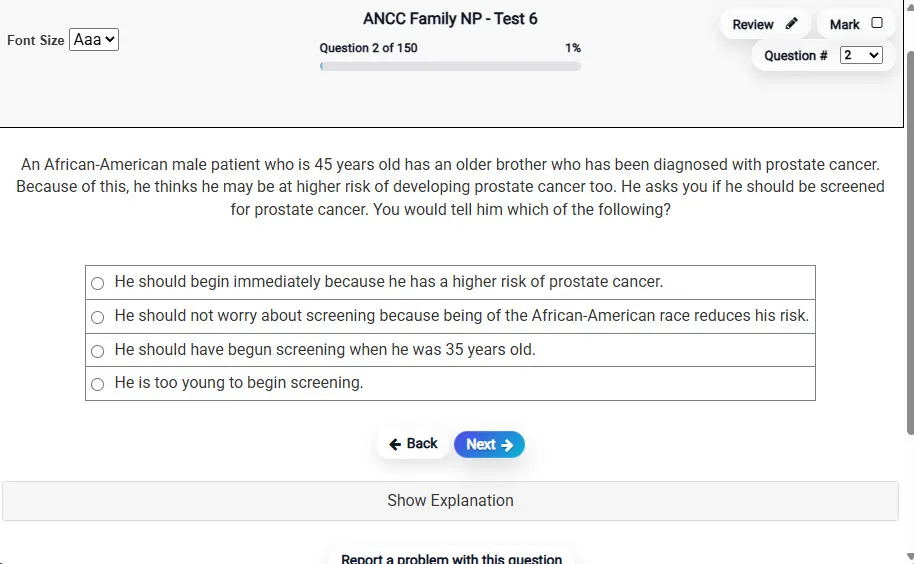
Answering a Question screen – Multiple-choice item view with navigation controls and progress tracker.
Answering a Question Multiple-choice item view with navigation controls and progress tracker.

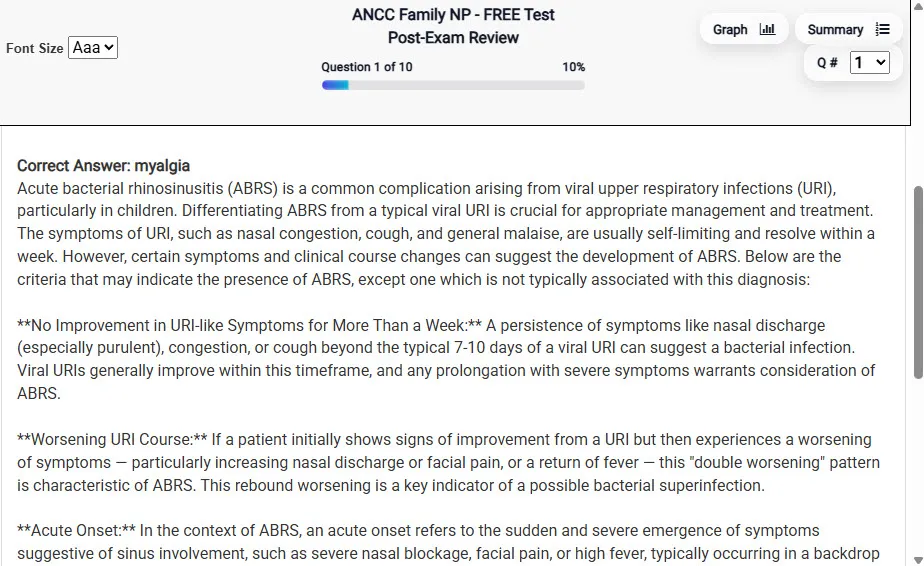
                           Detailed Explanation screen – 
                         Review mode showing chosen answer and rationale and references.
Detailed Explanation Review mode showing chosen answer and rationale and references.

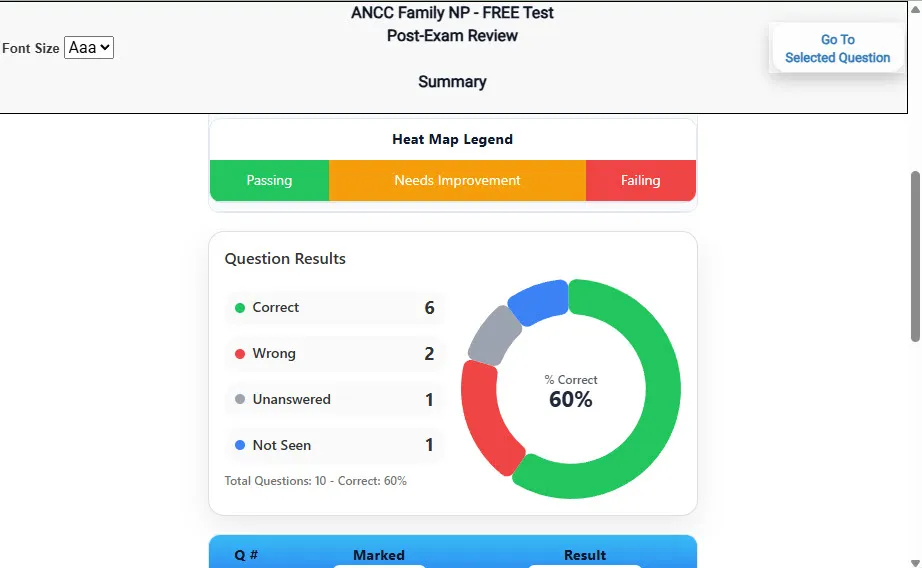
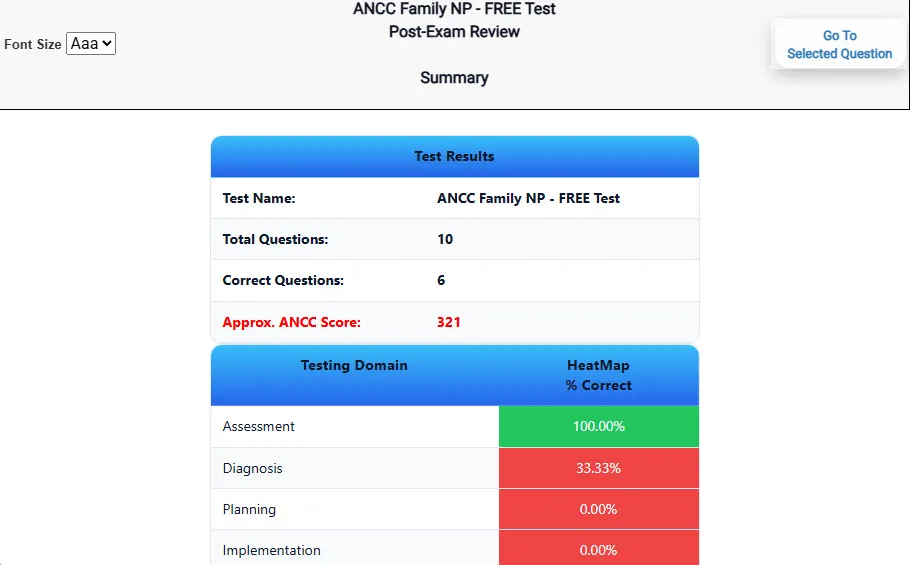
                           Review Summary 1 screen – 
                         Summary with counts for correct/wrong/unanswered and not seen items.
Review Summary 1 Summary with counts for correct/wrong/unanswered and not seen items.

                           Review Summary 2 screen – 
                         Advanced summary with category/domain breakdown and performance insights.
Review Summary 2 Advanced summary with category/domain breakdown and performance insights.

What Each Screen Shows

Answer Question Screen

  • Clean multiple-choice interface with progress bar.
  • Mark for review feature.
  • Matches real test pacing.

Detailed Explanation

  • Correct answer plus rationale.
  • Key concepts and guidelines highlighted.
  • Move between questions to fill knowledge gaps.

Review Summary 1

  • Overall results with total questions and scaled score.
  • Domain heatmap shows strengths and weaknesses.
  • Quick visual feedback on study priorities.

Review Summary 2

  • Chart of correct, wrong, unanswered, not seen.
  • Color-coded results for easy review.
  • Links back to missed items.

Top 10 Reasons to Use Exam Edge for your NYSTCE CST Multi-subject Teachers Of Childhood 1-6 Exam Prep

  1. Focused on the NYSTCE CST Multi-subject Teachers Of Childhood 1-6 Exam

    Our practice tests are built specifically for the NYSTCE CST Multi-subject: Teachers Of Childhood 1-6 exam — every question mirrors the real topics, format, and difficulty so you're studying exactly what matters.

  2. Real Exam Simulation

    We match the per-question time limits and pressure of the actual NYSTCE exam, so test day feels familiar and stress-free.

  3. 20 Full Practice Tests & 2,440 Unique Questions

    You'll have more than enough material to master every NYSTCE CST Multi-subject: Teachers Of Childhood 1-6 concept — no repeats, no fluff.

  4. Lower Cost Than a Retake

    Ordering 5 practice exams costs less than retaking the NYSTCE CST Multi-subject Teachers Of Childhood 1-6 exam after a failure. One low fee could save you both time and money.

  5. Flexible Testing

    Need to step away mid-exam? Pick up right where you left off — with your remaining time intact.

  6. Instant Scoring & Feedback

    See your raw score and an estimated NYSTCE CST Multi-subject Teachers Of Childhood 1-6 score immediately after finishing each practice test.

  7. Detailed Explanations for Every Question

    Review correct and incorrect answers with clear, step-by-step explanations so you truly understand each topic.

  8. Trusted & Accredited

    We're fully accredited by the Better Business Bureau and uphold the highest standards of trust and transparency.

  9. Web-Based & Always Available

    No software to install. Access your NYSTCE CST Multi-subject: Teachers Of Childhood 1-6 practice exams 24/7 from any computer or mobile device.

  10. Expert Support When You Need It

    Need extra help? Our specialized tutors are highly qualified and ready to support your NYSTCE exam prep.


Pass the NYSTCE CST Multi-subject Teachers Of Childhood 1-6 Exam with Realistic Practice Tests from Exam Edge

Preparing for your upcoming NYSTCE CST Multi-subject Teachers Of Childhood 1-6 (221/222/245) Certification Exam can feel overwhelming — but the right practice makes all the difference. Exam Edge gives you the tools, structure, and confidence to pass on your first try. Our online practice exams are built to match the real NYSTCE CST Multi-subject: Teachers Of Childhood 1-6 exam in content, format, and difficulty.

  • 📝 20 NYSTCE CST Multi-subject Teachers Of Childhood 1-6 Practice Tests: Access 20 full-length exams with 122 questions each, covering every major NYSTCE CST Multi-subject Teachers Of Childhood 1-6 topic in depth.
  • Instant Online Access: Start practicing right away — no software, no waiting.
  • 🧠 Step-by-Step Explanations: Understand the reasoning behind every correct answer so you can master NYSTCE CST Multi-subject: Teachers Of Childhood 1-6 exam concepts.
  • 🔄 Retake Each Exam Up to 4 Times: Build knowledge through repetition and track your improvement over time.
  • 🌐 Web-Based & Available 24/7: Study anywhere, anytime, on any device.
  • 🧘 Boost Your Test-Day Confidence: Familiarity with the NYSTCE format reduces anxiety and helps you perform under pressure.

These NYSTCE CST Multi-subject Teachers Of Childhood 1-6 practice exams are designed to simulate the real testing experience by matching question types, timing, and difficulty level. This approach helps you get comfortable not just with the exam content, but also with the testing environment, so you walk into your exam day focused and confident.

Exam Edge NYSTCE Reviews


Not a user friendly experience

Amelia , Rochester, New York

Didn't really reflect the questions that were on the test for the most part. Also, they totally got the format of the constructed response question wrong, which never changes. Overall OK if you have nothing else, but definitely not worth the price they charge in my opinion.

Randy , Queens, New York

It was a good test run. Now I know what to expect and what I need to study.

Timothy , Eden, New York

The experience was very practical and I did well.

Trina , Silver Spring , MD

Very easy to navigate.

Collene , Silver Spring , MD

Exam Edge was terrific. Even better than I hoped. Just completing and reviewing the tests are a great learning experience. I can't wait to take the certification test. Tom S.

Thomas , Port Washington, NY


NYSTCE CST Multi-subject Teachers Of Childhood 1-6 Aliases Test Name

Here is a list of alternative names used for this exam.

  • NYSTCE CST Multi-subject Teachers Of Childhood 1-6
  • NYSTCE CST Multi-subject Teachers Of Childhood 1-6 test
  • NYSTCE CST Multi-subject Teachers Of Childhood 1-6 Certification Test
  • NYSTCE CST Multi-subject: Teachers Of Childhood 1-6 test
  • NYSTCE
  • NYSTCE 221/222/245
  • 221/222/245 test
  • NYSTCE CST Multi-subject Teachers Of Childhood 1-6 (221/222/245)
  • CST Multi-subject Teachers Of Childhood 1-6 certification