This is the content of the pop-over!

CST Multi-subject: Teachers Of Childhood 1-6 ELA (221) Practice Tests & Test Prep by Exam Edge


NYSTCE CST Multi-subject Teachers Of Childhood 1-6 Literacy and English Language Arts product image
(4.8)
Based on 34 Reviews

  • Real Exam Simulation: Timed questions and matching content build comfort for your CST Multi-subject: Teachers Of Childhood 1-6 ELA test day.
  • Instant, 24/7 Access: Web-based NYSTCE CST Multi-subject Teachers Of Childhood 1-6 Literacy and English Language Arts practice exams with no software needed.
  • Clear Explanations: Step-by-step answers and explanations for your NYSTCE exam to strengthen understanding.
  • Boosted Confidence: Reduces anxiety and improves test-taking skills to ace your NYSTCE CST Multi-subject Teachers Of Childhood 1-6 Literacy and English Language Arts (221).

Featured on

NYSTCE CST Multi-subject Teachers Of Childhood 1-6 Literacy and English Language Arts Online Practice Test Bundles

BEST VALUE
20 practice tests

$174.00

$799.00

SAVE $625

Only $8.70 per test!

  • 100% Pass Guarantee
  • 20 online practice tests
  • 40 questions + 1 essay per test
  • Bonus: 100 Flash Cards + Study Guide
  • Instant access
  • Detailed Explanations
  • Practice tests never expire
  • Timed, untimed, or study guide mode
MOST POPULAR
10 practice tests

$99.50

$399.50

SAVE $300

Only $9.95 per test!

  • 10 online practice tests
  • 40 questions + 1 essay per test
  • Bonus: 100 Flash Cards + Study Guide
  • Instant access
  • Detailed Explanations
  • Practice tests never expire
  • Timed, untimed, or study guide mode
5 practice tests

$69.75

$199.75

SAVE $130

Only $13.95 per test!

  • 5 online practice tests
  • 40 questions + 1 essay per test
  • Bonus: 100 Flash Cards
  • Instant access
  • Detailed Explanations
  • Practice tests never expire
  • Timed, untimed, or study guide mode
1 practice test

$39.95

  • 1 online practice test
  • 40 questions + 1 essay per test
  • Instant access
  • Detailed Explanations
  • Practice tests never expire
  • Timed, untimed, or study guide mode
Quick Select
Tap to choose a bundle

** All Prices are in US Dollars (USD) **


CST Multi-subject: Teachers Of Childhood 1-6 ELA (221) Resources

Jump to the section you need most.

Understanding the exact breakdown of the NYSTCE CST Multi-subject Teachers Of Childhood 1-6 Literacy and English Language Arts test will help you know what to expect and how to most effectively prepare. The NYSTCE CST Multi-subject Teachers Of Childhood 1-6 Literacy and English Language Arts has 40 multiple-choice questions and 1 essay questions. The exam will be broken down into the sections below:

NYSTCE CST Multi-subject Teachers Of Childhood 1-6 Literacy and English Language Arts Exam Blueprint
Domain Name % Number of
Questions
Literacy and English Language Arts  
     Knowledge of Literacy Language Arts 30% 12
     Instruction in Foundational Literacy Skills 30% 12
     Instruction in English Language Arts 10% 4
     Analysis - Synthesis Application 30% 12

NYSTCE CST Multi-subject Teachers Of Childhood 1-6 Literacy and English Language Arts Study Tips by Domain

  • Align literacy instruction to NYS learning standards and a clear objective (e.g., theme, main idea, author’s craft); red flag: activities (centers, projects) with no stated literacy outcome or assessment match.
  • Use multiple measures (running records, decoding/fluency checks, comprehension probes, writing samples) to drive instruction; common trap: relying on a single benchmark score without corroborating classroom evidence.
  • Match text complexity to purpose and student need (quantitative, qualitative, and reader/task factors); priority rule: if comprehension breaks down due to decoding load, adjust scaffolds or text rather than “push through”.
  • Teach vocabulary through morphology (prefixes, roots, suffixes), context, and domain knowledge; red flag: asking students to memorize definitions without repeated meaningful use in reading/writing.
  • Integrate reading, writing, speaking/listening, and language (e.g., discussion to plan evidence-based writing); common trap: treating conventions/grammar as isolated worksheets instead of editing for a real writing purpose.
  • Ensure equity and access (ELLs, IEPs, dyslexia risk) with appropriate scaffolds and accommodations while maintaining the same learning target; contraindication: lowering cognitive demand by replacing grade-level tasks with unrelated “easy” work.
  • Differentiate major text types and structures (e.g., narrative, informational, argumentative; compare/contrast, cause/effect) and match instruction to purpose—common trap: teaching “main idea” the same way across all structures.
  • Apply knowledge of the writing process (planning, drafting, revising, editing, publishing) and emphasize revision for meaning before conventions—red flag: grading mechanics heavily on first drafts.
  • Know conventions of English (grammar, usage, capitalization, punctuation) and use context to teach them in authentic sentences—priority rule: correct errors that change meaning first (e.g., subject-verb agreement, tense consistency).
  • Understand vocabulary knowledge (tiers, morphology, context clues, multiple-meaning words) and teach word-learning strategies explicitly—common trap: relying on dictionary definitions instead of using morphemes and context.
  • Recognize literary elements (theme, character, setting, plot, point of view, figurative language) and support claims with text evidence—red flag: students retell without citing specific details or quotes.
  • Understand research and media literacy skills (source credibility, bias, paraphrase vs. plagiarism, citation basics) and teach note-taking routines—threshold: copying phrases without quotation marks or attribution is plagiarism even if the source is listed.
  • Teach phonological awareness in a clear progression (word → syllable → onset-rime → phoneme) and use quick oral checks; red flag: jumping straight to phonics when students can’t blend/segment phonemes accurately.
  • Provide explicit, systematic phonics with cumulative review (short vowels, common digraphs, blends, r-controlled, vowel teams) and keep a scope-and-sequence; common trap: relying on word lists/worksheets without daily decoding practice in connected text.
  • Build accurate decoding with a routine (model → guided → independent) using decodable text aligned to taught patterns; priority rule: if the text includes many untaught patterns, it won’t isolate the skill and errors will look like “poor comprehension.”
  • Develop automaticity and fluency (accuracy, rate, prosody) through repeated reading with feedback and phrasing practice; red flag: pushing speed goals when accuracy is below about 95% in grade-level passages.
  • Teach spelling/encoding as the “flip side” of decoding (phoneme-grapheme mapping, word sorts, morphology as appropriate) with immediate error correction; common trap: memorizing weekly word lists instead of teaching patterns and generalizations.
  • Differentiate using data from brief assessments (phonemic segmentation, nonsense-word decoding, oral reading fluency) and intensify instruction promptly; NYSTCE-style pitfall: choosing interventions that are not matched to the specific deficit (e.g., extra silent reading for weak decoding).
  • Plan ELA lessons with a clear objective tied to a specific reading/writing standard and an aligned assessment; red flag: activities (e.g., crafts, “fun” projects) that don’t produce evidence of the targeted skill.
  • Use text-dependent questions that move from literal to inferential to analytic and require citing evidence; common trap: questions answerable from prior knowledge instead of the text.
  • Teach writing as a process (plan → draft → revise → edit → publish) with explicit models and rubrics; priority rule: give feedback first on meaning/organization before conventions.
  • Build academic language by preteaching only critical vocabulary and teaching word-learning strategies (context, morphology, reference tools); red flag: long word lists or definitions without repeated use in speaking/writing.
  • Differentiate ELA instruction using flexible grouping, leveled supports, and scaffolds (sentence frames, graphic organizers, chunking) while keeping the same learning goal; contraindication: lowering the cognitive demand instead of increasing support.
  • Use formative assessment (running notes, conferring, exit slips, quick writes) to adjust instruction immediately; common trap: relying only on end-of-unit tests and missing misconceptions in comprehension or writing.
  • When given a student work sample or running record, identify the highest-leverage pattern (e.g., meaning vs. structure vs. visual/phonics) and choose one targeted next step—red flag: naming a generic strategy without citing evidence from the data.
  • In multi-text questions, synthesize a central idea across sources and explain how specific details support it—common trap: summarizing each text separately without an explicit connection.
  • Match an instructional response to the precise skill deficit (e.g., weak decoding vs. weak vocabulary vs. weak comprehension monitoring)—priority rule: address access to print (decoding/fluency) before expecting higher-order comprehension in complex text.
  • Use assessment information to adjust grouping and scaffolds (e.g., reteach in small group, enrich independently)—red flag: reteaching the same way after data show no growth.
  • When evaluating lesson plans, check alignment among objective, task, and assessment—common trap: an objective about inference paired with questions that only ask for recall.
  • In applied scenarios, choose supports that preserve grade-level rigor (e.g., chunking, pre-teaching critical vocabulary, sentence frames) rather than replacing the text—contraindication: lowering complexity instead of scaffolding comprehension.


Built to Fit Into Your Busy Life

Everything you need to prepare with confidence—without wasting a minute.

Three Study Modes

Timed, No Time Limit, or Explanation mode.

Actionable Analytics

Heatmaps and scaled scores highlight weak areas.

High-Yield Rationales

Concise explanations emphasize key concepts.

Realistic Interface

Matches the feel of the actual exam environment.

Accessible by Design

Clean layout reduces cognitive load.

Anytime, Anywhere

Web-based access 24/7 on any device.
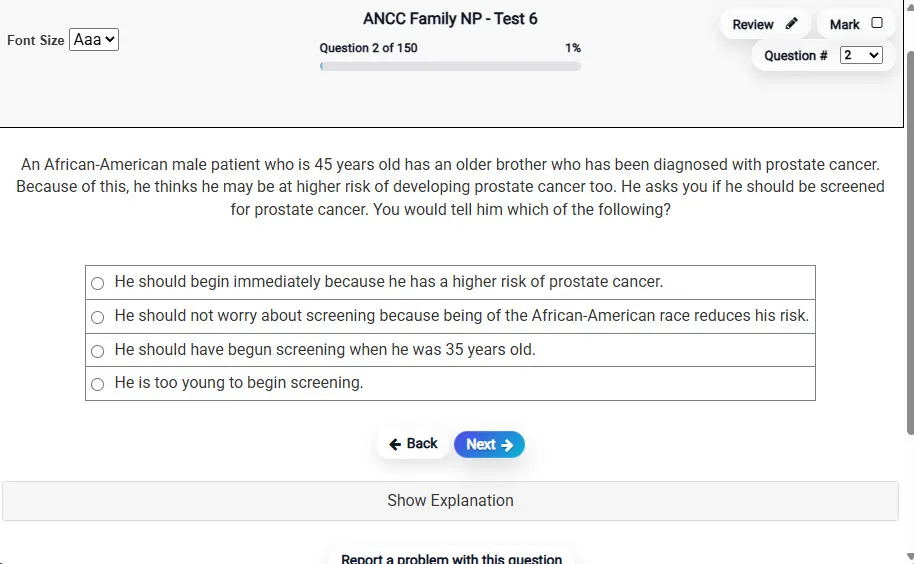
Answering a Question screen – Multiple-choice item view with navigation controls and progress tracker.
Answering a Question Multiple-choice item view with navigation controls and progress tracker.

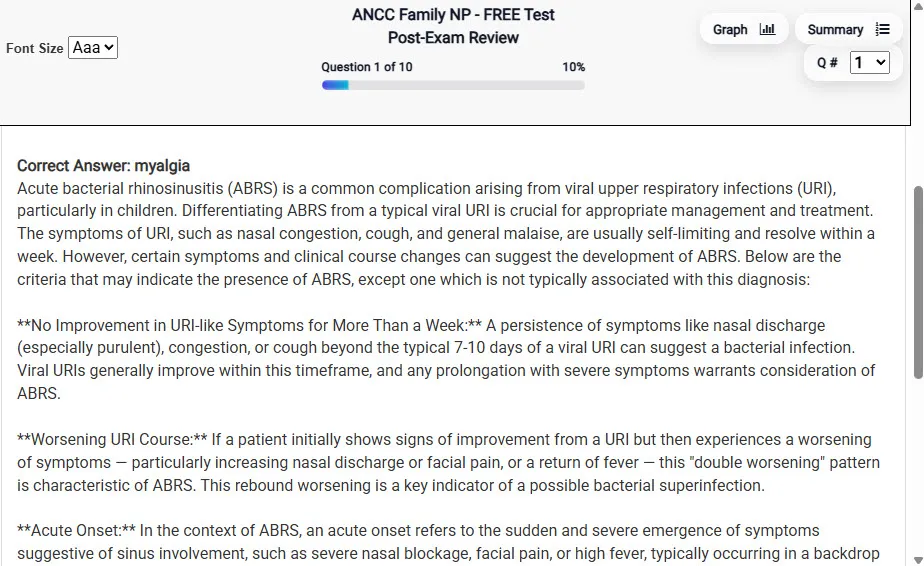
                           Detailed Explanation screen – 
                         Review mode showing chosen answer and rationale and references.
Detailed Explanation Review mode showing chosen answer and rationale and references.

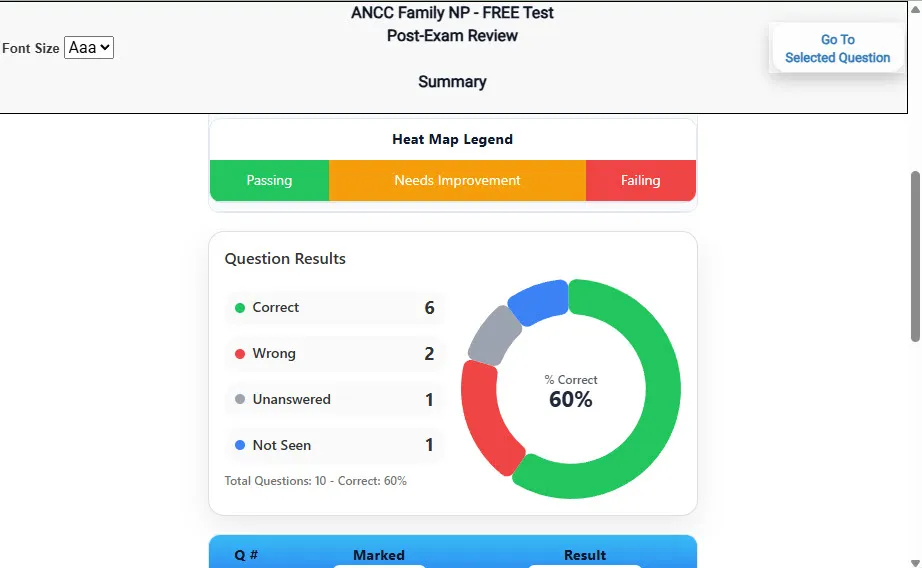
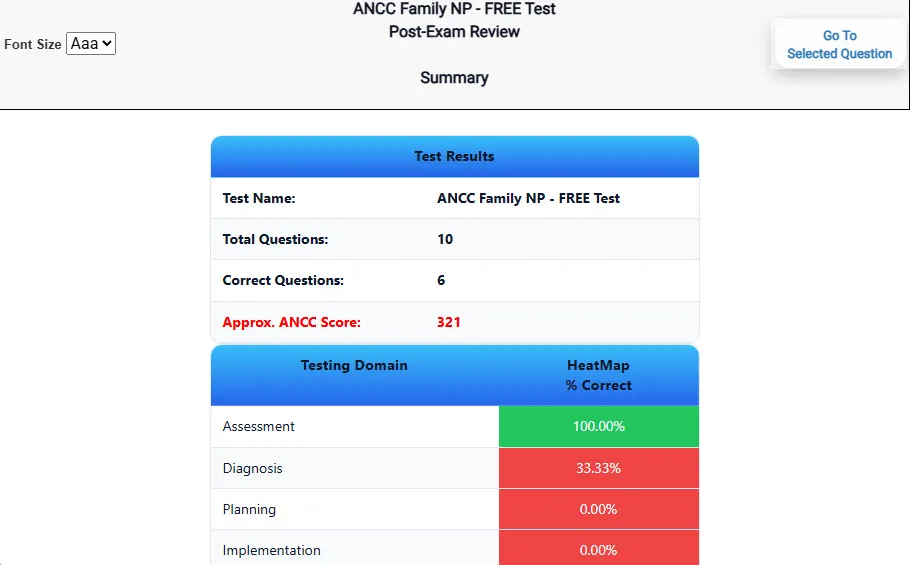
                           Review Summary 1 screen – 
                         Summary with counts for correct/wrong/unanswered and not seen items.
Review Summary 1 Summary with counts for correct/wrong/unanswered and not seen items.

                           Review Summary 2 screen – 
                         Advanced summary with category/domain breakdown and performance insights.
Review Summary 2 Advanced summary with category/domain breakdown and performance insights.

What Each Screen Shows

Answer Question Screen

  • Clean multiple-choice interface with progress bar.
  • Mark for review feature.
  • Matches real test pacing.

Detailed Explanation

  • Correct answer plus rationale.
  • Key concepts and guidelines highlighted.
  • Move between questions to fill knowledge gaps.

Review Summary 1

  • Overall results with total questions and scaled score.
  • Domain heatmap shows strengths and weaknesses.
  • Quick visual feedback on study priorities.

Review Summary 2

  • Chart of correct, wrong, unanswered, not seen.
  • Color-coded results for easy review.
  • Links back to missed items.

Top 10 Reasons to Use Exam Edge for your NYSTCE CST Multi-subject Teachers Of Childhood 1-6 Literacy and English Language Arts Exam Prep

  1. Focused on the NYSTCE CST Multi-subject Teachers Of Childhood 1-6 Literacy and English Language Arts Exam

    Our practice tests are built specifically for the CST Multi-subject: Teachers Of Childhood 1-6 ELA exam — every question mirrors the real topics, format, and difficulty so you're studying exactly what matters.

  2. Real Exam Simulation

    We match the per-question time limits and pressure of the actual NYSTCE exam, so test day feels familiar and stress-free.

  3. 20 Full Practice Tests & 820 Unique Questions

    You'll have more than enough material to master every CST Multi-subject: Teachers Of Childhood 1-6 ELA concept — no repeats, no fluff.

  4. Lower Cost Than a Retake

    Ordering 5 practice exams costs less than retaking the NYSTCE CST Multi-subject Teachers Of Childhood 1-6 Literacy and English Language Arts exam after a failure. One low fee could save you both time and money.

  5. Flexible Testing

    Need to step away mid-exam? Pick up right where you left off — with your remaining time intact.

  6. Instant Scoring & Feedback

    See your raw score and an estimated NYSTCE CST Multi-subject Teachers Of Childhood 1-6 Literacy and English Language Arts score immediately after finishing each practice test.

  7. Detailed Explanations for Every Question

    Review correct and incorrect answers with clear, step-by-step explanations so you truly understand each topic.

  8. Trusted & Accredited

    We're fully accredited by the Better Business Bureau and uphold the highest standards of trust and transparency.

  9. Web-Based & Always Available

    No software to install. Access your CST Multi-subject: Teachers Of Childhood 1-6 ELA practice exams 24/7 from any computer or mobile device.

  10. Expert Support When You Need It

    Need extra help? Our specialized tutors are highly qualified and ready to support your NYSTCE exam prep.


Pass the NYSTCE CST Multi-subject Teachers Of Childhood 1-6 Literacy and English Language Arts Exam with Realistic Practice Tests from Exam Edge

Preparing for your upcoming NYSTCE CST Multi-subject Teachers Of Childhood 1-6 Literacy and English Language Arts (221) Certification Exam can feel overwhelming — but the right practice makes all the difference. Exam Edge gives you the tools, structure, and confidence to pass on your first try. Our online practice exams are built to match the real CST Multi-subject: Teachers Of Childhood 1-6 ELA exam in content, format, and difficulty.

  • 📝 20 NYSTCE CST Multi-subject Teachers Of Childhood 1-6 Literacy and English Language Arts Practice Tests: Access 20 full-length exams with 41 questions each, covering every major NYSTCE CST Multi-subject Teachers Of Childhood 1-6 Literacy and English Language Arts topic in depth.
  • Instant Online Access: Start practicing right away — no software, no waiting.
  • 🧠 Step-by-Step Explanations: Understand the reasoning behind every correct answer so you can master CST Multi-subject: Teachers Of Childhood 1-6 ELA exam concepts.
  • 🔄 Retake Each Exam Up to 4 Times: Build knowledge through repetition and track your improvement over time.
  • 🌐 Web-Based & Available 24/7: Study anywhere, anytime, on any device.
  • 🧘 Boost Your Test-Day Confidence: Familiarity with the NYSTCE format reduces anxiety and helps you perform under pressure.

These NYSTCE CST Multi-subject Teachers Of Childhood 1-6 Literacy and English Language Arts practice exams are designed to simulate the real testing experience by matching question types, timing, and difficulty level. This approach helps you get comfortable not just with the exam content, but also with the testing environment, so you walk into your exam day focused and confident.


Exam Edge NYSTCE Reviews


Not a user friendly experience

Amelia , Rochester, New York

Didn't really reflect the questions that were on the test for the most part. Also, they totally got the format of the constructed response question wrong, which never changes. Overall OK if you have nothing else, but definitely not worth the price they charge in my opinion.

Randy , Queens, New York

It was a good test run. Now I know what to expect and what I need to study.

Timothy , Eden, New York

The experience was very practical and I did well.

Trina , Silver Spring , MD

Very easy to navigate.

Collene , Silver Spring , MD

Exam Edge was terrific. Even better than I hoped. Just completing and reviewing the tests are a great learning experience. I can't wait to take the certification test. Tom S.

Thomas , Port Washington, NY


NYSTCE CST Multi-subject Teachers Of Childhood 1-6 Literacy and English Language Arts Aliases Test Name

Here is a list of alternative names used for this exam.

  • NYSTCE CST Multi-subject Teachers Of Childhood 1-6 Literacy and English Language Arts
  • NYSTCE CST Multi-subject Teachers Of Childhood 1-6 Literacy and English Language Arts test
  • NYSTCE CST Multi-subject Teachers Of Childhood 1-6 Literacy and English Language Arts Certification Test
  • CST Multi-subject: Teachers Of Childhood 1-6 ELA test
  • NYSTCE
  • NYSTCE 221
  • 221 test
  • NYSTCE CST Multi-subject Teachers Of Childhood 1-6 Literacy and English Language Arts (221)
  • CST Multi-subject Teachers Of Childhood 1-6 Literacy and English Language Arts certification