This is the content of the pop-over!

NYSTCE CST Chemistry (161) Practice Tests & Test Prep by Exam Edge


NYSTCE CST Chemistry  product image
(4.5)
Based on 17 Reviews

  • Real Exam Simulation: Timed questions and matching content build comfort for your NYSTCE CST Chemistry test day.
  • Instant, 24/7 Access: Web-based NYSTCE CST Chemistry practice exams with no software needed.
  • Clear Explanations: Step-by-step answers and explanations for your NYSTCE exam to strengthen understanding.
  • Boosted Confidence: Reduces anxiety and improves test-taking skills to ace your NYSTCE CST Chemistry (161).

Featured on

NYSTCE CST Chemistry Online Practice Test Bundles

BEST VALUE
20 practice tests

$174.00

$799.00

SAVE $625

Only $8.70 per test!

  • 100% Pass Guarantee
  • 20 online practice tests
  • 90 questions per test
  • Bonus: 100 Flash Cards + Study Guide
  • Instant access
  • Detailed Explanations
  • Practice tests never expire
  • Timed, untimed, or study guide mode
MOST POPULAR
10 practice tests

$99.50

$399.50

SAVE $300

Only $9.95 per test!

  • 10 online practice tests
  • 90 questions per test
  • Bonus: 100 Flash Cards + Study Guide
  • Instant access
  • Detailed Explanations
  • Practice tests never expire
  • Timed, untimed, or study guide mode
5 practice tests

$69.75

$199.75

SAVE $130

Only $13.95 per test!

  • 5 online practice tests
  • 90 questions per test
  • Bonus: 100 Flash Cards
  • Instant access
  • Detailed Explanations
  • Practice tests never expire
  • Timed, untimed, or study guide mode
1 practice test

$39.95

  • 1 online practice test
  • 90 questions per test
  • Instant access
  • Detailed Explanations
  • Practice tests never expire
  • Timed, untimed, or study guide mode
Quick Select
Tap to choose a bundle

** All Prices are in US Dollars (USD) **


NYSTCE CST Chemistry (161) Resources

Jump to the section you need most.

Understanding the exact breakdown of the NYSTCE CST Chemistry test will help you know what to expect and how to most effectively prepare. The NYSTCE CST Chemistry has 90 multiple-choice questions and 1 essay questions. The exam will be broken down into the sections below:

NYSTCE CST Chemistry Exam Blueprint
Domain Name % Number of
Questions
Structure of Matter 20% 18
Properties of Matter 20% 18
Chemical Reactions 20% 18
Energy 20% 18
Pedagogical Content Knowledge (Constructed-Response) not on Practice test 20% 18

NYSTCE CST Chemistry Study Tips by Domain

  • Distinguish atomic number, mass number, and isotopes/ions; red flag: using average atomic mass to identify a specific isotope instead of using mass number.
  • Apply electron configuration and orbital diagrams (Aufbau, Pauli, Hund) to predict properties; common trap: forgetting 4s fills before 3d but 4s electrons are lost first in transition-metal cations.
  • Use periodic trends (radius, ionization energy, electronegativity) with clear directionality; priority rule: when comparing trends, state “across a period” vs “down a group” to avoid reversed conclusions.
  • Classify bonding (ionic, covalent, metallic) and relate to lattice/network structure; red flag: assuming all covalent substances conduct electricity—graphite conducts, diamond does not.
  • Determine molecular geometry and polarity via Lewis structures and VSEPR; common trap: treating lone pairs as “invisible” and predicting wrong shapes (e.g., NH3 is trigonal pyramidal, not trigonal planar).
  • Connect intermolecular forces (London, dipole–dipole, hydrogen bonding) to boiling/melting points and solubility; threshold cue: hydrogen bonding requires H bonded to N, O, or F—H attached to C does not qualify.
  • Classify substances by intensive vs. extensive properties (e.g., density vs. mass) and use density as an identity check—red flag: assuming density changes when sample size changes.
  • Distinguish physical vs. chemical properties/changes (phase change vs. reaction) and tie evidence to observations (gas, precipitate, color, heat)—common trap: calling boiling a chemical change.
  • Use phase diagrams to identify phase at given T/P and locate triple/critical points—priority rule: below the triple-point pressure, a substance cannot exist as a liquid.
  • Apply intermolecular force strength (dispersion, dipole-dipole, H-bonding) to predict boiling point, viscosity, surface tension, and vapor pressure—red flag: stronger IMFs mean lower (not higher) vapor pressure at the same temperature.
  • Analyze solution properties (solubility trends, conductivity, colligative effects) and identify electrolytes vs. nonelectrolytes—common trap: assuming all polar solutes conduct or forgetting acids/bases are electrolytes in water.
  • Relate physical properties to bonding/structure (ionic vs. molecular vs. network covalent vs. metallic) to predict melting point, hardness, and conductivity—contraindication: graphite conducts despite being covalent because of delocalized electrons.
  • Balance equations by conserving atoms and charge (especially for ionic and redox reactions); red flag: coefficients change atom counts, subscripts never do.
  • Classify reactions (synthesis, decomposition, single/double replacement, combustion, acid–base, redox) using oxidation numbers; common trap: assuming precipitation without checking solubility rules.
  • Predict products for acid–base and gas-forming reactions (e.g., carbonates → CO2, sulfites → SO2, ammonium salts + base → NH3); cue: write net ionic equations by canceling spectator ions.
  • Use stoichiometry from a balanced equation (mole ratios, limiting reactant, percent yield); priority rule: identify the limiting reagent before calculating theoretical yield.
  • Apply equilibrium concepts qualitatively and quantitatively (K, Q, Le Châtelier); red flag: catalysts change rate but do not change K or equilibrium position.
  • Relate reaction rates to collision theory (concentration, temperature, surface area, catalysts) and interpret rate laws/graphs; common trap: confusing reaction order with stoichiometric coefficients unless explicitly given.
  • Use thermochemistry sign conventions consistently: q > 0 when the system absorbs heat and ΔH < 0 for exothermic reactions; red flag—many errors come from mixing up “system” vs. “surroundings.”
  • Know calorimetry basics (q = mcΔT) and the threshold cue that ΔT is final minus initial; common trap—using the calorimeter’s temperature change with the reaction’s sign without reversing it.
  • Apply Hess’s law by reversing reactions (flip the sign of ΔH) and scaling coefficients (scale ΔH accordingly); priority rule—manipulate equations first, then add enthalpies last.
  • Relate ΔG, ΔH, and ΔS via ΔG = ΔH − TΔS (T in kelvins); red flag—predicting spontaneity from ΔH alone when entropy and temperature dominate.
  • Distinguish kinetic vs. thermodynamic control: catalysts lower activation energy (Ea) but do not change ΔG or equilibrium; common trap—claiming a catalyst makes an endergonic process spontaneous.
  • For phase changes and heating curves, use q = nΔHfus or nΔHvap on plateaus and q = mcΔT on slopes; red flag—using ΔT during a phase change where temperature stays constant.
  • Start by stating the learning objective in NYS chemistry terms (what students will know/do) and align evidence to it; red flag: answering with “fun activity” details but no measurable outcome.
  • Use a claim–evidence–reasoning structure when scoring student work or explaining expected responses; common trap: accepting correct numbers without units, significant figures, or chemical justification.
  • Plan misconceptions explicitly (e.g., equilibrium “stops,” heat vs. temperature, conservation of mass in open systems) and include a targeted check-for-understanding; priority rule: address the misconception before introducing extensions.
  • Specify lab safety and procedure controls (PPE, proper disposal, ventilation, control variables) when describing an investigation; red flag: omitting a key safety constraint for acids/bases, flammables, or unknowns.
  • Differentiate instruction with a concrete scaffold (sentence frames for CER, particle diagrams, guided calculations) and a rigorous extension (transfer to a new context); common trap: lowering cognitive demand instead of scaffolding access.
  • Include an assessment plan with criteria (rubric descriptors, partial-credit points, or exemplar features) and next steps based on results; threshold cue: identify what would count as proficiency vs. common errors and how you would respond instructionally.


Built to Fit Into Your Busy Life

Everything you need to prepare with confidence—without wasting a minute.

Three Study Modes

Timed, No Time Limit, or Explanation mode.

Actionable Analytics

Heatmaps and scaled scores highlight weak areas.

High-Yield Rationales

Concise explanations emphasize key concepts.

Realistic Interface

Matches the feel of the actual exam environment.

Accessible by Design

Clean layout reduces cognitive load.

Anytime, Anywhere

Web-based access 24/7 on any device.
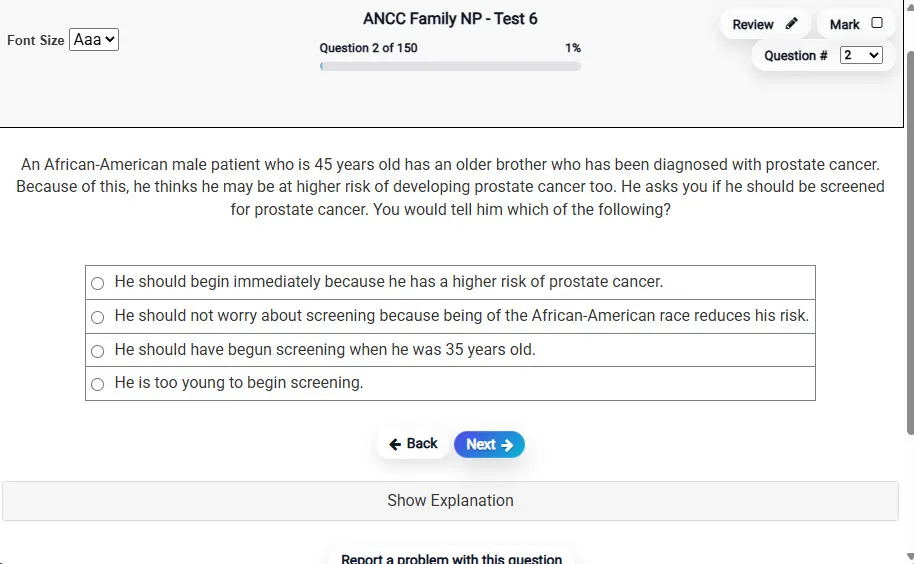
Answering a Question screen – Multiple-choice item view with navigation controls and progress tracker.
Answering a Question Multiple-choice item view with navigation controls and progress tracker.

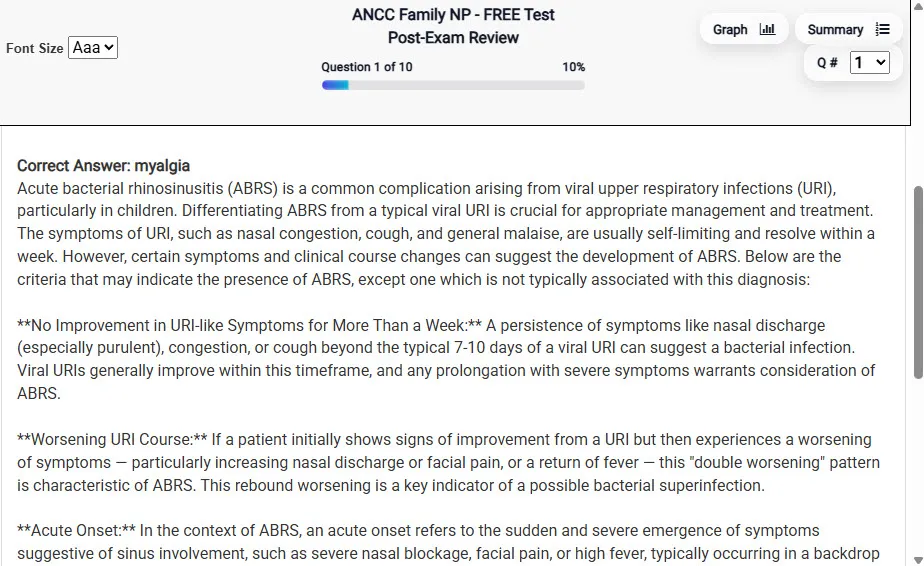
                           Detailed Explanation screen – 
                         Review mode showing chosen answer and rationale and references.
Detailed Explanation Review mode showing chosen answer and rationale and references.

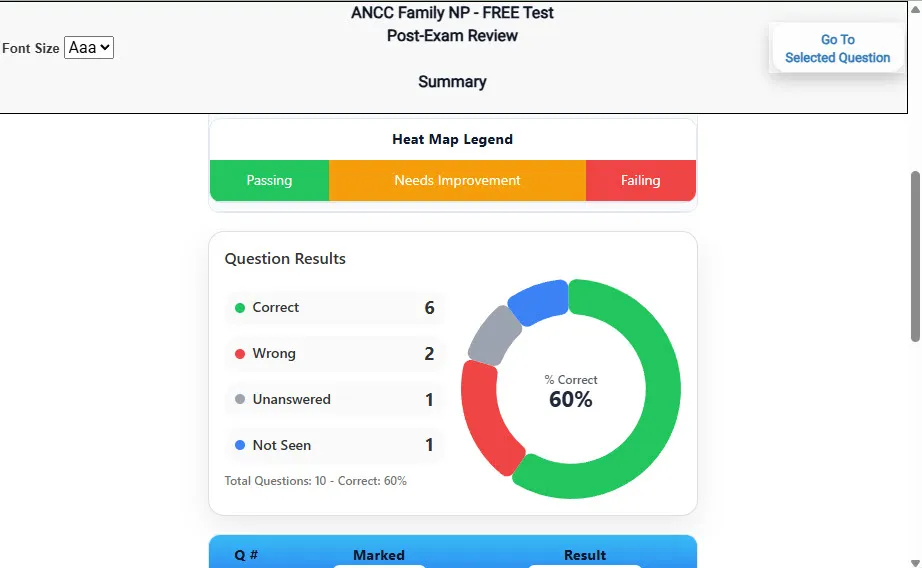
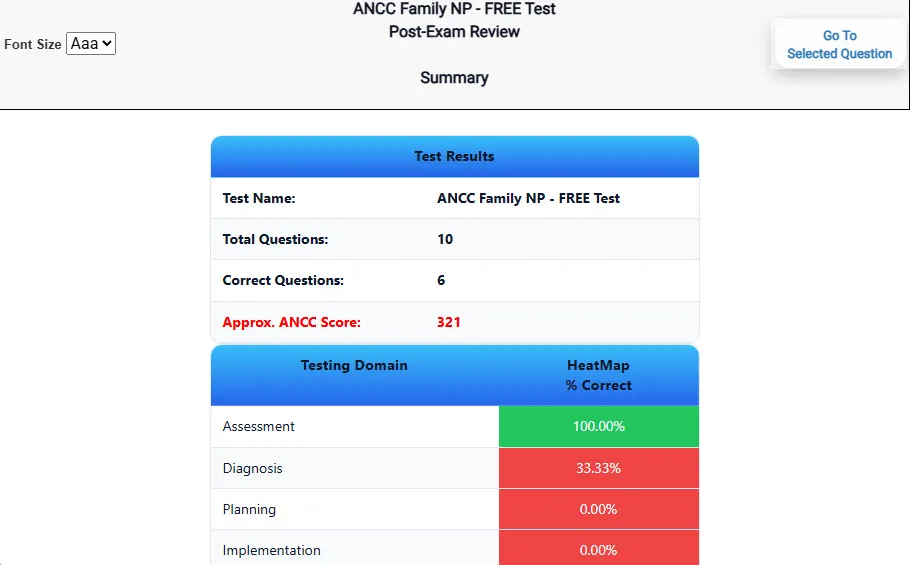
                           Review Summary 1 screen – 
                         Summary with counts for correct/wrong/unanswered and not seen items.
Review Summary 1 Summary with counts for correct/wrong/unanswered and not seen items.

                           Review Summary 2 screen – 
                         Advanced summary with category/domain breakdown and performance insights.
Review Summary 2 Advanced summary with category/domain breakdown and performance insights.

What Each Screen Shows

Answer Question Screen

  • Clean multiple-choice interface with progress bar.
  • Mark for review feature.
  • Matches real test pacing.

Detailed Explanation

  • Correct answer plus rationale.
  • Key concepts and guidelines highlighted.
  • Move between questions to fill knowledge gaps.

Review Summary 1

  • Overall results with total questions and scaled score.
  • Domain heatmap shows strengths and weaknesses.
  • Quick visual feedback on study priorities.

Review Summary 2

  • Chart of correct, wrong, unanswered, not seen.
  • Color-coded results for easy review.
  • Links back to missed items.

Top 10 Reasons to Use Exam Edge for your NYSTCE CST Chemistry Exam Prep

  1. Focused on the NYSTCE CST Chemistry Exam

    Our practice tests are built specifically for the NYSTCE CST Chemistry exam — every question mirrors the real topics, format, and difficulty so you're studying exactly what matters.

  2. Real Exam Simulation

    We match the per-question time limits and pressure of the actual NYSTCE exam, so test day feels familiar and stress-free.

  3. 20 Full Practice Tests & 1,800 Unique Questions

    You'll have more than enough material to master every NYSTCE CST Chemistry concept — no repeats, no fluff.

  4. Lower Cost Than a Retake

    Ordering 5 practice exams costs less than retaking the NYSTCE CST Chemistry exam after a failure. One low fee could save you both time and money.

  5. Flexible Testing

    Need to step away mid-exam? Pick up right where you left off — with your remaining time intact.

  6. Instant Scoring & Feedback

    See your raw score and an estimated NYSTCE CST Chemistry score immediately after finishing each practice test.

  7. Detailed Explanations for Every Question

    Review correct and incorrect answers with clear, step-by-step explanations so you truly understand each topic.

  8. Trusted & Accredited

    We're fully accredited by the Better Business Bureau and uphold the highest standards of trust and transparency.

  9. Web-Based & Always Available

    No software to install. Access your NYSTCE CST Chemistry practice exams 24/7 from any computer or mobile device.

  10. Expert Support When You Need It

    Need extra help? Our specialized tutors are highly qualified and ready to support your NYSTCE exam prep.


Pass the NYSTCE CST Chemistry Exam with Realistic Practice Tests from Exam Edge

Preparing for your upcoming NYSTCE CST Chemistry (161) Certification Exam can feel overwhelming — but the right practice makes all the difference. Exam Edge gives you the tools, structure, and confidence to pass on your first try. Our online practice exams are built to match the real NYSTCE CST Chemistry exam in content, format, and difficulty.

  • 📝 20 NYSTCE CST Chemistry Practice Tests: Access 20 full-length exams with 90 questions each, covering every major NYSTCE CST Chemistry topic in depth.
  • Instant Online Access: Start practicing right away — no software, no waiting.
  • 🧠 Step-by-Step Explanations: Understand the reasoning behind every correct answer so you can master NYSTCE CST Chemistry exam concepts.
  • 🔄 Retake Each Exam Up to 4 Times: Build knowledge through repetition and track your improvement over time.
  • 🌐 Web-Based & Available 24/7: Study anywhere, anytime, on any device.
  • 🧘 Boost Your Test-Day Confidence: Familiarity with the NYSTCE format reduces anxiety and helps you perform under pressure.

These NYSTCE CST Chemistry practice exams are designed to simulate the real testing experience by matching question types, timing, and difficulty level. This approach helps you get comfortable not just with the exam content, but also with the testing environment, so you walk into your exam day focused and confident.


Exam Edge NYSTCE Reviews


Not a user friendly experience

Amelia , Rochester, New York

Didn't really reflect the questions that were on the test for the most part. Also, they totally got the format of the constructed response question wrong, which never changes. Overall OK if you have nothing else, but definitely not worth the price they charge in my opinion.

Randy , Queens, New York

It was a good test run. Now I know what to expect and what I need to study.

Timothy , Eden, New York

The experience was very practical and I did well.

Trina , Silver Spring , MD

Very easy to navigate.

Collene , Silver Spring , MD

Exam Edge was terrific. Even better than I hoped. Just completing and reviewing the tests are a great learning experience. I can't wait to take the certification test. Tom S.

Thomas , Port Washington, NY


NYSTCE CST Chemistry Aliases Test Name

Here is a list of alternative names used for this exam.

  • NYSTCE CST Chemistry
  • NYSTCE CST Chemistry test
  • NYSTCE CST Chemistry Certification Test
  • NYSTCE
  • NYSTCE 161
  • 161 test
  • NYSTCE CST Chemistry (161)
  • CST Chemistry certification