This is the content of the pop-over!

NYSTCE CST Business and Marketing (069) Practice Tests & Test Prep by Exam Edge


NYSTCE CST Business and Marketing  product image
(4.8)
Based on 32 Reviews

  • Real Exam Simulation: Timed questions and matching content build comfort for your NYSTCE CST Business and Marketing test day.
  • Instant, 24/7 Access: Web-based NYSTCE CST Business and Marketing practice exams with no software needed.
  • Clear Explanations: Step-by-step answers and explanations for your NYSTCE exam to strengthen understanding.
  • Boosted Confidence: Reduces anxiety and improves test-taking skills to ace your NYSTCE CST Business and Marketing (069).

Featured on

NYSTCE CST Business and Marketing Online Practice Test Bundles

BEST VALUE
20 practice tests

$174.00

$799.00

SAVE $625

Only $8.70 per test!

  • 100% Pass Guarantee
  • 20 online practice tests
  • 100 questions per test
  • Bonus: 100 Flash Cards + Study Guide
  • Instant access
  • Detailed Explanations
  • Practice tests never expire
  • Timed, untimed, or study guide mode
MOST POPULAR
10 practice tests

$99.50

$399.50

SAVE $300

Only $9.95 per test!

  • 10 online practice tests
  • 100 questions per test
  • Bonus: 100 Flash Cards + Study Guide
  • Instant access
  • Detailed Explanations
  • Practice tests never expire
  • Timed, untimed, or study guide mode
5 practice tests

$69.75

$199.75

SAVE $130

Only $13.95 per test!

  • 5 online practice tests
  • 100 questions per test
  • Bonus: 100 Flash Cards
  • Instant access
  • Detailed Explanations
  • Practice tests never expire
  • Timed, untimed, or study guide mode
1 practice test

$39.95

  • 1 online practice test
  • 100 questions per test
  • Instant access
  • Detailed Explanations
  • Practice tests never expire
  • Timed, untimed, or study guide mode
Quick Select
Tap to choose a bundle

** All Prices are in US Dollars (USD) **


NYSTCE CST Business and Marketing (069) Resources

Jump to the section you need most.

Understanding the exact breakdown of the NYSTCE CST Business and Marketing test will help you know what to expect and how to most effectively prepare. The NYSTCE CST Business and Marketing has 90 multiple-choice questions . The exam will be broken down into the sections below:

NYSTCE CST Business and Marketing Exam Blueprint
Domain Name % Number of
Questions
Business management 15% 14
Marketing 19% 17
Accounting 15% 14
Business technology and information systems 19% 17
Economics - entrepreneurship international business 11% 10
Quantitative analysis - consumer economics career development 11% 10
Business management 10% 9

NYSTCE CST Business and Marketing Study Tips by Domain

  • Apply core management functions (planning, organizing, leading, controlling) and align them to measurable objectives—red flag: goals without KPIs or timelines are difficult to evaluate on CST scenarios.
  • Use appropriate organizational structures (line, line-and-staff, matrix, team-based) based on size and complexity—common trap: choosing a matrix without clarifying dual reporting and conflict-resolution processes.
  • Differentiate leadership styles (autocratic, democratic, laissez-faire, transformational) and match them to situational needs—priority rule: safety, legal compliance, and ethics override participative decision-making.
  • Implement staffing processes (job analysis, recruitment, selection, onboarding, training, appraisal) with documentation—red flag: inconsistent performance evaluations can create HR liability and undermine equity.
  • Manage operations with quality and productivity tools (workflow analysis, TQM/continuous improvement, benchmarking) and basic project controls—common trap: focusing on output volume while ignoring defect rates and rework costs.
  • Apply ethical and legal decision-making in workplace issues (conflicts of interest, harassment, discrimination, privacy, safety) and know when to escalate—contraindication: “handle informally” when policy requires reporting and documentation.
  • Use STP to justify a marketing plan: define measurable segments, choose a target, and write a one-sentence positioning statement; red flag—vague targets like “everyone” or “all students” rarely earn credit.
  • Apply the 4Ps/marketing mix to match strategy to execution (product, price, place, promotion); common trap—proposing heavy promotion when distribution (“place”) constraints prevent customers from buying.
  • Read and interpret basic research outputs (sample, margin of error, validity/reliability) before acting; priority rule—don’t generalize results from a convenience sample to the whole market.
  • Choose pricing methods (cost-plus, value-based, competitive) and consider elasticity; red flag—raising price in a highly elastic market often reduces total revenue unless value/ differentiation is strengthened.
  • Plan promotion ethically and legally (truth in advertising, endorsements, privacy) with clear objectives and metrics; common trap—claims like “guaranteed” or undisclosed influencer sponsorships can violate standards and backfire.
  • Track performance with marketing metrics (conversion rate, CAC, CLV, ROI) and adjust based on data; threshold cue—if CAC exceeds CLV, scaling the campaign is a losing strategy even if sales are increasing.
  • Master the accounting equation and double-entry rules; red flag: any journal entry that leaves Assets ≠ Liabilities + Equity will be incorrect.
  • Differentiate accrual vs. cash basis and apply adjusting entries (prepaids, accruals, depreciation); common trap: recording revenue/expense without matching to the correct period.
  • Prepare and interpret the core financial statements (income statement, balance sheet, statement of cash flows) and their linkages; cue: net income flows to retained earnings, not directly to cash.
  • Know merchandising inventory systems (perpetual vs. periodic) and valuation (FIFO, LIFO, weighted average); priority rule: COGS and ending inventory must reconcile to goods available for sale.
  • Use basic ratio analysis (liquidity, solvency, profitability) to evaluate financial health; red flag: comparing ratios without checking consistent time periods and industry context.
  • Apply internal controls and ethics concepts (segregation of duties, authorization, documentation); common trap on tests: one person handling custody of assets and recordkeeping is a control weakness.
  • Differentiate hardware, system software, and application software; red flag: confusing an operating system’s functions (resource management, security, file systems) with what applications do.
  • Know common network types and components (LAN/WAN, routers, switches, Wi-Fi, client–server vs. peer-to-peer); common trap: assuming a switch routes between networks—routing is the router’s job.
  • Apply cybersecurity basics (authentication vs. authorization, encryption, firewalls, malware/phishing); priority rule: use least privilege and strong passwords/MFA, especially for student or customer data.
  • Use spreadsheets and databases appropriately (formulas, relative vs. absolute references, pivot tables; tables, keys, queries); threshold cue: if data are repeated across rows, normalize into related tables rather than one giant worksheet.
  • Understand information systems in business (TPS, MIS, DSS, ERP/CRM) and how data flow supports decisions; red flag: treating reports as real-time when they rely on batch processing or stale extracts.
  • Address legal/ethical technology issues (copyright, licensing, acceptable use, privacy/confidentiality); contraindication: installing unlicensed software or sharing login credentials—both are compliance and security violations.
  • Use supply-and-demand shifts (not just movement along a curve) to predict price/quantity changes; red flag: calling an increase in demand a “supply increase” because quantity sold rises.
  • Apply elasticity correctly for pricing and tax-incidence questions—when demand is inelastic, total revenue rises with a price increase; common trap: reversing the sign or mixing up elastic vs. inelastic cases.
  • Recognize core entrepreneurship finance thresholds: break-even occurs where total revenue = total cost and contribution margin drives the break-even units; red flag: using gross profit instead of contribution margin for CVP problems.
  • Know business-formation and liability implications (sole proprietorship, partnership, corporation, LLC)—priority rule: limited liability generally protects owners’ personal assets unless personal guarantees or fraud apply.
  • For international business, distinguish absolute vs. comparative advantage and interpret trade-offs; common trap: assuming the country with the lower absolute cost always gains more from trade.
  • Handle currency and trade-policy basics: an appreciating domestic currency tends to make exports less competitive and imports cheaper; red flag: claiming both exports and imports rise from appreciation without justification.
  • Use quantitative decision tools (e.g., break-even, contribution margin, ROI) to justify recommendations; red flag: mixing up fixed vs. variable costs or using revenue instead of contribution margin in break-even.
  • Interpret financial statements and ratios (liquidity, profitability, solvency) to assess performance; common trap: treating cash flow as the same as net income when answering “ability to pay” questions.
  • Apply consumer economics concepts (utility, elasticity, opportunity cost, marginal analysis) to predict buying behavior; priority rule: if elasticity > 1, price decreases tend to raise total revenue (and vice versa).
  • Compute and compare credit costs (APR, total finance charge, amortization) and evaluate consumer protection implications; red flag: choosing the lowest monthly payment without checking total cost of credit.
  • Use quantitative methods for careers (wage calculations, benefits valuation, time value of money for education/training ROI); threshold cue: compare net present value (NPV) of options rather than just starting salary.
  • Read and create basic charts/tables (frequency, mean/median, percent change, index numbers) for consumer and workforce data; common trap: using mean when data are skewed—median is often the better descriptor.
  • Apply core management functions (planning, organizing, leading, controlling) to business scenarios; red flag: choosing a leadership style that doesn’t match task maturity or urgency.
  • Interpret organizational structures (line, functional, matrix) and spans of control; common trap: assuming matrix improves speed without increasing role conflict and dual-authority issues.
  • Use decision-making tools (SWOT, SMART goals, cost–benefit, risk analysis) and define measurable KPIs; priority rule: if a goal can’t be measured, it can’t be effectively controlled.
  • Manage human resources basics (recruitment, selection, training, performance appraisal) with legal/ethical compliance; red flag: interview questions that probe protected characteristics rather than job-related criteria.
  • Align operations and quality (workflow, capacity, inventory concepts, continuous improvement) to customer requirements; common trap: optimizing one department’s efficiency while creating bottlenecks downstream.
  • Apply business ethics and social responsibility in management choices (conflicts of interest, confidentiality, fair dealing); contraindication: using customer or employee data beyond the stated purpose or without authorization.


Built to Fit Into Your Busy Life

Everything you need to prepare with confidence—without wasting a minute.

Three Study Modes

Timed, No Time Limit, or Explanation mode.

Actionable Analytics

Heatmaps and scaled scores highlight weak areas.

High-Yield Rationales

Concise explanations emphasize key concepts.

Realistic Interface

Matches the feel of the actual exam environment.

Accessible by Design

Clean layout reduces cognitive load.

Anytime, Anywhere

Web-based access 24/7 on any device.
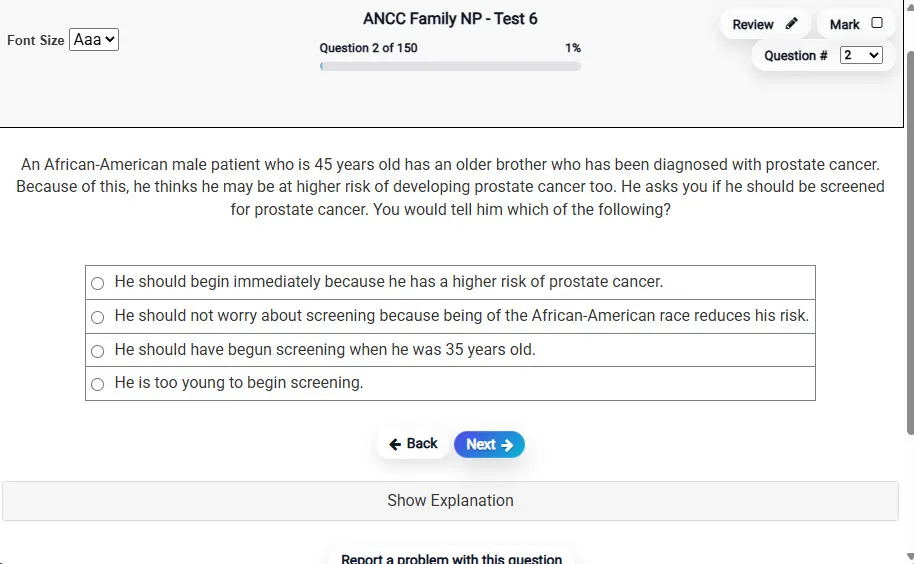
Answering a Question screen – Multiple-choice item view with navigation controls and progress tracker.
Answering a Question Multiple-choice item view with navigation controls and progress tracker.

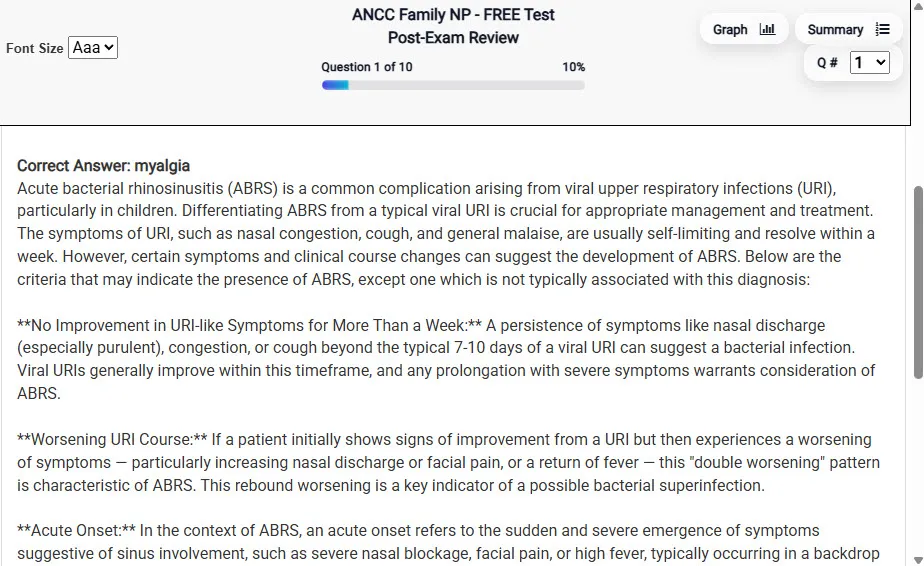
                           Detailed Explanation screen – 
                         Review mode showing chosen answer and rationale and references.
Detailed Explanation Review mode showing chosen answer and rationale and references.

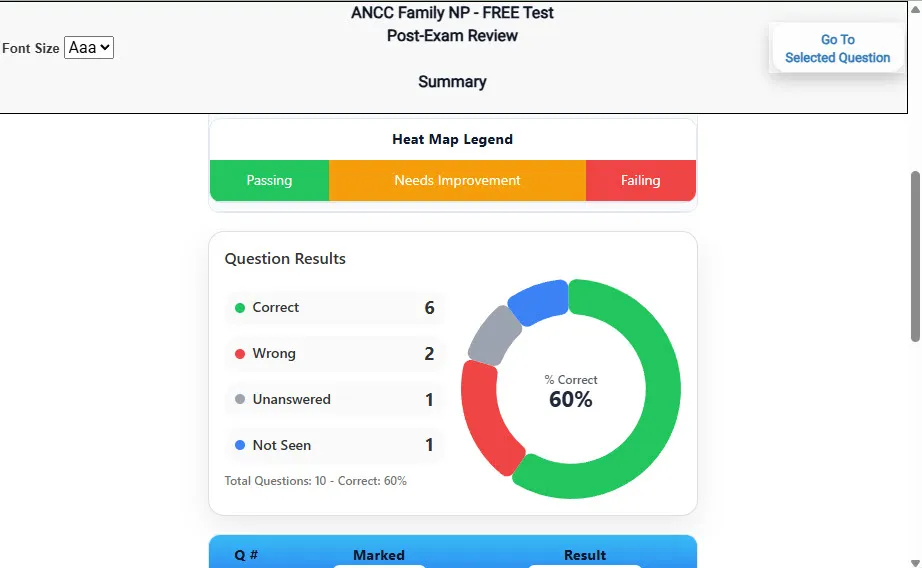
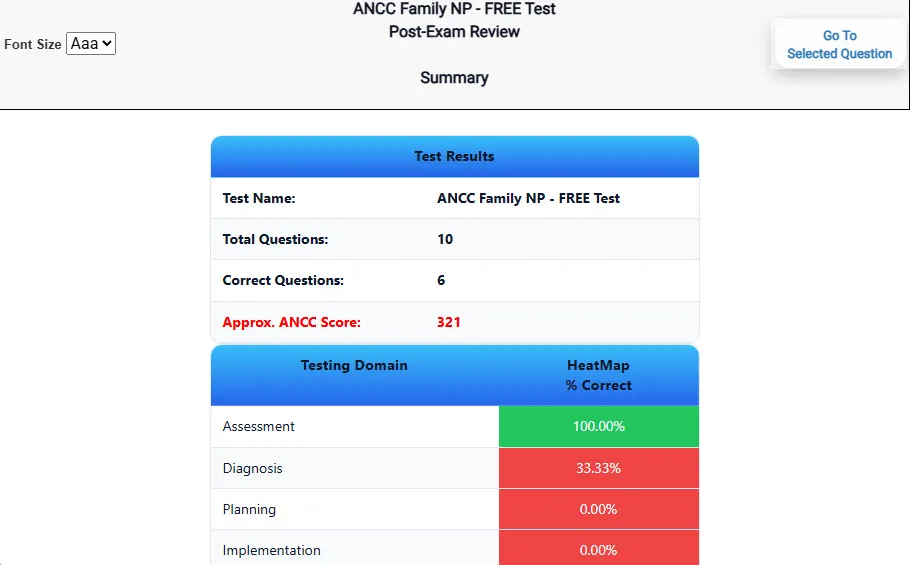
                           Review Summary 1 screen – 
                         Summary with counts for correct/wrong/unanswered and not seen items.
Review Summary 1 Summary with counts for correct/wrong/unanswered and not seen items.

                           Review Summary 2 screen – 
                         Advanced summary with category/domain breakdown and performance insights.
Review Summary 2 Advanced summary with category/domain breakdown and performance insights.

What Each Screen Shows

Answer Question Screen

  • Clean multiple-choice interface with progress bar.
  • Mark for review feature.
  • Matches real test pacing.

Detailed Explanation

  • Correct answer plus rationale.
  • Key concepts and guidelines highlighted.
  • Move between questions to fill knowledge gaps.

Review Summary 1

  • Overall results with total questions and scaled score.
  • Domain heatmap shows strengths and weaknesses.
  • Quick visual feedback on study priorities.

Review Summary 2

  • Chart of correct, wrong, unanswered, not seen.
  • Color-coded results for easy review.
  • Links back to missed items.

Top 10 Reasons to Use Exam Edge for your NYSTCE CST Business and Marketing Exam Prep

  1. Focused on the NYSTCE CST Business and Marketing Exam

    Our practice tests are built specifically for the NYSTCE CST Business and Marketing exam — every question mirrors the real topics, format, and difficulty so you're studying exactly what matters.

  2. Real Exam Simulation

    We match the per-question time limits and pressure of the actual NYSTCE exam, so test day feels familiar and stress-free.

  3. 20 Full Practice Tests & 2,000 Unique Questions

    You'll have more than enough material to master every NYSTCE CST Business and Marketing concept — no repeats, no fluff.

  4. Lower Cost Than a Retake

    Ordering 5 practice exams costs less than retaking the NYSTCE CST Business and Marketing exam after a failure. One low fee could save you both time and money.

  5. Flexible Testing

    Need to step away mid-exam? Pick up right where you left off — with your remaining time intact.

  6. Instant Scoring & Feedback

    See your raw score and an estimated NYSTCE CST Business and Marketing score immediately after finishing each practice test.

  7. Detailed Explanations for Every Question

    Review correct and incorrect answers with clear, step-by-step explanations so you truly understand each topic.

  8. Trusted & Accredited

    We're fully accredited by the Better Business Bureau and uphold the highest standards of trust and transparency.

  9. Web-Based & Always Available

    No software to install. Access your NYSTCE CST Business and Marketing practice exams 24/7 from any computer or mobile device.

  10. Expert Support When You Need It

    Need extra help? Our specialized tutors are highly qualified and ready to support your NYSTCE exam prep.


Pass the NYSTCE CST Business and Marketing Exam with Realistic Practice Tests from Exam Edge

Preparing for your upcoming NYSTCE CST Business and Marketing (069) Certification Exam can feel overwhelming — but the right practice makes all the difference. Exam Edge gives you the tools, structure, and confidence to pass on your first try. Our online practice exams are built to match the real NYSTCE CST Business and Marketing exam in content, format, and difficulty.

  • 📝 20 NYSTCE CST Business and Marketing Practice Tests: Access 20 full-length exams with 100 questions each, covering every major NYSTCE CST Business and Marketing topic in depth.
  • Instant Online Access: Start practicing right away — no software, no waiting.
  • 🧠 Step-by-Step Explanations: Understand the reasoning behind every correct answer so you can master NYSTCE CST Business and Marketing exam concepts.
  • 🔄 Retake Each Exam Up to 4 Times: Build knowledge through repetition and track your improvement over time.
  • 🌐 Web-Based & Available 24/7: Study anywhere, anytime, on any device.
  • 🧘 Boost Your Test-Day Confidence: Familiarity with the NYSTCE format reduces anxiety and helps you perform under pressure.

These NYSTCE CST Business and Marketing practice exams are designed to simulate the real testing experience by matching question types, timing, and difficulty level. This approach helps you get comfortable not just with the exam content, but also with the testing environment, so you walk into your exam day focused and confident.

Exam Edge NYSTCE Reviews


Not a user friendly experience

Amelia , Rochester, New York

Didn't really reflect the questions that were on the test for the most part. Also, they totally got the format of the constructed response question wrong, which never changes. Overall OK if you have nothing else, but definitely not worth the price they charge in my opinion.

Randy , Queens, New York

It was a good test run. Now I know what to expect and what I need to study.

Timothy , Eden, New York

The experience was very practical and I did well.

Trina , Silver Spring , MD

Very easy to navigate.

Collene , Silver Spring , MD

Exam Edge was terrific. Even better than I hoped. Just completing and reviewing the tests are a great learning experience. I can't wait to take the certification test. Tom S.

Thomas , Port Washington, NY


NYSTCE CST Business and Marketing Aliases Test Name

Here is a list of alternative names used for this exam.

  • NYSTCE CST Business and Marketing
  • NYSTCE CST Business and Marketing test
  • NYSTCE CST Business and Marketing Certification Test
  • NYSTCE
  • NYSTCE 069
  • 069 test
  • NYSTCE CST Business and Marketing (069)
  • CST Business and Marketing certification