This is the content of the pop-over!

NYSTCE CST Biology (160) Practice Tests & Test Prep by Exam Edge


NYSTCE CST Biology  product image
(4.8)
Based on 32 Reviews

  • Real Exam Simulation: Timed questions and matching content build comfort for your NYSTCE CST Biology test day.
  • Instant, 24/7 Access: Web-based NYSTCE CST Biology practice exams with no software needed.
  • Clear Explanations: Step-by-step answers and explanations for your NYSTCE exam to strengthen understanding.
  • Boosted Confidence: Reduces anxiety and improves test-taking skills to ace your NYSTCE CST Biology (160).

Featured on

NYSTCE CST Biology Online Practice Test Bundles

BEST VALUE
20 practice tests

$174.00

$799.00

SAVE $625

Only $8.70 per test!

  • 100% Pass Guarantee
  • 20 online practice tests
  • 90 questions per test
  • Bonus: 100 Flash Cards + Study Guide
  • Instant access
  • Detailed Explanations
  • Practice tests never expire
  • Timed, untimed, or study guide mode
MOST POPULAR
10 practice tests

$99.50

$399.50

SAVE $300

Only $9.95 per test!

  • 10 online practice tests
  • 90 questions per test
  • Bonus: 100 Flash Cards + Study Guide
  • Instant access
  • Detailed Explanations
  • Practice tests never expire
  • Timed, untimed, or study guide mode
5 practice tests

$69.75

$199.75

SAVE $130

Only $13.95 per test!

  • 5 online practice tests
  • 90 questions per test
  • Bonus: 100 Flash Cards
  • Instant access
  • Detailed Explanations
  • Practice tests never expire
  • Timed, untimed, or study guide mode
1 practice test

$39.95

  • 1 online practice test
  • 90 questions per test
  • Instant access
  • Detailed Explanations
  • Practice tests never expire
  • Timed, untimed, or study guide mode
Quick Select
Tap to choose a bundle

** All Prices are in US Dollars (USD) **


NYSTCE CST Biology (160) Resources

Jump to the section you need most.

Understanding the exact breakdown of the NYSTCE CST Biology test will help you know what to expect and how to most effectively prepare. The NYSTCE CST Biology has 90 multiple-choice questions and 1 essay questions. The exam will be broken down into the sections below:

NYSTCE CST Biology Exam Blueprint
Domain Name % Number of
Questions
Structure and Function of Cells and Molecules 13% 12
Structure and Function of Organisms 14% 13
Matter and Energy 13% 12
Interdependent Relationships in Ecosystems 13% 12
Inheritance and Variation of Traits 14% 13
Evolution and the Unity and Diversity of Life 13% 12
Pedagogical Content Knowledge (constructed-response) - Not Included 20% 18

NYSTCE CST Biology Study Tips by Domain

  • Differentiate organelles by function and membrane structure (e.g., rough ER → secreted proteins; smooth ER → lipids/detox); red flag: attributing protein synthesis to the Golgi rather than ribosomes/ER.
  • Connect membrane structure to transport (fluid mosaic, polarity, gradients) and predict outcomes for diffusion, osmosis, and active transport; common trap: thinking facilitated diffusion requires ATP.
  • Relate enzyme activity to environmental conditions (temperature, pH, substrate concentration) and interpret basic rate/graph scenarios; priority rule: enzyme denaturation changes shape/active site, not the substrate.
  • Compare cellular respiration and photosynthesis by location, inputs/outputs, and electron carriers; red flag: claiming the Calvin cycle produces ATP (it consumes ATP/NADPH to fix carbon).
  • Explain DNA structure, replication, transcription, and translation with correct directionality; common trap: mixing up 5’→3’ synthesis and assuming RNA polymerase needs a primer like DNA polymerase.
  • Distinguish mitosis vs. meiosis and link to chromosome number, genetic variation (crossing over, independent assortment), and cell type; threshold cue: meiosis produces haploid gametes, and nondisjunction is a common source of aneuploidy.
  • Know how organ systems maintain homeostasis via negative feedback (e.g., thermoregulation, blood glucose)—red flag: describing positive feedback as the default stabilizing mechanism.
  • Connect structure to function across levels (tissue → organ → system), such as alveoli surface area for gas exchange—common trap: listing anatomy facts without explaining the functional advantage.
  • Differentiate plant vs. animal transport (xylem/phloem vs. circulatory systems) and the driving forces (transpiration pull, pressure flow)—priority rule: always specify the direction of water vs. sugar movement.
  • Explain nervous and endocrine signaling (speed, duration, signal type) and how receptors determine response—red flag: assuming hormones act on all cells rather than target cells with specific receptors.
  • Describe immune defenses from barriers to adaptive responses (antibodies, memory cells)—common trap: confusing antigens with antibodies or claiming antibiotics treat viral infections.
  • Relate reproduction and development to regulation and environment (gametogenesis, fertilization, embryonic patterning, plant hormones)—contraindication: mixing mitosis and meiosis outcomes (chromosome number and genetic variation).
  • Track energy flow with the 10% rule: only a small fraction of energy transfers to the next trophic level; red flag—confusing energy flow (one-way, lost as heat) with matter cycling (reused).
  • Use photosynthesis/respiration equations to trace atoms and energy: atoms are conserved while energy transforms; common trap—saying plants “get mass from soil” instead of primarily from CO2 fixed into sugars.
  • Interpret biogeochemical cycles (carbon, nitrogen, phosphorus, water) by identifying reservoirs, fluxes, and limiting nutrients; priority rule—phosphorus has no major atmospheric pool, so runoff/erosion signals high eutrophication risk.
  • Apply enzyme kinetics and thermodynamics: enzymes lower activation energy but do not change ΔG or equilibrium; contraindication—claiming enzymes make endergonic reactions spontaneous.
  • Differentiate aerobic vs. anaerobic pathways by ATP yield and electron acceptors: O2 is the terminal electron acceptor in aerobic respiration; red flag—calling fermentation an “alternative electron transport chain” rather than NAD+ regeneration.
  • Recognize feedbacks and human impacts on matter/energy systems: combustion and deforestation increase atmospheric CO2 and can shift ecosystem productivity; common trap—equating ozone depletion with the greenhouse effect (distinct mechanisms).
  • Track energy flow with trophic levels and biomass/energy pyramids—red flag: claiming energy “cycles” through a food web instead of flowing while matter cycles.
  • Use carrying capacity (K) and limiting factors (density-dependent vs. density-independent) to predict population change—common trap: assuming exponential growth persists without resource constraints.
  • Distinguish species interactions (mutualism, commensalism, parasitism, predation, competition) using fitness effects (+/0/-)—priority rule: correctly label outcomes for both species, not just one.
  • Connect biogeochemical cycles (carbon, nitrogen, phosphorus, water) to human impacts—threshold cue: excess N/P inputs can trigger eutrophication, algal blooms, and hypoxia.
  • Interpret community dynamics (succession, disturbance, keystone species, invasive species) from scenario data—common trap: treating invasives as merely “new predators” rather than agents that reduce native biodiversity and alter niches.
  • Read ecosystem data (abiotic factors like pH, temperature, dissolved oxygen, salinity) to infer organism distributions—red flag: ignoring tolerance ranges and assuming all organisms respond similarly to a single abiotic shift.
  • Use meiosis to predict gamete genotypes and explain how crossing over and independent assortment generate variation; red flag: saying homologous chromosomes separate in mitosis or that sister chromatids separate in meiosis I.
  • Apply Mendelian patterns (dominant/recessive, codominance, incomplete dominance) and use Punnett squares to compute probabilities; common trap: treating phenotypic ratios as certainties rather than probabilities across offspring.
  • Interpret pedigrees by identifying likely inheritance modes (autosomal dominant/recessive, X-linked) and key cues (skipping generations, sex bias); red flag: claiming father-to-son transmission in X-linked traits.
  • Differentiate genotype vs phenotype and recognize how environment and gene regulation affect expression (e.g., penetrance/expressivity, polygenic traits); common trap: concluding a trait is single-gene just because it looks “discrete.”
  • Explain molecular inheritance—DNA replication (5’→3’, complementary base pairing), transcription/translation, and how mutations alter proteins; red flag: stating RNA polymerase needs a primer or that DNA contains uracil.
  • Connect chromosomal changes (nondisjunction, deletions, duplications, inversions, translocations) to variation and genetic disorders; priority rule: if a karyotype shows aneuploidy, check meiosis nondisjunction before proposing point mutation.
  • Natural selection requires heritable variation and differential reproductive success; red flag: explaining evolution as individuals “adapting because they need to” (teleology) instead of population allele-frequency change.
  • Distinguish mechanisms of evolution (selection, drift, gene flow, mutation) and predict when each dominates; common trap: assuming selection is always the strongest force in small populations where genetic drift can overwhelm it.
  • Apply Hardy–Weinberg (p + q = 1; p2 + 2pq + q2 = 1) to identify non-evolving populations; cue: any violation of assumptions (nonrandom mating, selection, small N, migration, mutation) is a “not in equilibrium” red flag.
  • Interpret phylogenetic trees/cladograms using shared derived characters (synapomorphies); common trap: reading “more evolved” from tip position or assuming node order implies higher complexity.
  • Explain speciation via reproductive isolation (prezygotic vs. postzygotic) and geographic context (allopatric vs. sympatric); priority rule: speciation is supported when gene flow is reduced to near zero between diverging groups.
  • Use evidence for common ancestry (fossils, homologous structures, embryology, molecular sequences) while separating homology from analogy; red flag: citing convergent traits as proof of close relatedness without checking underlying structure or DNA similarity.


Built to Fit Into Your Busy Life

Everything you need to prepare with confidence—without wasting a minute.

Three Study Modes

Timed, No Time Limit, or Explanation mode.

Actionable Analytics

Heatmaps and scaled scores highlight weak areas.

High-Yield Rationales

Concise explanations emphasize key concepts.

Realistic Interface

Matches the feel of the actual exam environment.

Accessible by Design

Clean layout reduces cognitive load.

Anytime, Anywhere

Web-based access 24/7 on any device.
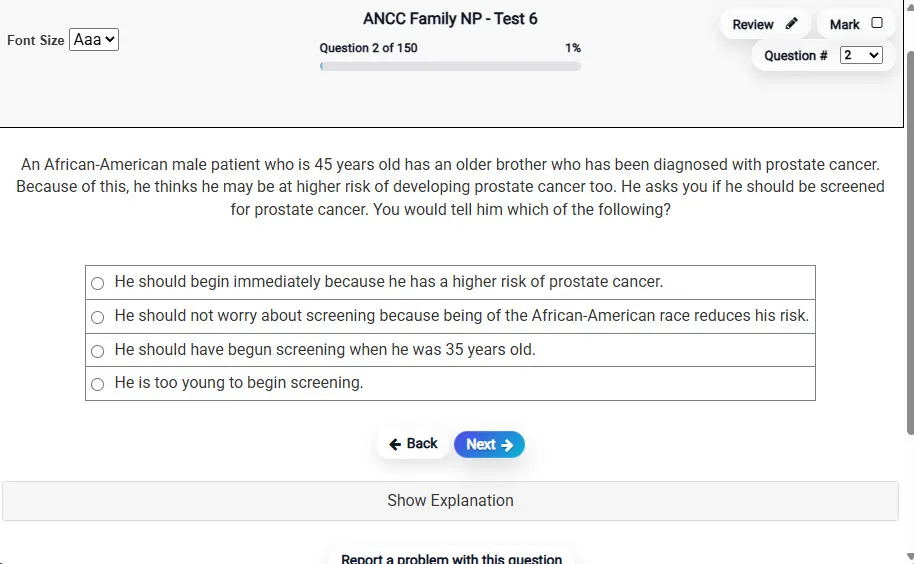
Answering a Question screen – Multiple-choice item view with navigation controls and progress tracker.
Answering a Question Multiple-choice item view with navigation controls and progress tracker.

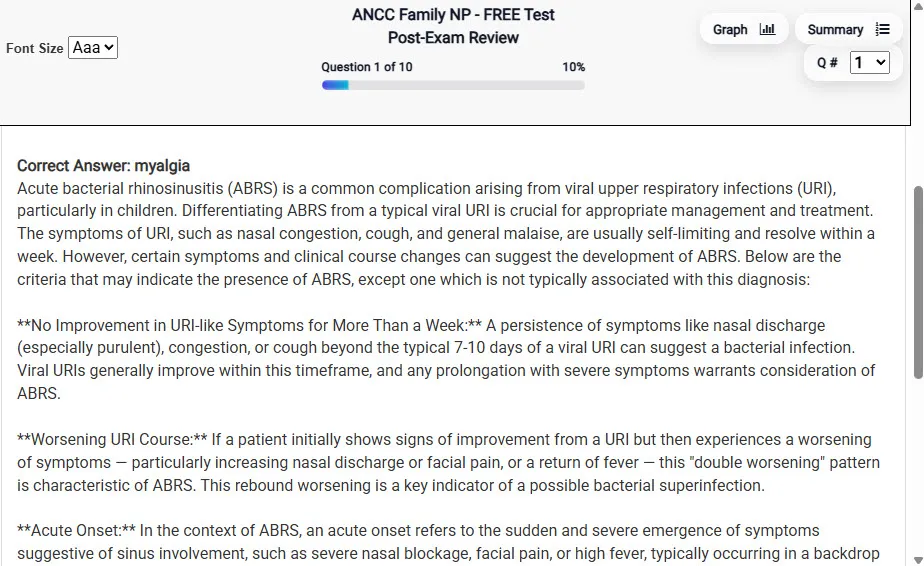
                           Detailed Explanation screen – 
                         Review mode showing chosen answer and rationale and references.
Detailed Explanation Review mode showing chosen answer and rationale and references.

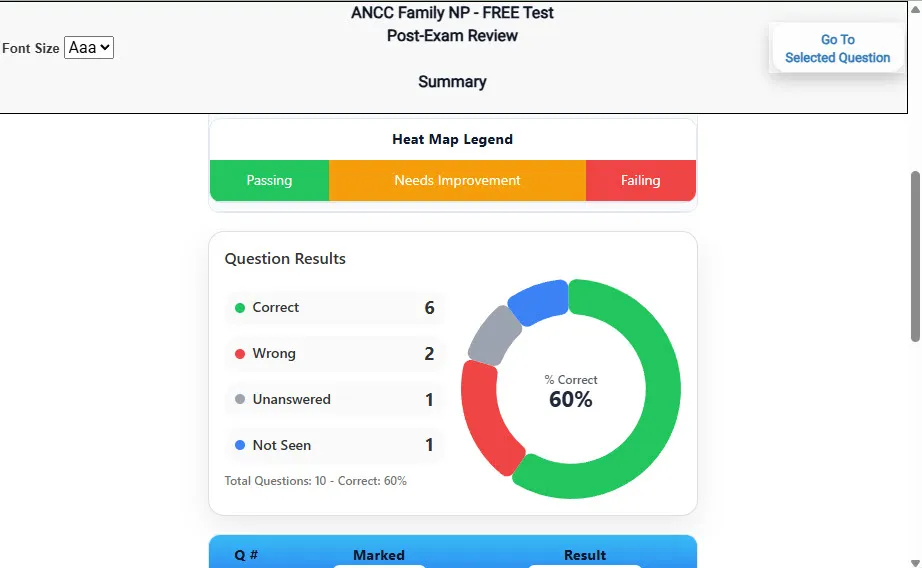
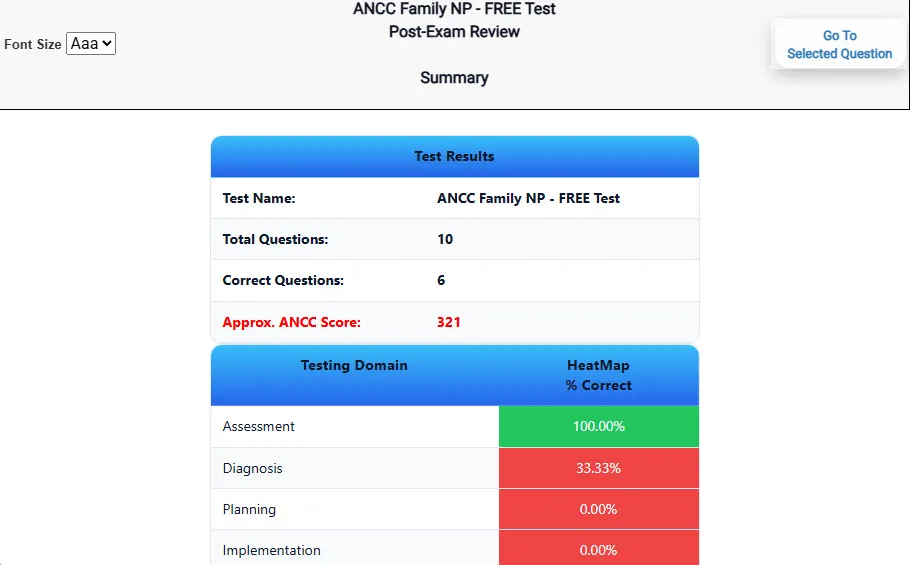
                           Review Summary 1 screen – 
                         Summary with counts for correct/wrong/unanswered and not seen items.
Review Summary 1 Summary with counts for correct/wrong/unanswered and not seen items.

                           Review Summary 2 screen – 
                         Advanced summary with category/domain breakdown and performance insights.
Review Summary 2 Advanced summary with category/domain breakdown and performance insights.

What Each Screen Shows

Answer Question Screen

  • Clean multiple-choice interface with progress bar.
  • Mark for review feature.
  • Matches real test pacing.

Detailed Explanation

  • Correct answer plus rationale.
  • Key concepts and guidelines highlighted.
  • Move between questions to fill knowledge gaps.

Review Summary 1

  • Overall results with total questions and scaled score.
  • Domain heatmap shows strengths and weaknesses.
  • Quick visual feedback on study priorities.

Review Summary 2

  • Chart of correct, wrong, unanswered, not seen.
  • Color-coded results for easy review.
  • Links back to missed items.

Top 10 Reasons to Use Exam Edge for your NYSTCE CST Biology Exam Prep

  1. Focused on the NYSTCE CST Biology Exam

    Our practice tests are built specifically for the NYSTCE CST Biology exam — every question mirrors the real topics, format, and difficulty so you're studying exactly what matters.

  2. Real Exam Simulation

    We match the per-question time limits and pressure of the actual NYSTCE exam, so test day feels familiar and stress-free.

  3. 20 Full Practice Tests & 1,800 Unique Questions

    You'll have more than enough material to master every NYSTCE CST Biology concept — no repeats, no fluff.

  4. Lower Cost Than a Retake

    Ordering 5 practice exams costs less than retaking the NYSTCE CST Biology exam after a failure. One low fee could save you both time and money.

  5. Flexible Testing

    Need to step away mid-exam? Pick up right where you left off — with your remaining time intact.

  6. Instant Scoring & Feedback

    See your raw score and an estimated NYSTCE CST Biology score immediately after finishing each practice test.

  7. Detailed Explanations for Every Question

    Review correct and incorrect answers with clear, step-by-step explanations so you truly understand each topic.

  8. Trusted & Accredited

    We're fully accredited by the Better Business Bureau and uphold the highest standards of trust and transparency.

  9. Web-Based & Always Available

    No software to install. Access your NYSTCE CST Biology practice exams 24/7 from any computer or mobile device.

  10. Expert Support When You Need It

    Need extra help? Our specialized tutors are highly qualified and ready to support your NYSTCE exam prep.


Pass the NYSTCE CST Biology Exam with Realistic Practice Tests from Exam Edge

Preparing for your upcoming NYSTCE CST Biology (160) Certification Exam can feel overwhelming — but the right practice makes all the difference. Exam Edge gives you the tools, structure, and confidence to pass on your first try. Our online practice exams are built to match the real NYSTCE CST Biology exam in content, format, and difficulty.

  • 📝 20 NYSTCE CST Biology Practice Tests: Access 20 full-length exams with 90 questions each, covering every major NYSTCE CST Biology topic in depth.
  • Instant Online Access: Start practicing right away — no software, no waiting.
  • 🧠 Step-by-Step Explanations: Understand the reasoning behind every correct answer so you can master NYSTCE CST Biology exam concepts.
  • 🔄 Retake Each Exam Up to 4 Times: Build knowledge through repetition and track your improvement over time.
  • 🌐 Web-Based & Available 24/7: Study anywhere, anytime, on any device.
  • 🧘 Boost Your Test-Day Confidence: Familiarity with the NYSTCE format reduces anxiety and helps you perform under pressure.

These NYSTCE CST Biology practice exams are designed to simulate the real testing experience by matching question types, timing, and difficulty level. This approach helps you get comfortable not just with the exam content, but also with the testing environment, so you walk into your exam day focused and confident.


Exam Edge NYSTCE Reviews


Not a user friendly experience

Amelia , Rochester, New York

Didn't really reflect the questions that were on the test for the most part. Also, they totally got the format of the constructed response question wrong, which never changes. Overall OK if you have nothing else, but definitely not worth the price they charge in my opinion.

Randy , Queens, New York

It was a good test run. Now I know what to expect and what I need to study.

Timothy , Eden, New York

The experience was very practical and I did well.

Trina , Silver Spring , MD

Very easy to navigate.

Collene , Silver Spring , MD

Exam Edge was terrific. Even better than I hoped. Just completing and reviewing the tests are a great learning experience. I can't wait to take the certification test. Tom S.

Thomas , Port Washington, NY


NYSTCE CST Biology Aliases Test Name

Here is a list of alternative names used for this exam.

  • NYSTCE CST Biology
  • NYSTCE CST Biology test
  • NYSTCE CST Biology Certification Test
  • NYSTCE
  • NYSTCE 160
  • 160 test
  • NYSTCE CST Biology (160)
  • CST Biology certification