This is the content of the pop-over!

Lightning Deal Alert – 12% Off Ends at Midnight!

Strike while the savings are hot! Use promo code FlashSale at checkout for 12% off any Exam Edge test or bundle. Hurry—the clock is ticking!

CSET Social Science (114, 115, 116) Practice Tests & Test Prep by Exam Edge


CSET Social Science  product image
(4.8)
Based on 25 Reviews

  • Real Exam Simulation: Timed questions and matching content build comfort for your CSET Social Science test day.
  • Instant, 24/7 Access: Web-based CSET Social Science practice exams with no software needed.
  • Clear Explanations: Step-by-step answers and explanations for your CSET exam to strengthen understanding.
  • Boosted Confidence: Reduces anxiety and improves test-taking skills to ace your CSET Social Science (114, 115, 116).

Featured on

CSET Social Science Online Practice Test Bundles

BEST VALUE
20 practice tests

$174.00

$799.00

SAVE $625

Only $8.70 per test!

  • 100% Pass Guarantee
  • 20 online practice tests
  • 115 questions + 3 essays per test
  • Bonus: 100 Flash Cards + Study Guide
  • Instant access
  • Detailed Explanations
  • Practice tests never expire
  • Timed, untimed, or study guide mode
MOST POPULAR
10 practice tests

$99.50

$399.50

SAVE $300

Only $9.95 per test!

  • 10 online practice tests
  • 115 questions + 3 essays per test
  • Bonus: 100 Flash Cards + Study Guide
  • Instant access
  • Detailed Explanations
  • Practice tests never expire
  • Timed, untimed, or study guide mode
5 practice tests

$69.75

$199.75

SAVE $130

Only $13.95 per test!

  • 5 online practice tests
  • 115 questions + 3 essays per test
  • Bonus: 100 Flash Cards
  • Instant access
  • Detailed Explanations
  • Practice tests never expire
  • Timed, untimed, or study guide mode
1 practice test

$39.95

  • 1 online practice test
  • 115 questions + 3 essays per test
  • Instant access
  • Detailed Explanations
  • Practice tests never expire
  • Timed, untimed, or study guide mode
Quick Select
Tap to choose a bundle

** All Prices are in US Dollars (USD) **


CSET Social Science (114, 115, 116) Resources

Jump to the section you need most.

Understanding the exact breakdown of the CSET Social Science test will help you know what to expect and how to most effectively prepare. The CSET Social Science has multiple-choice questions . The exam will be broken down into the sections below:

CSET Social Science Exam Blueprint
Domain Name
World History  
U.S. History  
California History  
Principles of American Democracy  
Principles of Economics  
Principles of Geography  

CSET Social Science Study Tips by Domain

  • Anchor each era by a clear cause-and-effect chain (e.g., agricultural revolution → surplus → specialization → states); red flag: listing events without explaining the mechanism that links them.
  • Compare belief systems (Hinduism, Buddhism, Judaism, Christianity, Islam, Confucianism) using one consistent lens (origins, core texts, social ethics); common trap: treating all as identical “religions” or ignoring non-theistic traditions.
  • For classical civilizations, pair political structure with economy (polis/empire/mandate — tribute, slavery, taxation, trade routes); priority rule: name a governing model and one concrete way it raised revenue.
  • When discussing cross-cultural exchange (Silk Roads, Indian Ocean, trans-Saharan), include one technology/disease/idea that moved and one resulting change; red flag: describing trade as only goods moving with no social or demographic impacts.
  • In early modern history, link exploration/colonization to labor systems and global finance (encomienda, slavery, mercantilism); common trap: presenting exploration as purely “discovery” without coercion, extraction, or demographic collapse.
  • For the modern era, distinguish political ideologies and revolutions by goals and outcomes (liberalism, nationalism, socialism, imperialism, decolonization); threshold: cite at least one specific policy or document (e.g., Declaration of the Rights of Man, Meiji reforms) to avoid vague generalities.
  • Anchor each era to a few high-yield turning points (e.g., 1776/1787, 1861–1865, 1898, 1929, 1941, 1945, 1964–1965); red flag: mixing causes of events with their immediate triggers (e.g., long-term sectionalism vs. Fort Sumter).
  • For the early Republic, connect political development to constitutional conflict (Federalists vs. Democratic-Republicans, Marshall Court, Jacksonian democracy); common trap: treating the Bill of Rights as originally applying to states before 14th Amendment incorporation.
  • For the Civil War and Reconstruction, distinguish emancipation (wartime) from civil/political rights (Reconstruction amendments) and explain the rollback (Black Codes, Jim Crow, Compromise of 1877); red flag: assuming Reconstruction ended because the amendments were repealed—they were not.
  • For industrialization and reform, tie the Gilded Age to labor, immigration, urbanization, and regulation (Sherman Antitrust, muckrakers, Progressive amendments); common trap: confusing nativist restriction (e.g., Chinese Exclusion, quotas) with pro-immigrant settlement efforts.
  • For 20th-century crises, compare New Deal liberalism, WWII mobilization, and the Cold War national security state (containment, McCarthyism, Vietnam); red flag: claiming the New Deal ended the Great Depression by itself—wartime production was a major driver.
  • For civil rights and modern politics, connect grassroots activism to landmark policy (Brown, Civil Rights Act 1964, Voting Rights Act 1965) and trace political realignment (Southern Strategy, rise of conservatism); priority rule: always identify which level of government (federal vs. state) had enforcement power in a given rights expansion.
  • Know the sequence of major eras in California history (Indigenous societies → Spanish mission/presidio system → Mexican ranchos → U.S. conquest/statehood → Gold Rush) — red flag: mixing Mexican secularization (1830s) with the U.S. takeover (1846–1848).
  • Connect Spanish mission goals (conversion, labor, settlement) to demographic and cultural impacts on Native Californians — common trap: describing missions as purely religious without noting coercive labor, disease, and population collapse.
  • Track sovereignty shifts and key legal outcomes (Treaty of Guadalupe Hidalgo, statehood in 1850) — priority rule: remember the treaty promised property rights but did not protect many Californios/Native land claims in practice.
  • Use the Gold Rush as an organizing case for migration, urban growth, and environmental change — red flag: overlooking hydraulic mining impacts and the resulting conflicts that led to regulation (e.g., court limits on debris).
  • Identify how transportation and water projects reshaped regions (railroads, aqueducts, dams) — common trap: treating California growth as inevitable while ignoring policy decisions, boosters, and interregional water conflicts.
  • For 20th-century California, link defense/aerospace, migration, and suburbanization to political and social movements — red flag: forgetting that war mobilization and federal spending were major drivers of population and economic change.
  • Distinguish types of government and sovereignty: federalism shares power between national and state governments, while confederal systems keep most power at the state level—red flag: treating local governments as sovereign (they are “creatures of the state”).
  • Apply constitutional principles (popular sovereignty, limited government, separation of powers, checks and balances) to scenarios—common trap: confusing separation of powers (between branches) with checks and balances (tools each branch uses to limit others).
  • Know First Amendment protections and limits (speech, press, religion, assembly, petition)—priority rule: public schools and government workplaces allow more regulation than traditional public forums, especially for disruptive or school-sponsored speech.
  • Differentiate civil liberties from civil rights and connect each to enforcement mechanisms—red flag: assuming discrimination claims always require intent (many civil-rights frameworks allow disparate impact or different evidentiary standards).
  • Understand the lawmaking and policymaking process at federal and state levels (committees, veto, override, initiative/referendum/recall in California)—common trap: thinking a bill becomes law after passing both houses without addressing executive action or possible veto override.
  • Explain elections, representation, and parties: primary vs general elections, winner-take-all vs proportional systems, and the Electoral College—threshold cue: constitutional amendments require 2/3 of each house and 3/4 of states (not a simple majority).
  • Distinguish opportunity cost, marginal analysis, and the production possibilities curve (PPC); red flag: confusing a movement along the PPC (reallocation) with an outward shift (growth/technology).
  • Use supply-and-demand to predict price/quantity changes from shifts (income, tastes, input costs, technology); common trap: treating a price change as a “shift” rather than a movement along the curve.
  • Apply elasticity (price, income, cross-price) to revenue and tax-incidence questions; threshold cue: demand is elastic when |E| > 1 (price drop raises total revenue).
  • Differentiate market structures (perfect competition, monopoly, monopolistic competition, oligopoly) by price-setting power and entry barriers; red flag: assuming “many firms” always means price taker (product differentiation matters).
  • Identify market failures and policy tools (externalities, public goods, asymmetric information); priority rule: match the fix to the failure (e.g., Pigouvian tax for negative externality, not a price ceiling).
  • Interpret macro indicators and policy (GDP, inflation, unemployment, monetary vs. fiscal policy); common trap: thinking lowering interest rates reduces inflation immediately—it typically raises AD first and can be inflationary in the short run.
  • Distinguish absolute vs. relative location and use latitude/longitude correctly; red flag: swapping N/S or E/W or confusing degrees with minutes when reading a graticule.
  • Apply the five themes of geography (location, place, human–environment interaction, movement, region) to an example; common trap: describing only “place” features without linking to a theme-based argument.
  • Interpret map projections and their distortions (area, shape, distance, direction); priority rule: Mercator preserves direction for navigation but greatly exaggerates high-latitude land areas.
  • Read and infer from thematic maps (choropleth, dot density, proportional symbol, isoline) using legends and units; red flag: treating raw counts like rates in a choropleth without normalizing by population/area.
  • Explain spatial patterns and diffusion (relocation, hierarchical, contagious, stimulus) using push–pull factors; common trap: calling any spread “contagious” when it actually follows a hierarchy (e.g., major cities first).
  • Analyze human–environment interaction with carrying capacity, sustainability, and natural hazards; contraindication: proposing solutions that ignore local constraints (water availability, soil limits, or hazard zones like floodplains and faults).


Built to Fit Into Your Busy Life

Everything you need to prepare with confidence—without wasting a minute.

Three Study Modes

Timed, No Time Limit, or Explanation mode.

Actionable Analytics

Heatmaps and scaled scores highlight weak areas.

High-Yield Rationales

Concise explanations emphasize key concepts.

Realistic Interface

Matches the feel of the actual exam environment.

Accessible by Design

Clean layout reduces cognitive load.

Anytime, Anywhere

Web-based access 24/7 on any device.
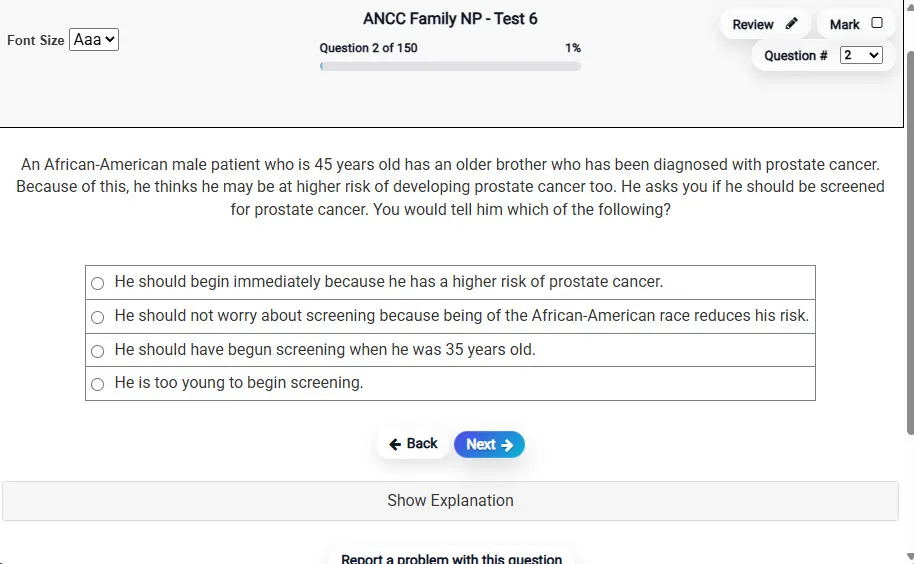
Answering a Question screen – Multiple-choice item view with navigation controls and progress tracker.
Answering a Question Multiple-choice item view with navigation controls and progress tracker.

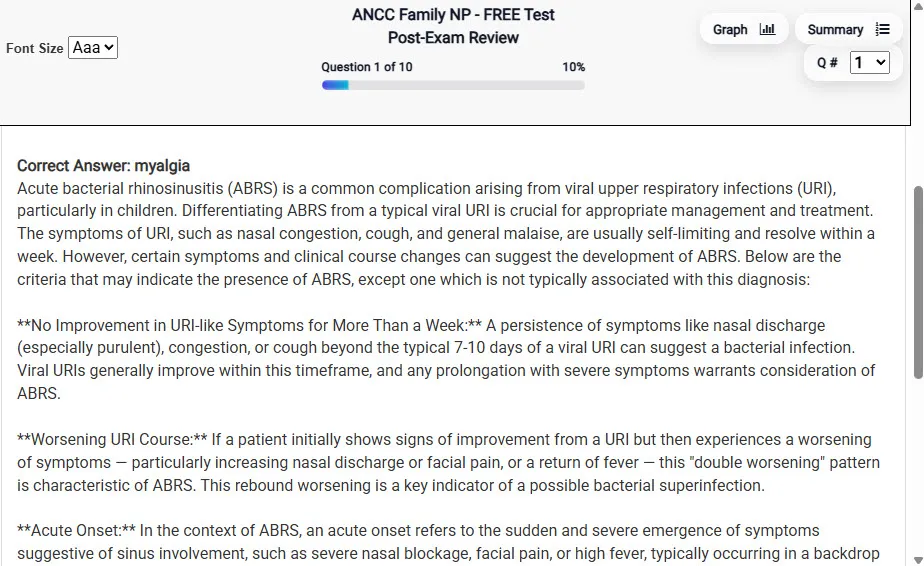
                           Detailed Explanation screen – 
                         Review mode showing chosen answer and rationale and references.
Detailed Explanation Review mode showing chosen answer and rationale and references.

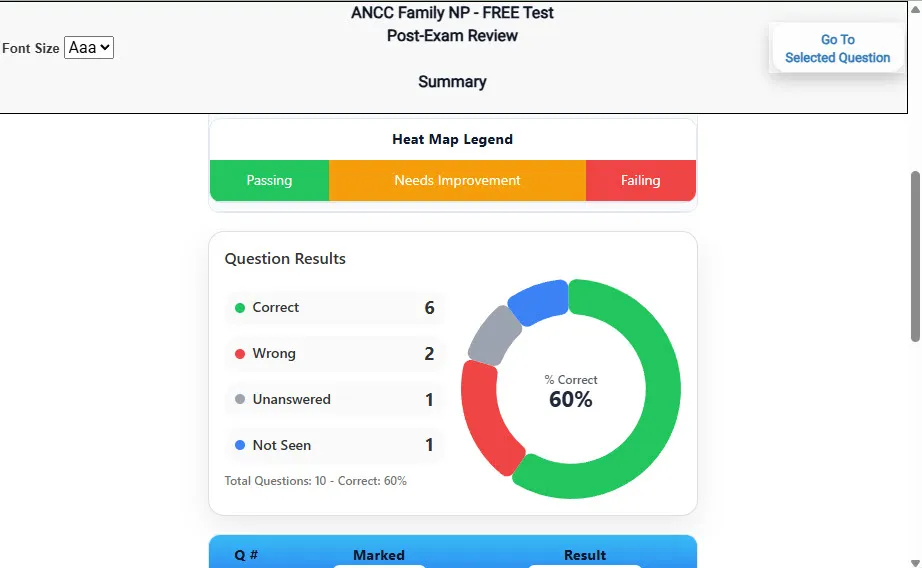
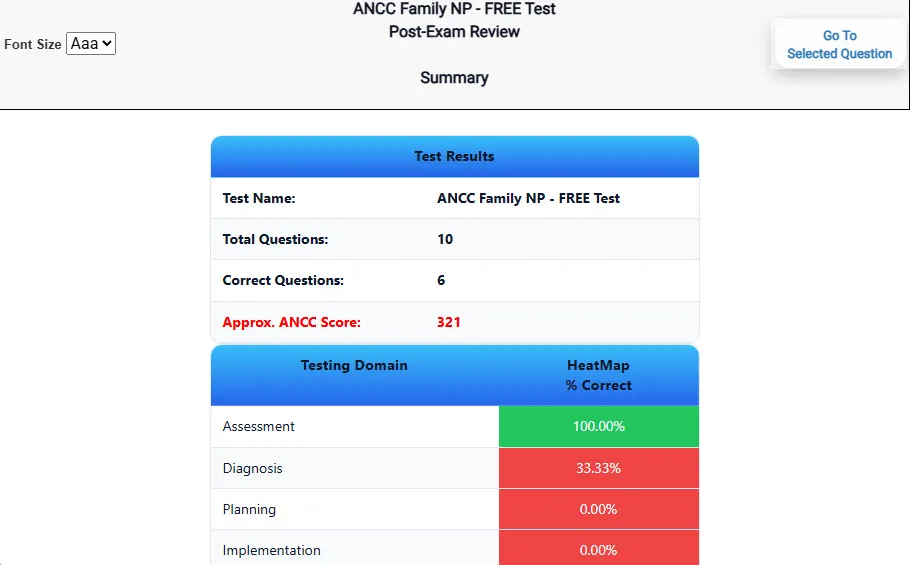
                           Review Summary 1 screen – 
                         Summary with counts for correct/wrong/unanswered and not seen items.
Review Summary 1 Summary with counts for correct/wrong/unanswered and not seen items.

                           Review Summary 2 screen – 
                         Advanced summary with category/domain breakdown and performance insights.
Review Summary 2 Advanced summary with category/domain breakdown and performance insights.

What Each Screen Shows

Answer Question Screen

  • Clean multiple-choice interface with progress bar.
  • Mark for review feature.
  • Matches real test pacing.

Detailed Explanation

  • Correct answer plus rationale.
  • Key concepts and guidelines highlighted.
  • Move between questions to fill knowledge gaps.

Review Summary 1

  • Overall results with total questions and scaled score.
  • Domain heatmap shows strengths and weaknesses.
  • Quick visual feedback on study priorities.

Review Summary 2

  • Chart of correct, wrong, unanswered, not seen.
  • Color-coded results for easy review.
  • Links back to missed items.

Top 10 Reasons to Use Exam Edge for your CSET Social Science Exam Prep

  1. Focused on the CSET Social Science Exam

    Our practice tests are built specifically for the CSET Social Science exam — every question mirrors the real topics, format, and difficulty so you're studying exactly what matters.

  2. Real Exam Simulation

    We match the per-question time limits and pressure of the actual CSET exam, so test day feels familiar and stress-free.

  3. 20 Full Practice Tests & 2,360 Unique Questions

    You'll have more than enough material to master every CSET Social Science concept — no repeats, no fluff.

  4. Lower Cost Than a Retake

    Ordering 5 practice exams costs less than retaking the CSET Social Science exam after a failure. One low fee could save you both time and money.

  5. Flexible Testing

    Need to step away mid-exam? Pick up right where you left off — with your remaining time intact.

  6. Instant Scoring & Feedback

    See your raw score and an estimated CSET Social Science score immediately after finishing each practice test.

  7. Detailed Explanations for Every Question

    Review correct and incorrect answers with clear, step-by-step explanations so you truly understand each topic.

  8. Trusted & Accredited

    We're fully accredited by the Better Business Bureau and uphold the highest standards of trust and transparency.

  9. Web-Based & Always Available

    No software to install. Access your CSET Social Science practice exams 24/7 from any computer or mobile device.

  10. Expert Support When You Need It

    Need extra help? Our specialized tutors are highly qualified and ready to support your CSET exam prep.


Pass the CSET Social Science Exam with Realistic Practice Tests from Exam Edge

Preparing for your upcoming CSET Social Science (114, 115, 116) Certification Exam can feel overwhelming — but the right practice makes all the difference. Exam Edge gives you the tools, structure, and confidence to pass on your first try. Our online practice exams are built to match the real CSET Social Science exam in content, format, and difficulty.

  • 📝 20 CSET Social Science Practice Tests: Access 20 full-length exams with 118 questions each, covering every major CSET Social Science topic in depth.
  • Instant Online Access: Start practicing right away — no software, no waiting.
  • 🧠 Step-by-Step Explanations: Understand the reasoning behind every correct answer so you can master CSET Social Science exam concepts.
  • 🔄 Retake Each Exam Up to 4 Times: Build knowledge through repetition and track your improvement over time.
  • 🌐 Web-Based & Available 24/7: Study anywhere, anytime, on any device.
  • 🧘 Boost Your Test-Day Confidence: Familiarity with the CSET format reduces anxiety and helps you perform under pressure.

These CSET Social Science practice exams are designed to simulate the real testing experience by matching question types, timing, and difficulty level. This approach helps you get comfortable not just with the exam content, but also with the testing environment, so you walk into your exam day focused and confident.


Exam Edge CTC Reviews


Just wanted to let you guys know that your tests really helped me prepare for the CBEST math exam. I took it yesterday and passed with a 47! I will tell other people about your site.

Shawna M, California

I passed my cbest today! This was the second time I took the test. My first time I scored 35. This time I scored 43. Taking your practice tests helped me a great deal, because several types of questions on the real test were also on your practice tests. Thanks so much for the help!

TIm F, California

For the last year, I have been trying to pass the reading section of the CBEST. I had taken it six times and if I did not pass it this month, then I could not take my college courses in education. I went to Google and typed in practice reading tests and your website came up. I clicked on it, signed ...
Read More
Stacy S, California

Thank you so much for your reading tests. I just passed the real CBEST Reading test by 4 points! After failing it 3 other times, I thought I would have to quit. I already told everyone in my class about your site.

Sara L, Oregon

For the last year, I have been trying to pass my cset exam. I had taken it six times and was running out of hope I would ever pass. I went to Google and your website came up. I clicked on, signed up and took the free test. I knew that I would buy a couple of tests after taking that one. I ended up b ...
Read More
Stacy,

Purchased the five pack of tests this weekend. Took CBEST math today and passed! Your tests had very similar content as the actual CBEST.

Fresno , CA


CSET Social Science Aliases Test Name

Here is a list of alternative names used for this exam.

  • CSET Social Science
  • CSET Social Science test
  • CSET Social Science Certification Test
  • CTC
  • CTC 114, 115, 116
  • 114, 115, 116 test
  • CSET Social Science (114, 115, 116)
  • CSET Social Science certification