This is the content of the pop-over!

Lightning Deal Alert – 12% Off Ends at Midnight!

Strike while the savings are hot! Use promo code FlashSale at checkout for 12% off any Exam Edge test or bundle. Hurry—the clock is ticking!

CSET Science (118, 119) Practice Tests & Test Prep by Exam Edge


CSET Science  product image
(4.9)
Based on 40 Reviews

  • Real Exam Simulation: Timed questions and matching content build comfort for your CSET Science test day.
  • Instant, 24/7 Access: Web-based CSET Science practice exams with no software needed.
  • Clear Explanations: Step-by-step answers and explanations for your CSET exam to strengthen understanding.
  • Boosted Confidence: Reduces anxiety and improves test-taking skills to ace your CSET Science (118, 119).

Featured on

CSET Science Online Practice Test Bundles

BEST VALUE
20 practice tests

$174.00

$799.00

SAVE $625

Only $8.70 per test!

  • 100% Pass Guarantee
  • 20 online practice tests
  • 100 questions per test
  • Bonus: 100 Flash Cards + Study Guide
  • Instant access
  • Detailed Explanations
  • Practice tests never expire
  • Timed, untimed, or study guide mode
MOST POPULAR
10 practice tests

$99.50

$399.50

SAVE $300

Only $9.95 per test!

  • 10 online practice tests
  • 100 questions per test
  • Bonus: 100 Flash Cards + Study Guide
  • Instant access
  • Detailed Explanations
  • Practice tests never expire
  • Timed, untimed, or study guide mode
5 practice tests

$69.75

$199.75

SAVE $130

Only $13.95 per test!

  • 5 online practice tests
  • 100 questions per test
  • Bonus: 100 Flash Cards
  • Instant access
  • Detailed Explanations
  • Practice tests never expire
  • Timed, untimed, or study guide mode
1 practice test

$39.95

  • 1 online practice test
  • 100 questions per test
  • Instant access
  • Detailed Explanations
  • Practice tests never expire
  • Timed, untimed, or study guide mode
Quick Select
Tap to choose a bundle

** All Prices are in US Dollars (USD) **


CSET Science (118, 119) Resources

Jump to the section you need most.

Understanding the exact breakdown of the CSET Science test will help you know what to expect and how to most effectively prepare. The CSET Science has multiple-choice questions . The exam will be broken down into the sections below:

CSET Science Exam Blueprint
Domain Name
Astronomy  
Dynamic Processes of the Earth (Geodynamics)  
Earth Resources  
Ecology  
Genetics and Evolution  
Molecular Biology and Biochemistry  
Cell and Organismal Biology  
Waves  
Forces and Motion  
Electricity and Magnetism  
Heat Transfer and Thermodynamics  
Structure and Properties of Matter  

CSET Science Study Tips by Domain

  • Use angular size and small-angle reasoning: if two objects have the same physical diameter, the one with the larger angular diameter is closer (red flag: confusing angular size with brightness).
  • Apply Kepler’s 3rd law consistently (P2 ∝ a3): doubling orbital radius increases period by more than double (common trap: treating period as linear in distance).
  • Remember stellar parallax distance is inversely proportional to parallax angle: d (pc) = 1/p (arcsec) (priority rule: smaller p means farther, not nearer).
  • Interpret HR diagrams correctly: main-sequence stars get hotter to the left, brighter upward (red flag: mixing up temperature axis direction and misclassifying giants vs. dwarfs).
  • Use phase and eclipse geometry: lunar eclipses occur at full Moon with alignment, solar eclipses at new Moon (common trap: assuming eclipses happen every full/new Moon due to ignoring orbital tilt).
  • Connect spectra to motion and composition: Doppler redshift means receding, blueshift approaching; absorption lines reveal elements (red flag: thinking a “red star” is necessarily redshifted rather than cooler).
  • Distinguish plate-boundary types by diagnostic landforms—mid-ocean ridges (divergent), trenches/arc volcanism (convergent), and linear offsets with shallow quakes (transform); red flag: describing transform boundaries as sites of crust creation or destruction.
  • Use seismic-wave evidence correctly: S-waves do not travel through liquids, supporting a liquid outer core; common trap: claiming P-waves cannot travel through liquids or confusing refraction effects with “stopping.”
  • Connect mantle convection to plate motion as a heat-transfer-driven process (buoyancy from temperature/density contrasts) rather than “plates float on magma”; priority rule: always tie mechanism to density differences and viscosity, not to a global molten mantle.
  • Relate earthquake patterns to tectonic setting—deep-focus quakes occur in subduction zones (Wadati–Benioff zones), while divergent/transform quakes are mostly shallow; red flag: placing deep earthquakes at mid-ocean ridges.
  • Explain isostasy with crustal thickness and density (Airy vs. Pratt concepts) and predict uplift/subsidence from loading/unloading; common trap: asserting that erosion always lowers elevation without accounting for isostatic rebound.
  • Link volcanism style to composition and gas content: basaltic magmas tend to be less viscous and more effusive, while silicic magmas are more viscous and explosive; red flag: reversing viscosity trends or attributing explosivity primarily to higher temperature alone.
  • Distinguish renewable vs. nonrenewable resources by formation timescale (e.g., fossil fuels and many mineral ores are nonrenewable on human timescales)—common trap: calling groundwater or soils “renewable” without noting recharge/formation rates.
  • Connect extraction methods to impacts: surface mining increases habitat loss and erosion, while subsurface mining raises subsidence and acid mine drainage risk—red flag terms include “tailings,” “overburden,” and low pH runoff.
  • Interpret ore formation processes (magmatic segregation, hydrothermal veins, sedimentary deposition) and link them to likely resource locations—priority rule: match deposit type to plate-tectonic setting before guessing where ore is found.
  • Evaluate energy resources by energy density, emissions, and reliability (baseload vs. intermittent)—common trap: assuming “clean” equals “no environmental tradeoffs” (e.g., nuclear waste, hydro ecosystem impacts, battery mining).
  • Apply water-resource concepts (aquifers, permeability, porosity, confined vs. unconfined) and recognize overdraft indicators—threshold cue: when pumping exceeds recharge, expect falling water tables, land subsidence, and saltwater intrusion near coasts.
  • Use conservation and management strategies (recycling metals, efficiency, reclamation, sustainable yield) with attention to regulation and mitigation—red flag: plans that ignore life-cycle costs or reclamation requirements often fail CTC-style scenario questions.
  • Distinguish fundamental vs realized niche using limiting factors (e.g., temperature, moisture) and biotic interactions; common trap: confusing a species’ habitat with its niche.
  • Apply energy-flow rules in food webs—~10% trophic transfer efficiency is a standard approximation; red flag: biomass pyramids can invert in aquatic systems even when energy pyramids cannot.
  • Interpret population growth models: exponential vs logistic with carrying capacity (K); priority rule: if per-capita growth rate declines as N increases, you’re in density-dependent regulation.
  • Use life-history tradeoffs (r- vs K-selected tendencies) to predict responses to disturbance; common trap: treating r/K as strict categories instead of endpoints on a continuum.
  • Analyze community change via succession (primary vs secondary) and disturbance regimes; red flag: secondary succession retains soil and often seed banks, changing the recovery timeline.
  • Track biogeochemical cycles (C, N, P, H2O) and human impacts; priority cue: phosphorus lacks a significant gaseous phase, so runoff-driven eutrophication is a frequent exam target.
  • Use Hardy–Weinberg as a baseline: if genotype frequencies deviate (given large population, random mating, no selection/migration/mutation), you must name which assumption is violated—common trap is treating H–W as “proof of evolution” rather than a null model.
  • Distinguish mechanisms of evolution (mutation, gene flow, genetic drift, natural/sexual selection) and predict outcomes; red flag: confusing drift (strong in small populations, bottleneck/founder effects) with selection (consistently increases fitness-linked alleles).
  • Interpret pedigrees and inheritance patterns (autosomal vs X-linked, dominant vs recessive, mitochondrial) using probabilities; common trap is ignoring male-to-male transmission (rules out X-linked) or assuming dominant traits are always common.
  • Explain meiosis-based sources of variation (independent assortment, crossing over) and link errors to outcomes; red flag: nondisjunction causes aneuploidy (e.g., trisomy) and is more likely in meiosis I/II than in mitosis for inherited conditions.
  • Apply population genetics reasoning to selection types (directional, stabilizing, disruptive, frequency-dependent) and identify how allele frequencies change; priority rule: selection acts on phenotypes but evolution is measured as allele-frequency change across generations.
  • Use evidence for evolution (fossils, homologous structures, biogeography, molecular sequences) and distinguish homology vs analogy; common trap is using “individuals evolve” language—on CTC-style items, populations evolve while individuals acclimate.
  • Connect DNA → RNA → protein to location and enzymes (replication in nucleus, translation at ribosomes)—common trap: mixing up DNA polymerase vs RNA polymerase vs ribosome function.
  • Know enzyme kinetics basics (active site specificity, competitive vs noncompetitive inhibition)—red flag: if Vmax changes, it is not purely competitive inhibition.
  • Be able to predict pH effects on proteins (ionizable side chains, denaturation) and buffers—priority rule: strongest buffering occurs when pH ≈ pKa (±1).
  • Distinguish major biomolecules by bonds and monomers (peptide, glycosidic, phosphodiester)—common trap: calling phospholipids “polymers” like proteins or nucleic acids.
  • Understand cellular energy coupling (ATP hydrolysis, redox, NADH/FADH2 roles) in respiration/photosynthesis—red flag: electrons flow from lower to higher reduction potential; don’t reverse donor/acceptor roles.
  • Interpret basic biotech results (PCR, gel electrophoresis, restriction digests, blotting)—common trap: larger DNA fragments migrate less on agarose gels (they stay closer to the wells).
  • Contrast prokaryotic vs. eukaryotic cells by the presence of membrane-bound organelles and linear chromosomes; red flag: calling ribosomes an organelle or claiming prokaryotes have a nucleus.
  • Map organelles to functions (e.g., mitochondria—ATP production, rough ER—protein synthesis, Golgi—modification/packaging); common trap: reversing rough vs. smooth ER roles.
  • Explain membrane transport (diffusion, osmosis, facilitated diffusion, active transport) and predict water movement from solute concentration; priority rule: water moves toward higher solute (lower water potential).
  • Differentiate mitosis vs. meiosis outcomes (2 identical diploid cells vs. 4 nonidentical haploid gametes); red flag: forgetting that homologous chromosome separation occurs in meiosis I (not mitosis).
  • Connect structure to function in major animal systems (digestive, respiratory, circulatory, nervous, endocrine, immune); common trap: mixing up negative feedback (homeostasis) with positive feedback (amplification, limited cases).
  • Describe plant structure and transport (xylem—water/minerals, phloem—sugars) and the role of stomata in gas exchange/transpiration; red flag: claiming phloem carries only water upward or that xylem transports sugars.
  • Use v = fλ to connect speed, frequency, and wavelength; red flag: frequency is set by the source and does not change when a wave enters a new medium (speed and λ do).
  • Distinguish transverse vs. longitudinal waves by particle motion relative to propagation; common trap: calling sound in air transverse or mixing up compressions/rarefactions with crests/troughs.
  • Apply superposition to interference and standing waves; priority rule: constructive interference requires phase alignment (path difference = mλ), while destructive is out of phase (path difference = (m + 1/2)λ).
  • For strings and open/closed pipes, recall boundary conditions for harmonics; red flag: a closed end is a displacement node, so closed pipes support only odd harmonics (n = 1, 3, 5, …).
  • Use Snell’s law and refraction concepts qualitatively and quantitatively; common trap: thinking a wave “bends toward the normal” because frequency changes—it bends because speed changes.
  • Recognize Doppler effect sign conventions and limits; practical cue: for typical CSET-style problems, higher observed frequency means the source and observer are approaching (but watch the trap of mixing source motion vs. observer motion formulas).
  • Draw a free-body diagram before writing equations; red flag: including forces that don’t act (e.g., adding “force of motion”) or forgetting the normal force on an incline.
  • Apply Newton’s 2nd law with consistent sign conventions (SF = ma); common trap: mixing components (x/y) or changing positive direction mid-solution.
  • Distinguish mass vs. weight (W = mg); priority rule: only weight changes with g—don’t treat kilograms as a force (no “kg” in a force balance).
  • Use kinematics only when acceleration is constant; red flag: plugging into v2 = v02 + 2a?x when a varies (then use calculus or energy methods instead).
  • For work–energy, include only forces that do work along displacement (W = Fd cos?); common trap: counting normal force or static friction doing work when there is no displacement at the contact point.
  • For momentum/impulse, choose an isolated system and check external impulses; red flag: assuming momentum conservation during collisions with significant external forces (e.g., friction or a fixed wall) without accounting for impulse.
  • Apply Coulomb’s law (F ∝ q1q2/r2) and distinguish force vs field; red flag: forgetting the sign of charge only affects direction, not magnitude.
  • Use superposition for electric fields/potentials from multiple charges or symmetric distributions; common trap: adding potentials as vectors instead of scalars.
  • Analyze DC circuits with Ohm’s law and Kirchhoff’s rules; priority rule: series elements share current, parallel branches share voltage.
  • Relate capacitance, energy, and dielectrics (U = ½CV2); contraindication: in a disconnected capacitor, charge stays constant even if dielectric is inserted.
  • Compute magnetic forces and fields (F = qvB sin θ, F = ILB sin θ); red flag: using the right-hand rule with conventional current, not electron flow.
  • Apply Faraday’s law and Lenz’s law for induced emf and direction; common trap: ignoring that induced currents oppose the change in magnetic flux, not the flux itself.
  • Distinguish heat vs. temperature: heat is energy transfer (J), temperature is average kinetic energy; red flag—using “heat rises” when you mean warmer, less-dense fluid rises (buoyancy).
  • Apply the 1st Law with clear sign conventions (e.g., ΔU = Q − W for work done by the system); common trap—forgetting that compression (work done on the gas) increases internal energy even if Q = 0.
  • Use the 2nd Law to predict direction: spontaneous heat flow is hot → cold and total entropy increases; priority rule—any proposed cycle claiming 100% conversion of heat to work violates Kelvin–Planck.
  • Identify dominant transfer modes: conduction (solids), convection (fluids with bulk motion), radiation (no medium); common trap—thinking a thermos prevents radiation rather than mainly reducing conduction/convection and reflecting IR.
  • For phase changes, use latent heat (Q = mL) and remember temperature stays constant during melting/boiling at constant pressure; red flag—adding heat during boiling yet calculating a temperature increase with Q = mcΔT.
  • Relate gas behavior to thermodynamic processes with PV diagrams (isothermal, adiabatic, isobaric, isochoric) and ideal gas law PV = nRT; threshold cue—adiabatic implies Q = 0, not “temperature constant,” so T typically changes with P and V.
  • Differentiate substances by bonding and intermolecular forces—ionic vs covalent vs metallic, plus hydrogen bonding and dipole forces; red flag: attributing boiling point trends to bond polarity when London dispersion (molar mass/surface area) is the driver.
  • Use the mole concept to move among mass, particles, and volume (for gases) with dimensional analysis; common trap: skipping unit cancellation and mixing grams with moles or molecules without Avogadro’s number.
  • Predict periodic trends (atomic radius, ionization energy, electronegativity) and connect them to reactivity; priority rule: explain trends with effective nuclear charge and shielding, not memorized arrows.
  • Classify matter and mixtures (elements, compounds, homogeneous/heterogeneous mixtures) and choose separation methods (filtration, distillation, chromatography); red flag: proposing chemical change methods for purely physical separations.
  • Relate structure to properties of solids (crystalline vs amorphous) and conductivity in metals, ionic solids, and network covalent solids; common trap: claiming solid NaCl conducts electricity—it conducts only when molten or in solution.
  • Apply gas laws and the ideal gas model (PV = nRT) with conditions for deviation; threshold cue: real-gas behavior becomes significant at high pressure/low temperature where intermolecular forces and particle volume matter.


Built to Fit Into Your Busy Life

Everything you need to prepare with confidence—without wasting a minute.

Three Study Modes

Timed, No Time Limit, or Explanation mode.

Actionable Analytics

Heatmaps and scaled scores highlight weak areas.

High-Yield Rationales

Concise explanations emphasize key concepts.

Realistic Interface

Matches the feel of the actual exam environment.

Accessible by Design

Clean layout reduces cognitive load.

Anytime, Anywhere

Web-based access 24/7 on any device.
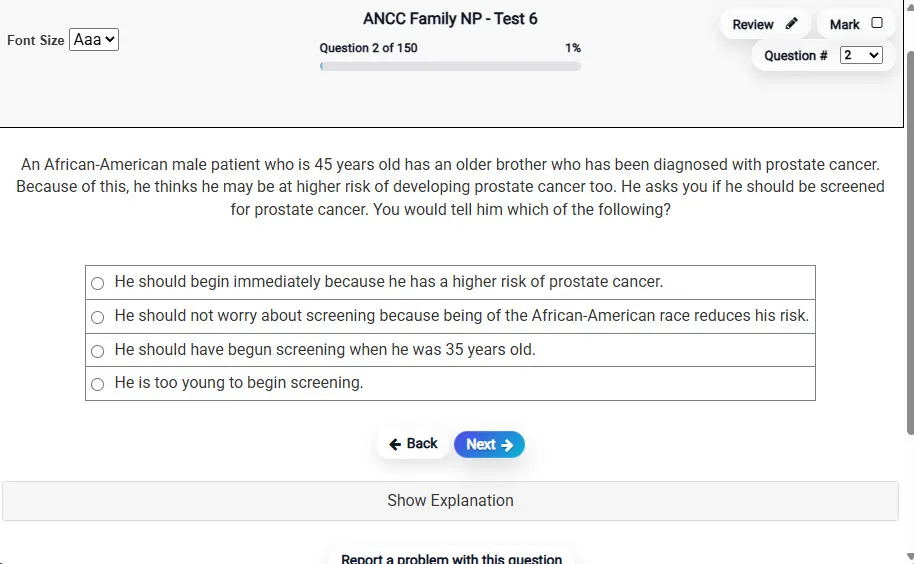
Answering a Question screen – Multiple-choice item view with navigation controls and progress tracker.
Answering a Question Multiple-choice item view with navigation controls and progress tracker.

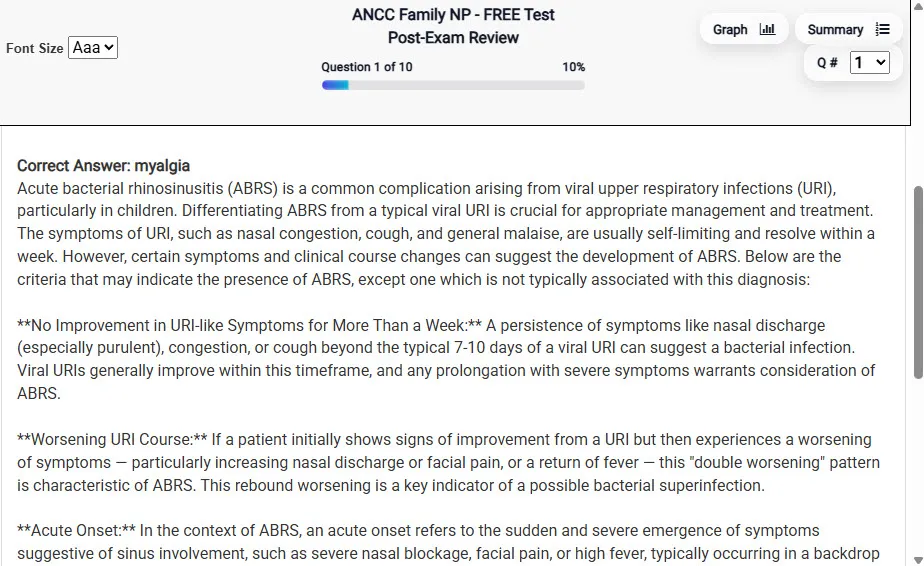
                           Detailed Explanation screen – 
                         Review mode showing chosen answer and rationale and references.
Detailed Explanation Review mode showing chosen answer and rationale and references.

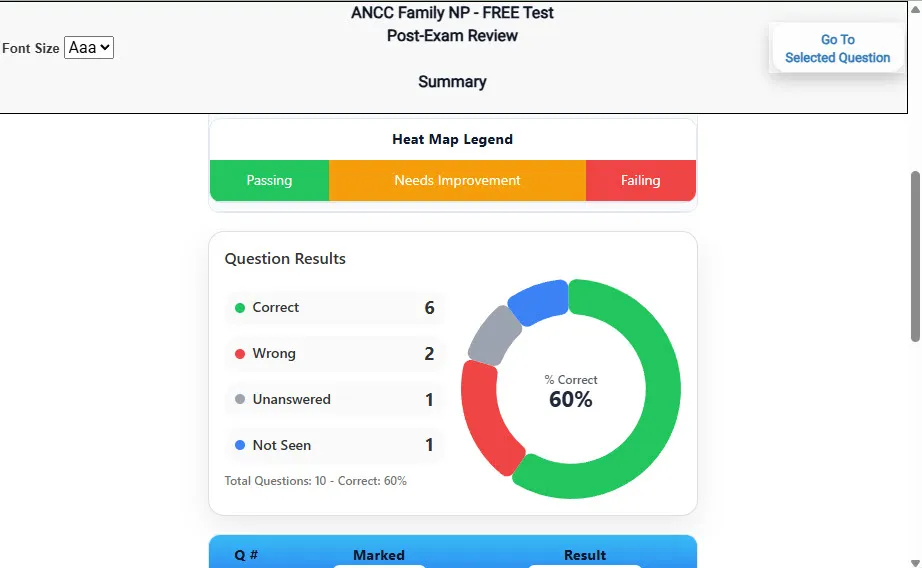
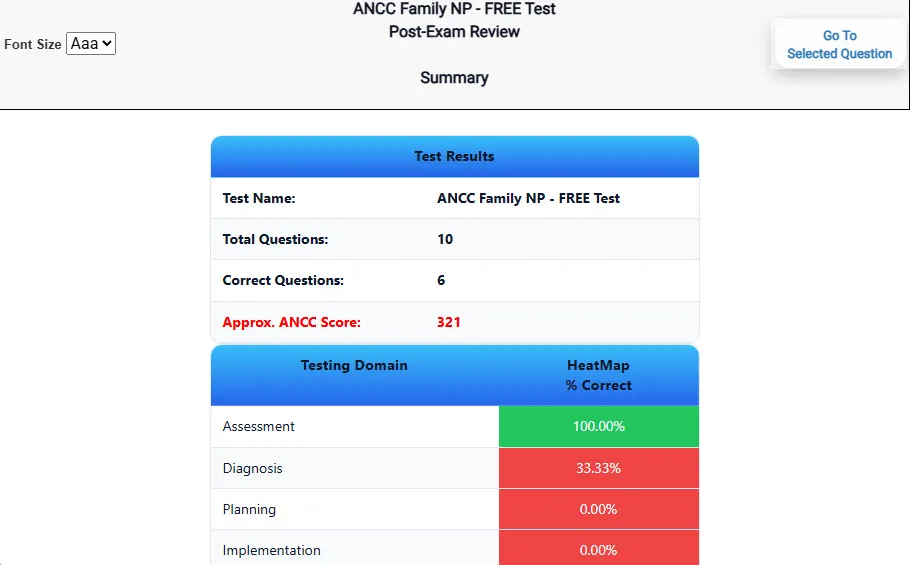
                           Review Summary 1 screen – 
                         Summary with counts for correct/wrong/unanswered and not seen items.
Review Summary 1 Summary with counts for correct/wrong/unanswered and not seen items.

                           Review Summary 2 screen – 
                         Advanced summary with category/domain breakdown and performance insights.
Review Summary 2 Advanced summary with category/domain breakdown and performance insights.

What Each Screen Shows

Answer Question Screen

  • Clean multiple-choice interface with progress bar.
  • Mark for review feature.
  • Matches real test pacing.

Detailed Explanation

  • Correct answer plus rationale.
  • Key concepts and guidelines highlighted.
  • Move between questions to fill knowledge gaps.

Review Summary 1

  • Overall results with total questions and scaled score.
  • Domain heatmap shows strengths and weaknesses.
  • Quick visual feedback on study priorities.

Review Summary 2

  • Chart of correct, wrong, unanswered, not seen.
  • Color-coded results for easy review.
  • Links back to missed items.

Top 10 Reasons to Use Exam Edge for your CSET Science Exam Prep

  1. Focused on the CSET Science Exam

    Our practice tests are built specifically for the CSET Science exam — every question mirrors the real topics, format, and difficulty so you're studying exactly what matters.

  2. Real Exam Simulation

    We match the per-question time limits and pressure of the actual CSET exam, so test day feels familiar and stress-free.

  3. 20 Full Practice Tests & 2,000 Unique Questions

    You'll have more than enough material to master every CSET Science concept — no repeats, no fluff.

  4. Lower Cost Than a Retake

    Ordering 5 practice exams costs less than retaking the CSET Science exam after a failure. One low fee could save you both time and money.

  5. Flexible Testing

    Need to step away mid-exam? Pick up right where you left off — with your remaining time intact.

  6. Instant Scoring & Feedback

    See your raw score and an estimated CSET Science score immediately after finishing each practice test.

  7. Detailed Explanations for Every Question

    Review correct and incorrect answers with clear, step-by-step explanations so you truly understand each topic.

  8. Trusted & Accredited

    We're fully accredited by the Better Business Bureau and uphold the highest standards of trust and transparency.

  9. Web-Based & Always Available

    No software to install. Access your CSET Science practice exams 24/7 from any computer or mobile device.

  10. Expert Support When You Need It

    Need extra help? Our specialized tutors are highly qualified and ready to support your CSET exam prep.


Pass the CSET Science Exam with Realistic Practice Tests from Exam Edge

Preparing for your upcoming CSET Science (118, 119) Certification Exam can feel overwhelming — but the right practice makes all the difference. Exam Edge gives you the tools, structure, and confidence to pass on your first try. Our online practice exams are built to match the real CSET Science exam in content, format, and difficulty.

  • 📝 20 CSET Science Practice Tests: Access 20 full-length exams with 100 questions each, covering every major CSET Science topic in depth.
  • Instant Online Access: Start practicing right away — no software, no waiting.
  • 🧠 Step-by-Step Explanations: Understand the reasoning behind every correct answer so you can master CSET Science exam concepts.
  • 🔄 Retake Each Exam Up to 4 Times: Build knowledge through repetition and track your improvement over time.
  • 🌐 Web-Based & Available 24/7: Study anywhere, anytime, on any device.
  • 🧘 Boost Your Test-Day Confidence: Familiarity with the CSET format reduces anxiety and helps you perform under pressure.

These CSET Science practice exams are designed to simulate the real testing experience by matching question types, timing, and difficulty level. This approach helps you get comfortable not just with the exam content, but also with the testing environment, so you walk into your exam day focused and confident.


Exam Edge CTC Reviews


Just wanted to let you guys know that your tests really helped me prepare for the CBEST math exam. I took it yesterday and passed with a 47! I will tell other people about your site.

Shawna M, California

I passed my cbest today! This was the second time I took the test. My first time I scored 35. This time I scored 43. Taking your practice tests helped me a great deal, because several types of questions on the real test were also on your practice tests. Thanks so much for the help!

TIm F, California

For the last year, I have been trying to pass the reading section of the CBEST. I had taken it six times and if I did not pass it this month, then I could not take my college courses in education. I went to Google and typed in practice reading tests and your website came up. I clicked on it, signed ...
Read More
Stacy S, California

Thank you so much for your reading tests. I just passed the real CBEST Reading test by 4 points! After failing it 3 other times, I thought I would have to quit. I already told everyone in my class about your site.

Sara L, Oregon

For the last year, I have been trying to pass my cset exam. I had taken it six times and was running out of hope I would ever pass. I went to Google and your website came up. I clicked on, signed up and took the free test. I knew that I would buy a couple of tests after taking that one. I ended up b ...
Read More
Stacy,

Purchased the five pack of tests this weekend. Took CBEST math today and passed! Your tests had very similar content as the actual CBEST.

Fresno , CA


CSET Science Aliases Test Name

Here is a list of alternative names used for this exam.

  • CSET Science
  • CSET Science test
  • CSET Science Certification Test
  • CTC
  • CTC 118, 119
  • 118, 119 test
  • CSET Science (118, 119)
  • CSET Science certification