This is the content of the pop-over!

Lightning Deal Alert – 12% Off Ends at Midnight!

Strike while the savings are hot! Use promo code FlashSale at checkout for 12% off any Exam Edge test or bundle. Hurry—the clock is ticking!

CSET Physics (220) Practice Tests & Test Prep by Exam Edge


CSET Physics  product image
(4.8)
Based on 20 Reviews

  • Real Exam Simulation: Timed questions and matching content build comfort for your CSET Physics test day.
  • Instant, 24/7 Access: Web-based CSET Physics practice exams with no software needed.
  • Clear Explanations: Step-by-step answers and explanations for your CSET exam to strengthen understanding.
  • Boosted Confidence: Reduces anxiety and improves test-taking skills to ace your CSET Physics (220).

Featured on

CSET Physics Online Practice Test Bundles

BEST VALUE
30 practice tests

$238.50

$1,198.50

SAVE $960

Only $7.95 per test!

  • 100% Pass Guarantee
  • 30 online practice tests
  • 50 questions per test
  • Bonus: 100 Flash Cards + Study Guide
  • Instant access
  • Detailed Explanations
  • Practice tests never expire
  • Timed, untimed, or study guide mode
MOST POPULAR
15 practice tests

$149.25

$599.25

SAVE $450

Only $9.95 per test!

  • 15 online practice tests
  • 50 questions per test
  • Bonus: 100 Flash Cards + Study Guide
  • Instant access
  • Detailed Explanations
  • Practice tests never expire
  • Timed, untimed, or study guide mode
5 practice tests

$69.75

$199.75

SAVE $130

Only $13.95 per test!

  • 5 online practice tests
  • 50 questions per test
  • Bonus: 100 Flash Cards
  • Instant access
  • Detailed Explanations
  • Practice tests never expire
  • Timed, untimed, or study guide mode
1 practice test

$39.95

  • 1 online practice test
  • 50 questions per test
  • Instant access
  • Detailed Explanations
  • Practice tests never expire
  • Timed, untimed, or study guide mode
Quick Select
Tap to choose a bundle

** All Prices are in US Dollars (USD) **


CSET Physics (220) Resources

Jump to the section you need most.

Understanding the exact breakdown of the CSET Physics test will help you know what to expect and how to most effectively prepare. The CSET Physics has 50 multiple-choice questions and 3 essay questions. The exam will be broken down into the sections below:

CSET Physics Exam Blueprint
Domain Name
Motion and Forces  
Conservation of Energy and Momentum  
Heat and Thermodynamics  
Waves  
Electromagnetism  
Quantum Mechanics and the Standard Model of Particles  

CSET Physics Study Tips by Domain

  • Apply Newton’s laws with explicit free-body diagrams; red flag: mixing up action–reaction pairs (they act on different objects) or forgetting normal force changes on inclines and in elevators.
  • Use kinematics only when acceleration is known/constant; common trap: assuming constant acceleration in two-dimensional projectile motion when a non-gravitational force (e.g., drag) is present.
  • Work with friction carefully: static friction satisfies 0 ≤ fs ≤ μsN and adjusts as needed; red flag: automatically setting fs = μsN when the object is not on the verge of slipping.
  • For circular motion, require net inward (centripetal) force Fc = mv2/r; common trap: treating “centripetal force” as an extra force instead of the radial component of real forces (tension, friction, gravity).
  • In rotational dynamics, keep torque signs and lever arms straight with τ = rF sin θ and I about the correct axis; red flag: forgetting the parallel-axis theorem when the rotation axis is not through the center of mass.
  • For gravitation, use F = Gm1m2/r2 and g = GM/r2 (varies with altitude); common trap: using g = 9.8 m/s2 for all radii or confusing mass (constant) with weight (depends on g).
  • Apply conservation of mechanical energy only when nonconservative work is zero; red flag: kinetic friction, air drag, or a motor means you must use Wnc = ΔK + ΔU instead.
  • Use momentum conservation when external impulse is negligible over the collision time; common trap: including gravity during an impact when mgΔt is tiny compared to the contact impulse.
  • Distinguish elastic vs inelastic collisions by whether kinetic energy is conserved; practical cue: “sticks together” implies perfectly inelastic and maximum kinetic energy loss.
  • For explosions and recoil, total momentum is conserved even though kinetic energy increases; priority rule: choose the system to include all fragments to avoid hidden external forces.
  • Track energy transfers with gravitational potential U = mgh near Earth (or U = −GMm/r generally); red flag: using mgh for large altitude changes where g is not approximately constant.
  • Use impulse J = ∫F dt = Δp and interpret area under an F–t graph carefully; common trap: confusing average force with peak force when estimating stopping time and momentum change.
  • Apply the First Law with a consistent sign convention (e.g., ΔU = Q − W where W is work done by the system); red flag: mixing conventions is a common trap that flips answers.
  • Know ideal-gas process shortcuts: isothermal ⇒ ΔU = 0 so Q = W, adiabatic ⇒ Q = 0 so ΔU = −W; cue: if the problem says “insulated” it usually implies adiabatic.
  • Use PV-diagram geometry: work by the gas is the area under the curve (and zero for isochoric); trap: using average pressure without checking whether the path is linear.
  • Separate heat vs. temperature: Q = mcΔT for sensible heating and Q = mL for phase change; cue: during a phase change, temperature stays constant despite heat transfer.
  • Second Law/entropy: for reversible processes ΔS = ∫ dQrev/T and isolated systems have ΔS ≥ 0; red flag: claiming 100% conversion of heat to work in a cycle violates the Kelvin–Planck statement.
  • Heat engines and refrigerators: efficiency η = W/QH and COPs are defined with desired output in the numerator; priority rule: Carnot sets the upper bound using absolute temperatures (K), so never plug in °C.
  • For traveling waves use v = fλ and k = 2π/λ, ω = 2πf; red flag: mixing ω (rad/s) with f (Hz) or using k in cycles/m instead of rad/m.
  • Write a harmonic wave as y(x,t) = A cos(kx − ωt + φ); common trap: the sign on ωt sets propagation direction (+x uses −ωt), so check by holding phase constant.
  • At a boundary, reflection phase flips only when reflecting from a higher-impedance (fixed end) boundary; priority rule: fixed end → inversion, free end → no inversion.
  • For standing waves, nodes/antinodes set allowed wavelengths (string fixed-fixed: L = nλ/2; open-closed pipe: L = (2n−1)λ/4); common trap: using the wrong end condition and getting all harmonics when only odd are allowed.
  • Use intensity relations I ∝ A2 and for point sources I = P/(4πr2); red flag: confusing amplitude falloff (A ∝ 1/r) with intensity falloff (I ∝ 1/r2).
  • Doppler shift: f′ = f (v ± vo)/(v ∓ vs); common trap: wrong sign convention—approaching increases observed frequency, receding decreases it.
  • Use Gauss’s law strategically: high symmetry (spherical/cylindrical/planar) means you can pick a Gaussian surface to make E constant; red flag—trying to use it for an off-center point charge or irregular distribution.
  • Apply Ampère’s law for steady currents with symmetry (long straight wire, solenoid, toroid); common trap—forgetting displacement current, so Ampère’s law without Maxwell’s term fails for time-varying fields (e.g., charging capacitor).
  • For Faraday’s law, the induced emf is tied to changing magnetic flux, not just a changing field; priority rule—use Lenz’s law to set the sign/direction and don’t drop the negative sign when relating emf to dΦB/dt.
  • Distinguish electric potential from electric field: E = −∇V and work depends on potential difference; common trap—saying a charge has zero potential energy just because V=0 at a chosen reference.
  • In circuits, enforce Kirchhoff’s laws with correct sign conventions; red flag—treating non-ideal sources (internal resistance) or meters (ammeter ~0Ω, voltmeter ~∞Ω) as ideal when they materially change the circuit.
  • Know force and motion in fields: magnetic force is qv×B (no work, changes direction) and electric force is qE (can change speed); common trap—assuming a magnetic field can speed up a charge or confusing right-hand rule direction for electrons (negative q reverses direction).
  • Use quantization to connect energy to frequency/wavelength: E = hf and p = h/λ; red flag—mixing up photon energy E with intensity (intensity changes photon number, not hf).
  • Apply de Broglie matter waves (λ = h/p) and the uncertainty principle (ΔxΔp ≥ ℏ/2); common trap—treating uncertainty as instrument error rather than a fundamental limit.
  • For simple bound systems, interpret discrete spectra as transitions between energy levels (e.g., hydrogen En ∝ −1/n2); cue—if an emission line is asked for, use ΔE = hf and pick the lower final level.
  • Use wavefunctions probabilistically: |ψ|2 is probability density and must be normalized; red flag—confusing ψ itself with a probability or forgetting units of probability density in 1D vs 3D.
  • Know key quantum numbers and exclusion: Pauli exclusion forbids identical fermions sharing all quantum numbers, and electron spin is ±1/2; common trap—placing more than two electrons in an orbital or ignoring spin when counting states.
  • Standard Model basics: classify particles as fermions (quarks/leptons) vs bosons (force carriers) and match forces to mediators (photon, W/Z, gluon); cue—remember neutrinos are leptons and have no electric charge, and the Higgs gives mass via interaction rather than being a force carrier.


Built to Fit Into Your Busy Life

Everything you need to prepare with confidence—without wasting a minute.

Three Study Modes

Timed, No Time Limit, or Explanation mode.

Actionable Analytics

Heatmaps and scaled scores highlight weak areas.

High-Yield Rationales

Concise explanations emphasize key concepts.

Realistic Interface

Matches the feel of the actual exam environment.

Accessible by Design

Clean layout reduces cognitive load.

Anytime, Anywhere

Web-based access 24/7 on any device.
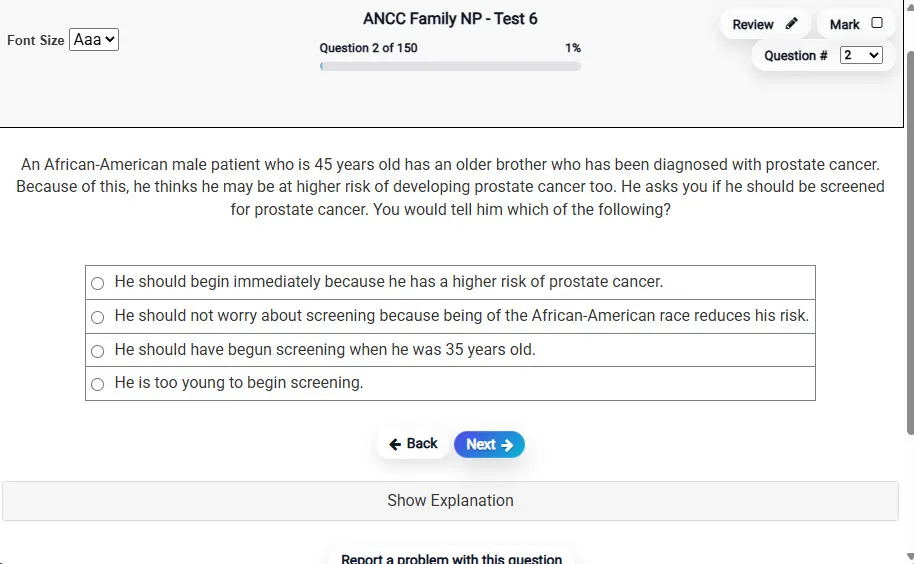
Answering a Question screen – Multiple-choice item view with navigation controls and progress tracker.
Answering a Question Multiple-choice item view with navigation controls and progress tracker.

                           Detailed Explanation screen – 
                         Review mode showing chosen answer and rationale and references.
Detailed Explanation Review mode showing chosen answer and rationale and references.

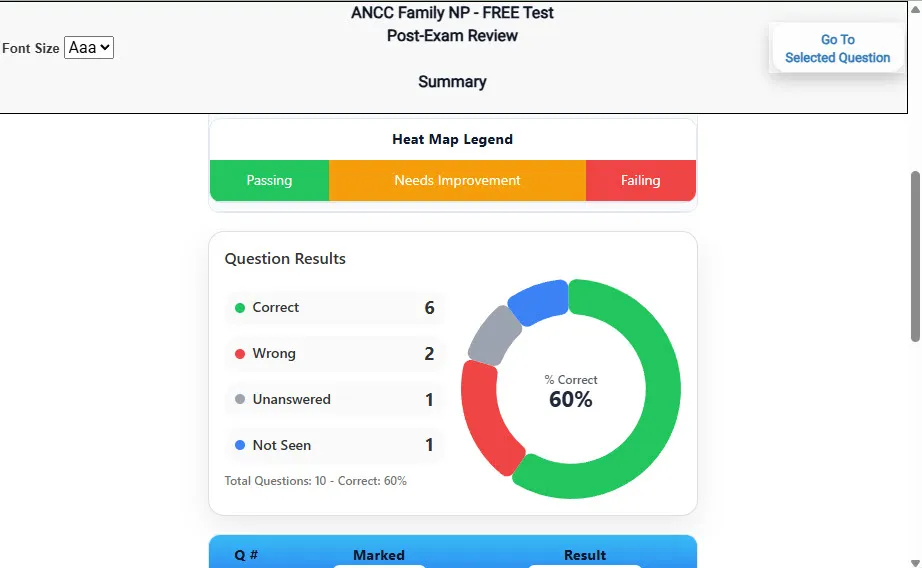
                           Review Summary 1 screen – 
                         Summary with counts for correct/wrong/unanswered and not seen items.
Review Summary 1 Summary with counts for correct/wrong/unanswered and not seen items.

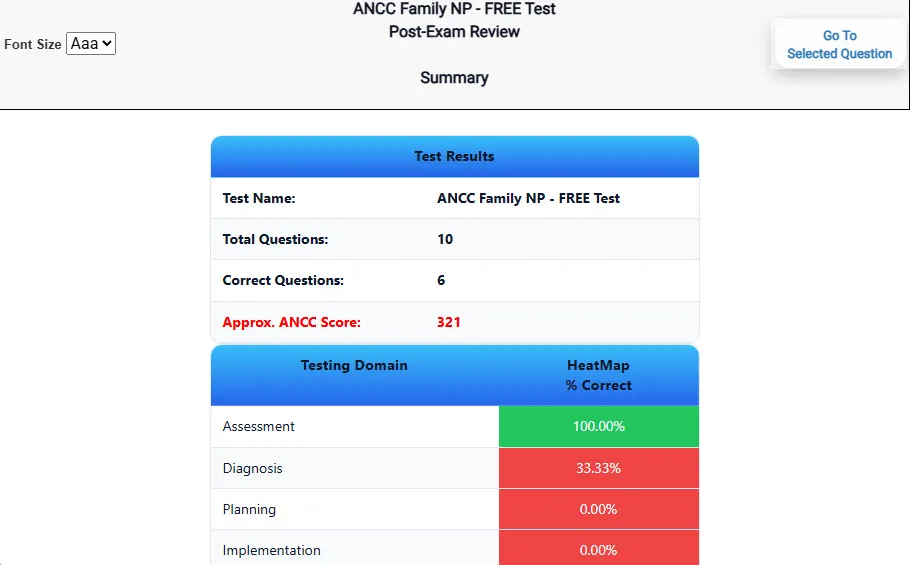
                           Review Summary 2 screen – 
                         Advanced summary with category/domain breakdown and performance insights.
Review Summary 2 Advanced summary with category/domain breakdown and performance insights.

What Each Screen Shows

Answer Question Screen

  • Clean multiple-choice interface with progress bar.
  • Mark for review feature.
  • Matches real test pacing.

Detailed Explanation

  • Correct answer plus rationale.
  • Key concepts and guidelines highlighted.
  • Move between questions to fill knowledge gaps.

Review Summary 1

  • Overall results with total questions and scaled score.
  • Domain heatmap shows strengths and weaknesses.
  • Quick visual feedback on study priorities.

Review Summary 2

  • Chart of correct, wrong, unanswered, not seen.
  • Color-coded results for easy review.
  • Links back to missed items.

Top 10 Reasons to Use Exam Edge for your CSET Physics Exam Prep

  1. Focused on the CSET Physics Exam

    Our practice tests are built specifically for the CSET Physics exam — every question mirrors the real topics, format, and difficulty so you're studying exactly what matters.

  2. Real Exam Simulation

    We match the per-question time limits and pressure of the actual CSET exam, so test day feels familiar and stress-free.

  3. 30 Full Practice Tests & 1,500 Unique Questions

    You'll have more than enough material to master every CSET Physics concept — no repeats, no fluff.

  4. Lower Cost Than a Retake

    Ordering 5 practice exams costs less than retaking the CSET Physics exam after a failure. One low fee could save you both time and money.

  5. Flexible Testing

    Need to step away mid-exam? Pick up right where you left off — with your remaining time intact.

  6. Instant Scoring & Feedback

    See your raw score and an estimated CSET Physics score immediately after finishing each practice test.

  7. Detailed Explanations for Every Question

    Review correct and incorrect answers with clear, step-by-step explanations so you truly understand each topic.

  8. Trusted & Accredited

    We're fully accredited by the Better Business Bureau and uphold the highest standards of trust and transparency.

  9. Web-Based & Always Available

    No software to install. Access your CSET Physics practice exams 24/7 from any computer or mobile device.

  10. Expert Support When You Need It

    Need extra help? Our specialized tutors are highly qualified and ready to support your CSET exam prep.


Pass the CSET Physics Exam with Realistic Practice Tests from Exam Edge

Preparing for your upcoming CSET Physics (220) Certification Exam can feel overwhelming — but the right practice makes all the difference. Exam Edge gives you the tools, structure, and confidence to pass on your first try. Our online practice exams are built to match the real CSET Physics exam in content, format, and difficulty.

  • 📝 30 CSET Physics Practice Tests: Access 30 full-length exams with 50 questions each, covering every major CSET Physics topic in depth.
  • Instant Online Access: Start practicing right away — no software, no waiting.
  • 🧠 Step-by-Step Explanations: Understand the reasoning behind every correct answer so you can master CSET Physics exam concepts.
  • 🔄 Retake Each Exam Up to 4 Times: Build knowledge through repetition and track your improvement over time.
  • 🌐 Web-Based & Available 24/7: Study anywhere, anytime, on any device.
  • 🧘 Boost Your Test-Day Confidence: Familiarity with the CSET format reduces anxiety and helps you perform under pressure.

These CSET Physics practice exams are designed to simulate the real testing experience by matching question types, timing, and difficulty level. This approach helps you get comfortable not just with the exam content, but also with the testing environment, so you walk into your exam day focused and confident.


Exam Edge CTC Reviews


I bought the CSET Physics practice test bundle (5 tests) for somewhere around $50. Although most of the questions were related to Physics, the style and rigor of the questions didn't match up to my actual exam :(

Precious , San Jose, California

Just wanted to let you guys know that your tests really helped me prepare for the CBEST math exam. I took it yesterday and passed with a 47! I will tell other people about your site.

Shawna M, California

I passed my cbest today! This was the second time I took the test. My first time I scored 35. This time I scored 43. Taking your practice tests helped me a great deal, because several types of questions on the real test were also on your practice tests. Thanks so much for the help!

TIm F, California

For the last year, I have been trying to pass the reading section of the CBEST. I had taken it six times and if I did not pass it this month, then I could not take my college courses in education. I went to Google and typed in practice reading tests and your website came up. I clicked on it, signed ...
Read More
Stacy S, California

Thank you so much for your reading tests. I just passed the real CBEST Reading test by 4 points! After failing it 3 other times, I thought I would have to quit. I already told everyone in my class about your site.

Sara L, Oregon

For the last year, I have been trying to pass my cset exam. I had taken it six times and was running out of hope I would ever pass. I went to Google and your website came up. I clicked on, signed up and took the free test. I knew that I would buy a couple of tests after taking that one. I ended up b ...
Read More
Stacy,


CSET Physics Aliases Test Name

Here is a list of alternative names used for this exam.

  • CSET Physics
  • CSET Physics test
  • CSET Physics Certification Test
  • CTC
  • CTC 220
  • 220 test
  • CSET Physics (220)
  • CSET Physics certification