This is the content of the pop-over!

Lightning Deal Alert – 12% Off Ends at Midnight!

Strike while the savings are hot! Use promo code FlashSale at checkout for 12% off any Exam Edge test or bundle. Hurry—the clock is ticking!

CSET Physical Education (129, 130, 131) Practice Tests & Test Prep by Exam Edge


CSET Physical Education  product image
(4.9)
Based on 32 Reviews

  • Real Exam Simulation: Timed questions and matching content build comfort for your CSET Physical Education test day.
  • Instant, 24/7 Access: Web-based CSET Physical Education practice exams with no software needed.
  • Clear Explanations: Step-by-step answers and explanations for your CSET exam to strengthen understanding.
  • Boosted Confidence: Reduces anxiety and improves test-taking skills to ace your CSET Physical Education (129, 130, 131).

Featured on

CSET Physical Education Online Practice Test Bundles

BEST VALUE
15 practice tests

$149.25

$599.25

SAVE $450

Only $9.95 per test!

  • 100% Pass Guarantee
  • 15 online practice tests
  • 120 questions + 2 essays per test
  • Bonus: 100 Flash Cards + Study Guide
  • Instant access
  • Detailed Explanations
  • Practice tests never expire
  • Timed, untimed, or study guide mode
MOST POPULAR
10 practice tests

$99.50

$399.50

SAVE $300

Only $9.95 per test!

  • 10 online practice tests
  • 120 questions + 2 essays per test
  • Bonus: 100 Flash Cards + Study Guide
  • Instant access
  • Detailed Explanations
  • Practice tests never expire
  • Timed, untimed, or study guide mode
5 practice tests

$69.75

$199.75

SAVE $130

Only $13.95 per test!

  • 5 online practice tests
  • 120 questions + 2 essays per test
  • Bonus: 100 Flash Cards
  • Instant access
  • Detailed Explanations
  • Practice tests never expire
  • Timed, untimed, or study guide mode
1 practice test

$39.95

  • 1 online practice test
  • 120 questions + 2 essays per test
  • Instant access
  • Detailed Explanations
  • Practice tests never expire
  • Timed, untimed, or study guide mode
Quick Select
Tap to choose a bundle

** All Prices are in US Dollars (USD) **


CSET Physical Education (129, 130, 131) Resources

Jump to the section you need most.

Understanding the exact breakdown of the CSET Physical Education test will help you know what to expect and how to most effectively prepare. The CSET Physical Education has 120 multiple-choice questions and 5 essay questions. The exam will be broken down into the sections below:

CSET Physical Education Exam Blueprint
Domain Name % Number of
Questions
Professional Foundations  
Growth - Motor Development Motor Learning  
The Science of Human Movement  
The Sociology and Psychology of Human Movement  
Movement Concepts and Forms  
Assessment and Evaluation Principles  
Integration of Concepts  

CSET Physical Education Study Tips by Domain

  • Align instruction to California standards and district curriculum maps; red flag: lesson objectives that don’t match the assessed skill or stated standard.
  • Apply CTC-driven professional ethics, mandated reporting, and student confidentiality rules; common trap: discussing student IEP/504 details in public or with non-need-to-know staff.
  • Follow legal safety and liability practices in PE (supervision, equipment checks, emergency action plan); priority rule: stop activity immediately for unsafe facilities/equipment or missing supervision ratios.
  • Design inclusive PE using UDL and legally required accommodations (IEP/504, ADA); contraindication: modifying expectations without documenting/supporting access, which can become inequitable or noncompliant.
  • Use sound classroom management and positive behavior supports specific to active settings; common trap: vague rules—use 3–5 explicitly taught signals, boundaries, and routines before high-movement tasks.
  • Engage in ongoing professional growth (reflection, collaboration, data use, continuing education) and maintain credentials; threshold cue: track required professional learning/credential renewal timelines to avoid lapses.
  • Distinguish growth (quantitative change), development (qualitative change), and maturation (biological readiness); red flag: assuming chronological age alone predicts skill readiness.
  • Apply stage-related characteristics (e.g., early childhood vs. adolescence) to task selection and feedback; common trap: teaching adult-form technique before fundamental motor patterns are stable.
  • Use motor learning principles (practice specificity, feedback timing, and attentional focus) to improve retention and transfer; priority rule: evaluate learning with delayed retention/transfer tests, not just immediate performance.
  • Select practice schedules deliberately—blocked for initial acquisition, random/variable for long-term retention; threshold cue: if performance drops sharply under random practice, reduce task difficulty but keep variability.
  • Differentiate intrinsic vs. extrinsic feedback and avoid over-coaching; red flag: constant corrective cues every rep can create feedback dependence and reduce self-correction.
  • Account for individual differences (disability, language, prior experience, and motivation) using appropriate modifications; common trap: modifying rules/equipment without preserving the skill’s essential movement outcome.
  • Apply basic biomechanics (force, torque, center of mass, levers) to explain performance changes; red flag: confusing mass with weight or mixing up internal vs. external forces.
  • Use exercise physiology principles (ATP-PC, glycolytic, oxidative) to match intensity and duration; common trap: assuming aerobic energy dominates at the start of all activities.
  • Interpret cardio-respiratory responses (HR, stroke volume, VO2, ventilation) and training effects; priority rule: do not infer fitness from a single heart-rate value without context (age, medications, environment).
  • Connect neuromuscular function (motor unit recruitment, fiber types, reflexes) to strength, power, and fatigue; red flag: claiming “slow-twitch can’t produce power” or that lactate is simply “waste” with no purpose.
  • Apply thermoregulation and environmental physiology (heat index, hydration, acclimatization, altitude) to safe activity planning; contraindication: heat illness signs (confusion, cessation of sweating) require immediate cessation and emergency response.
  • Use basic anatomy/kinesiology (joint actions, planes, agonist/antagonist, connective tissue roles) to analyze movement and injury risk; common trap: mislabeling motions (e.g., calling hip extension “knee extension”) or ignoring overuse mechanisms.
  • Distinguish intrinsic vs. extrinsic motivation and use autonomy-supportive cues (choice, rationale, acknowledgment) to increase persistence; red flag: relying on rewards/punishments can undermine long-term engagement.
  • Apply goal-setting (specific, measurable, process-oriented) and align feedback to the goal; common trap: emphasizing only outcome goals increases anxiety and off-task behavior for novices.
  • Use group management strategies (clear roles, equitable participation, structured rotations) to reduce social loafing; red flag: letting captains pick teams publicly can damage climate and trigger disengagement.
  • Identify stages of group development (forming–storming–norming–performing) and pre-teach conflict-resolution norms; priority rule: address unsafe or exclusionary behavior immediately, even if it interrupts instruction.
  • Promote inclusive practices across gender, culture, language, and ability (adapt rules/equipment, varied leadership opportunities) to support belonging; common trap: “same for everyone” can be inequitable when access barriers exist.
  • Interpret affect and arousal in performance (inverted-U, self-talk, imagery, breathing) and select a regulation strategy matched to the learner; contraindication: over-coaching during performance can increase cognitive load and reduce skill execution.
  • Apply biomechanical concepts (force, torque, levers) to movement efficiency; red flag: changing multiple variables at once makes it impossible to identify the true cause of a performance error.
  • Differentiate stability vs mobility using base of support, center of gravity, and friction; priority rule: widen the base and lower the center of gravity before adding speed or load.
  • Use the critical elements of fundamental movement patterns (locomotor, nonlocomotor, manipulative) to progress skills; common trap: advancing to complex sport skills before students demonstrate consistent mature patterns.
  • Design movement sequences with clear space, time, and effort qualities (e.g., levels, pathways, tempo); contraindication: avoid blind-travel pathways in crowded spaces without defined boundaries and traffic flow.
  • Teach sport-specific forms (e.g., striking, throwing, jumping, landing) with an emphasis on safe alignment; red flag: knee valgus on landing requires immediate regression and targeted cueing (e.g., “knees over toes”).
  • Adapt movement forms for diverse learners using task, environment, and equipment modifications; priority rule: modify the task first (distance, target size, rules) before attributing low performance to “effort” or motivation.
  • Align assessments to CA PE standards and stated lesson objectives; red flag: a test that measures only effort or participation rather than the targeted skill/fitness outcome.
  • Use multiple measures (skill rubric, observation checklist, fitness data, student reflection) to improve validity; common trap: relying on a single timed trial to infer overall competency.
  • Ensure reliability by defining performance criteria and conducting rater calibration; priority rule: if two teachers can’t score it similarly, the rubric needs clearer descriptors.
  • Apply developmentally appropriate and accessible assessment accommodations (e.g., modified equipment, alternate response formats) while keeping the construct constant; contraindication: changing the task so much that it no longer assesses the intended skill.
  • Interpret fitness and performance data using norms/criterion-referenced standards appropriately; red flag: comparing students only to classmates (norm-referenced) when mastery (criterion) is required for grading.
  • Use formative assessment cycles to adjust instruction and provide timely feedback; common trap: waiting until the end-of-unit summative to identify misconceptions or unsafe movement patterns.
  • Design integrated units that align standards, instruction, and assessment (e.g., tactics + fitness + personal/social responsibility) and document evidence; red flag: lessons that only list activities without stating measurable outcomes.
  • Use backward design to connect essential questions, skill/tactic progressions, and checks for understanding; common trap: assessing only game performance when the objective targets decision-making or movement quality.
  • Differentiate tasks (space, equipment, rules, roles) to ensure access and challenge for all learners; priority rule: modify the task before removing the learner from participation.
  • Integrate safety and risk management into planning (environment scan, equipment checks, supervision ratios); red flag: transitions without clear routines that increase collision or off-task risk.
  • Embed technology and data appropriately (heart rate, pedometers, video feedback) to support learning and reflection; common trap: collecting data without teaching students how to interpret it against criteria.
  • Connect PE content to broader goals (SEL, health literacy, equity, and inclusion) with explicit teaching moves and reflection prompts; red flag: assuming teamwork or sportsmanship will “just happen” without structured practice and feedback.


Built to Fit Into Your Busy Life

Everything you need to prepare with confidence—without wasting a minute.

Three Study Modes

Timed, No Time Limit, or Explanation mode.

Actionable Analytics

Heatmaps and scaled scores highlight weak areas.

High-Yield Rationales

Concise explanations emphasize key concepts.

Realistic Interface

Matches the feel of the actual exam environment.

Accessible by Design

Clean layout reduces cognitive load.

Anytime, Anywhere

Web-based access 24/7 on any device.
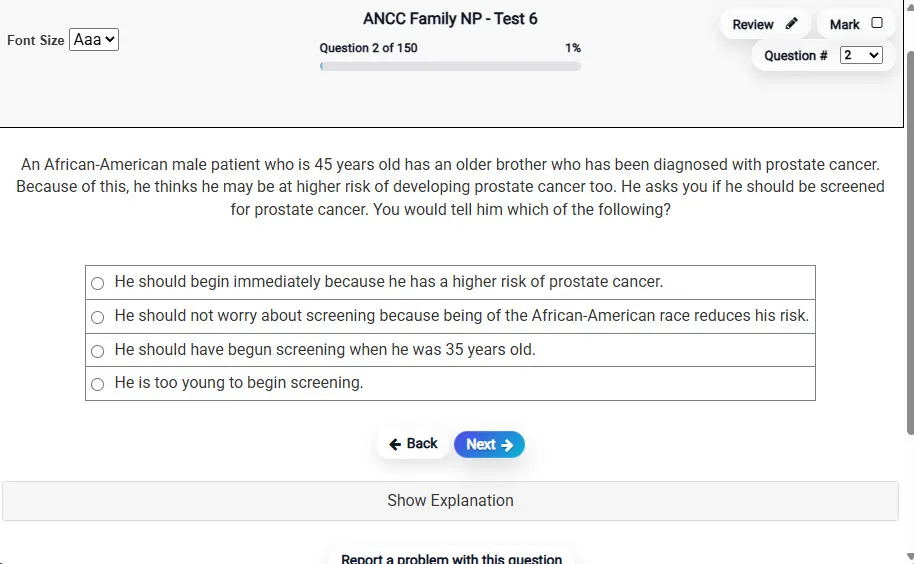
Answering a Question screen – Multiple-choice item view with navigation controls and progress tracker.
Answering a Question Multiple-choice item view with navigation controls and progress tracker.

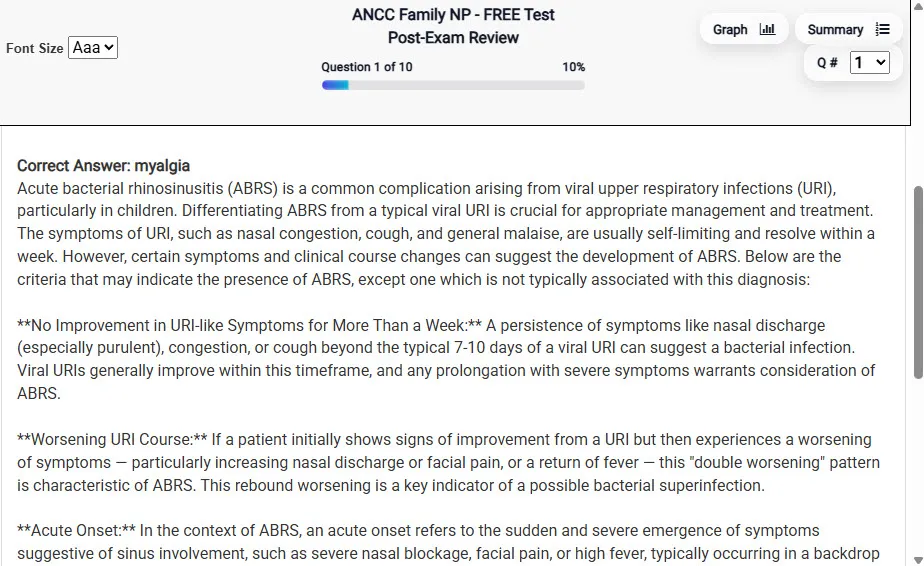
                           Detailed Explanation screen – 
                         Review mode showing chosen answer and rationale and references.
Detailed Explanation Review mode showing chosen answer and rationale and references.

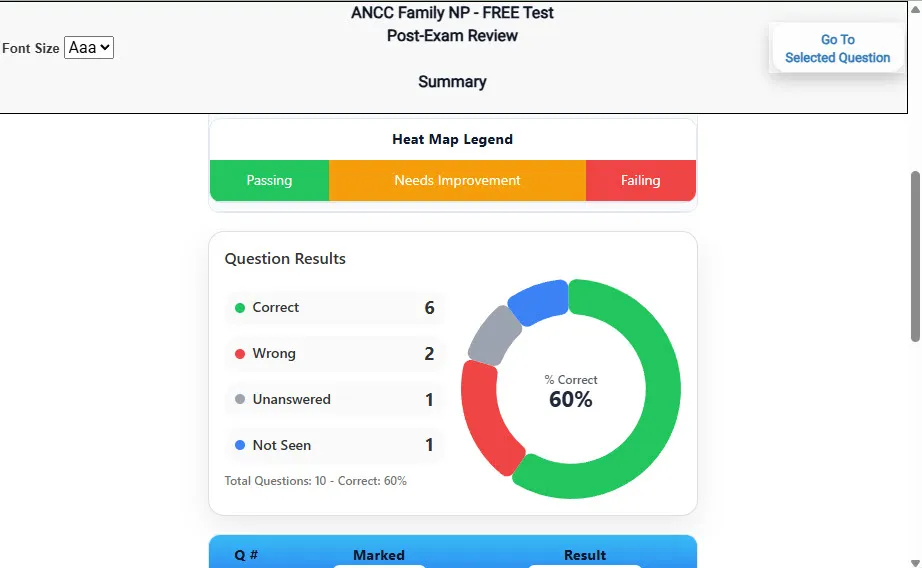
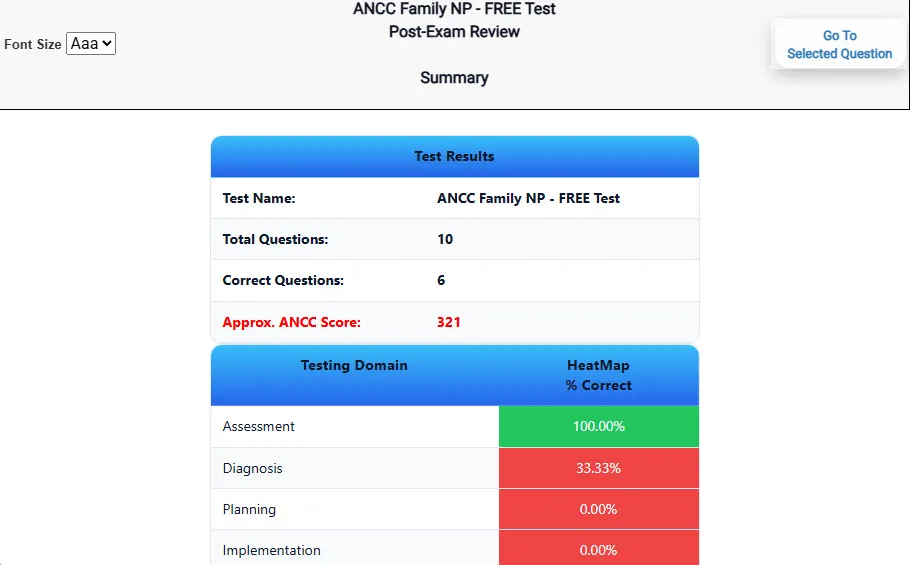
                           Review Summary 1 screen – 
                         Summary with counts for correct/wrong/unanswered and not seen items.
Review Summary 1 Summary with counts for correct/wrong/unanswered and not seen items.

                           Review Summary 2 screen – 
                         Advanced summary with category/domain breakdown and performance insights.
Review Summary 2 Advanced summary with category/domain breakdown and performance insights.

What Each Screen Shows

Answer Question Screen

  • Clean multiple-choice interface with progress bar.
  • Mark for review feature.
  • Matches real test pacing.

Detailed Explanation

  • Correct answer plus rationale.
  • Key concepts and guidelines highlighted.
  • Move between questions to fill knowledge gaps.

Review Summary 1

  • Overall results with total questions and scaled score.
  • Domain heatmap shows strengths and weaknesses.
  • Quick visual feedback on study priorities.

Review Summary 2

  • Chart of correct, wrong, unanswered, not seen.
  • Color-coded results for easy review.
  • Links back to missed items.

Top 10 Reasons to Use Exam Edge for your CSET Physical Education Exam Prep

  1. Focused on the CSET Physical Education Exam

    Our practice tests are built specifically for the CSET Physical Education exam — every question mirrors the real topics, format, and difficulty so you're studying exactly what matters.

  2. Real Exam Simulation

    We match the per-question time limits and pressure of the actual CSET exam, so test day feels familiar and stress-free.

  3. 15 Full Practice Tests & 1,830 Unique Questions

    You'll have more than enough material to master every CSET Physical Education concept — no repeats, no fluff.

  4. Lower Cost Than a Retake

    Ordering 5 practice exams costs less than retaking the CSET Physical Education exam after a failure. One low fee could save you both time and money.

  5. Flexible Testing

    Need to step away mid-exam? Pick up right where you left off — with your remaining time intact.

  6. Instant Scoring & Feedback

    See your raw score and an estimated CSET Physical Education score immediately after finishing each practice test.

  7. Detailed Explanations for Every Question

    Review correct and incorrect answers with clear, step-by-step explanations so you truly understand each topic.

  8. Trusted & Accredited

    We're fully accredited by the Better Business Bureau and uphold the highest standards of trust and transparency.

  9. Web-Based & Always Available

    No software to install. Access your CSET Physical Education practice exams 24/7 from any computer or mobile device.

  10. Expert Support When You Need It

    Need extra help? Our specialized tutors are highly qualified and ready to support your CSET exam prep.


Pass the CSET Physical Education Exam with Realistic Practice Tests from Exam Edge

Preparing for your upcoming CSET Physical Education (129, 130, 131) Certification Exam can feel overwhelming — but the right practice makes all the difference. Exam Edge gives you the tools, structure, and confidence to pass on your first try. Our online practice exams are built to match the real CSET Physical Education exam in content, format, and difficulty.

  • 📝 15 CSET Physical Education Practice Tests: Access 15 full-length exams with 122 questions each, covering every major CSET Physical Education topic in depth.
  • Instant Online Access: Start practicing right away — no software, no waiting.
  • 🧠 Step-by-Step Explanations: Understand the reasoning behind every correct answer so you can master CSET Physical Education exam concepts.
  • 🔄 Retake Each Exam Up to 4 Times: Build knowledge through repetition and track your improvement over time.
  • 🌐 Web-Based & Available 24/7: Study anywhere, anytime, on any device.
  • 🧘 Boost Your Test-Day Confidence: Familiarity with the CSET format reduces anxiety and helps you perform under pressure.

These CSET Physical Education practice exams are designed to simulate the real testing experience by matching question types, timing, and difficulty level. This approach helps you get comfortable not just with the exam content, but also with the testing environment, so you walk into your exam day focused and confident.


Exam Edge CTC Reviews


Just wanted to let you guys know that your tests really helped me prepare for the CBEST math exam. I took it yesterday and passed with a 47! I will tell other people about your site.

Shawna M, California

I passed my cbest today! This was the second time I took the test. My first time I scored 35. This time I scored 43. Taking your practice tests helped me a great deal, because several types of questions on the real test were also on your practice tests. Thanks so much for the help!

TIm F, California

For the last year, I have been trying to pass the reading section of the CBEST. I had taken it six times and if I did not pass it this month, then I could not take my college courses in education. I went to Google and typed in practice reading tests and your website came up. I clicked on it, signed ...
Read More
Stacy S, California

Thank you so much for your reading tests. I just passed the real CBEST Reading test by 4 points! After failing it 3 other times, I thought I would have to quit. I already told everyone in my class about your site.

Sara L, Oregon

For the last year, I have been trying to pass my cset exam. I had taken it six times and was running out of hope I would ever pass. I went to Google and your website came up. I clicked on, signed up and took the free test. I knew that I would buy a couple of tests after taking that one. I ended up b ...
Read More
Stacy,

Purchased the five pack of tests this weekend. Took CBEST math today and passed! Your tests had very similar content as the actual CBEST.

Fresno , CA


CSET Physical Education Aliases Test Name

Here is a list of alternative names used for this exam.

  • CSET Physical Education
  • CSET Physical Education test
  • CSET Physical Education Certification Test
  • CTC
  • CTC 129, 130, 131
  • 129, 130, 131 test
  • CSET Physical Education (129, 130, 131)
  • CSET Physical Education certification