This is the content of the pop-over!

Lightning Deal Alert – 12% Off Ends at Midnight!

Strike while the savings are hot! Use promo code FlashSale at checkout for 12% off any Exam Edge test or bundle. Hurry—the clock is ticking!

CSET Multiple Subjects (101/214/103) Practice Tests & Test Prep by Exam Edge


CSET Multiple Subjects  product image
(4.9)
Based on 34 Reviews

  • Real Exam Simulation: Timed questions and matching content build comfort for your CSET Multiple Subjects test day.
  • Instant, 24/7 Access: Web-based CSET Multiple Subjects practice exams with no software needed.
  • Clear Explanations: Step-by-step answers and explanations for your CSET exam to strengthen understanding.
  • Boosted Confidence: Reduces anxiety and improves test-taking skills to ace your CSET Multiple Subjects (101/214/103).

Featured on

CSET Multiple Subjects Online Practice Test Bundles

BEST VALUE
20 practice tests

$174.00

$799.00

SAVE $625

Only $8.70 per test!

  • 100% Pass Guarantee
  • 20 online practice tests
  • 143 questions + 10 essays per test
  • Bonus: 100 Flash Cards + Study Guide
  • Instant access
  • Detailed Explanations
  • Practice tests never expire
  • Timed, untimed, or study guide mode
MOST POPULAR
10 practice tests

$99.50

$399.50

SAVE $300

Only $9.95 per test!

  • 10 online practice tests
  • 143 questions + 10 essays per test
  • Bonus: 100 Flash Cards + Study Guide
  • Instant access
  • Detailed Explanations
  • Practice tests never expire
  • Timed, untimed, or study guide mode
5 practice tests

$69.75

$199.75

SAVE $130

Only $13.95 per test!

  • 5 online practice tests
  • 143 questions + 10 essays per test
  • Bonus: 100 Flash Cards
  • Instant access
  • Detailed Explanations
  • Practice tests never expire
  • Timed, untimed, or study guide mode
1 practice test

$39.95

  • 1 online practice test
  • 143 questions + 10 essays per test
  • Instant access
  • Detailed Explanations
  • Practice tests never expire
  • Timed, untimed, or study guide mode
Quick Select
Tap to choose a bundle

** All Prices are in US Dollars (USD) **


CSET Multiple Subjects (101/214/103) Resources

Jump to the section you need most.

Understanding the exact breakdown of the CSET Multiple Subjects test will help you know what to expect and how to most effectively prepare. The CSET Multiple Subjects has 143 multiple-choice questions and 11 essay questions. The exam will be broken down into the sections below:

CSET Multiple Subjects Exam Blueprint
Domain Name % Number of
Questions
Subject Matter Understanding and Skill in Reading - Language Literature  
     Language and Linguistics  
     Non-Written and Written Communication  
     Reading Comprehension and Analysis  
Subject Matter Understanding and Skill in History and Social Science  
     World History  
     United States History  
     California History  
Subject Matter Understanding and Skill in Mathematics  
     Number Sense  
     Algebra and Functions  
     Measurement and Geometry  
     Statistics - Data Analysis Probability  
Subject Matter Understanding and Skill in Science  
     Physical Science  
     Life Science  
     Earth and Space Science  
Subject Matter Understanding and Skill in Visual and Performing Arts  
     Dance  
     Music  
     Theatre  
     Visual Art  
Subject Matter Understanding and Skill in Physical Education  
     Movement Skills and Movement Knowledge  
     Self-Image and Personal Development  
     Social Development  
Subject Matter Understanding and Skill in Human Development  
     Cognitive Development from Birth Through Adolescence  
     Social and Physical Development from Birth Through Adolescence  
     Influences on Development from Birth Through Adolescence  

CSET Multiple Subjects Study Tips by Domain

  • Prioritize evidence-based reading instruction: explicitly teach phonological awareness, phonics, fluency, vocabulary, and comprehension (a common CTC-aligned trap is skipping foundational skills and relying only on “balanced literacy” routines).
  • Know text complexity factors (quantitative measures, qualitative features, and task/reader demands) and match scaffolds accordingly—red flag: lowering the text instead of supporting access with purposeful scaffolding.
  • Teach vocabulary in depth (morphology, Greek/Latin roots, affixes, and context analysis) and avoid the common trap of assigning dictionary definitions without multiple meaningful encounters in text.
  • Use close reading skills: cite textual evidence, analyze author’s purpose, craft, and structure, and distinguish main idea vs. supporting details—priority rule: claims must be supported by specific evidence, not general impressions.
  • Demonstrate command of language conventions (grammar, usage, punctuation, and syntax) and connect them to meaning—red flag: teaching mechanics as isolated worksheets with no revision/editing application.
  • Know core literary elements and genres (theme, characterization, point of view, figurative language, and narrative structure) and avoid the trap of summarizing plot instead of analyzing how literary devices shape meaning.
  • Differentiate phonetics vs. phonology vs. morphology vs. syntax vs. semantics vs. pragmatics; common trap: calling /p/ (a phoneme) a “letter” rather than a speech sound.
  • Know morpheme types (free/bound, inflectional/derivational) and be able to segment words; red flag: confusing inflection (e.g., -ed, -s) with derivation (e.g., un-, -ness) that changes meaning or part of speech.
  • Apply basic syntactic concepts (phrase, clause, subject/predicate, coordination/subordination) and punctuation links; priority rule: subordinate clauses depend on an independent clause even if they come first (watch comma placement).
  • Explain semantic relationships (synonymy, antonymy, homonymy, polysemy, denotation/connotation) and how context shifts meaning; common trap: treating multiple-meaning words as “homonyms” when they are polysemous.
  • Use pragmatics/discourse ideas (register, audience, purpose, implicature, turn-taking) to analyze communication; red flag: judging language variety as “incorrect” instead of identifying it as dialect/register choice.
  • Connect language acquisition concepts to instruction (overgeneralization, code-switching, transfer/interference, receptive vs. expressive language); contraindication: equating an accent or dialect features with a language disorder.
  • Distinguish oral language from written language (e.g., discourse markers, syntax density, audience awareness)—common trap: treating fluent speech as evidence of strong writing proficiency.
  • Use standard writing process moves (plan → draft → revise for ideas/organization → edit for conventions)—priority rule: revise before proofreading, or you’ polish weak structure.
  • Recognize text structures (narrative, descriptive, compare/contrast, cause/effect, problem/solution) and match them to purpose—red flag: a mismatch between purpose and structure lowers coherence.
  • Apply sentence-level control (fragments, run-ons, subject–verb agreement, pronoun reference, parallelism)—common trap: fixing punctuation without correcting the underlying clause structure.
  • Evaluate audience, tone, and register in both speaking and writing (formal vs. informal, academic vs. conversational)—contraindication: sarcasm or vague pronouns (“this,” “they”) that obscure meaning for an unfamiliar reader.
  • Interpret and produce non-written communication (visuals, gestures, prosody, graphics) alongside text—priority rule: captions/labels must align with the data shown, not the conclusion you want.
  • Use a purpose-driven first read (identify genre, audience, and claim) and then annotate for “what is said” vs. “what is implied”—red flag: answering from background knowledge instead of textual evidence.
  • When a question asks for the main idea, choose the option that is broad enough to cover most paragraphs but specific enough to exclude side details—common trap: picking a vivid example or a single paragraph’s topic.
  • For inference items, cite at least two supporting clues (word choice, context, or logical consequence) before selecting an answer—priority rule: the best inference is the one most directly supported, not the most interesting.
  • Track argument structure (claim, reasons, evidence, and assumptions) and evaluate whether evidence is relevant and sufficient—red flag: confusing a reason with an example or mistaking correlation for causation.
  • Interpret tone and point of view by focusing on diction, syntax, and what the author includes or omits—common trap: labeling tone as “negative” or “positive” without specific textual cues.
  • Use context to determine meaning of unfamiliar words and distinguish denotation from connotation—contraindication: relying on a familiar definition that doesn’t fit the passage’s context.
  • Be able to place major events in correct chronological order (ancient → medieval → early modern → modern) and anchor them with approximate centuries; red flag: confusing causation with simple sequence.
  • Compare core principles and structures of U.S. government (separation of powers, federalism, checks and balances) to other systems; common trap: mixing up enumerated vs. reserved powers.
  • Use basic economic reasoning (scarcity, opportunity cost, incentives, supply/demand) to interpret everyday scenarios; priority rule: distinguish a shift in demand/supply from a move along the curve.
  • Analyze primary vs. secondary sources for purpose, audience, and bias; red flag: treating a source as “objective” without corroboration or context.
  • Connect California history to broader U.S. themes (Indigenous histories, Spanish/Mexican periods, statehood, Gold Rush, migration, water/land use); common trap: collapsing distinct periods into one narrative.
  • Apply geography tools (map scale, latitude/longitude, physical vs. human geography) to explain patterns of settlement and trade; red flag: confusing absolute location with relative location.
  • Sequence major eras (classical, postclassical, early modern, modern) and anchor with at least one turning point per era—trap: mixing up what changes vs. what persists across periods.
  • Compare belief systems (e.g., Buddhism, Christianity, Islam) by origins, core practices, and diffusion routes—red flag: treating a religion as monolithic across regions and centuries.
  • Explain how trade networks (Silk Roads, Indian Ocean, trans-Saharan) moved goods, people, and ideas—priority rule: tie a commodity to a specific route and resulting cultural exchange.
  • Analyze state-building and governance (empires, city-states, nation-states) using evidence like bureaucracy, taxation, and military organization—common trap: attributing imperial stability to a single cause.
  • Connect the Columbian Exchange, Atlantic slavery, and mercantilism to demographic and economic change—contraindication: don’t describe the exchange as uniformly beneficial or symmetric.
  • Evaluate 19th–20th century revolutions, nationalism, imperialism, and decolonization with cause-and-effect chains—red flag: confusing immediate triggers with long-term structural causes.
  • Use a tight chronology (Colonial → Revolution → Constitution → sectionalism → Civil War → industrialization → Progressive Era → world wars → Cold War → contemporary) and flag any answer that jumps eras without a clear cause-and-effect link.
  • Know founding documents and structures: Articles of Confederation weaknesses, Constitutional principles (federalism, separation of powers, checks and balances), and the Bill of Rights; common trap—confusing enumerated powers with reserved powers (10th Amendment).
  • Connect major conflicts to outcomes and policies (e.g., Civil War → Reconstruction amendments; WWII → internment and postwar order; Cold War → containment); red flag—treating wars as isolated events rather than catalysts for domestic change.
  • Track economic transformations (market revolution, industrialization, labor movements, Great Depression, New Deal, postwar prosperity) and watch for the cue that the test wants an example of government response (regulation, relief, or reform) rather than a description of conditions.
  • Be precise with civil rights and social movements (abolition, women’s suffrage, labor, civil rights, Chicano, American Indian, LGBTQ+) and use key legal landmarks; common trap—mixing up Brown v. Board (school segregation) with Plessy v. Ferguson (separate but equal).
  • Interpret primary/secondary sources by sourcing and context (author, audience, purpose, historical moment) and treat absolute language (“always,” “only”) as a red flag unless strongly supported by the document set.
  • Know the major Indigenous nations/regions and how Spanish mission, presidio, and pueblo systems reshaped land, labor, and culture; red flag: treating California Natives as a single group or ignoring forced labor/disease impacts.
  • Track sovereignty shifts—Spain → Mexico → United States (Treaty of Guadalupe Hidalgo)—and connect each to legal/economic change; common trap: assuming treaty land protections were consistently honored (they often weren’t in practice).
  • Explain the Gold Rush as a demographic, environmental, and political turning point (statehood in 1850, rapid urban growth); cue: tie causes to effects (migration → resource demand → conflict and new institutions).
  • Understand the rise and decline of the ranchos and the land grant system under Mexico and after U.S. annexation; red flag: forgetting the Land Act of 1851 and how litigation/taxes led many Californios to lose land.
  • Connect immigration and labor systems (Chinese railroad work, agricultural labor, exclusion laws) to policy outcomes; priority rule: name at least one specific law (e.g., Chinese Exclusion Act, 1882) and its effect on California.
  • Know key 20th-century developments—water projects, defense industries, suburbanization, and WWII internment—and link them to civil liberties and growth; contraindication: describing internment as voluntary relocation rather than forced removal under Executive Order 9066.
  • Show fluency across Number Sense, Algebra and Functions, Measurement and Geometry, and Statistics – Data Analysis – Probability; red flag: leaving answers as unreduced fractions or mismatching units.
  • Use properties of operations and place value to justify procedures (e.g., why algorithms work), not just compute; common trap: treating commutative/associative rules as valid for subtraction or division.
  • Solve linear equations/inequalities and interpret solutions in context; priority rule: when multiplying/dividing an inequality by a negative, you must reverse the inequality symbol.
  • Work confidently with ratios, rates, and percent (including percent change); red flag: confusing percent of vs percent increase and failing to label the base quantity.
  • Apply geometry formulas with correct constraints (area, surface area, volume, Pythagorean theorem) and reason about transformations; common trap: using perimeter formulas for area problems or mixing linear vs square vs cubic units.
  • Interpret graphs, tables, and summary statistics (mean/median, variability) and basic probability; contraindication: assuming correlation implies causation or treating mutually exclusive events as independent.
  • Know place value through billions and thousandths and compare/order using <, >, =; red flag: misaligning digits when comparing decimals with different lengths (e.g., 0.3 vs 0.27).
  • Compute fluently with integers and rational numbers and explain strategies (properties, decomposing); common trap: sign errors when subtracting negatives or applying order of operations.
  • Convert among fractions, decimals, and percents and use benchmarks (0, 1/2, 1) to estimate; priority rule: simplify before converting to reduce arithmetic mistakes.
  • Use ratio, rate, and proportion reasoning (unit rate, scale factor) in context; red flag: setting up proportions with mismatched units or reversing corresponding terms.
  • Apply number theory basics (prime/composite, factors/multiples, GCF/LCM) to solve problems; common trap: confusing GCF with LCM in word problems about grouping vs scheduling.
  • Interpret and use exponents (including zero and negative) and powers of 10 in scientific notation; contraindication: adding exponents when bases differ or forgetting that 10−3 means move the decimal three places left.
  • Solve linear equations/inequalities (including absolute value) by preserving equivalence; red flag: multiplying/dividing by a negative in an inequality requires reversing the inequality sign.
  • Interpret and graph functions using rate of change and intercepts; common trap: confusing slope (units of y per x) with the y-intercept or mixing up rise/run order.
  • Recognize and use function notation (e.g., f(x)) and evaluate from tables/graphs; priority rule: when given a graph, f(a) is the y-value at x = a (not the x-value where y = a).
  • Work with linear systems (substitution/elimination) and interpret solutions; threshold cue: 1 solution = intersecting lines, no solution = parallel lines, infinitely many = same line.
  • Compare and manipulate expressions (factoring, expanding, simplifying rational expressions); red flag: you can cancel factors, not terms (e.g., x(x+1)/(x+1) cancels, but x+1/x does not).
  • Analyze basic polynomial/quadratic behavior (zeros, vertex, end behavior) from factored/vertex form; common trap: solutions to a quadratic come from setting the expression equal to 0, not from the y-intercept.
  • Know unit conversions and dimensional analysis (U.S. customary and metric)—common trap: converting area/volume by the linear factor instead of squaring/cubing it.
  • Apply perimeter, area, and volume formulas for common figures (triangles, parallelograms, circles, prisms, cylinders)—red flag: mixing up circumference (2πr) with area (πr2).
  • Use angle relationships (vertical, supplementary, complementary) and parallel-line theorems—priority rule: when lines are parallel, alternate interior angles are congruent.
  • Work fluently with triangles (Pythagorean Theorem, similarity, basic congruence ideas)—common trap: using the Pythagorean Theorem on a non-right triangle.
  • Coordinate geometry skills matter: distance, midpoint, slope, and simple transformations—red flag: forgetting absolute value when taking square roots in distance calculations.
  • Reason about 2D/3D properties (nets, surface area vs. volume, symmetry, and scaling)—threshold cue: if dimensions scale by k, area scales by k2 and volume by k3.
  • Distinguish categorical vs. quantitative data and choose appropriate displays (bar chart/pie vs. histogram/box plot)—red flag: using a histogram for categorical data or unequal bin widths that distort conclusions.
  • Use center and spread correctly (mean/median; range/IQR/SD) and justify choices—priority rule: for skewed data or outliers, report median and IQR, not mean and SD.
  • Interpret and compare distributions (shape, center, variability, outliers) rather than single statistics—common trap: concluding a group is “higher” based only on mean when spreads differ substantially.
  • Compute and interpret probabilities including complements, independence, and conditional probability—threshold cue: check whether P(A|B)=P(A) to confirm independence before multiplying probabilities.
  • Apply counting methods (permutations vs. combinations) and sample spaces accurately—red flag: if order doesn’t matter, do not use permutations (nPr) when combinations (nCr) are required.
  • Evaluate statistical claims using sampling ideas (randomness, bias, sample size) and correlation vs. causation—priority rule: observational studies cannot establish causation, especially with confounding variables.
  • Plan explanations that connect crosscutting concepts (e.g., systems, energy, structure–function) to specific phenomena; red flag: listing facts without a causal model or mechanism.
  • Use SI units, dimensional analysis, and significant figures consistently in calculations; common trap: mixing units (e.g., g vs. kg, mL vs. L) and losing powers of ten.
  • Interpret graphs/tables by identifying variables, scales, and trends before computing anything; priority rule: state what the axes mean and whether the relationship is linear, inverse, or exponential.
  • Evaluate experimental design by naming the independent/dependent variables, controls, and sources of error; red flag: confusing correlation with causation or failing to include a control condition.
  • Apply conservation ideas (mass, energy, charge) to check answers and explanations; common trap: violating conservation during phase changes, chemical reactions, or closed-system energy transfers.
  • Use evidence-based claims with accurate scientific vocabulary (e.g., hypothesis vs. theory vs. law); contraindication: writing normative or teleological explanations (e.g., “organisms evolved in order to”) instead of selection-based mechanisms.
  • Differentiate physical vs. chemical changes using evidence (e.g., gas formation alone isn’t definitive)—red flag: calling any irreversible change a chemical reaction without identifying new substances.
  • Apply conservation laws (mass, energy, charge) to closed systems—common trap: forgetting that mass can appear to change in open systems when gas escapes.
  • Use atomic structure and periodic trends (valence, electronegativity, ion formation) to predict bonding and properties—priority rule: metals tend to form cations and nonmetals anions, but watch exceptions like covalent networks.
  • Analyze forces and motion with free-body diagrams and Newton’s laws—common trap: confusing mass with weight or omitting normal force/friction directions.
  • Work energy and momentum problems with correct units and system boundaries—red flag: mixing up energy conservation with momentum conservation (momentum requires an isolated system).
  • Interpret electricity, magnetism, and circuits (Ohm’s law, series/parallel, current direction)—common trap: assuming current is “used up” in a circuit or that voltage is the same in parallel and series.
  • Differentiate prokaryotes vs. eukaryotes (nucleus, organelles, DNA form); red flag: mixing up where transcription/translation occur (prokaryotes couple them in the cytoplasm).
  • Trace energy flow and matter cycling in ecosystems (food webs, trophic levels, carbon/water cycles); common trap: claiming energy “recycles”—energy flows one-way and is lost as heat while matter cycles.
  • Know photosynthesis vs. cellular respiration inputs/outputs and where they occur (chloroplasts vs. mitochondria); practical cue: if a question mentions “oxygen produced” it points to photosynthesis, not respiration.
  • Apply Mendelian genetics (dominant/recessive, genotype/phenotype, Punnett squares) and basic probability; threshold cue: distinguish homozygous vs. heterozygous before calculating ratios (e.g., 1:2:1 vs. 3:1).
  • Explain natural selection using variation, heritability, differential survival/reproduction, and time; red flag: teleology—avoid answers implying organisms “try to adapt” or evolve traits because they “need” them.
  • Understand human body systems and homeostasis (e.g., digestion, circulation, respiration, nervous/endocrine); priority rule: connect structure to function and use negative feedback examples (e.g., temperature or blood glucose regulation) rather than vague “balance” statements.
  • Differentiate Earth’s internal layers (crust, mantle, outer/inner core) and link convection to plate motion—red flag: saying plates “float on magma” instead of moving over the ductile asthenosphere.
  • Explain plate boundaries (divergent, convergent, transform) and predict landforms/hazards (ridges, trenches, quakes, volcanoes)—common trap: placing most volcanoes at transform boundaries.
  • Use the rock cycle to connect igneous, sedimentary, and metamorphic formation processes—priority rule: metamorphic rocks form by heat/pressure without melting; if it melts, it becomes igneous.
  • Interpret weather vs. climate and the water cycle (evaporation, condensation, precipitation, runoff, infiltration)—common trap: treating groundwater as underground rivers rather than water stored in pore spaces/aquifers.
  • Relate Earth’s tilt and revolution to seasons and day length—red flag: attributing seasons primarily to Earth’s distance from the Sun.
  • Apply basic solar system and Moon concepts (phases, eclipses, gravity/orbits)—threshold cue: eclipses require alignment near nodes; don’t confuse a new Moon with a lunar eclipse.
  • Know the elements/principles of art (line, color, value, form, space; balance, contrast, emphasis, movement, pattern, rhythm, unity) and apply them to analyze a work—common trap: describing subject matter without citing a specific element/principle.
  • Distinguish creative process stages (idea generation, planning, drafting/rehearsal, revision/refinement, presentation) across arts disciplines—priority rule: always include revision/feedback as part of the process, not just the final product.
  • Identify core music concepts (beat vs. rhythm, melody vs. harmony, dynamics, tempo, timbre, form such as AB/ABA/verse-chorus) and basic notation awareness—red flag: confusing tempo changes with dynamic changes.
  • For theatre, connect story structure (objective, obstacle, conflict, climax/resolution) to performance choices (blocking, voice, gesture, stage directions) and production roles—common trap: mixing up actor responsibilities with director/designer responsibilities.
  • For dance, use accurate movement vocabulary (locomotor vs. non-locomotor, levels, pathways, shapes, energy qualities) and describe how choreography conveys meaning—red flag: naming steps without referencing space/time/energy.
  • Address arts in cultural/historical context and appropriate student engagement (safe materials, respectful representation, age-appropriate content)—CTC-style priority: avoid cultural stereotypes or appropriation by citing authentic context and intent.
  • Demonstrate the elements of dance (body, action, space, time, energy) by describing how each changes meaning in a short movement phrase; common trap: naming elements without linking them to observable movement choices.
  • Identify and apply basic choreographic devices (repetition, retrograde, inversion, canon, accumulation) to transform a motif; red flag: confusing canon (staggered unison) with round or simple unison repetition.
  • Use correct spatial concepts (levels, pathways, directions, shape, facings, floor patterns) when analyzing or planning choreography; priority rule: always specify a reference point (e.g., dancer’s perspective vs. audience) to avoid spatial ambiguity.
  • Analyze how music/rhythm supports dance (meter, tempo, accent, phrasing, syncopation) and match movement counts to phrased structure; common trap: counting in 8s that ignore musical phrasing or downbeats.
  • Compare major dance forms and contexts (e.g., ballet, modern, jazz, social/folk, cultural traditions) with attention to purpose and stylistic features; red flag: stereotyping a tradition instead of citing specific movement qualities, structure, or function.
  • Address safety and pedagogy basics (warm-up, alignment, conditioning, cool-down, injury prevention) when describing instruction or performance; contraindication: ballistic stretching “cold” or forcing turnout/alignment beyond natural range.
  • Identify core musical elements—rhythm (beat/meter), melody (pitch), harmony (chords), timbre, texture, form, and dynamics—and use correct terms; common trap: calling tempo or dynamics a “rhythm” or confusing timbre with texture.
  • Read and interpret basic notation (staff, clefs, note/rest values, time signatures, accidentals, ties/slurs); red flag: mixing up 3/4 vs 6/8—duple subdivision vs triple subdivision matters.
  • Know scales and key concepts (major/minor, whole/half steps, key signatures, tonic/dominant); priority rule: if you can locate do/tonic, you can infer the likely cadence (authentic vs plagal) from the final chords.
  • Recognize intervals and simple chords (unison through octave; major/minor triads) and describe them accurately; common trap: labeling an interval by letter names only instead of counting scale degrees and quality.
  • Describe common forms and genres (binary/ternary, rondo, theme and variations, verse–chorus) and identify sections by listening cues; red flag: assuming every repeated section is “rondo”—look for an A section returning between contrasting sections (A–B–A–C–A).
  • Apply classroom-appropriate performance and response practices (singing/playing, movement, listening, critique) with safety and inclusion; contraindication: avoid forcing singing in a range that strains voices—keep children’s songs in a comfortable tessitura and use call-and-response for accuracy.
  • Know core theatre vocabulary and stage geography (e.g., upstage/downstage, stage left/right, blocking); red flag: mixing actor perspective with audience perspective.
  • Differentiate major dramatic structures and styles (e.g., Aristotle’s plot elements, tragedy vs. comedy, realism vs. nonrealism) and tie them to staging choices; common trap: describing themes without citing specific textual/stage evidence.
  • Understand the roles and workflow of production (playwright, director, stage manager, designers, actors) and how decisions move from concept to performance; priority rule: the stage manager is the hub for rehearsal/performance documentation (prompt book, cues, reports).
  • Identify basic technical theatre concepts (lighting purpose, sound reinforcement, scenic conventions, costume/makeup functions); safety cue: never improvise with rigging/electrics—assume live power and follow ladder/tool protocols.
  • Apply script analysis basics (given circumstances, objectives, obstacles, beats, subtext) to performance choices; common trap: confusing an actor’s objective (action) with an emotion label.
  • Connect theatre to history and culture (e.g., Greek theatre, Shakespearean conventions, commedia dell’arte, modern American theatre) with at least one defining feature per tradition; red flag: listing time periods without naming a hallmark convention (chorus, stock characters, soliloquy, etc.).
  • Know the elements of art (line, shape, form, color, value, texture, space) and principles of design (balance, contrast, emphasis, movement, pattern, rhythm, unity)—common trap: confusing value (light/dark) with hue (color family).
  • Be able to analyze artworks using discipline-specific vocabulary (e.g., composition, perspective, focal point, negative space)—red flag: giving only personal preference instead of evidence from what is visible in the work.
  • Distinguish major processes and media (drawing, painting, printmaking, sculpture, ceramics, photography, digital)—priority rule: identify the process by the marks/structure (e.g., relief print shows raised-area ink, not brushstrokes).
  • Understand historical and cultural contexts for art (function, patronage, symbolism, cultural influence)—common trap: assuming a work’s meaning is universal rather than tied to time/place and intended audience.
  • Know basic techniques and safety for classroom art (tool handling, ventilation, cleanup, material storage)—contraindication: treat unknown pigments/solvents as potentially hazardous and avoid aerosol use in unventilated rooms.
  • Recognize developmental expectations in student art and appropriate feedback—red flag: grading solely on realism instead of growth in observation, craftsmanship, and intentional use of elements/principles.
  • Plan instruction around California PE content focus areas (motor skills, movement knowledge, fitness concepts, and responsible behavior)—red flag: lessons that are only games with no stated objective or assessment.
  • Use developmentally appropriate progressions (e.g., locomotor → manipulative → combined skills)—common trap: teaching regulation sport rules before fundamental movement patterns are proficient.
  • Apply safety and risk management (equipment checks, spacing, supervision, warm-up/cool-down)—priority rule: stop activity immediately for unsafe conditions or head/neck injury concerns.
  • Assess with observable criteria (task cues, rubrics, checklists) and give specific feedback—red flag: grading primarily on participation, athleticism, or win/loss outcomes.
  • Teach fitness principles (FITT, overload, specificity, aerobic vs. anaerobic) using age-appropriate metrics—common trap: using adult training loads or one-size-fits-all conditioning without individualization.
  • Ensure equitable access with adaptations (task, equipment, environment, rules) and inclusive groupings—contraindication: singling out students with disabilities or using elimination games that reduce activity time.
  • Differentiate locomotor, nonlocomotor, and manipulative skills and match each to a teaching progression (e.g., walk → run → sprint); red flag: treating “throwing” as only an arm action rather than a whole-body pattern.
  • Identify key movement cues for fundamental skills (e.g., jump: bend-knees, swing-arms, soft-landing) and diagnose common errors; common trap: giving too many cues at once instead of 1–2 priority cues.
  • Apply biomechanical basics (base of support, center of gravity, force production, balance) to explain performance changes; red flag: confusing “speed” with “acceleration” when analyzing movement.
  • Use principles of practice and skill learning (distributed vs. massed practice, feedback timing, variability) to select an instructional approach; priority rule: give immediate safety-related feedback, but delay some technique feedback to promote self-correction.
  • Recognize developmentally appropriate expectations for motor skills across elementary grades and adapt tasks (equipment size, distance, tempo); common trap: using adult-sized implements that mask skill deficits.
  • Address movement safety and rules knowledge (spatial awareness, spotting, safe landing, proper warm-up/cool-down) in lesson planning; contraindication: static stretching as the main warm-up before high-intensity activity.
  • Differentiate self-concept (descriptive beliefs) from self-esteem (evaluative worth) and self-efficacy (belief in ability); a common trap is treating them as interchangeable when selecting supports.
  • Know major psychosocial frameworks (e.g., Erikson) and the age-linked central tasks; red flag: choosing an intervention that targets the wrong developmental stage (e.g., “industry” supports for a toddler).
  • Recognize how fixed vs. growth mindset shapes persistence and risk-taking; priority rule: praise effort/strategies over traits because ability-only praise can reduce resilience after failure.
  • Understand attribution patterns (internal/external, stable/unstable, controllable/uncontrollable) and their impact on motivation; red flag: reinforcing stable, uncontrollable attributions (e.g., “I’m just bad at math”).
  • Identify warning signs for low self-worth and maladaptive perfectionism (avoidance, procrastination, extreme fear of mistakes); practical cue: sudden withdrawal from previously enjoyed activities warrants closer monitoring and support.
  • Apply culturally responsive approaches to identity development (family, language, community values) and avoid deficit interpretations; common trap: assuming one cultural norm for independence or self-advocacy fits all students.
  • Differentiate major social-development theories (e.g., Erikson, attachment, social learning, Bronfenbrenner) and apply them to classroom scenarios; red flag: confusing a child’s behavior with a single cause instead of multiple interacting contexts.
  • Identify indicators of secure vs. insecure attachment and predictable school impacts (e.g., exploration, help-seeking, emotion regulation); common trap: treating separation anxiety as “misbehavior” rather than a developmentally expected response for some ages.
  • Explain how peers shape social competence (friendship, groups, conformity, social status) across childhood and adolescence; priority rule: consider peer context first when a student’s behavior changes suddenly with a new group.
  • Recognize typical developmental patterns in perspective-taking, empathy, and moral reasoning; red flag: expecting formal, abstract reasoning about fairness from children who are still concrete in their judgments.
  • Describe forms of aggression and bullying (physical, verbal, relational, cyber) and protective factors (adult monitoring, clear norms, bystander support); common trap: overlooking relational aggression because it leaves no visible evidence.
  • Connect culture, language, and identity development to social behavior and communication; contraindication: interpreting culturally normative eye contact, personal space, or turn-taking patterns as defiance without additional evidence.
  • Know major developmental theories (e.g., Piaget, Vygotsky, Erikson, Kohlberg) and apply them to classroom scenarios; red flag: confusing stage names/ages or treating stages as rigid, universal timelines.
  • Explain typical physical milestones from infancy through adolescence (growth patterns, puberty, motor development) and distinguish normal variation from concerns; priority rule: focus on functional impact and persistence over one-time outliers.
  • Describe cognitive development changes (attention, memory, executive function, language growth) and match instructional supports to developmental readiness; common trap: assuming younger students can consistently use abstract reasoning without concrete scaffolds.
  • Address social-emotional development (attachment, temperament, emotion regulation, identity) and the role of relationships at home/school; red flag: attributing behavior solely to “motivation” instead of considering developmental capacity and context.
  • Analyze influences on development (family systems, culture, SES, peers, media, trauma/stress, disability) using an assets-based lens; common trap: stereotyping groups rather than citing specific risk/protective factors.
  • Apply development knowledge to safe, ethical practice (recognizing signs of abuse/neglect, mental-health warning signs, appropriate boundaries); priority rule: when safety concerns arise, follow mandated reporting procedures and document objectively.
  • Differentiate major stage theories (Piaget, Vygotsky, Erikson) by what changes (schemas/operations, socially mediated learning, psychosocial tasks)—common trap: treating Piagetian stages as strict age cutoffs rather than typical progressions with variability.
  • Identify hallmark Piaget concepts across childhood (object permanence, conservation, reversibility, formal reasoning)—red flag: confusing “lack of conservation” with lack of memory or intelligence.
  • Apply Vygotsky’s ZPD and scaffolding to instruction—priority rule: supports should be gradually faded as competence increases, not maintained indefinitely.
  • Explain information-processing growth (attention, working memory, strategies, metacognition) and link to classroom performance—common trap: attributing strategy-use failures solely to motivation rather than limited executive functions.
  • Recognize typical language-related cognitive milestones (phonological awareness, vocabulary growth, pragmatics, literacy foundations) and what deviations may signal—contraindication: do not label bilingual code-switching as a language disorder.
  • Distinguish typical versus atypical cognitive development patterns and appropriate next steps (documented observations, referral pathways, targeted supports)—red flag: relying on a single test score instead of multiple data sources and settings.
  • Use developmental milestones as ranges, not single ages—red flag: choosing an answer that treats a milestone (e.g., walking, pubertal changes) as universal and exact.
  • Differentiate gross vs. fine motor development (and typical sequences)—common trap: mixing up skills like cutting/handwriting (fine) with running/jumping/throwing (gross).
  • Link puberty to physical, cognitive, and psychosocial shifts—priority rule: expect wide variability in timing and note related health needs (sleep, nutrition, body image) during early adolescence.
  • Know basic principles of growth and health (nutrition, physical activity, sleep, hygiene)—red flag: recommendations that ignore age-appropriate safety (e.g., unsafe equipment use or unrealistic training loads).
  • Recognize signs that warrant referral for possible developmental, sensory, or motor concerns—threshold cue: regression (loss of previously acquired skills) or persistent functional impairment is more concerning than minor delay.
  • Understand peer relationships, play, and identity as drivers of social development across childhood and adolescence—common trap: attributing behavior solely to “attitude” rather than typical social-developmental tasks and context.
  • Differentiate heredity versus environment (nature/nurture) and their interaction (gene–environment correlation/interaction); red flag: treating traits like intelligence as purely genetic or purely environmental.
  • Explain major family, cultural, and socioeconomic influences (e.g., parenting style, language exposure, poverty-related stress) on development; common trap: assuming one “normative” upbringing fits all cultures.
  • Identify how adverse childhood experiences (ACEs), trauma, and chronic stress affect brain development and behavior; priority rule: distinguish acute stress from toxic stress and connect toxic stress to long-term risk.
  • Describe the role of schools, peers, media, and community in socialization and identity formation; red flag: confusing peer influence (acceptance/status) with parental influence (values/expectations) across adolescence.
  • Recognize risk and protective factors (resilience, secure attachment, supportive adults, safe routines) and how they buffer challenges; common trap: listing factors without stating whether they increase risk or provide protection.
  • Apply basic research concepts (correlation vs. causation, cohort effects, ethical limits with minors) to developmental claims; red flag: concluding causation from a single correlational study or anecdote.


Built to Fit Into Your Busy Life

Everything you need to prepare with confidence—without wasting a minute.

Three Study Modes

Timed, No Time Limit, or Explanation mode.

Actionable Analytics

Heatmaps and scaled scores highlight weak areas.

High-Yield Rationales

Concise explanations emphasize key concepts.

Realistic Interface

Matches the feel of the actual exam environment.

Accessible by Design

Clean layout reduces cognitive load.

Anytime, Anywhere

Web-based access 24/7 on any device.
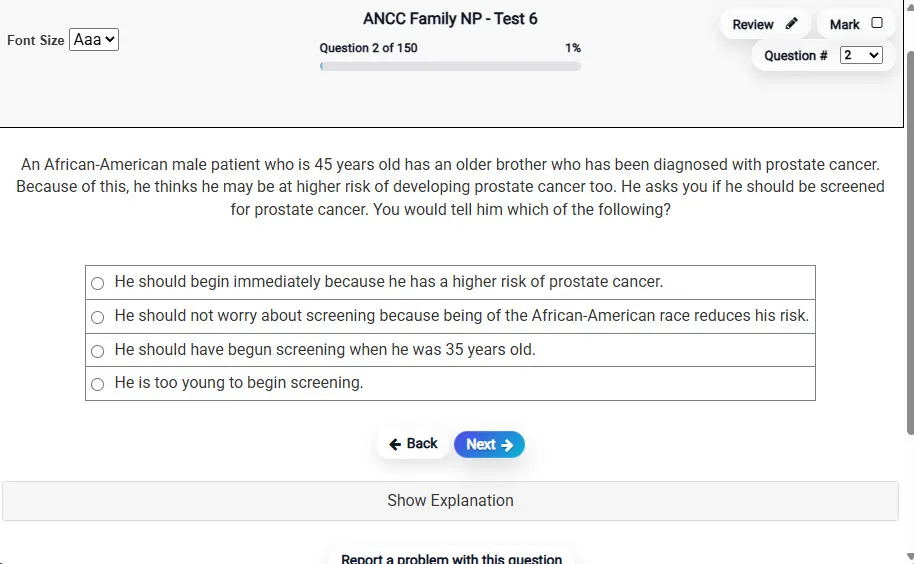
Answering a Question screen – Multiple-choice item view with navigation controls and progress tracker.
Answering a Question Multiple-choice item view with navigation controls and progress tracker.

                           Detailed Explanation screen – 
                         Review mode showing chosen answer and rationale and references.
Detailed Explanation Review mode showing chosen answer and rationale and references.

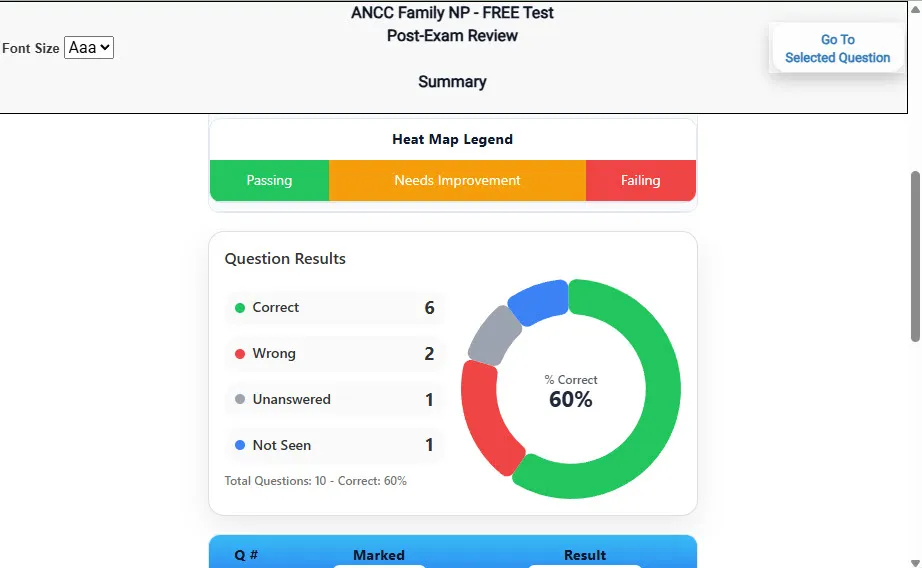
                           Review Summary 1 screen – 
                         Summary with counts for correct/wrong/unanswered and not seen items.
Review Summary 1 Summary with counts for correct/wrong/unanswered and not seen items.

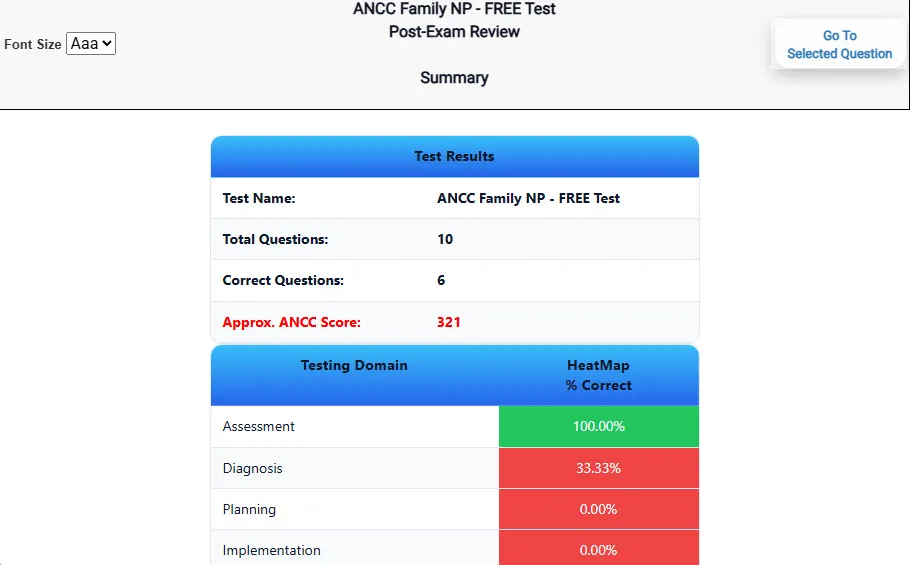
                           Review Summary 2 screen – 
                         Advanced summary with category/domain breakdown and performance insights.
Review Summary 2 Advanced summary with category/domain breakdown and performance insights.

What Each Screen Shows

Answer Question Screen

  • Clean multiple-choice interface with progress bar.
  • Mark for review feature.
  • Matches real test pacing.

Detailed Explanation

  • Correct answer plus rationale.
  • Key concepts and guidelines highlighted.
  • Move between questions to fill knowledge gaps.

Review Summary 1

  • Overall results with total questions and scaled score.
  • Domain heatmap shows strengths and weaknesses.
  • Quick visual feedback on study priorities.

Review Summary 2

  • Chart of correct, wrong, unanswered, not seen.
  • Color-coded results for easy review.
  • Links back to missed items.

Top 10 Reasons to Use Exam Edge for your CSET Multiple Subjects Exam Prep

  1. Focused on the CSET Multiple Subjects Exam

    Our practice tests are built specifically for the CSET Multiple Subjects exam — every question mirrors the real topics, format, and difficulty so you're studying exactly what matters.

  2. Real Exam Simulation

    We match the per-question time limits and pressure of the actual CSET exam, so test day feels familiar and stress-free.

  3. 20 Full Practice Tests & 3,060 Unique Questions

    You'll have more than enough material to master every CSET Multiple Subjects concept — no repeats, no fluff.

  4. Lower Cost Than a Retake

    Ordering 5 practice exams costs less than retaking the CSET Multiple Subjects exam after a failure. One low fee could save you both time and money.

  5. Flexible Testing

    Need to step away mid-exam? Pick up right where you left off — with your remaining time intact.

  6. Instant Scoring & Feedback

    See your raw score and an estimated CSET Multiple Subjects score immediately after finishing each practice test.

  7. Detailed Explanations for Every Question

    Review correct and incorrect answers with clear, step-by-step explanations so you truly understand each topic.

  8. Trusted & Accredited

    We're fully accredited by the Better Business Bureau and uphold the highest standards of trust and transparency.

  9. Web-Based & Always Available

    No software to install. Access your CSET Multiple Subjects practice exams 24/7 from any computer or mobile device.

  10. Expert Support When You Need It

    Need extra help? Our specialized tutors are highly qualified and ready to support your CSET exam prep.


Pass the CSET Multiple Subjects Exam with Realistic Practice Tests from Exam Edge

Preparing for your upcoming CSET Multiple Subjects (101/214/103) Certification Exam can feel overwhelming — but the right practice makes all the difference. Exam Edge gives you the tools, structure, and confidence to pass on your first try. Our online practice exams are built to match the real CSET Multiple Subjects exam in content, format, and difficulty.

  • 📝 20 CSET Multiple Subjects Practice Tests: Access 20 full-length exams with 153 questions each, covering every major CSET Multiple Subjects topic in depth.
  • Instant Online Access: Start practicing right away — no software, no waiting.
  • 🧠 Step-by-Step Explanations: Understand the reasoning behind every correct answer so you can master CSET Multiple Subjects exam concepts.
  • 🔄 Retake Each Exam Up to 4 Times: Build knowledge through repetition and track your improvement over time.
  • 🌐 Web-Based & Available 24/7: Study anywhere, anytime, on any device.
  • 🧘 Boost Your Test-Day Confidence: Familiarity with the CSET format reduces anxiety and helps you perform under pressure.

These CSET Multiple Subjects practice exams are designed to simulate the real testing experience by matching question types, timing, and difficulty level. This approach helps you get comfortable not just with the exam content, but also with the testing environment, so you walk into your exam day focused and confident.

Exam Edge CTC Reviews


Just wanted to let you guys know that your tests really helped me prepare for the CBEST math exam. I took it yesterday and passed with a 47! I will tell other people about your site.

Shawna M, California

I passed my cbest today! This was the second time I took the test. My first time I scored 35. This time I scored 43. Taking your practice tests helped me a great deal, because several types of questions on the real test were also on your practice tests. Thanks so much for the help!

TIm F, California

For the last year, I have been trying to pass the reading section of the CBEST. I had taken it six times and if I did not pass it this month, then I could not take my college courses in education. I went to Google and typed in practice reading tests and your website came up. I clicked on it, signed ...
Read More
Stacy S, California

Thank you so much for your reading tests. I just passed the real CBEST Reading test by 4 points! After failing it 3 other times, I thought I would have to quit. I already told everyone in my class about your site.

Sara L, Oregon

For the last year, I have been trying to pass my cset exam. I had taken it six times and was running out of hope I would ever pass. I went to Google and your website came up. I clicked on, signed up and took the free test. I knew that I would buy a couple of tests after taking that one. I ended up b ...
Read More
Stacy,

Purchased the five pack of tests this weekend. Took CBEST math today and passed! Your tests had very similar content as the actual CBEST.

Fresno , CA


CSET Multiple Subjects Aliases Test Name

Here is a list of alternative names used for this exam.

  • CSET Multiple Subjects
  • CSET Multiple Subjects test
  • CSET Multiple Subjects Certification Test
  • CTC
  • CTC 101/214/103
  • 101/214/103 test
  • CSET Multiple Subjects (101/214/103)
  • CSET Multiple Subjects certification