This is the content of the pop-over!

Lightning Deal Alert – 12% Off Ends at Midnight!

Strike while the savings are hot! Use promo code FlashSale at checkout for 12% off any Exam Edge test or bundle. Hurry—the clock is ticking!

CSET Math (211, 212, 213) Practice Tests & Test Prep by Exam Edge


CSET Mathematics  product image
(4.9)
Based on 28 Reviews

  • Real Exam Simulation: Timed questions and matching content build comfort for your CSET Math test day.
  • Instant, 24/7 Access: Web-based CSET Mathematics practice exams with no software needed.
  • Clear Explanations: Step-by-step answers and explanations for your CSET exam to strengthen understanding.
  • Boosted Confidence: Reduces anxiety and improves test-taking skills to ace your CSET Mathematics (211, 212, 213).

Featured on

CSET Mathematics Online Practice Test Bundles

BEST VALUE
15 practice tests

$149.25

$599.25

SAVE $450

Only $9.95 per test!

  • 100% Pass Guarantee
  • 15 online practice tests
  • 100 questions + 5 essays per test
  • Bonus: 100 Flash Cards + Study Guide
  • Instant access
  • Detailed Explanations
  • Practice tests never expire
  • Timed, untimed, or study guide mode
MOST POPULAR
10 practice tests

$99.50

$399.50

SAVE $300

Only $9.95 per test!

  • 10 online practice tests
  • 100 questions + 5 essays per test
  • Bonus: 100 Flash Cards + Study Guide
  • Instant access
  • Detailed Explanations
  • Practice tests never expire
  • Timed, untimed, or study guide mode
5 practice tests

$69.75

$199.75

SAVE $130

Only $13.95 per test!

  • 5 online practice tests
  • 100 questions + 5 essays per test
  • Bonus: 100 Flash Cards
  • Instant access
  • Detailed Explanations
  • Practice tests never expire
  • Timed, untimed, or study guide mode
1 practice test

$39.95

  • 1 online practice test
  • 100 questions + 5 essays per test
  • Instant access
  • Detailed Explanations
  • Practice tests never expire
  • Timed, untimed, or study guide mode
Quick Select
Tap to choose a bundle

** All Prices are in US Dollars (USD) **


CSET Math (211, 212, 213) Resources

Jump to the section you need most.

Understanding the exact breakdown of the CSET Mathematics test will help you know what to expect and how to most effectively prepare. The CSET Mathematics has 100 multiple-choice questions and 7 essay questions. The exam will be broken down into the sections below:

CSET Mathematics Exam Blueprint
Domain Name
Algebra  
Geometry  
Number Theory  
Probability and Statistics  
Calculus  
History of Mathematics  

CSET Mathematics Study Tips by Domain

  • Manipulate expressions using structure first (e.g., factor by grouping, special products) before expanding; red flag: canceling terms across addition such as “(x+1)/(x+2) → 1.”
  • When solving equations/inequalities, state domain restrictions up front (denominators ≠ 0, even roots require radicand ≥ 0); common trap: keeping extraneous solutions after squaring or clearing fractions.
  • Interpret functions via multiple representations (rule, table, graph) and track transformations; priority rule: a horizontal shift affects the input, so f(x−h) shifts right by h.
  • For linear/quadratic/polynomial analysis, connect key features to coefficients (slope, intercepts, vertex, end behavior); red flag: assuming all quadratics open up—check the sign of a.
  • Work fluently with systems (substitution, elimination, matrix methods) and interpret solution types; practical cue: dependent systems yield infinitely many solutions, often revealed by proportional equations after elimination.
  • Use exponential and logarithmic properties correctly, especially with bases and domains; common trap: applying log(a+b)=log a+log b or forgetting that log arguments must be positive.
  • Use triangle congruence tests (SSS, SAS, ASA, AAS) and similarity tests (AA, SAS~, SSS~); red flag: claiming SSA proves congruence unless the right-triangle HL condition applies.
  • Apply right-triangle relationships (Pythagorean Theorem, special 30–60–90 and 45–45–90 ratios) and be careful with units; common trap: mixing leg/hypotenuse when substituting into a proportion.
  • Coordinate geometry: compute slope, distance, midpoint, and equation of a line/circle; red flag: using slope with a vertical line (undefined) or forgetting to square both coordinates in the distance formula.
  • Angle facts in parallel lines and polygons: interior/exterior angle sums and corresponding/alternate interior angles; common trap: using (n−2)180 for a nonconvex polygon without checking the problem’s definition.
  • Circles: use central/inscribed angle theorems, chord/tangent properties, and power of a point; priority rule: a tangent is perpendicular to the radius at the point of tangency—don’t assume tangency without a given/right-angle cue.
  • Surface area and volume for prisms, cylinders, pyramids, cones, and spheres, including scaling; red flag: when dimensions scale by k, area scales by k2 and volume by k3, not linearly.
  • Use the Euclidean algorithm to find gcd(a, b) and express it as ax + by (Bézout); red flag: stopping at the gcd without back-substituting to produce x, y.
  • Solve linear congruences ax ≡ b (mod n) by checking d = gcd(a, n) first; trap: assuming an inverse exists when d ≠ 1 (solutions exist only if d | b, yielding d solutions mod n).
  • Apply the Chinese Remainder Theorem only when moduli are pairwise coprime (or verify consistency in the non-coprime case); cue: if two congruences disagree mod gcd(m, n), there is no solution.
  • Use prime factorization to compute lcm/gcd and count divisors; common slip: for n = paqb, the number of positive divisors is (a + 1)(b + 1), not a + b + 1.
  • Invoke modular arithmetic properties carefully with negatives and exponents; priority rule: reduce bases modulo n early, but don’t cancel factors unless they are units mod n (gcd = 1).
  • For Diophantine equations like ax + by = c, first check gcd(a, b) | c; CTC-style pitfall: giving one solution but not the full integer family x = x0 + (b/d)t, y = y0 − (a/d)t.
  • For conditional probability, explicitly identify the conditioning set and use P(A|B)=P(A∩B)/P(B); red flag: dividing by P(A) or forgetting to restrict the sample space to B.
  • When testing independence, compare P(A∩B) to P(A)P(B) (or P(A|B) to P(A)); common trap: assuming disjoint events are independent or treating independence as “unrelated” without calculation.
  • Choose distributions by structure: Binomial (fixed n, independent trials, constant p) vs. Geometric (first success) vs. Hypergeometric (without replacement); red flag: using Binomial when sampling without replacement from a small population.
  • Compute expectation and variance carefully (Var(X)=E(X2)−[E(X)]2); common trap: using SD where variance is required or assuming E(g(X))=g(E(X)) for nonlinear g.
  • For normal problems, standardize with z=(x−μ)/σ and watch whether a value is a percentile or a raw score; red flag: mixing up population σ with sample s in z/t contexts.
  • In inference, match method to conditions: use t for a mean with unknown σ and small n, and use a CI/test on proportions only if np and n(1−p) are sufficiently large; common trap: treating statistical significance as practical importance or ignoring violation of random/independent sampling.
  • Differentiate using the simplest rule set first (power, product/quotient, chain) and simplify before substituting values; common trap: forgetting the chain-rule factor when differentiating compositions like (g(x))^n.
  • Connect derivative meaning to graphs: f’(x)>0 increasing, f’(x)<0 decreasing, f’’(x) concavity; red flag: concluding a critical point is a max/min without checking sign changes or second-derivative information.
  • Apply the Fundamental Theorem of Calculus carefully: d/dx ∫ax f(t)dt = f(x) and d/dx ∫ag(x) f(t)dt = f(g(x))g’(x); common trap: missing the g’(x) multiplier with variable limits.
  • For limits, use algebraic simplification before L’Hôpital’s Rule and verify an indeterminate form (0/0 or ∞/∞); priority rule: if direct substitution works, do it to avoid unnecessary rule misuse.
  • Compute definite integrals with substitution and integration by parts when structure dictates; red flag: choosing u without ensuring du appears (or can be created) in the integrand.
  • Use applications with correct setup and units: area as ∫ (top−bottom)dx, volume by disks/washers or shells, and average value as (1/(b−a))∫ab f(x)dx; common trap: mixing dx/dy (or radius/height) leading to a correct method but wrong integral.
  • Know hallmark results and their originators (e.g., Euclid’s Elements, al-Khwarizmi and algebra, Newton/Leibniz and calculus) — red flag: attributing a theorem to the wrong era or culture.
  • Track major number-system developments (Babylonian base-60, Hindu-Arabic numerals, zero, negatives) — common trap: claiming Greeks used positional decimal notation or that zero was always accepted in Europe.
  • Connect proof methods to periods (Greek axiomatic proof, Chinese algorithms, Renaissance symbolic manipulation) — priority rule: if a question mentions axioms/postulates, it almost always points to Greek geometry.
  • Recognize key mathematical instruments and texts (abacus, astrolabe, Napier’s logarithms, Descartes’ La Géométrie) — red flag: mixing up logarithms with calculus-era developments.
  • Identify how problems drove advances (e.g., squaring the circle, solving polynomial equations, navigation/astronomy motivating trigonometry) — common trap: treating applied motivations as modern-only rather than historical catalysts.
  • Be ready to place ideas on a rough timeline (ancient → medieval Islamic/Asian → Renaissance/Enlightenment → 19th century rigor) — practical cue: if “rigor/epsilons” appears, think 19th-century analysis (Cauchy/Weierstrass).


Built to Fit Into Your Busy Life

Everything you need to prepare with confidence—without wasting a minute.

Three Study Modes

Timed, No Time Limit, or Explanation mode.

Actionable Analytics

Heatmaps and scaled scores highlight weak areas.

High-Yield Rationales

Concise explanations emphasize key concepts.

Realistic Interface

Matches the feel of the actual exam environment.

Accessible by Design

Clean layout reduces cognitive load.

Anytime, Anywhere

Web-based access 24/7 on any device.
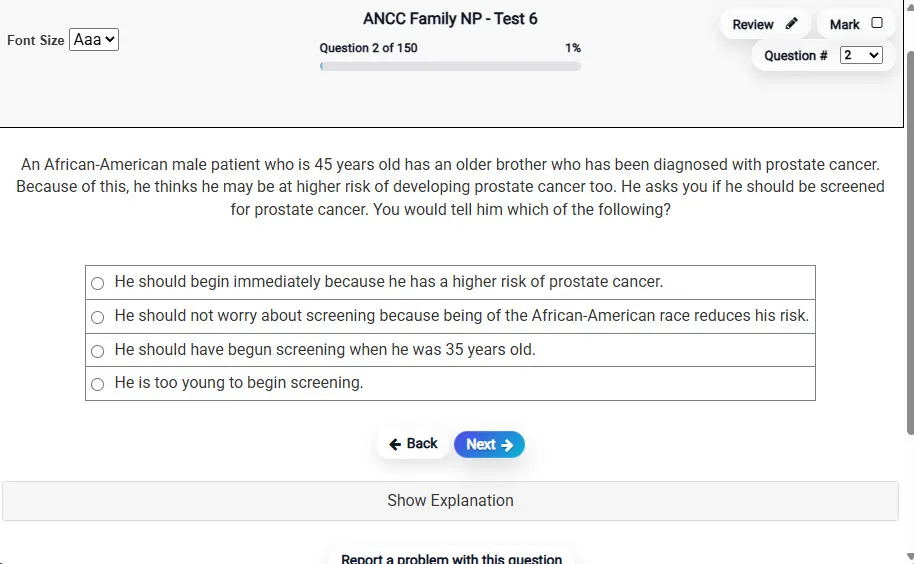
Answering a Question screen – Multiple-choice item view with navigation controls and progress tracker.
Answering a Question Multiple-choice item view with navigation controls and progress tracker.

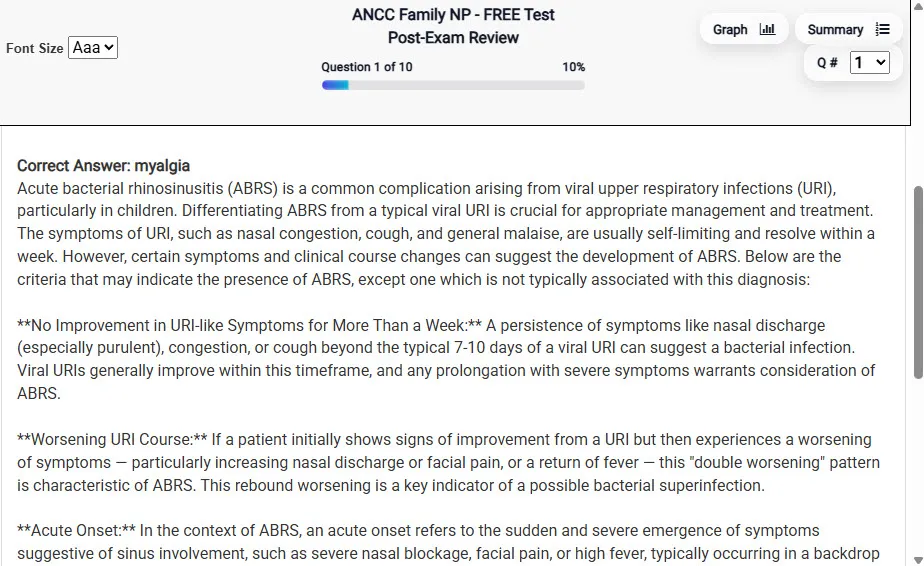
                           Detailed Explanation screen – 
                         Review mode showing chosen answer and rationale and references.
Detailed Explanation Review mode showing chosen answer and rationale and references.

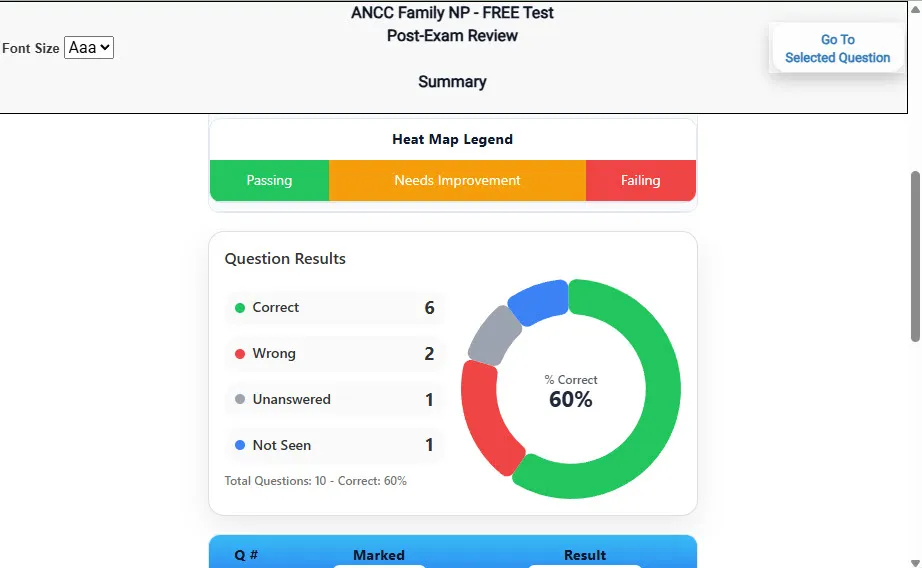
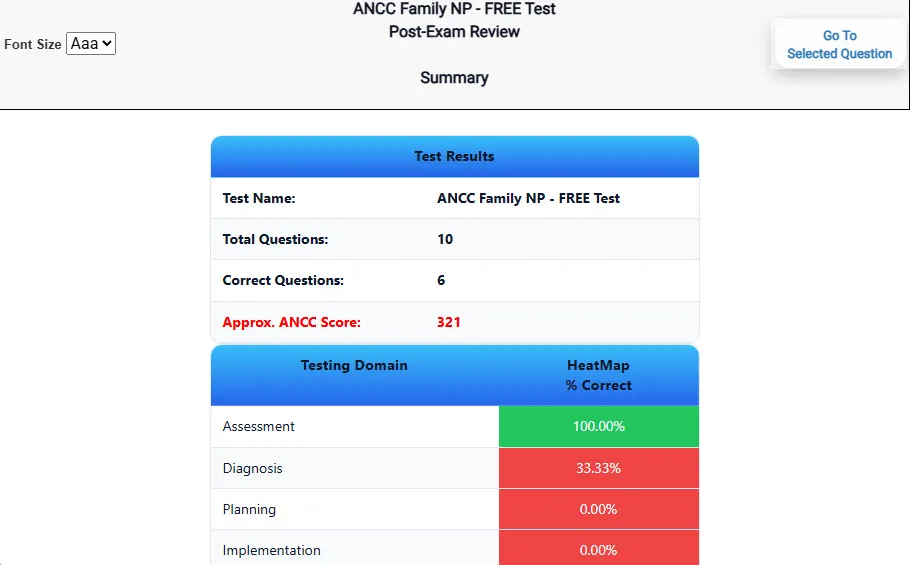
                           Review Summary 1 screen – 
                         Summary with counts for correct/wrong/unanswered and not seen items.
Review Summary 1 Summary with counts for correct/wrong/unanswered and not seen items.

                           Review Summary 2 screen – 
                         Advanced summary with category/domain breakdown and performance insights.
Review Summary 2 Advanced summary with category/domain breakdown and performance insights.

What Each Screen Shows

Answer Question Screen

  • Clean multiple-choice interface with progress bar.
  • Mark for review feature.
  • Matches real test pacing.

Detailed Explanation

  • Correct answer plus rationale.
  • Key concepts and guidelines highlighted.
  • Move between questions to fill knowledge gaps.

Review Summary 1

  • Overall results with total questions and scaled score.
  • Domain heatmap shows strengths and weaknesses.
  • Quick visual feedback on study priorities.

Review Summary 2

  • Chart of correct, wrong, unanswered, not seen.
  • Color-coded results for easy review.
  • Links back to missed items.

Top 10 Reasons to Use Exam Edge for your CSET Mathematics Exam Prep

  1. Focused on the CSET Mathematics Exam

    Our practice tests are built specifically for the CSET Math exam — every question mirrors the real topics, format, and difficulty so you're studying exactly what matters.

  2. Real Exam Simulation

    We match the per-question time limits and pressure of the actual CSET exam, so test day feels familiar and stress-free.

  3. 15 Full Practice Tests & 1,575 Unique Questions

    You'll have more than enough material to master every CSET Math concept — no repeats, no fluff.

  4. Lower Cost Than a Retake

    Ordering 5 practice exams costs less than retaking the CSET Mathematics exam after a failure. One low fee could save you both time and money.

  5. Flexible Testing

    Need to step away mid-exam? Pick up right where you left off — with your remaining time intact.

  6. Instant Scoring & Feedback

    See your raw score and an estimated CSET Mathematics score immediately after finishing each practice test.

  7. Detailed Explanations for Every Question

    Review correct and incorrect answers with clear, step-by-step explanations so you truly understand each topic.

  8. Trusted & Accredited

    We're fully accredited by the Better Business Bureau and uphold the highest standards of trust and transparency.

  9. Web-Based & Always Available

    No software to install. Access your CSET Math practice exams 24/7 from any computer or mobile device.

  10. Expert Support When You Need It

    Need extra help? Our specialized tutors are highly qualified and ready to support your CSET exam prep.


Pass the CSET Mathematics Exam with Realistic Practice Tests from Exam Edge

Preparing for your upcoming CSET Mathematics (211, 212, 213) Certification Exam can feel overwhelming — but the right practice makes all the difference. Exam Edge gives you the tools, structure, and confidence to pass on your first try. Our online practice exams are built to match the real CSET Math exam in content, format, and difficulty.

  • 📝 15 CSET Mathematics Practice Tests: Access 15 full-length exams with 105 questions each, covering every major CSET Mathematics topic in depth.
  • Instant Online Access: Start practicing right away — no software, no waiting.
  • 🧠 Step-by-Step Explanations: Understand the reasoning behind every correct answer so you can master CSET Math exam concepts.
  • 🔄 Retake Each Exam Up to 4 Times: Build knowledge through repetition and track your improvement over time.
  • 🌐 Web-Based & Available 24/7: Study anywhere, anytime, on any device.
  • 🧘 Boost Your Test-Day Confidence: Familiarity with the CSET format reduces anxiety and helps you perform under pressure.

These CSET Mathematics practice exams are designed to simulate the real testing experience by matching question types, timing, and difficulty level. This approach helps you get comfortable not just with the exam content, but also with the testing environment, so you walk into your exam day focused and confident.

Exam Edge CTC Reviews


For the last year, I have been trying to pass my cset exam. I had taken it six times and was running out of hope I would ever pass. I went to Google and your website came up. I clicked on, signed up and took the free test. I knew that I would buy a couple of tests after taking that one. I ended up b ...
Read More
Stacy,

Just wanted to let you guys know that your tests really helped me prepare for the CBEST math exam. I took it yesterday and passed with a 47! I will tell other people about your site.

Shawna M, California

I passed my cbest today! This was the second time I took the test. My first time I scored 35. This time I scored 43. Taking your practice tests helped me a great deal, because several types of questions on the real test were also on your practice tests. Thanks so much for the help!

TIm F, California

For the last year, I have been trying to pass the reading section of the CBEST. I had taken it six times and if I did not pass it this month, then I could not take my college courses in education. I went to Google and typed in practice reading tests and your website came up. I clicked on it, signed ...
Read More
Stacy S, California

Thank you so much for your reading tests. I just passed the real CBEST Reading test by 4 points! After failing it 3 other times, I thought I would have to quit. I already told everyone in my class about your site.

Sara L, Oregon

Purchased the five pack of tests this weekend. Took CBEST math today and passed! Your tests had very similar content as the actual CBEST.

Fresno , CA


CSET Mathematics Aliases Test Name

Here is a list of alternative names used for this exam.

  • CSET Mathematics
  • CSET Mathematics test
  • CSET Mathematics Certification Test
  • CSET Math test
  • CTC
  • CTC 211, 212, 213
  • 211, 212, 213 test
  • CSET Mathematics (211, 212, 213)
  • CSET Mathematics certification