This is the content of the pop-over!

Lightning Deal Alert – 12% Off Ends at Midnight!

Strike while the savings are hot! Use promo code FlashSale at checkout for 12% off any Exam Edge test or bundle. Hurry—the clock is ticking!

CSET English Language Development (205/206/207) Practice Tests & Test Prep by Exam Edge


CSET English Language Development  product image
(4.8)
Based on 25 Reviews

  • Real Exam Simulation: Timed questions and matching content build comfort for your CSET English Language Development test day.
  • Instant, 24/7 Access: Web-based CSET English Language Development practice exams with no software needed.
  • Clear Explanations: Step-by-step answers and explanations for your CSET exam to strengthen understanding.
  • Boosted Confidence: Reduces anxiety and improves test-taking skills to ace your CSET English Language Development (205/206/207).

Featured on

CSET English Language Development Online Practice Test Bundles

BEST VALUE
10 practice tests

$99.50

$399.50

SAVE $300

Only $9.95 per test!

  • 100% Pass Guarantee
  • 10 online practice tests
  • 100 questions per test
  • Bonus: 100 Flash Cards + Study Guide
  • Instant access
  • Detailed Explanations
  • Practice tests never expire
  • Timed, untimed, or study guide mode
5 practice tests

$69.75

$199.75

SAVE $130

Only $13.95 per test!

  • 5 online practice tests
  • 100 questions per test
  • Bonus: 100 Flash Cards + Study Guide
  • Instant access
  • Detailed Explanations
  • Practice tests never expire
  • Timed, untimed, or study guide mode
1 practice test

$39.95

  • 1 online practice test
  • 100 questions per test
  • Instant access
  • Detailed Explanations
  • Practice tests never expire
  • Timed, untimed, or study guide mode
Quick Select
Tap to choose a bundle

** All Prices are in US Dollars (USD) **


CSET English Language Development (205/206/207) Resources

Jump to the section you need most.

Understanding the exact breakdown of the CSET English Language Development test will help you know what to expect and how to most effectively prepare. The CSET English Language Development has 100 multiple-choice questions and 7 essay questions. The exam will be broken down into the sections below:

CSET English Language Development Exam Blueprint
Domain Name
Knowledge of English Learners in California and the United States  
Applied Linguistics  
Cultural Foundations  
Foundations of English Learner Education in California and the United States  
Principles of ELD Instruction and Assessment to Promote Receptive and Productive Language
Proficiency
 

CSET English Language Development Study Tips by Domain

  • Know California’s EL identification & reclassification process (Home Language Survey → initial ELPAC → annual ELPAC → criteria); red flag: assuming a single test score alone can reclassify a student.
  • Distinguish EL, IFEP, RFEP, LTEL, newcomer, and “at-risk of LTEL” labels as used in California reporting; common trap: treating “LTEL” as a disability category rather than an indicator of sustained language-development need.
  • Use multiple measures to interpret EL progress (ELPAC domains, classroom performance, grades, work samples, and teacher observation); priority rule: if a student’s speaking is strong but writing lags, target productive language demands rather than lowering content expectations.
  • Differentiate language difference vs. suspected disability using evidence across settings and languages; red flag: recommending special education solely because a student is quiet, makes grammatical errors, or is behind in English shortly after arrival.
  • Recognize how U.S. schooling history and interrupted formal education can affect literacy and academic language (especially newcomers and SIFE); common trap: equating low English literacy with low cognitive ability or lack of content knowledge.
  • Interpret EL demographics and program contexts in California (e.g., dual language, bilingual, structured English immersion, designated/integrated ELD) with attention to access and outcomes; red flag: placing ELs in intervention that replaces ELD or core instruction without monitoring growth.
  • Distinguish BICS vs. CALP and plan explicit academic language supports; red flag: treating conversational fluency as proof an English learner can handle grade-level texts independently.
  • Use key SLA theories (Krashen, Swain, Long) to justify instruction—provide comprehensible input, required output, and interaction; common trap: relying on input-only “exposure” without structured speaking/writing tasks.
  • Apply contrastive analysis and error analysis to interpret learner errors (transfer vs. developmental); priority rule: correct errors that impede meaning or target a current objective rather than “fixing everything.”
  • Target language components (phonology, morphology, syntax, semantics, pragmatics) with examples; red flag: confusing phonemic awareness/phonics issues with accent or dialect differences and overcorrecting pronunciation.
  • Analyze discourse and registers (genre, cohesion, stance, pragmatics) to support school language; common trap: teaching vocabulary lists without the sentence frames, text structures, and cohesive devices needed for the task.
  • Differentiate language difference vs. disorder using multiple data points (L1 history, time in U.S. schools, patterns across contexts); contraindication: recommending special education based solely on English performance without considering typical second-language development.
  • Connect language learning to identity and belonging—red flag: treating accent, dialect, or emergent bilingualism as a deficit rather than a resource.
  • Use cultural knowledge as an instructional asset (funds of knowledge) to design tasks with authentic purpose—common trap: “culture days” that tokenize students instead of shaping daily curriculum.
  • Distinguish individual variation from cultural generalizations—priority rule: avoid stereotyping by using multiple data sources (student interviews, family input, classroom evidence) before drawing conclusions.
  • Attend to power, bias, and representation in texts and classroom discourse—red flag: only one narrative dominates (e.g., “single story” portrayals) without counterexamples or critical discussion.
  • Build reciprocal family and community partnerships aligned with students’ linguistic and cultural strengths—common trap: assuming limited family engagement equals lack of valuing education (often it’s access, schedules, or language barriers).
  • Recognize how U.S. schooling norms (participation styles, turn-taking, eye contact, individualism vs. collectivism) can affect classroom behavior—contraindication: interpreting culturally different behaviors as defiance without checking norms and expectations.
  • Know the legal arc for ELs (e.g., Lau v. Nichols, Castañeda v. Pickard, Plyler v. Doe, ESSA) and the priority rule: programs must be research-based, properly implemented, and evaluated for effectiveness—failure on any prong is a compliance red flag.
  • Differentiate California policy levers (e.g., Proposition 227 and the shift to multilingual approaches) and remember the trap: “English-only” is not a blanket requirement when parent choice, program models, and current state guidance allow multiple pathways.
  • Be clear on federal civil rights obligations: EL services are required and cannot be delayed for IEP/504 processing—denying language supports pending special education evaluation is a common audit finding.
  • Understand identification and placement basics (home language survey, initial ELP screening, parent notification) and the threshold cue: missing or late parent notification/documentation is a frequent compliance vulnerability.
  • Connect EL policy to accountability: ELP progress and reclassification outcomes matter under federal/state reporting—a key red flag is using a single test score as the only criterion for major placement or reclassification decisions.
  • Know the rights and access protections for ELs (meaningful access to core content, translation/interpretation where required, equitable participation) and the priority rule: if communication isn’t understandable to families, the school has not met access obligations.
  • Plan ELD with explicit language objectives aligned to content standards and the CA ELD Standards (Part I/II)—red flag: lessons that list only content objectives with no target language functions/forms.
  • Differentiate by proficiency level (Emerging, Expanding, Bridging) using scaffolds such as sentence frames, modeled texts, and structured interaction—common trap: giving the same speaking/writing task to all ELs and calling it “rigor.”
  • Build receptive skills through purposeful input (visuals, gestures, previewed vocabulary, and chunked texts) while maintaining grade-level meaning—priority rule: scaffold the text, not the cognitive demand.
  • Develop productive proficiency with frequent, accountable talk and writing (e.g., collaborative conversations, language frames, feedback on accuracy/complexity)—red flag: overcorrecting every error in early production, which can suppress output.
  • Use assessment as an ongoing cycle (elicit evidence, interpret, act) with rubrics tied to functions and forms—common trap: grading ELs primarily on mechanics when the target is language use for meaning.
  • Support academic language growth by teaching how English works in context (grammar, cohesion, and text structure) using mentor texts and contrastive examples—contraindication: isolated worksheet grammar that never reappears in speaking/writing tasks.


Built to Fit Into Your Busy Life

Everything you need to prepare with confidence—without wasting a minute.

Three Study Modes

Timed, No Time Limit, or Explanation mode.

Actionable Analytics

Heatmaps and scaled scores highlight weak areas.

High-Yield Rationales

Concise explanations emphasize key concepts.

Realistic Interface

Matches the feel of the actual exam environment.

Accessible by Design

Clean layout reduces cognitive load.

Anytime, Anywhere

Web-based access 24/7 on any device.
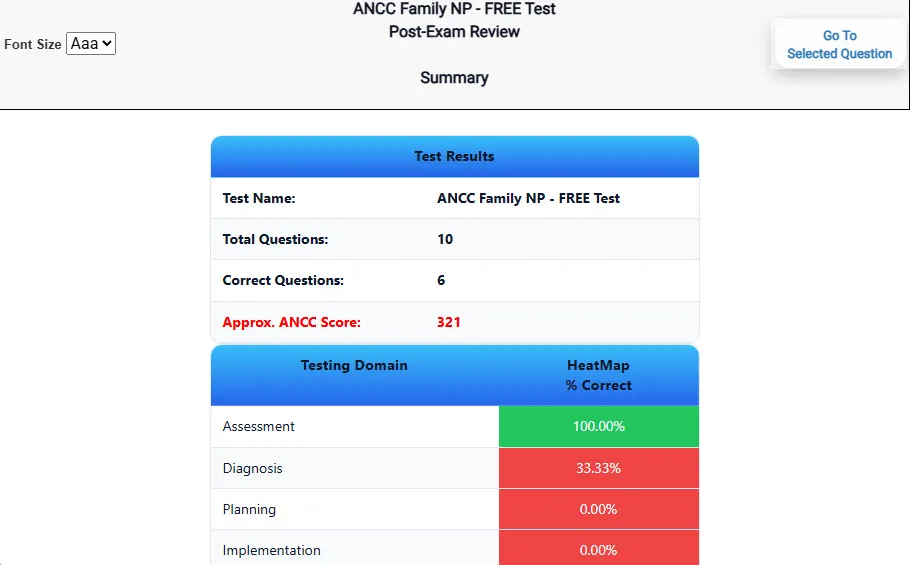
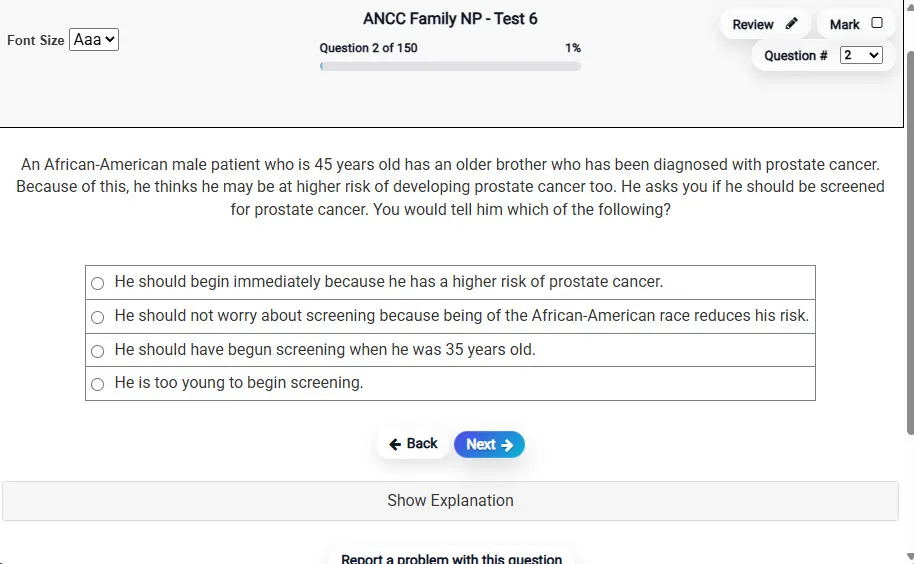
Answering a Question screen – Multiple-choice item view with navigation controls and progress tracker.
Answering a Question Multiple-choice item view with navigation controls and progress tracker.

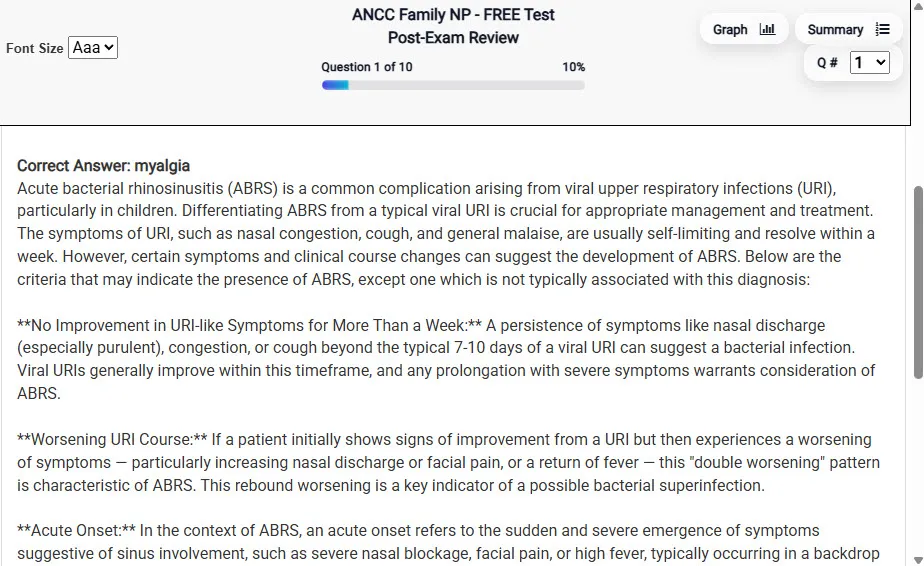
                           Detailed Explanation screen – 
                         Review mode showing chosen answer and rationale and references.
Detailed Explanation Review mode showing chosen answer and rationale and references.

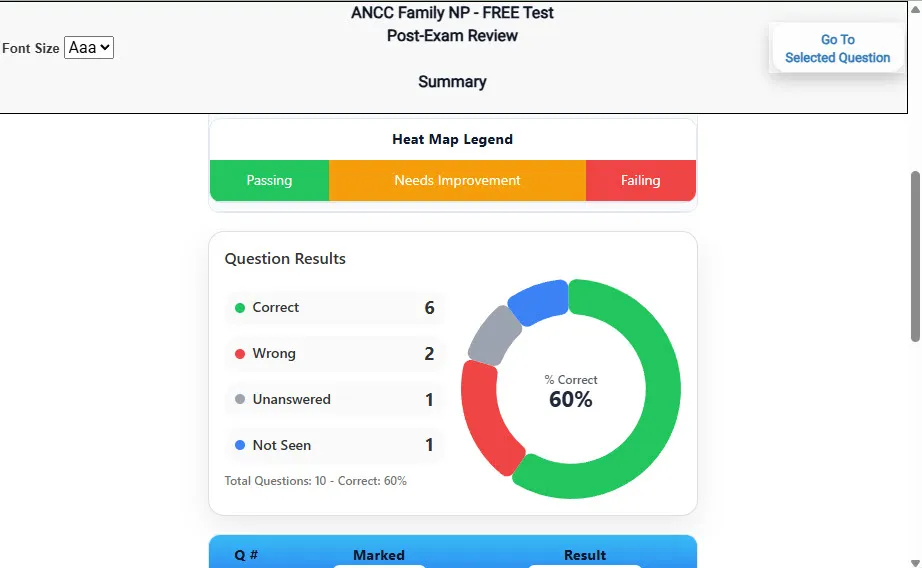
                           Review Summary 1 screen – 
                         Summary with counts for correct/wrong/unanswered and not seen items.
Review Summary 1 Summary with counts for correct/wrong/unanswered and not seen items.

                           Review Summary 2 screen – 
                         Advanced summary with category/domain breakdown and performance insights.
Review Summary 2 Advanced summary with category/domain breakdown and performance insights.

What Each Screen Shows

Answer Question Screen

  • Clean multiple-choice interface with progress bar.
  • Mark for review feature.
  • Matches real test pacing.

Detailed Explanation

  • Correct answer plus rationale.
  • Key concepts and guidelines highlighted.
  • Move between questions to fill knowledge gaps.

Review Summary 1

  • Overall results with total questions and scaled score.
  • Domain heatmap shows strengths and weaknesses.
  • Quick visual feedback on study priorities.

Review Summary 2

  • Chart of correct, wrong, unanswered, not seen.
  • Color-coded results for easy review.
  • Links back to missed items.

Top 10 Reasons to Use Exam Edge for your CSET English Language Development Exam Prep

  1. Focused on the CSET English Language Development Exam

    Our practice tests are built specifically for the CSET English Language Development exam — every question mirrors the real topics, format, and difficulty so you're studying exactly what matters.

  2. Real Exam Simulation

    We match the per-question time limits and pressure of the actual CSET exam, so test day feels familiar and stress-free.

  3. 10 Full Practice Tests & 1,000 Unique Questions

    You'll have more than enough material to master every CSET English Language Development concept — no repeats, no fluff.

  4. Lower Cost Than a Retake

    Ordering 5 practice exams costs less than retaking the CSET English Language Development exam after a failure. One low fee could save you both time and money.

  5. Flexible Testing

    Need to step away mid-exam? Pick up right where you left off — with your remaining time intact.

  6. Instant Scoring & Feedback

    See your raw score and an estimated CSET English Language Development score immediately after finishing each practice test.

  7. Detailed Explanations for Every Question

    Review correct and incorrect answers with clear, step-by-step explanations so you truly understand each topic.

  8. Trusted & Accredited

    We're fully accredited by the Better Business Bureau and uphold the highest standards of trust and transparency.

  9. Web-Based & Always Available

    No software to install. Access your CSET English Language Development practice exams 24/7 from any computer or mobile device.

  10. Expert Support When You Need It

    Need extra help? Our specialized tutors are highly qualified and ready to support your CSET exam prep.


Pass the CSET English Language Development Exam with Realistic Practice Tests from Exam Edge

Preparing for your upcoming CSET English Language Development (205/206/207) Certification Exam can feel overwhelming — but the right practice makes all the difference. Exam Edge gives you the tools, structure, and confidence to pass on your first try. Our online practice exams are built to match the real CSET English Language Development exam in content, format, and difficulty.

  • 📝 10 CSET English Language Development Practice Tests: Access 10 full-length exams with 100 questions each, covering every major CSET English Language Development topic in depth.
  • Instant Online Access: Start practicing right away — no software, no waiting.
  • 🧠 Step-by-Step Explanations: Understand the reasoning behind every correct answer so you can master CSET English Language Development exam concepts.
  • 🔄 Retake Each Exam Up to 4 Times: Build knowledge through repetition and track your improvement over time.
  • 🌐 Web-Based & Available 24/7: Study anywhere, anytime, on any device.
  • 🧘 Boost Your Test-Day Confidence: Familiarity with the CSET format reduces anxiety and helps you perform under pressure.

These CSET English Language Development practice exams are designed to simulate the real testing experience by matching question types, timing, and difficulty level. This approach helps you get comfortable not just with the exam content, but also with the testing environment, so you walk into your exam day focused and confident.


Exam Edge CTC Reviews


Just wanted to let you guys know that your tests really helped me prepare for the CBEST math exam. I took it yesterday and passed with a 47! I will tell other people about your site.

Shawna M, California

I passed my cbest today! This was the second time I took the test. My first time I scored 35. This time I scored 43. Taking your practice tests helped me a great deal, because several types of questions on the real test were also on your practice tests. Thanks so much for the help!

TIm F, California

For the last year, I have been trying to pass the reading section of the CBEST. I had taken it six times and if I did not pass it this month, then I could not take my college courses in education. I went to Google and typed in practice reading tests and your website came up. I clicked on it, signed ...
Read More
Stacy S, California

Thank you so much for your reading tests. I just passed the real CBEST Reading test by 4 points! After failing it 3 other times, I thought I would have to quit. I already told everyone in my class about your site.

Sara L, Oregon

For the last year, I have been trying to pass my cset exam. I had taken it six times and was running out of hope I would ever pass. I went to Google and your website came up. I clicked on, signed up and took the free test. I knew that I would buy a couple of tests after taking that one. I ended up b ...
Read More
Stacy,

Purchased the five pack of tests this weekend. Took CBEST math today and passed! Your tests had very similar content as the actual CBEST.

Fresno , CA


CSET English Language Development Aliases Test Name

Here is a list of alternative names used for this exam.

  • CSET English Language Development
  • CSET English Language Development test
  • CSET English Language Development Certification Test
  • CTC
  • CTC 205/206/207
  • 205/206/207 test
  • CSET English Language Development (205/206/207)
  • CSET English Language Development certification