This is the content of the pop-over!

Lightning Deal Alert – 12% Off Ends at Midnight!

Strike while the savings are hot! Use promo code FlashSale at checkout for 12% off any Exam Edge test or bundle. Hurry—the clock is ticking!

CSET Earth and Space (219) Practice Tests & Test Prep by Exam Edge


CSET Earth and Space Science product image
(4.8)
Based on 17 Reviews

  • Real Exam Simulation: Timed questions and matching content build comfort for your CSET Earth and Space test day.
  • Instant, 24/7 Access: Web-based CSET Earth and Space Science practice exams with no software needed.
  • Clear Explanations: Step-by-step answers and explanations for your CSET exam to strengthen understanding.
  • Boosted Confidence: Reduces anxiety and improves test-taking skills to ace your CSET Earth and Space Science (219).

Featured on

CSET Earth and Space Science Online Practice Test Bundles

BEST VALUE
20 practice tests

$174.00

$799.00

SAVE $625

Only $8.70 per test!

  • 100% Pass Guarantee
  • 20 online practice tests
  • 50 questions + 1 essay per test
  • Bonus: 100 Flash Cards + Study Guide
  • Instant access
  • Detailed Explanations
  • Practice tests never expire
  • Timed, untimed, or study guide mode
MOST POPULAR
10 practice tests

$99.50

$399.50

SAVE $300

Only $9.95 per test!

  • 10 online practice tests
  • 50 questions + 1 essay per test
  • Bonus: 100 Flash Cards + Study Guide
  • Instant access
  • Detailed Explanations
  • Practice tests never expire
  • Timed, untimed, or study guide mode
5 practice tests

$69.75

$199.75

SAVE $130

Only $13.95 per test!

  • 5 online practice tests
  • 50 questions + 1 essay per test
  • Bonus: 100 Flash Cards
  • Instant access
  • Detailed Explanations
  • Practice tests never expire
  • Timed, untimed, or study guide mode
1 practice test

$39.95

  • 1 online practice test
  • 50 questions + 1 essay per test
  • Instant access
  • Detailed Explanations
  • Practice tests never expire
  • Timed, untimed, or study guide mode
Quick Select
Tap to choose a bundle

** All Prices are in US Dollars (USD) **


CSET Earth and Space (219) Resources

Jump to the section you need most.

Understanding the exact breakdown of the CSET Earth and Space Science test will help you know what to expect and how to most effectively prepare. The CSET Earth and Space Science has 50 multiple-choice questions and 3 essay questions. The exam will be broken down into the sections below:

CSET Earth and Space Science Exam Blueprint
Domain Name
Earth’s Place in the Universe  
Planet Earth  
Energy in the Earth System  
Biogeochemical Cycles  
California Geology  
Investigation and Experimentation  
Nature of Science  
Science and Society  

CSET Earth and Space Science Study Tips by Domain

  • Use the H–R diagram to relate luminosity, temperature, and stellar evolution (main sequence → red giant/supergiant → white dwarf/neutron star/black hole)—red flag: confusing brightness (apparent magnitude) with luminosity (intrinsic).
  • Apply Kepler’s laws and Newtonian gravity to orbital motion—priority rule: for elliptical orbits, the planet moves fastest at perihelion, and \(P^2 \propto a^3\) (for the same central mass), so doubling semi-major axis increases period by more than double.
  • Explain evidence for the Big Bang (cosmic microwave background, Hubble expansion, primordial H/He abundances)—common trap: citing “explosion into empty space” rather than expansion of space itself.
  • Use electromagnetic spectrum and spectroscopy (absorption/emission lines) to infer composition, temperature, and radial velocity—threshold cue: redshift indicates recession; don’t reverse the sign when interpreting Doppler shift.
  • Differentiate solar system formation concepts (nebular hypothesis, accretion, differentiation) and resulting patterns (terrestrial vs. Jovian planets)—red flag: claiming inner planets are gas-rich; temperature gradient explains rocky inner planets and volatile-rich outer bodies.
  • Connect Earth–Moon–Sun geometry to observable cycles (phases, eclipses, seasons, tides)—common trap: seasons are caused by axial tilt, not Earth–Sun distance, and eclipses require near-node alignment due to orbital inclination.
  • Know Earth’s internal structure (crust, mantle, outer/inner core) and how seismic P- and S-waves constrain it; red flag: claiming S-waves travel through liquid outer core.
  • Connect plate tectonics to surface features (mid-ocean ridges, trenches, volcanic arcs, transform faults) using boundary type; common trap: mixing up convergent vs. transform indicators (e.g., trenches at transforms).
  • Use relative and absolute dating to sequence geologic events (superposition, cross-cutting, fossils, radiometric half-life); priority rule: always place intrusions/faults younger than the rocks they cut.
  • Relate rock cycle processes to textures and settings (igneous cooling rate, sedimentary sorting/cementation, metamorphic foliation); red flag: equating metamorphism with melting (it’s solid-state change).
  • Interpret Earth materials and landforms from maps/sections (topographic contours, stream gradients, folds/faults); common trap: reading contour V’s backward—they point upstream in valleys.
  • Explain earthquakes and volcanoes with hazard-relevant metrics (magnitude vs. intensity, recurrence, liquefaction, lahars) and California context; red flag: treating Richter as current standard and ignoring moment magnitude (Mw).
  • Track Earth’s energy budget: incoming solar shortwave vs outgoing terrestrial longwave; red flag—confusing heat with temperature or mixing up radiation with conduction/convection.
  • Differentiate energy-transfer mechanisms (radiation, conduction, convection, latent heat) and where each dominates; common trap—claiming radiation requires a medium or that convection occurs in solids.
  • Relate albedo and greenhouse gases to surface temperature using cause-and-effect chains; priority rule—albedo changes affect absorbed sunlight, while greenhouse gases primarily affect outgoing infrared.
  • Connect plate tectonics to internal heat sources (radiogenic decay, primordial heat, core crystallization) and mantle convection; red flag—attributing tectonic motion mainly to tidal forces or surface winds.
  • Use phase changes and water’s high heat capacity to explain weather/seasonal lag and ocean moderation; common trap—assuming coastal areas always have larger temperature ranges than inland regions.
  • Interpret energy-related Earth data (temperature profiles, heat flow maps, insolation by latitude/season) with correct units and scales; red flag—mixing W/m² (flux) with total energy (J) without stating area or time.
  • Trace the carbon cycle across reservoirs (atmosphere, biosphere, hydrosphere, lithosphere) and processes (photosynthesis, respiration, combustion, ocean uptake) — red flag: confusing carbon sequestration in carbonate rocks with short-term storage in biomass.
  • Explain the nitrogen cycle steps (fixation, nitrification, assimilation, ammonification, denitrification) and where they occur — common trap: placing nitrification in anaerobic settings; it typically requires oxygen.
  • Connect the phosphorus cycle to rock weathering, soil transport, and biological uptake — priority rule: phosphorus has no major gaseous phase, so long-term availability is often limited by geologic processes.
  • Link sulfur cycling to volcanic emissions, ocean sulfate, and microbial redox reactions — red flag: assuming acid rain is only from volcanoes; anthropogenic SO2/NOx sources are commonly tested.
  • Interpret how biogeochemical cycles drive water quality issues (eutrophication, hypoxia) using nutrient loading and residence time — common trap: blaming phosphorus for open-ocean limitation when nitrogen or iron can be the limiting nutrient.
  • Use isotope or concentration data (e.g., CO2, nitrate, d13C) to infer sources and processes — practical cue: check mass balance and units first; mismatched units are a frequent CTC-style error choice.
  • Know California’s plate-boundary setting—transform (San Andreas), subduction (Cascadia), and spreading (Gulf of California); red flag: calling the San Andreas a convergent boundary or linking it to volcanic arc volcanism.
  • Relate major provinces to processes: Sierra Nevada batholith (Mesozoic arc), Basin and Range extension, Coast Ranges accretionary complex, and Central Valley forearc basin; common trap: swapping “accreted terranes” (Coast Ranges) with “batholithic granites” (Sierra Nevada).
  • Connect key faults and hazards—San Andreas, Hayward, San Jacinto, and Garlock—to right-lateral strike-slip motion and earthquake recurrence; cue: if a prompt mentions offset streams or shutter ridges, prioritize strike-slip interpretation.
  • Use California’s rock record to infer environments: Franciscan mélange (subduction), Great Valley Group (forearc marine sediments), and Mojave/Colorado Desert metamorphic-plutonic histories; red flag: interpreting mélange as a stable continental shelf deposit.
  • Recognize geomorphic evidence of uplift, erosion, and climate—marine terraces, alluvial fans, river terraces, and glacial features in the Sierra; common trap: attributing U-shaped valleys to fluvial erosion rather than alpine glaciation.
  • Apply California-specific resource and risk context: groundwater overdraft and subsidence (Central Valley), landslide susceptibility on steep, weak strata after intense rain, and coastal erosion; priority rule: when given slope, lithology, and rainfall together, landslide risk often dominates the hazard explanation.
  • Start with a testable, falsifiable hypothesis that names both the independent and dependent variables; red flag: “prove” language or hypotheses that are just restated observations.
  • Identify controls and constants explicitly and use an appropriate control group/baseline; common trap: changing more than one factor at a time and then claiming causation.
  • Choose measurement tools with correct units, precision, and calibration checks (e.g., significant figures); priority rule: report uncertainty and don’t overstate precision beyond instrument resolution.
  • Plan for replication and adequate sample size to reduce random error; red flag: drawing conclusions from a single trial or n=1 data set.
  • Use graphs and statistics correctly (e.g., slope meaning, trend vs. scatter, correlation vs. causation); common trap: manipulating axes or omitting error bars when variability is high.
  • Evaluate data quality by separating systematic vs. random error and stating limits of inference; priority rule: if assumptions (normality, independence, steady-state) are violated, qualify conclusions or redesign the method.
  • Distinguish observations from inferences and hypotheses; red flag: claiming a model or theory becomes a “law” once proven.
  • Apply falsifiability and testable predictions as the demarcation for science; common trap: treating unfalsifiable claims (e.g., “it happens for unknown reasons”) as scientific explanations.
  • Identify controlled variables, independent/dependent variables, and appropriate controls; priority rule: change only one factor at a time unless a designed multivariable study is justified.
  • Evaluate data quality using uncertainty, precision vs. accuracy, and significant figures; red flag: overinterpreting differences smaller than the stated measurement uncertainty.
  • Interpret correlation vs. causation with alternative explanations and confounding variables; common trap: inferring causality from coincident time series without a mechanistic link.
  • Recognize how peer review, replication, and converging lines of evidence build scientific consensus; priority rule: a single study rarely overturns established understanding without independent replication.
  • Connect science to public decisions using evidence, risk, and tradeoffs; red flag: claiming a policy is “scientifically proven” without stating uncertainty and assumptions.
  • Apply ethical practices in research and communication (human/animal subjects, data integrity, citation); common trap: treating correlation as proof when informing health or environmental guidance.
  • Interpret how technology both advances and constrains science (instrument limits, model resolution, measurement error); priority rule: always state detection limits and sources of bias before drawing conclusions.
  • Evaluate societal impacts of Earth/space science (hazards, resources, climate, land use) with attention to equity; red flag: ignoring who bears the risk when proposing mitigation or development.
  • Use scientific literacy skills to assess claims in media (peer review, replication, funding/conflicts of interest); common trap: equating a single dramatic study or anecdote with consensus.
  • Know K–12 classroom safety, legal, and professional responsibilities aligned with CTC expectations (lab safety, accessibility, appropriate supervision); threshold: stop an activity if controls for hazards (PPE, ventilation, safe disposal) are not in place.


Built to Fit Into Your Busy Life

Everything you need to prepare with confidence—without wasting a minute.

Three Study Modes

Timed, No Time Limit, or Explanation mode.

Actionable Analytics

Heatmaps and scaled scores highlight weak areas.

High-Yield Rationales

Concise explanations emphasize key concepts.

Realistic Interface

Matches the feel of the actual exam environment.

Accessible by Design

Clean layout reduces cognitive load.

Anytime, Anywhere

Web-based access 24/7 on any device.
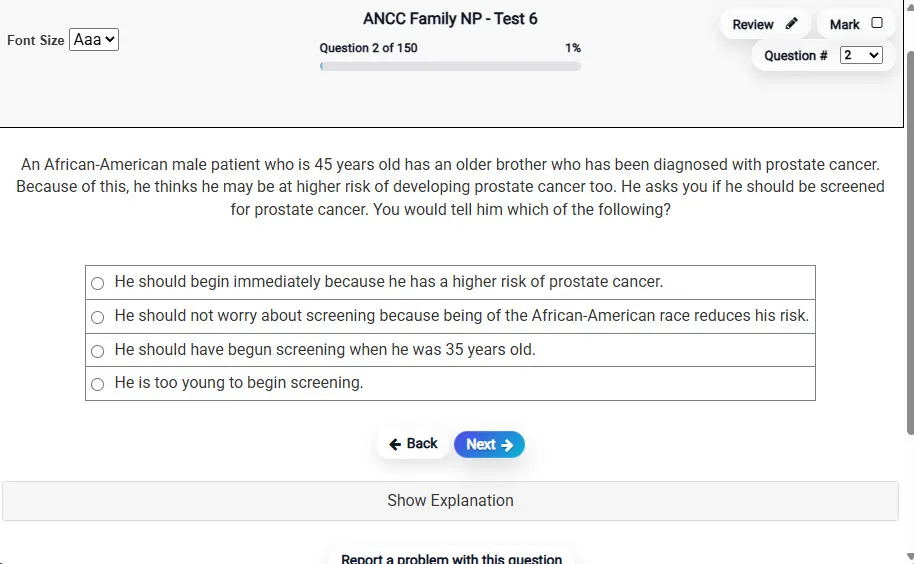
Answering a Question screen – Multiple-choice item view with navigation controls and progress tracker.
Answering a Question Multiple-choice item view with navigation controls and progress tracker.

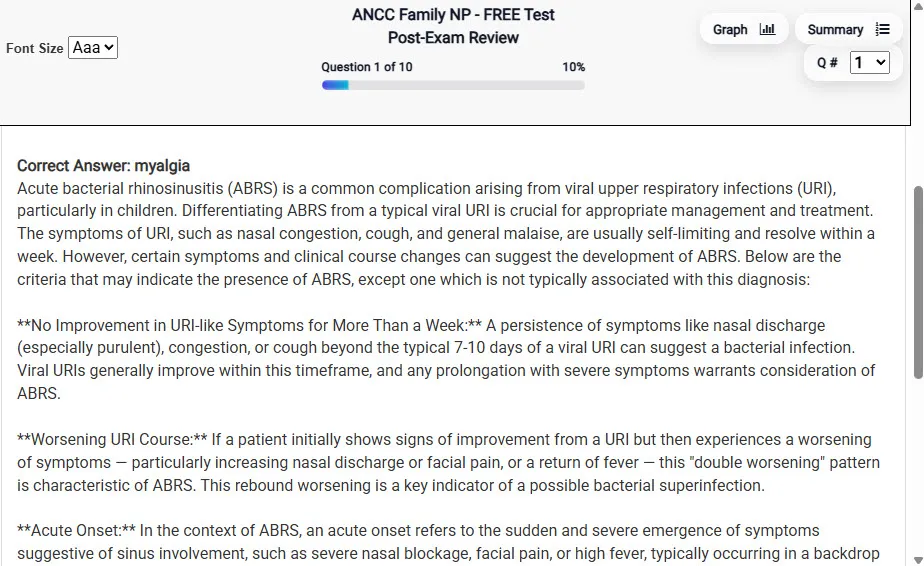
                           Detailed Explanation screen – 
                         Review mode showing chosen answer and rationale and references.
Detailed Explanation Review mode showing chosen answer and rationale and references.

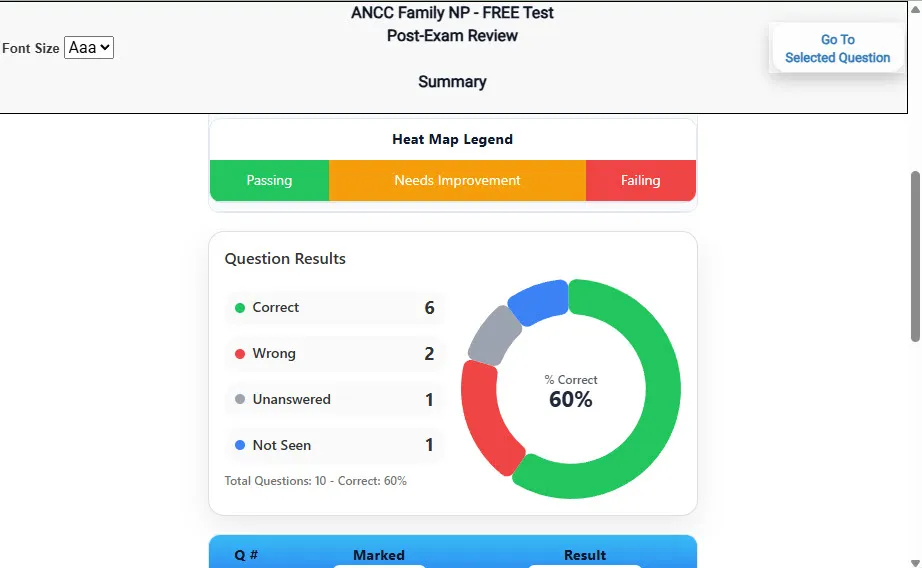
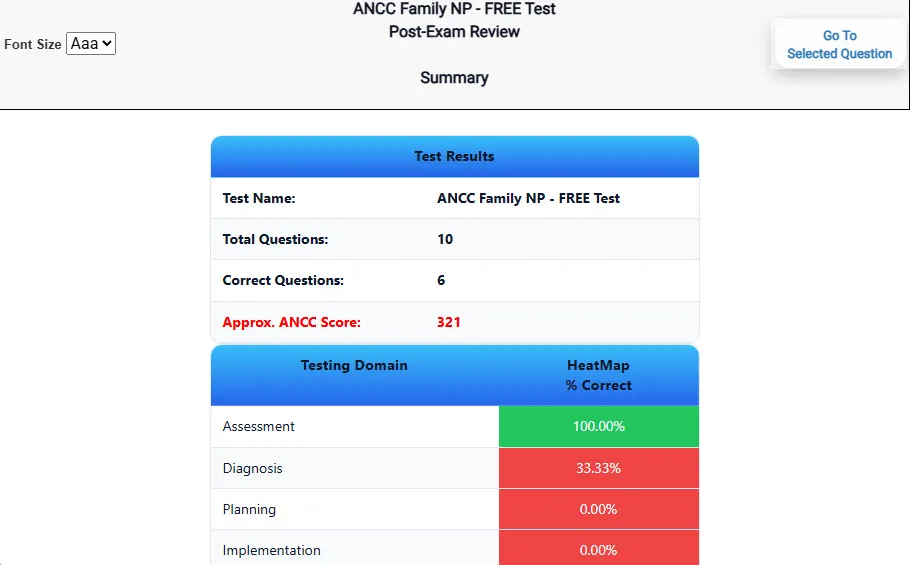
                           Review Summary 1 screen – 
                         Summary with counts for correct/wrong/unanswered and not seen items.
Review Summary 1 Summary with counts for correct/wrong/unanswered and not seen items.

                           Review Summary 2 screen – 
                         Advanced summary with category/domain breakdown and performance insights.
Review Summary 2 Advanced summary with category/domain breakdown and performance insights.

What Each Screen Shows

Answer Question Screen

  • Clean multiple-choice interface with progress bar.
  • Mark for review feature.
  • Matches real test pacing.

Detailed Explanation

  • Correct answer plus rationale.
  • Key concepts and guidelines highlighted.
  • Move between questions to fill knowledge gaps.

Review Summary 1

  • Overall results with total questions and scaled score.
  • Domain heatmap shows strengths and weaknesses.
  • Quick visual feedback on study priorities.

Review Summary 2

  • Chart of correct, wrong, unanswered, not seen.
  • Color-coded results for easy review.
  • Links back to missed items.

Top 10 Reasons to Use Exam Edge for your CSET Earth and Space Science Exam Prep

  1. Focused on the CSET Earth and Space Science Exam

    Our practice tests are built specifically for the CSET Earth and Space exam — every question mirrors the real topics, format, and difficulty so you're studying exactly what matters.

  2. Real Exam Simulation

    We match the per-question time limits and pressure of the actual CSET exam, so test day feels familiar and stress-free.

  3. 20 Full Practice Tests & 1,020 Unique Questions

    You'll have more than enough material to master every CSET Earth and Space concept — no repeats, no fluff.

  4. Lower Cost Than a Retake

    Ordering 5 practice exams costs less than retaking the CSET Earth and Space Science exam after a failure. One low fee could save you both time and money.

  5. Flexible Testing

    Need to step away mid-exam? Pick up right where you left off — with your remaining time intact.

  6. Instant Scoring & Feedback

    See your raw score and an estimated CSET Earth and Space Science score immediately after finishing each practice test.

  7. Detailed Explanations for Every Question

    Review correct and incorrect answers with clear, step-by-step explanations so you truly understand each topic.

  8. Trusted & Accredited

    We're fully accredited by the Better Business Bureau and uphold the highest standards of trust and transparency.

  9. Web-Based & Always Available

    No software to install. Access your CSET Earth and Space practice exams 24/7 from any computer or mobile device.

  10. Expert Support When You Need It

    Need extra help? Our specialized tutors are highly qualified and ready to support your CSET exam prep.


Pass the CSET Earth and Space Science Exam with Realistic Practice Tests from Exam Edge

Preparing for your upcoming CSET Earth and Space Science (219) Certification Exam can feel overwhelming — but the right practice makes all the difference. Exam Edge gives you the tools, structure, and confidence to pass on your first try. Our online practice exams are built to match the real CSET Earth and Space exam in content, format, and difficulty.

  • 📝 20 CSET Earth and Space Science Practice Tests: Access 20 full-length exams with 51 questions each, covering every major CSET Earth and Space Science topic in depth.
  • Instant Online Access: Start practicing right away — no software, no waiting.
  • 🧠 Step-by-Step Explanations: Understand the reasoning behind every correct answer so you can master CSET Earth and Space exam concepts.
  • 🔄 Retake Each Exam Up to 4 Times: Build knowledge through repetition and track your improvement over time.
  • 🌐 Web-Based & Available 24/7: Study anywhere, anytime, on any device.
  • 🧘 Boost Your Test-Day Confidence: Familiarity with the CSET format reduces anxiety and helps you perform under pressure.

These CSET Earth and Space Science practice exams are designed to simulate the real testing experience by matching question types, timing, and difficulty level. This approach helps you get comfortable not just with the exam content, but also with the testing environment, so you walk into your exam day focused and confident.


Exam Edge CTC Reviews


Just wanted to let you guys know that your tests really helped me prepare for the CBEST math exam. I took it yesterday and passed with a 47! I will tell other people about your site.

Shawna M, California

I passed my cbest today! This was the second time I took the test. My first time I scored 35. This time I scored 43. Taking your practice tests helped me a great deal, because several types of questions on the real test were also on your practice tests. Thanks so much for the help!

TIm F, California

For the last year, I have been trying to pass the reading section of the CBEST. I had taken it six times and if I did not pass it this month, then I could not take my college courses in education. I went to Google and typed in practice reading tests and your website came up. I clicked on it, signed ...
Read More
Stacy S, California

Thank you so much for your reading tests. I just passed the real CBEST Reading test by 4 points! After failing it 3 other times, I thought I would have to quit. I already told everyone in my class about your site.

Sara L, Oregon

For the last year, I have been trying to pass my cset exam. I had taken it six times and was running out of hope I would ever pass. I went to Google and your website came up. I clicked on, signed up and took the free test. I knew that I would buy a couple of tests after taking that one. I ended up b ...
Read More
Stacy,

Purchased the five pack of tests this weekend. Took CBEST math today and passed! Your tests had very similar content as the actual CBEST.

Fresno , CA


CSET Earth and Space Science Aliases Test Name

Here is a list of alternative names used for this exam.

  • CSET Earth and Space Science
  • CSET Earth and Space Science test
  • CSET Earth and Space Science Certification Test
  • CSET Earth and Space test
  • CTC
  • CTC 219
  • 219 test
  • CSET Earth and Space Science (219)
  • CSET Earth and Space Science certification