This is the content of the pop-over!

Lightning Deal Alert – 12% Off Ends at Midnight!

Strike while the savings are hot! Use promo code FlashSale at checkout for 12% off any Exam Edge test or bundle. Hurry—the clock is ticking!

CSET Chemistry (218) Practice Tests & Test Prep by Exam Edge


CSET Chemistry  product image
(4.9)
Based on 29 Reviews

  • Real Exam Simulation: Timed questions and matching content build comfort for your CSET Chemistry test day.
  • Instant, 24/7 Access: Web-based CSET Chemistry practice exams with no software needed.
  • Clear Explanations: Step-by-step answers and explanations for your CSET exam to strengthen understanding.
  • Boosted Confidence: Reduces anxiety and improves test-taking skills to ace your CSET Chemistry (218).

Featured on

CSET Chemistry Online Practice Test Bundles

BEST VALUE
30 practice tests

$238.50

$1,198.50

SAVE $960

Only $7.95 per test!

  • 100% Pass Guarantee
  • 30 online practice tests
  • 50 questions per test
  • Bonus: 100 Flash Cards + Study Guide
  • Instant access
  • Detailed Explanations
  • Practice tests never expire
  • Timed, untimed, or study guide mode
MOST POPULAR
15 practice tests

$149.25

$599.25

SAVE $450

Only $9.95 per test!

  • 15 online practice tests
  • 50 questions per test
  • Bonus: 100 Flash Cards + Study Guide
  • Instant access
  • Detailed Explanations
  • Practice tests never expire
  • Timed, untimed, or study guide mode
5 practice tests

$69.75

$199.75

SAVE $130

Only $13.95 per test!

  • 5 online practice tests
  • 50 questions per test
  • Bonus: 100 Flash Cards
  • Instant access
  • Detailed Explanations
  • Practice tests never expire
  • Timed, untimed, or study guide mode
1 practice test

$39.95

  • 1 online practice test
  • 50 questions per test
  • Instant access
  • Detailed Explanations
  • Practice tests never expire
  • Timed, untimed, or study guide mode
Quick Select
Tap to choose a bundle

** All Prices are in US Dollars (USD) **


CSET Chemistry (218) Resources

Jump to the section you need most.

Understanding the exact breakdown of the CSET Chemistry test will help you know what to expect and how to most effectively prepare. The CSET Chemistry has 50 multiple-choice questions and 3 essay questions. The exam will be broken down into the sections below:

CSET Chemistry Exam Blueprint
Domain Name
Atomic and Molecular Structure  
Chemical Reactions  
Kinetic Molecular Theory  
Solution Chemistry  
Chemical Thermodynamics  
Organic Chemistry and Biochemistry  
Nuclear Processes  
Investigation and Experimentation  
Nature of Science  
Science and Society  

CSET Chemistry Study Tips by Domain

  • Use electron configuration (Aufbau, Pauli, Hund) to predict valence electrons and common ions; red flag: mixing up the order around 4s/3d when forming transition-metal cations (remove 4s electrons first).
  • Apply periodic trends (atomic radius, ionization energy, electronegativity) with effective nuclear charge and shielding; common trap: assuming trends are monotonic down a group without noting subshell/penetration exceptions.
  • Distinguish ionic vs covalent bonding using electronegativity differences and lattice vs bond energies; priority rule: always check whether Lewis structures imply formal charges that can be minimized by resonance.
  • Build correct Lewis structures with octet/expanded octet limits and formal charge accounting; contraindication: giving second-row elements (C, N, O, F) more than 8 electrons.
  • Determine molecular shape and polarity via VSEPR and hybridization (sp, sp2, sp3); red flag: assuming a polar bond guarantees a polar molecule without checking symmetry and net dipole cancellation.
  • Connect quantum concepts (photon energy E = hν, de Broglie wavelength, quantum numbers) to spectra and orbitals; common trap: confusing line spectra (atomic transitions) with continuous spectra (blackbody/solids).
  • Balance equations by conserving atoms and net charge; red flag: changing subscripts to “fix” stoichiometry invalidates the identity of compounds.
  • Use mole ratios from the balanced equation to find limiting reactant and theoretical yield; common trap: picking the smaller given mass instead of the reactant that produces fewer moles of product.
  • Classify reactions (acid–base, redox, precipitation, combustion, synthesis/decomposition) from evidence; priority cue: in aqueous problems, write complete ionic then cancel spectators to get the net ionic equation.
  • Assign oxidation numbers systematically and balance redox with the half-reaction method; red flag: forgetting to balance O with H2O and H with H+ (or add OH to convert to basic conditions).
  • Apply equilibrium/Le Châtelier qualitatively to predict shifts in reversible reactions; common trap: adding a catalyst changes rate, not K or the equilibrium position.
  • Connect reaction types to quantitative measures like percent yield, molarity, and titration endpoints; threshold cue: at equivalence in strong acid–strong base titrations, pH ≈ 7 at 25 °C, but weak acid/strong base gives pH > 7.
  • Use KMT to relate temperature to average kinetic energy (Kelvin scale) — red flag: using °C directly in proportionality arguments instead of converting to K.
  • Apply the ideal gas law assumptions (negligible particle volume, no intermolecular forces) — common trap: expecting ideal behavior at high pressure or low temperature where real-gas deviations increase.
  • Explain diffusion/effusion with molecular speed (Graham’s law: rate ∝ 1/√M) — cue: if molar masses aren’t compared via square roots, the setup is wrong.
  • Connect pressure to particle-wall collisions and number density — priority rule: at constant T, increasing moles at fixed volume must increase P (watch for hidden STP/constant-P wording).
  • Use rms speed/average speed trends (lighter gases move faster at the same T) — red flag: claiming heavier gases have higher speed because they “hit harder” rather than recognizing mass in v ∝ 1/√M.
  • Interpret phase changes and real-gas behavior via intermolecular forces (IMFs) and vapor pressure — common trap: attributing boiling point differences to molar mass alone when IMF type/strength is the key comparator.
  • Use molarity (mol/L) for stoichiometry in aqueous reactions, but switch to molality (mol/kg solvent) or mole fraction for colligative properties; red flag: using volume-based units when temperature changes matter.
  • Predict precipitation with Ksp by comparing Q to Ksp (Q>Ksp precipitates, Q<Ksp no precipitate); common trap: forgetting to include stoichiometric exponents in Q.
  • Handle common-ion and pH effects on solubility by coupling Ksp with acid/base equilibria; priority rule: write the dissolution equilibrium first, then add equilibria and solve with charge balance as needed.
  • For acids/bases, choose the dominant equilibrium (strong dissociation vs Ka/Kb) and check the 5% rule for approximations; red flag: using Henderson–Hasselbalch when the solution is not a buffer (both weak acid/base and conjugate present).
  • In buffers, apply pH = pKa + log([base]/[acid]) and remember capacity is highest when [base] ≈ [acid]; common trap: using initial concentrations instead of equilibrium ratios after significant added strong acid/base.
  • Colligative properties depend on total particle concentration via i (van’t Hoff factor); red flag: assuming i equals the formula unit count for electrolytes without considering incomplete dissociation or ion pairing.
  • Use the first law as a priority rule: ΔU = q + w, with w = −PΔV for PV-work; red flag is mixing chemistry sign convention (work on system positive) with physics convention.
  • At constant pressure, equate qp to ΔH and at constant volume equate qv to ΔU; common trap is using ΔH for a rigid container (bomb calorimetry) problem.
  • Apply the second law with ΔSuniv = ΔSsys + ΔSsurr and spontaneity requires ΔSuniv > 0; red flag is concluding “ΔSsys > 0” alone guarantees spontaneity.
  • Use Gibbs free energy as the go-to at constant T, P: ΔG = ΔH − TΔS and spontaneity requires ΔG < 0; common trap is forgetting T must be in kelvins and thus flipping conclusions.
  • Link equilibrium to thermodynamics via ΔG° = −RT ln K and ΔG = ΔG° + RT ln Q; practical cue: if Q > K then ΔG > 0 and the reaction shifts left (students often reverse the inequality).
  • Use Hess’s law and standard formation data: ΔH°rxn = ΣνΔH°f(products) − ΣνΔH°f(reactants); red flag is forgetting elements in their standard states have ΔH°f = 0 and mistakenly assigning nonzero values.
  • Apply formal charge and resonance to predict the major contributor; red flag: drawing resonance forms that change atom connectivity or violate octets for second-row elements.
  • Use pKa trends to decide acid/base direction and equilibrium; common trap: treating resonance-stabilized conjugate bases (e.g., carboxylates) as “strong bases.”
  • Distinguish SN1/SN2/E1/E2 by substrate, nucleophile/base strength, and solvent; priority rule: bulky strong bases favor E2 and can flip Zaitsev to Hofmann products.
  • Identify key functional groups and their IR/NMR signatures; red flag: confusing aldehydes vs ketones—aldehydes show a distinctive 9–10 ppm 1H NMR signal and often a weak IR band near 2720 cm−1.
  • Track stereochemistry with R/S and E/Z and recognize enantiomers vs diastereomers; common trap: forgetting that SN2 inverts configuration while SN1 can racemize.
  • Relate biomolecule structure to function (proteins, carbohydrates, lipids, nucleic acids) and key reactions; contraindication cue: enzymes are highly pH/temperature sensitive—deviations from optimum can denature and invalidate experimental conclusions.
  • Distinguish alpha, beta (ß−/ß+), gamma, and neutron emissions by what changes in mass number A and atomic number Z—red flag: gamma emission changes neither A nor Z.
  • Write balanced nuclear equations by conserving A and Z; common trap: forgetting that an electron (ß−) has A = 0 and Z = −1 (and a positron ß+ has Z = +1).
  • Apply half-life relationships (N = N0(1/2)t/t1/2) and read decay curves; priority rule: after n half-lives, the fraction remaining is (1/2)n regardless of starting amount.
  • Compare fission vs fusion in terms of products and conditions; red flag: fusion requires extremely high temperature/pressure, while fission typically involves neutron capture and can proceed as a chain reaction.
  • Use mass defect and binding energy concepts (E = mc2) to explain energy release; common trap: treating atomic mass units without converting to energy units or ignoring significant figures in Q-value calculations.
  • Differentiate radiation types by shielding and biological hazard; practical cue: alpha is stopped by paper/skin but is a major internal hazard, whereas gamma requires dense shielding (e.g., lead) and is a major external hazard.
  • Design experiments with explicit independent/dependent variables and controlled constants; red flag: changing more than one factor at a time makes causal claims invalid.
  • Choose measurement tools to match required precision and report uncertainty (significant figures and units); common trap: over-reporting digits beyond instrument resolution.
  • Use proper controls, blanks, and calibration curves (e.g., standardized solutions) when quantifying; priority rule: verify instrument calibration before collecting “real” data.
  • Plan replicates and distinguish random vs. systematic error; red flag: consistent bias (e.g., zero offset, contaminated glassware) won’t be fixed by more trials.
  • Analyze data with appropriate graphs and linearization (slope/intercept meaning, R2 limits) and identify outliers with justification; common trap: deleting points just because they don’t fit the expected trend.
  • Follow chemical safety and waste protocols (PPE, SDS, labeling, segregation of incompatibles); contraindication: mixing oxidizers with organics or disposing heavy-metal solutions down the drain.
  • Differentiate observation vs. inference vs. hypothesis vs. theory vs. law; red flag: calling a well-tested theory “just a guess” is a common CSET trap.
  • Apply falsifiability and testable predictions when evaluating claims; priority rule: a scientific hypothesis must allow a possible observation that would refute it.
  • Identify sources of error (systematic vs. random) and their effects; red flag: repeating trials reduces random error but does not fix a biased instrument (systematic error).
  • Use appropriate data treatment and interpretation (significant figures, uncertainty, graphs); common trap: reporting more digits than justified by measurement precision undermines credibility.
  • Recognize how models and assumptions guide explanations and have limits; contraindication: extrapolating beyond a model’s valid range (e.g., idealizations) without justification.
  • Distinguish correlation from causation and evaluate evidence quality (peer review, replication); red flag: a single study without replication is weak support for a broad causal claim.
  • Connect chemistry to a societal decision (e.g., drinking-water treatment, air quality, materials) by stating a measurable criterion and tradeoff; red flag: giving “safer” or “cleaner” claims with no unit, standard, or comparison baseline.
  • Interpret risk using dose, exposure route, and vulnerable populations rather than hazard alone; common trap: assuming “natural” means non-toxic or that LD50 alone predicts real-world risk.
  • Apply basic regulatory/standards logic (limits, action levels, uncertainty factors) to evaluate chemical data; priority rule: distinguish acute vs chronic endpoints and don’t mix units (mg/L, ppm, ppb) without explicit conversion.
  • Evaluate environmental fate with persistence, bioaccumulation, and transport (air/water/soil partitioning); red flag: ignoring half-life or assuming dilution always eliminates harm.
  • Use chemistry to compare energy and climate impacts (combustion products, greenhouse gases, efficiencies) with clear system boundaries; common trap: treating “zero tailpipe emissions” as zero lifecycle emissions.
  • Assess ethical and equity considerations in chemical technologies (pollution burden, access to clean water, occupational exposure) and communicate uncertainty; red flag: overstating certainty or omitting who is most impacted by the exposure.


Built to Fit Into Your Busy Life

Everything you need to prepare with confidence—without wasting a minute.

Three Study Modes

Timed, No Time Limit, or Explanation mode.

Actionable Analytics

Heatmaps and scaled scores highlight weak areas.

High-Yield Rationales

Concise explanations emphasize key concepts.

Realistic Interface

Matches the feel of the actual exam environment.

Accessible by Design

Clean layout reduces cognitive load.

Anytime, Anywhere

Web-based access 24/7 on any device.
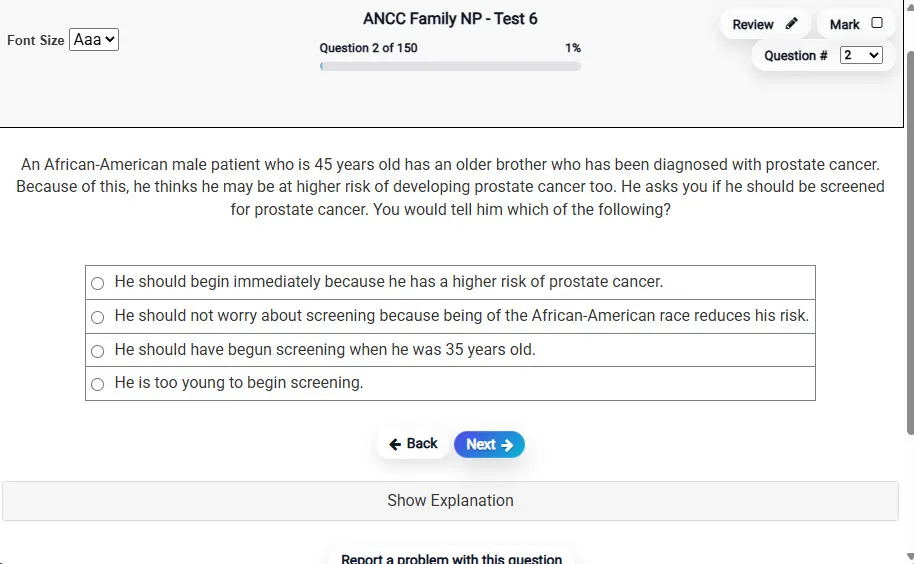
Answering a Question screen – Multiple-choice item view with navigation controls and progress tracker.
Answering a Question Multiple-choice item view with navigation controls and progress tracker.

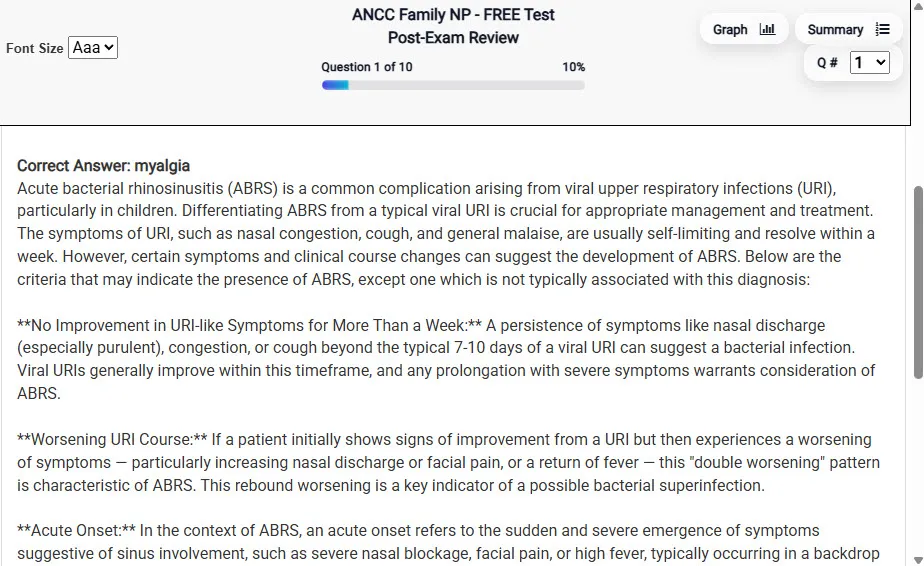
                           Detailed Explanation screen – 
                         Review mode showing chosen answer and rationale and references.
Detailed Explanation Review mode showing chosen answer and rationale and references.

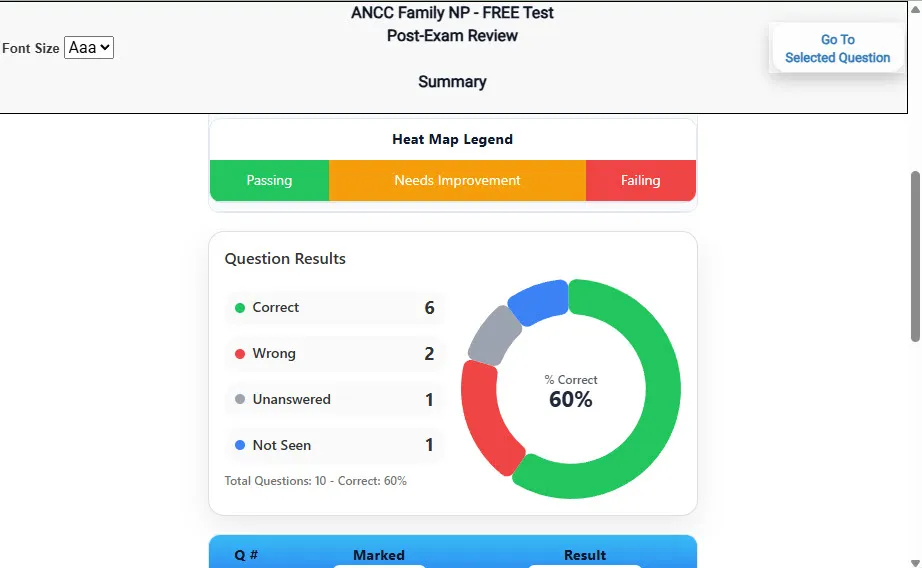
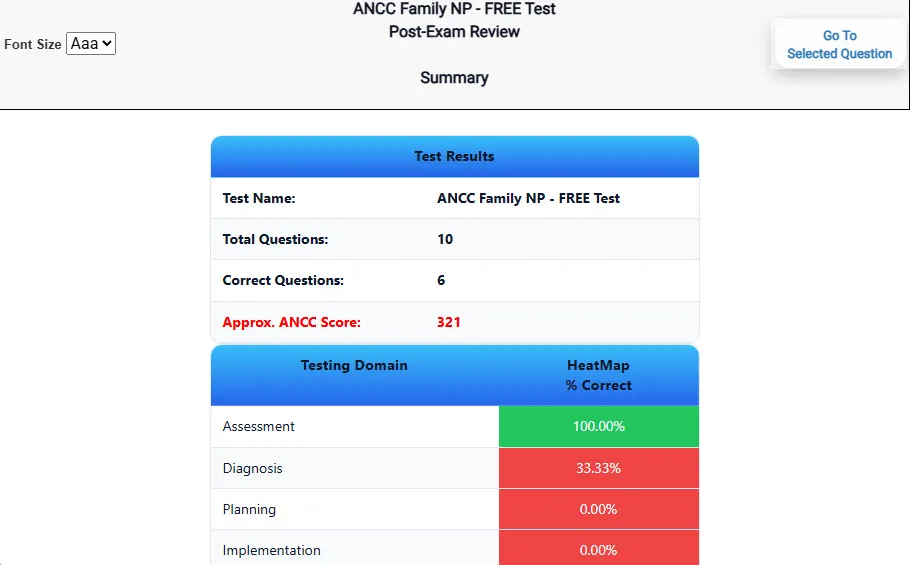
                           Review Summary 1 screen – 
                         Summary with counts for correct/wrong/unanswered and not seen items.
Review Summary 1 Summary with counts for correct/wrong/unanswered and not seen items.

                           Review Summary 2 screen – 
                         Advanced summary with category/domain breakdown and performance insights.
Review Summary 2 Advanced summary with category/domain breakdown and performance insights.

What Each Screen Shows

Answer Question Screen

  • Clean multiple-choice interface with progress bar.
  • Mark for review feature.
  • Matches real test pacing.

Detailed Explanation

  • Correct answer plus rationale.
  • Key concepts and guidelines highlighted.
  • Move between questions to fill knowledge gaps.

Review Summary 1

  • Overall results with total questions and scaled score.
  • Domain heatmap shows strengths and weaknesses.
  • Quick visual feedback on study priorities.

Review Summary 2

  • Chart of correct, wrong, unanswered, not seen.
  • Color-coded results for easy review.
  • Links back to missed items.

Top 10 Reasons to Use Exam Edge for your CSET Chemistry Exam Prep

  1. Focused on the CSET Chemistry Exam

    Our practice tests are built specifically for the CSET Chemistry exam — every question mirrors the real topics, format, and difficulty so you're studying exactly what matters.

  2. Real Exam Simulation

    We match the per-question time limits and pressure of the actual CSET exam, so test day feels familiar and stress-free.

  3. 30 Full Practice Tests & 1,500 Unique Questions

    You'll have more than enough material to master every CSET Chemistry concept — no repeats, no fluff.

  4. Lower Cost Than a Retake

    Ordering 5 practice exams costs less than retaking the CSET Chemistry exam after a failure. One low fee could save you both time and money.

  5. Flexible Testing

    Need to step away mid-exam? Pick up right where you left off — with your remaining time intact.

  6. Instant Scoring & Feedback

    See your raw score and an estimated CSET Chemistry score immediately after finishing each practice test.

  7. Detailed Explanations for Every Question

    Review correct and incorrect answers with clear, step-by-step explanations so you truly understand each topic.

  8. Trusted & Accredited

    We're fully accredited by the Better Business Bureau and uphold the highest standards of trust and transparency.

  9. Web-Based & Always Available

    No software to install. Access your CSET Chemistry practice exams 24/7 from any computer or mobile device.

  10. Expert Support When You Need It

    Need extra help? Our specialized tutors are highly qualified and ready to support your CSET exam prep.


Pass the CSET Chemistry Exam with Realistic Practice Tests from Exam Edge

Preparing for your upcoming CSET Chemistry (218) Certification Exam can feel overwhelming — but the right practice makes all the difference. Exam Edge gives you the tools, structure, and confidence to pass on your first try. Our online practice exams are built to match the real CSET Chemistry exam in content, format, and difficulty.

  • 📝 30 CSET Chemistry Practice Tests: Access 30 full-length exams with 50 questions each, covering every major CSET Chemistry topic in depth.
  • Instant Online Access: Start practicing right away — no software, no waiting.
  • 🧠 Step-by-Step Explanations: Understand the reasoning behind every correct answer so you can master CSET Chemistry exam concepts.
  • 🔄 Retake Each Exam Up to 4 Times: Build knowledge through repetition and track your improvement over time.
  • 🌐 Web-Based & Available 24/7: Study anywhere, anytime, on any device.
  • 🧘 Boost Your Test-Day Confidence: Familiarity with the CSET format reduces anxiety and helps you perform under pressure.

These CSET Chemistry practice exams are designed to simulate the real testing experience by matching question types, timing, and difficulty level. This approach helps you get comfortable not just with the exam content, but also with the testing environment, so you walk into your exam day focused and confident.


Exam Edge CTC Reviews


Just wanted to let you guys know that your tests really helped me prepare for the CBEST math exam. I took it yesterday and passed with a 47! I will tell other people about your site.

Shawna M, California

I passed my cbest today! This was the second time I took the test. My first time I scored 35. This time I scored 43. Taking your practice tests helped me a great deal, because several types of questions on the real test were also on your practice tests. Thanks so much for the help!

TIm F, California

For the last year, I have been trying to pass the reading section of the CBEST. I had taken it six times and if I did not pass it this month, then I could not take my college courses in education. I went to Google and typed in practice reading tests and your website came up. I clicked on it, signed ...
Read More
Stacy S, California

Thank you so much for your reading tests. I just passed the real CBEST Reading test by 4 points! After failing it 3 other times, I thought I would have to quit. I already told everyone in my class about your site.

Sara L, Oregon

For the last year, I have been trying to pass my cset exam. I had taken it six times and was running out of hope I would ever pass. I went to Google and your website came up. I clicked on, signed up and took the free test. I knew that I would buy a couple of tests after taking that one. I ended up b ...
Read More
Stacy,

Purchased the five pack of tests this weekend. Took CBEST math today and passed! Your tests had very similar content as the actual CBEST.

Fresno , CA


CSET Chemistry Aliases Test Name

Here is a list of alternative names used for this exam.

  • CSET Chemistry
  • CSET Chemistry test
  • CSET Chemistry Certification Test
  • CTC
  • CTC 218
  • 218 test
  • CSET Chemistry (218)
  • CSET Chemistry certification