This is the content of the pop-over!

Lightning Deal Alert – 12% Off Ends at Midnight!

Strike while the savings are hot! Use promo code FlashSale at checkout for 12% off any Exam Edge test or bundle. Hurry—the clock is ticking!

CSET Life Sciences (120) Practice Tests & Test Prep by Exam Edge


CSET Life Sciences product image
(4.9)
Based on 28 Reviews

  • Real Exam Simulation: Timed questions and matching content build comfort for your CSET Life Sciences test day.
  • Instant, 24/7 Access: Web-based CSET Life Sciences practice exams with no software needed.
  • Clear Explanations: Step-by-step answers and explanations for your CSET exam to strengthen understanding.
  • Boosted Confidence: Reduces anxiety and improves test-taking skills to ace your CSET Life Sciences (120).

Featured on

CSET Life Sciences Online Practice Test Bundles

BEST VALUE
20 practice tests

$174.00

$799.00

SAVE $625

Only $8.70 per test!

  • 100% Pass Guarantee
  • 20 online practice tests
  • 50 questions + 1 essay per test
  • Bonus: 100 Flash Cards + Study Guide
  • Instant access
  • Detailed Explanations
  • Practice tests never expire
  • Timed, untimed, or study guide mode
MOST POPULAR
10 practice tests

$99.50

$399.50

SAVE $300

Only $9.95 per test!

  • 10 online practice tests
  • 50 questions + 1 essay per test
  • Bonus: 100 Flash Cards + Study Guide
  • Instant access
  • Detailed Explanations
  • Practice tests never expire
  • Timed, untimed, or study guide mode
5 practice tests

$69.75

$199.75

SAVE $130

Only $13.95 per test!

  • 5 online practice tests
  • 50 questions + 1 essay per test
  • Bonus: 100 Flash Cards
  • Instant access
  • Detailed Explanations
  • Practice tests never expire
  • Timed, untimed, or study guide mode
1 practice test

$39.95

  • 1 online practice test
  • 50 questions + 1 essay per test
  • Instant access
  • Detailed Explanations
  • Practice tests never expire
  • Timed, untimed, or study guide mode
Quick Select
Tap to choose a bundle

** All Prices are in US Dollars (USD) **


CSET Life Sciences (120) Resources

Jump to the section you need most.

Understanding the exact breakdown of the CSET Life Sciences test will help you know what to expect and how to most effectively prepare. The CSET Life Sciences has 50 multiple-choice questions and 3 essay questions. The exam will be broken down into the sections below:

CSET Life Sciences Exam Blueprint
Domain Name
Cell Biology and Physiology  
Genetics  
Evolution  
Ecology  
Investigation and Experimentation  
Nature of Science  
Science and Society  

CSET Life Sciences Study Tips by Domain

  • Compare prokaryotic vs. eukaryotic cells by what they lack or contain (e.g., membrane-bound organelles, nucleus)—red flag: calling ribosomes an organelle with a membrane.
  • Link membrane structure to transport (diffusion, osmosis, facilitated diffusion, active transport, endo/exocytosis)—common trap: saying solutes move against a gradient without ATP or a coupled gradient.
  • Trace energy flow through cellular respiration and photosynthesis (where it happens, inputs/outputs, electron carriers)—priority rule: NADH/FADH2 feed the ETC; most ATP is made by chemiosmosis, not glycolysis.
  • Connect enzyme function to factors that change reaction rate (temperature, pH, substrate concentration, inhibitors)—contraindication: denaturation typically lowers activity even if substrate is abundant.
  • Explain cell cycle control (G1/S/G2/M checkpoints, cyclins/CDKs, apoptosis) and outcomes of failures—red flag: confusing mitosis (somatic, identical) with meiosis (gametes, variation).
  • Relate tissue and organ physiology to homeostasis using feedback loops (nervous/endocrine, glucose regulation, thermoregulation)—common trap: mislabeling negative feedback as positive when a response reduces the original stimulus.
  • Track inheritance with clear allele notation and test expectations for Mendelian ratios (e.g., 3:1, 1:2:1); red flag: treating phenotypic ratios as proof without considering sample size and chance.
  • Use pedigrees to infer mode of inheritance (autosomal vs. X-linked, dominant vs. recessive); common trap: calling a trait X-linked dominant when affected fathers do not pass it to all daughters.
  • Link meiosis to genetic variation via independent assortment and crossing over; priority rule: recombination frequency is capped at 50%—values near 50% indicate unlinked genes or far-apart loci.
  • Connect DNA structure and replication (5’→3’ synthesis, antiparallel strands) to mutation types; red flag: confusing replication errors (mismatches) with transcription errors (RNA) when predicting heritable changes.
  • Explain gene expression from DNA → RNA → protein and how regulation alters phenotype; common trap: assuming a mutation in an intron always changes amino acids rather than potentially affecting splicing or having no coding effect.
  • Interpret molecular genetics data (gel electrophoresis, karyotypes, PCR-based results) using size/charge logic and controls; priority rule: always verify a positive and negative control before concluding a genotype from band patterns.
  • Be ready to justify evolution as “descent with modification” using multiple evidence lines (fossils, comparative anatomy, molecular data)—red flag: claiming any single dataset “proves” evolution without noting converging support.
  • Explain natural selection with the full logic chain (heritable variation → differential survival/reproduction → change in allele frequencies)—common trap: describing selection as organisms “adapting because they need to.”
  • Distinguish mechanisms: selection vs. genetic drift vs. gene flow vs. mutation—priority rule: emphasize drift in small populations (e.g., founder/bottleneck effects) and avoid implying drift is “goal-directed.”
  • Apply Hardy–Weinberg as a null model and interpret deviations—threshold cue: if conditions (large population, random mating, no selection/mutation/migration) are violated, you must state which violation could explain the pattern.
  • Interpret phylogenetic trees using common ancestry and shared derived traits (synapomorphies)—common trap: reading trees left-to-right as “progress” or assuming more similar-looking taxa are always more closely related without node-based reasoning.
  • Compare speciation modes and isolating mechanisms (prezygotic vs. postzygotic; allopatric vs. sympatric)—red flag: calling hybrids “infertile” as a universal rule when reduced viability/fertility can vary by cross direction and taxa.
  • Differentiate energy flow from matter cycling—energy moves one-way through trophic levels while nutrients (C, N, P, H2O) cycle; red flag: treating energy as “recycled” in ecosystems.
  • Interpret population growth models: exponential (r-selected conditions) vs logistic (carrying capacity, K); common trap: assuming populations stabilize exactly at K without oscillations or time lags.
  • Track community interactions (competition, predation, mutualism, parasitism) and their effects on population size; priority rule: use sign notation (+/+, +/0, +/-, -/-) to avoid mixing up mutualism and commensalism.
  • Apply niche concepts (fundamental vs realized) and competitive exclusion; red flag: defining niche as just “habitat” rather than the full resource/role requirements.
  • Analyze succession and disturbance (primary vs secondary) with expected pioneer traits; common trap: calling succession after fire “primary” when soil (and seed bank) remains.
  • Use biodiversity metrics and conservation logic (keystone species, edge effects, fragmentation); priority cue: small isolated patches increase local extinction risk even if total habitat area seems adequate.
  • Identify independent vs. dependent vs. controlled variables and include a control group when possible; red flag: changing more than one factor at a time makes causal claims invalid.
  • Choose appropriate sample size and replication (biological vs. technical) to reduce random error; common trap: treating repeated measurements of one specimen as true replication.
  • Use proper data displays and statistics (mean/median, SD, error bars, correlation vs. causation) matched to the question; red flag: concluding “significant difference” from overlapping or undefined error bars.
  • Check measurement quality—calibration, precision, accuracy, and units—before collecting data; priority rule: always report with units and reasonable significant figures to avoid overstating precision.
  • Design procedures to minimize bias (random assignment, blinding, consistent protocols) and document methods for reproducibility; common trap: excluding “outliers” without a pre-stated criterion.
  • Interpret results by linking evidence to claims and acknowledging limitations and alternative explanations; red flag: extrapolating beyond the tested range (e.g., different species, conditions, or time scales) without supporting data.
  • Distinguish hypotheses, theories, and laws: a theory is a well-supported explanatory framework, not a “guess”—red flag if a prompt implies theories become laws with enough evidence.
  • Emphasize falsifiability and testability: good scientific claims specify what evidence would count against them—common trap is writing a hypothesis that can’t be disproven.
  • Separate observation from inference: observations are recorded measurements/phenomena, inferences interpret them—cue: label statements carefully when analyzing data tables or field notes.
  • Understand peer review and replication: peer review screens methods and logic but doesn’t guarantee truth—priority rule: reproducible results across independent studies carry more weight than a single “significant” finding.
  • Recognize uncertainty and error: report variability (e.g., SD/SE) and consider systematic vs random error—red flag if a conclusion ignores measurement error or overstates precision beyond instrument limits.
  • Apply ethical norms in science: proper citation, honest reporting, and responsible treatment of organisms/humans are non-negotiable—contraindication: manipulating or selectively omitting data to fit a hypothesis.
  • Know how scientific findings inform public policy (e.g., vaccination, climate, endangered species) while separating data from values—red flag: claiming science alone dictates a single “right” policy choice.
  • Evaluate risk using both hazard and exposure (risk = hazard × exposure) and compare relative vs absolute risk—common trap: interpreting correlation as causation in public health headlines.
  • Understand ethics in research with humans/animals (informed consent, IRB/IACUC, minimizing harm)—contraindication: lack of a control or coercive recruitment undermines ethical validity.
  • Interpret scientific information in media by checking sources, sample size, and peer review status—priority rule: treat single studies and press releases as preliminary until replicated.
  • Apply sustainability concepts (carrying capacity, ecological footprint, renewable vs nonrenewable resources) to resource-management scenarios—red flag: proposed solutions that shift impacts elsewhere (e.g., biofuels increasing habitat loss).
  • Recognize equity and access issues in science/technology (environmental justice, healthcare access, data privacy) and how they affect outcomes—common trap: assuming technological fixes work uniformly across populations.


Built to Fit Into Your Busy Life

Everything you need to prepare with confidence—without wasting a minute.

Three Study Modes

Timed, No Time Limit, or Explanation mode.

Actionable Analytics

Heatmaps and scaled scores highlight weak areas.

High-Yield Rationales

Concise explanations emphasize key concepts.

Realistic Interface

Matches the feel of the actual exam environment.

Accessible by Design

Clean layout reduces cognitive load.

Anytime, Anywhere

Web-based access 24/7 on any device.
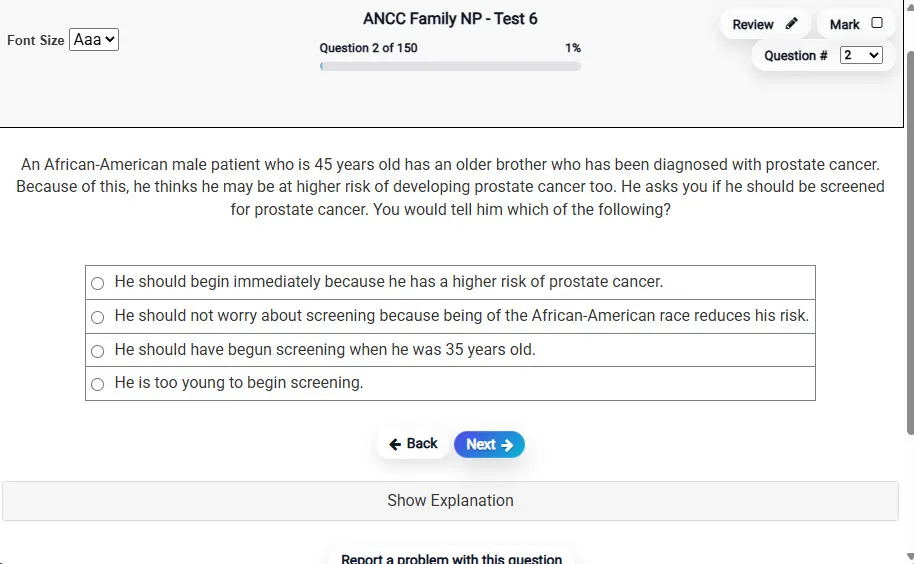
Answering a Question screen – Multiple-choice item view with navigation controls and progress tracker.
Answering a Question Multiple-choice item view with navigation controls and progress tracker.

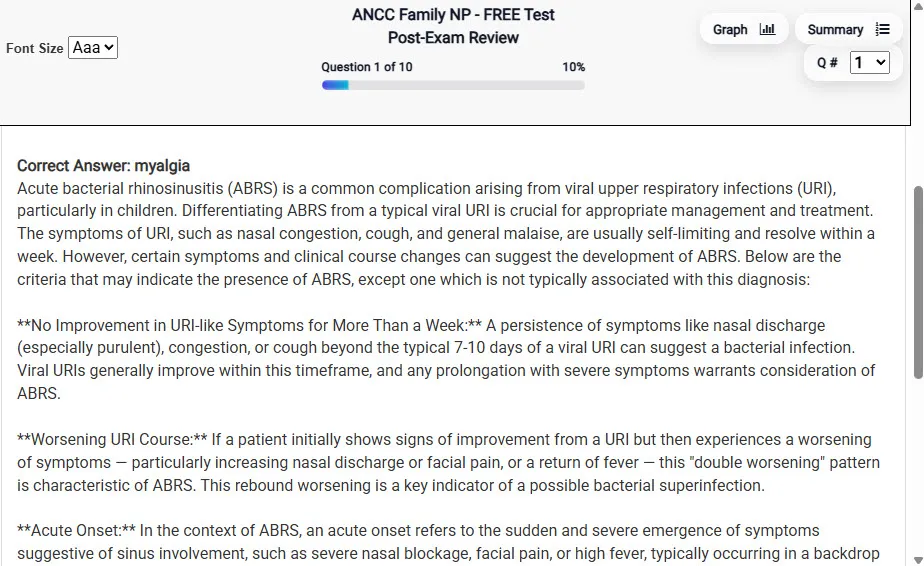
                           Detailed Explanation screen – 
                         Review mode showing chosen answer and rationale and references.
Detailed Explanation Review mode showing chosen answer and rationale and references.

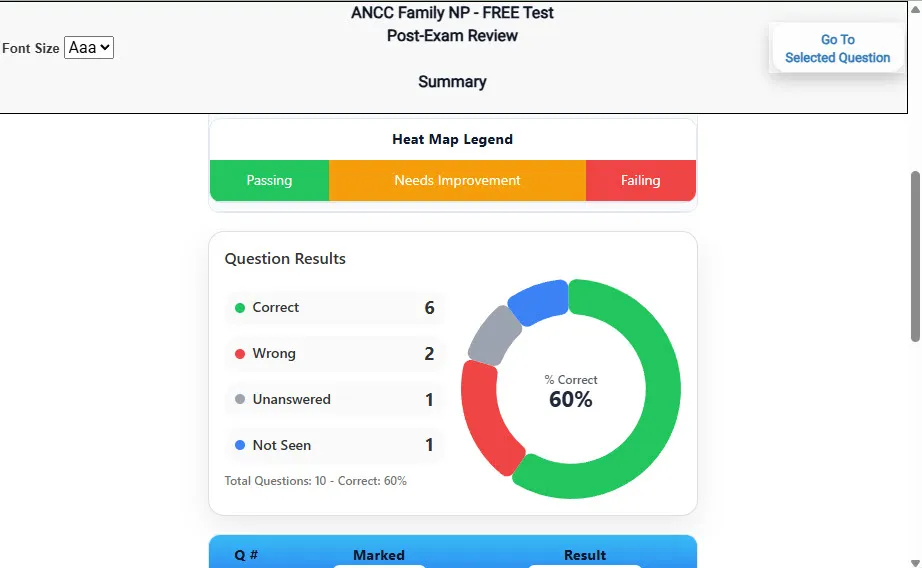
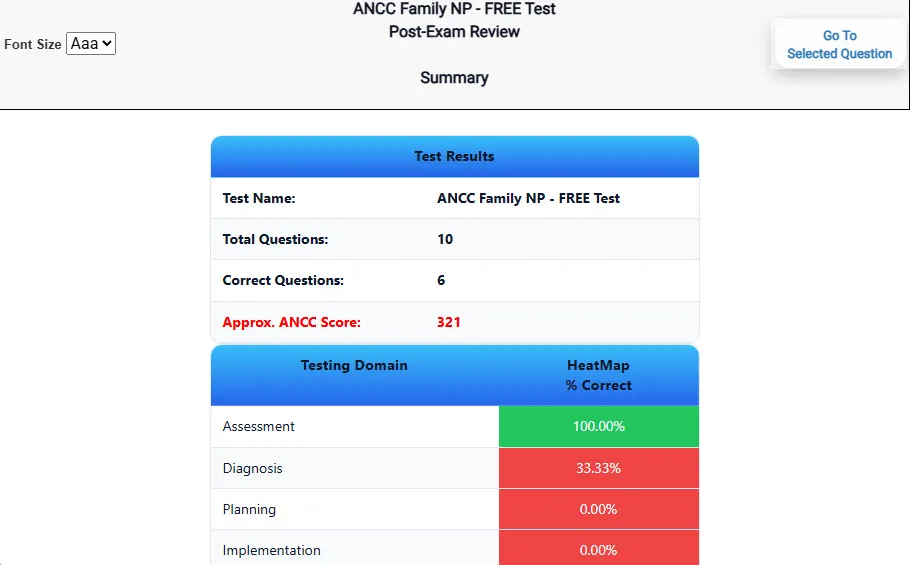
                           Review Summary 1 screen – 
                         Summary with counts for correct/wrong/unanswered and not seen items.
Review Summary 1 Summary with counts for correct/wrong/unanswered and not seen items.

                           Review Summary 2 screen – 
                         Advanced summary with category/domain breakdown and performance insights.
Review Summary 2 Advanced summary with category/domain breakdown and performance insights.

What Each Screen Shows

Answer Question Screen

  • Clean multiple-choice interface with progress bar.
  • Mark for review feature.
  • Matches real test pacing.

Detailed Explanation

  • Correct answer plus rationale.
  • Key concepts and guidelines highlighted.
  • Move between questions to fill knowledge gaps.

Review Summary 1

  • Overall results with total questions and scaled score.
  • Domain heatmap shows strengths and weaknesses.
  • Quick visual feedback on study priorities.

Review Summary 2

  • Chart of correct, wrong, unanswered, not seen.
  • Color-coded results for easy review.
  • Links back to missed items.

Top 10 Reasons to Use Exam Edge for your CSET Life Sciences Exam Prep

  1. Focused on the CSET Life Sciences Exam

    Our practice tests are built specifically for the CSET Life Sciences exam — every question mirrors the real topics, format, and difficulty so you're studying exactly what matters.

  2. Real Exam Simulation

    We match the per-question time limits and pressure of the actual CSET exam, so test day feels familiar and stress-free.

  3. 20 Full Practice Tests & 1,020 Unique Questions

    You'll have more than enough material to master every CSET Life Sciences concept — no repeats, no fluff.

  4. Lower Cost Than a Retake

    Ordering 5 practice exams costs less than retaking the CSET Life Sciences exam after a failure. One low fee could save you both time and money.

  5. Flexible Testing

    Need to step away mid-exam? Pick up right where you left off — with your remaining time intact.

  6. Instant Scoring & Feedback

    See your raw score and an estimated CSET Life Sciences score immediately after finishing each practice test.

  7. Detailed Explanations for Every Question

    Review correct and incorrect answers with clear, step-by-step explanations so you truly understand each topic.

  8. Trusted & Accredited

    We're fully accredited by the Better Business Bureau and uphold the highest standards of trust and transparency.

  9. Web-Based & Always Available

    No software to install. Access your CSET Life Sciences practice exams 24/7 from any computer or mobile device.

  10. Expert Support When You Need It

    Need extra help? Our specialized tutors are highly qualified and ready to support your CSET exam prep.


Pass the CSET Life Sciences Exam with Realistic Practice Tests from Exam Edge

Preparing for your upcoming CSET Life Sciences (120) Certification Exam can feel overwhelming — but the right practice makes all the difference. Exam Edge gives you the tools, structure, and confidence to pass on your first try. Our online practice exams are built to match the real CSET Life Sciences exam in content, format, and difficulty.

  • 📝 20 CSET Life Sciences Practice Tests: Access 20 full-length exams with 51 questions each, covering every major CSET Life Sciences topic in depth.
  • Instant Online Access: Start practicing right away — no software, no waiting.
  • 🧠 Step-by-Step Explanations: Understand the reasoning behind every correct answer so you can master CSET Life Sciences exam concepts.
  • 🔄 Retake Each Exam Up to 4 Times: Build knowledge through repetition and track your improvement over time.
  • 🌐 Web-Based & Available 24/7: Study anywhere, anytime, on any device.
  • 🧘 Boost Your Test-Day Confidence: Familiarity with the CSET format reduces anxiety and helps you perform under pressure.

These CSET Life Sciences practice exams are designed to simulate the real testing experience by matching question types, timing, and difficulty level. This approach helps you get comfortable not just with the exam content, but also with the testing environment, so you walk into your exam day focused and confident.


Exam Edge CTC Reviews


Just wanted to let you guys know that your tests really helped me prepare for the CBEST math exam. I took it yesterday and passed with a 47! I will tell other people about your site.

Shawna M, California

I passed my cbest today! This was the second time I took the test. My first time I scored 35. This time I scored 43. Taking your practice tests helped me a great deal, because several types of questions on the real test were also on your practice tests. Thanks so much for the help!

TIm F, California

For the last year, I have been trying to pass the reading section of the CBEST. I had taken it six times and if I did not pass it this month, then I could not take my college courses in education. I went to Google and typed in practice reading tests and your website came up. I clicked on it, signed ...
Read More
Stacy S, California

Thank you so much for your reading tests. I just passed the real CBEST Reading test by 4 points! After failing it 3 other times, I thought I would have to quit. I already told everyone in my class about your site.

Sara L, Oregon

For the last year, I have been trying to pass my cset exam. I had taken it six times and was running out of hope I would ever pass. I went to Google and your website came up. I clicked on, signed up and took the free test. I knew that I would buy a couple of tests after taking that one. I ended up b ...
Read More
Stacy,

Purchased the five pack of tests this weekend. Took CBEST math today and passed! Your tests had very similar content as the actual CBEST.

Fresno , CA


CSET Life Sciences Aliases Test Name

Here is a list of alternative names used for this exam.

  • CSET Life Sciences
  • CSET Life Sciences test
  • CSET Life Sciences Certification Test
  • CTC
  • CTC 120
  • 120 test
  • CSET Life Sciences (120)
  • CSET Life Sciences certification