This is the content of the pop-over!

Lightning Deal Alert – 12% Off Ends at Midnight!

Strike while the savings are hot! Use promo code FlashSale at checkout for 12% off any Exam Edge test or bundle. Hurry—the clock is ticking!

CSET Art (140, 141) Practice Tests & Test Prep by Exam Edge


CSET Art  product image
(4.9)
Based on 40 Reviews

  • Real Exam Simulation: Timed questions and matching content build comfort for your CSET Art test day.
  • Instant, 24/7 Access: Web-based CSET Art practice exams with no software needed.
  • Clear Explanations: Step-by-step answers and explanations for your CSET exam to strengthen understanding.
  • Boosted Confidence: Reduces anxiety and improves test-taking skills to ace your CSET Art (140, 141).

Featured on

CSET Art Online Practice Test Bundles

BEST VALUE
20 practice tests

$174.00

$799.00

SAVE $625

Only $8.70 per test!

  • 100% Pass Guarantee
  • 20 online practice tests
  • 100 questions per test
  • Bonus: 100 Flash Cards + Study Guide
  • Instant access
  • Detailed Explanations
  • Practice tests never expire
  • Timed, untimed, or study guide mode
MOST POPULAR
10 practice tests

$99.50

$399.50

SAVE $300

Only $9.95 per test!

  • 10 online practice tests
  • 100 questions per test
  • Bonus: 100 Flash Cards + Study Guide
  • Instant access
  • Detailed Explanations
  • Practice tests never expire
  • Timed, untimed, or study guide mode
5 practice tests

$69.75

$199.75

SAVE $130

Only $13.95 per test!

  • 5 online practice tests
  • 100 questions per test
  • Bonus: 100 Flash Cards
  • Instant access
  • Detailed Explanations
  • Practice tests never expire
  • Timed, untimed, or study guide mode
1 practice test

$39.95

  • 1 online practice test
  • 100 questions per test
  • Instant access
  • Detailed Explanations
  • Practice tests never expire
  • Timed, untimed, or study guide mode
Quick Select
Tap to choose a bundle

** All Prices are in US Dollars (USD) **


CSET Art (140, 141) Resources

Jump to the section you need most.

Understanding the exact breakdown of the CSET Art test will help you know what to expect and how to most effectively prepare. The CSET Art has 100 multiple-choice questions and 8 essay questions. The exam will be broken down into the sections below:

CSET Art Exam Blueprint
Domain Name
Artistic Perception; Historical and Cultural Context of the Visual Arts; Aesthetic Valuing  
     Artistic Perception  
     Creative Expression  
     Historical and Cultural Context of the Visual Arts  
     Aesthetic Valuing  
     Connections - Relationships Applications  
     History and Theories of Learning in Art  
Creative Expression; Connections - Relationships Applications; History and Theories of Learning in Art  
     Creative Expression  
     Connections - Relationships Applications  
     History And Theories Of Learning In Art  

CSET Art Study Tips by Domain

  • Use formal elements and principles precisely (line, value, hue/chroma, space, balance, emphasis) and tie each to observable evidence—red flag: vague claims like “it feels balanced” with no visual support.
  • When analyzing media/technique, distinguish process from effect (e.g., chiaroscuro vs. sfumato; impasto vs. glazing) and state how it changes meaning—common trap: naming a technique but misattributing its visual outcome.
  • Place works in historical/cultural context with specific markers (patronage, function, audience, technology, materials) rather than broad eras—priority rule: one accurate contextual detail beats multiple generic period labels.
  • Compare styles and movements by shared conventions and departures (e.g., idealization vs. naturalism; abstraction vs. representation) and cite at least one concrete visual indicator—red flag: equating “modern” with “abstract” automatically.
  • Apply aesthetic theories/criteria (formalism, expressionism, instrumentalism/contextualism) to justify a judgment and acknowledge an alternative lens—common trap: confusing personal preference with a criteria-based evaluation.
  • Use critique vocabulary correctly (description → analysis → interpretation → judgment) and keep claims aligned to the step—contraindication: interpreting symbolism before describing what is literally present.
  • Differentiate visual elements (line, shape, form, color, value, texture, space) from principles (balance, contrast, emphasis, movement, pattern, proportion, unity)—common trap: calling “texture” a principle or “balance” an element.
  • Use value structure (high-key, low-key, full range) to predict mood and focal hierarchy—red flag: discussing color symbolism when the prompt is clearly value-driven (e.g., grayscale images).
  • Explain color relationships using hue/value/chroma and schemes (complementary, analogous, triadic)—priority rule: when asked about “intensity,” address chroma/saturation, not brightness (value).
  • Read space convincingly by naming specific depth cues (overlap, scale change, linear perspective, atmospheric perspective, cast shadow)—common trap: saying “foreshortening” when the image actually shows simple overlap/scale.
  • Identify common compositional structures (rule of thirds, symmetry/asymmetry, diagonal thrust, golden ratio, leading lines) and link them to viewer attention—red flag: describing content without stating how the composition guides the eye.
  • Distinguish media/process from visual effect (e.g., watercolor washes vs acrylic impasto, relief vs intaglio printmaking)—contraindication: don’t claim etching/engraving results in a raised ink surface (that’s relief).
  • Show command of the elements and principles by explaining how specific choices (e.g., value contrast, asymmetrical balance) produce a stated effect; red flag: naming elements without linking them to visual outcomes.
  • Demonstrate process from ideation to refinement (thumbnails, studies, revisions) with clear intent; common trap: presenting a final product with no evidence of iterative problem-solving.
  • Match media, tools, and techniques to the task (e.g., glazing vs. impasto, relief vs. intaglio) and state why; priority rule: if technique obscures intent, adjust method before adding detail.
  • Address craftsmanship and safe practice (proper tool handling, ventilation for solvents, kiln/etching safety) as part of making; red flag: ignoring safety protocols when discussing studio procedures.
  • Use accurate studio vocabulary to describe how work is constructed (e.g., armature, registering a screen, underpainting) and what problems were solved; common trap: vague language like “I just blended it” without specifying method.
  • Plan for presentation and critique (mounting, lighting, sequencing) to support the intended reading of the work; contraindication: presentation choices that introduce glare, color shift, or distracting borders.
  • Place artworks in time and geography by citing at least one concrete marker (e.g., patronage system, materials technology, religious practice)—red flag: only describing style with no contextual evidence.
  • Explain how function and audience shaped form (ritual, propaganda, domestic use, public monument)—common trap: assuming all art was made for “self-expression” across cultures and eras.
  • Compare cross-cultural exchange (trade routes, colonization, diaspora) and its visual impact—priority rule: name the direction of influence and what specifically changed (iconography, medium, technique).
  • Identify major movements and their cultural drivers (e.g., industrialization, modernism, civil rights) and connect them to identifiable visual traits—red flag: listing artists without linking to broader historical conditions.
  • Address issues of power, representation, and cultural appropriation with precise terms (stereotype, gaze, hybridity, reclamation)—contraindication: flattening diverse communities into a single “culture” label.
  • Use accurate art-historical vocabulary (iconography, provenance, patron, workshop, canon) and cite plausible context for interpretation—common trap: making claims about meaning without evidence from historical sources or material context.
  • Apply a clear aesthetic theory lens (e.g., formalism, expressionism, contextualism) and cite specific evidence; red flag: broad claims like “it’s beautiful” with no criteria.
  • Use disciplined critique language (describe → analyze → interpret → judge) and keep each step distinct; common trap: judging before describing observable features.
  • When evaluating quality, reference elements/principles and how they function (unity, emphasis, balance) rather than naming them; priority rule: link each criterion to a concrete visual example.
  • Address cultural and historical context as part of valuing, not as a side note; red flag: imposing one culture’s standards as universal without acknowledging perspective.
  • Differentiate personal preference from reasoned judgment and state your standard up front; common trap: substituting biography or intent for what the work actually communicates/does.
  • For classroom-aligned responses (CTC framing), justify assessment criteria and ensure they are measurable (rubric language, observable outcomes); contraindication: grading solely on effort or “neatness” without stated artistic objectives.
  • Show how artworks communicate across disciplines (e.g., visualizing scientific processes, illustrating literary themes); red flag: naming a connection without explaining the shared concept or purpose.
  • Address art’s relationship to society by linking form and content to function (propaganda, ritual, commerce, activism); common trap: giving historical facts but not stating the artwork’s intended audience or impact.
  • Use correct visual arts vocabulary to compare works across media and contexts (line, value, space, emphasis, unity); priority rule: always anchor comparisons in observable evidence rather than personal preference.
  • Explain how context changes interpretation (museum vs. public space, original vs. reproduced, site-specific vs. portable); red flag: treating meaning as fixed regardless of setting or presentation.
  • Connect visual art to contemporary applications (design, advertising, UI/UX, architecture, film); common trap: describing the field without identifying the specific design principle being applied.
  • Discuss ethical and legal considerations in using images (copyright, fair use, cultural appropriation); priority rule: if you can’t justify permission, transformation, or attribution, assume it’s a compliance risk.
  • Contrast major learning theories (behaviorism, constructivism, sociocultural, cognitive) and tie each to an art-class move; red flag: naming theorists without explaining what changes in instruction or assessment.
  • Use CA Visual and Performing Arts standards framing (process-based outcomes) to justify lesson sequencing; common trap: describing an activity list without explicit, measurable student learning evidence.
  • Apply developmental considerations (fine-motor, spatial reasoning, visual schema) when selecting media and complexity; priority rule: match task demands to age-level readiness to avoid skill frustration masking artistic intent.
  • Plan critique as a taught skill (descriptive → interpretive → evaluative) with norms and sentence frames; red flag: letting critique become personal opinion (“I like it”) rather than evidence-based reasoning.
  • Differentiate for English learners, students with disabilities, and advanced learners using accessible vocab, exemplars, and alternative demonstrations; common trap: reducing rigor instead of providing multiple pathways to the same standard.
  • Design assessment with clear criteria (rubrics separating process, craftsmanship, and concept) and opportunities for revision; threshold cue: include formative checks before final production so grades don’t reflect only the end product.
  • Plan instruction that moves from direct modeling to guided practice to independent studio work, and name the learning theory you’re using (e.g., Vygotsky/ZPD, Bandura modeling)—red flag: lesson plans that list activities without a teachable skill or scaffold.
  • Use the Elements of Art and Principles of Design as shared vocabulary to connect making, critique, and revision—common trap: treating them as a checklist instead of a rationale for choices and problem-solving.
  • Build critique routines that are evidence-based (describe, analyze, interpret, judge) and tied to criteria—priority rule: opinions alone (“I like it”) do not meet CTC-aligned expectations for assessment language.
  • Show cross-disciplinary connections (history, ELA, science/math) through a specific studio task (e.g., proportion, perspective, visual metaphor, data visualization)—red flag: vague “integrates standards” claims with no concrete product or process.
  • Differentiate for diverse learners (ELs, students with IEPs/504) with targeted supports (sentence frames for critique, chunked demos, adapted tools) while keeping the same artistic goal—common trap: lowering the task instead of adjusting access.
  • Use assessment that matches studio learning: clear rubrics for process + product, formative checkpoints, and feedback that prompts iteration—threshold cue: include at least one measurable criterion (craftsmanship, composition, originality, risk-taking, or use of media) tied to the objective.
  • Show controlled use of the elements of art and principles of design (e.g., value contrast to direct focal point); red flag: listing elements without explaining how they function in the composition.
  • Demonstrate safe, correct handling of media/processes (e.g., proper ventilation for aerosols, correct tool use); common trap: ignoring safety and setup/cleanup as part of studio practice.
  • Apply color strategies intentionally (e.g., limited palette, complementary contrast, warm/cool depth cues); priority rule: justify choices by the intended mood/message rather than personal preference alone.
  • Use drawing/observation skills with accurate proportion, perspective, and value structure; red flag: relying on symbols (e.g., “stick hands”) instead of observed forms.
  • Describe a workable creative process (ideation → thumbnails/maquettes → revision → final); common trap: presenting the first idea as the final without evidence of refinement.
  • Critique and revise using specific criteria (craftsmanship, unity/variety, emphasis, intent); threshold cue: revisions should address at least one compositional issue (e.g., tangents, weak contrast) rather than only adding detail.
  • Link a specific artwork to a specific context (artist intent, audience, function) and cite at least one concrete visual feature—red flag: only giving themes without evidence from the work.
  • Compare visual arts to another discipline (music, theater, literature, science) using parallel elements/principles or structures—common trap: vague “they both express emotion” with no formal comparison.
  • Use correct technical vocabulary when relating art to media/tech (e.g., additive vs. subtractive color, vector vs. raster, relief vs. intaglio)—contraindication: mixing terms (e.g., calling etching a relief process).
  • Connect art to community/career applications (design briefs, client constraints, copyright/fair use, accessibility) and state one real-world constraint—priority rule: always address audience and purpose.
  • Analyze how cultural exchange, patronage, or institutions (museums, galleries, markets) shape what gets made and valued—red flag: treating art as isolated from economics/power structures.
  • Frame interdisciplinary lesson/application examples with an assessable outcome (criteria, rubric focus, or documentation) aligned to standards-like goals—common trap: activity-only plans with no measurable evidence of learning.
  • Distinguish major art education theories (e.g., DBAE, constructivism, social learning, discipline-based studio models) by what they prioritize in instruction; red flag: naming a theory without linking it to a concrete classroom practice.
  • Apply developmental considerations (fine-motor control, perceptual development, symbolic representation) when selecting tasks; trap: expecting realistic perspective drawing from students not yet ready for proportional or spatial concepts.
  • Use Vygotsky-informed scaffolding (modeling, guided practice, peer critique) to move students through a ZPD; priority rule: gradually remove supports rather than leaving “training wheels” in place.
  • Align assessment to learning goals with clear criteria (rubrics for process, craftsmanship, reflection, and revision), not just finished products; red flag: grading solely on talent or style preference.
  • Plan instruction with multiple entry points (choice of materials, exemplars, and culturally responsive references) to support diverse learners; trap: treating one canonical sequence as universally valid for all students.
  • Integrate critique and metacognition (describe–analyze–interpret–judge; artist statements; peer feedback norms) as teachable skills; contraindication: unstructured critique that becomes personal opinion or discourages risk-taking.


Built to Fit Into Your Busy Life

Everything you need to prepare with confidence—without wasting a minute.

Three Study Modes

Timed, No Time Limit, or Explanation mode.

Actionable Analytics

Heatmaps and scaled scores highlight weak areas.

High-Yield Rationales

Concise explanations emphasize key concepts.

Realistic Interface

Matches the feel of the actual exam environment.

Accessible by Design

Clean layout reduces cognitive load.

Anytime, Anywhere

Web-based access 24/7 on any device.
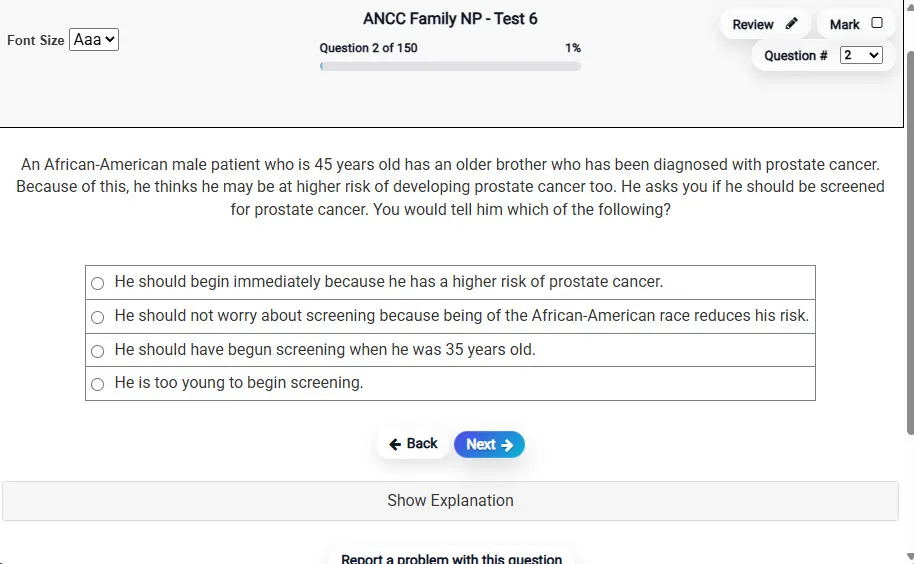
Answering a Question screen – Multiple-choice item view with navigation controls and progress tracker.
Answering a Question Multiple-choice item view with navigation controls and progress tracker.

                           Detailed Explanation screen – 
                         Review mode showing chosen answer and rationale and references.
Detailed Explanation Review mode showing chosen answer and rationale and references.

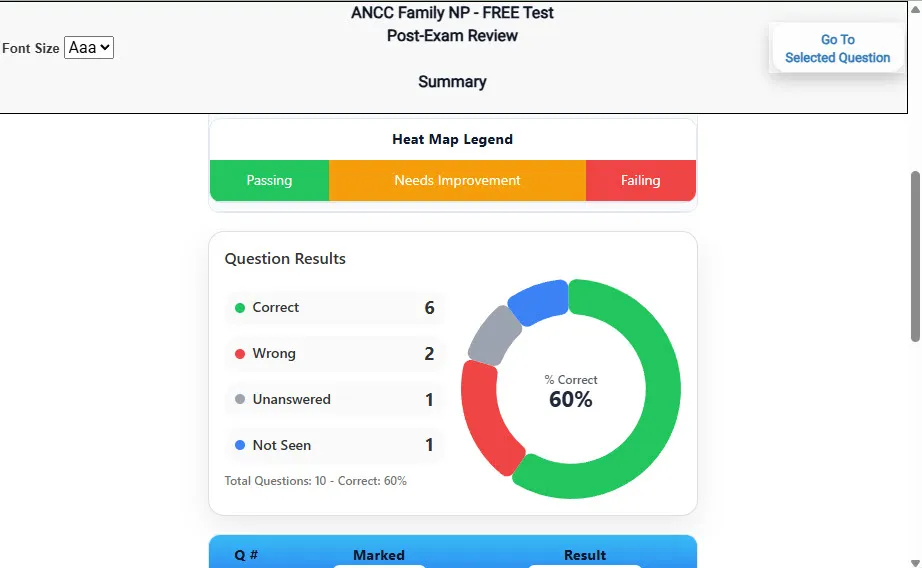
                           Review Summary 1 screen – 
                         Summary with counts for correct/wrong/unanswered and not seen items.
Review Summary 1 Summary with counts for correct/wrong/unanswered and not seen items.

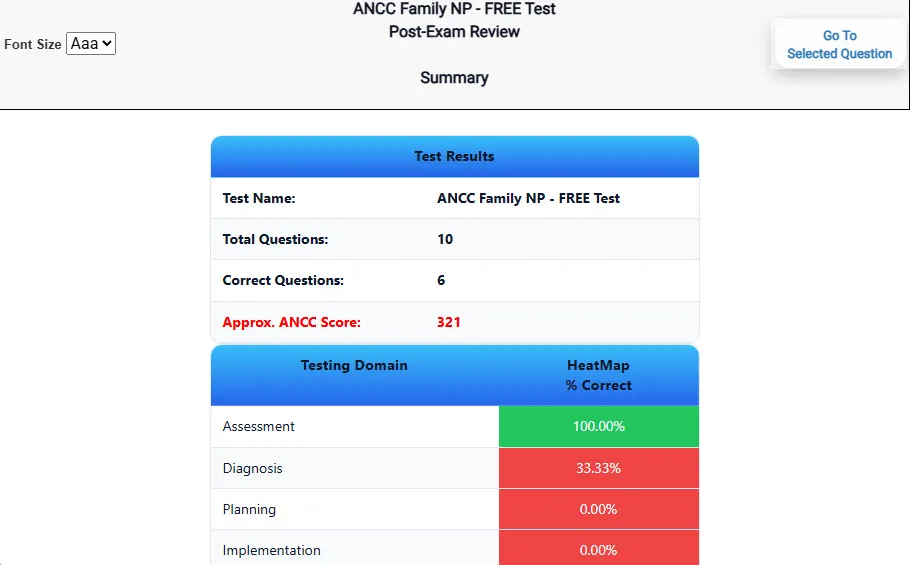
                           Review Summary 2 screen – 
                         Advanced summary with category/domain breakdown and performance insights.
Review Summary 2 Advanced summary with category/domain breakdown and performance insights.

What Each Screen Shows

Answer Question Screen

  • Clean multiple-choice interface with progress bar.
  • Mark for review feature.
  • Matches real test pacing.

Detailed Explanation

  • Correct answer plus rationale.
  • Key concepts and guidelines highlighted.
  • Move between questions to fill knowledge gaps.

Review Summary 1

  • Overall results with total questions and scaled score.
  • Domain heatmap shows strengths and weaknesses.
  • Quick visual feedback on study priorities.

Review Summary 2

  • Chart of correct, wrong, unanswered, not seen.
  • Color-coded results for easy review.
  • Links back to missed items.

Top 10 Reasons to Use Exam Edge for your CSET Art Exam Prep

  1. Focused on the CSET Art Exam

    Our practice tests are built specifically for the CSET Art exam — every question mirrors the real topics, format, and difficulty so you're studying exactly what matters.

  2. Real Exam Simulation

    We match the per-question time limits and pressure of the actual CSET exam, so test day feels familiar and stress-free.

  3. 20 Full Practice Tests & 2,000 Unique Questions

    You'll have more than enough material to master every CSET Art concept — no repeats, no fluff.

  4. Lower Cost Than a Retake

    Ordering 5 practice exams costs less than retaking the CSET Art exam after a failure. One low fee could save you both time and money.

  5. Flexible Testing

    Need to step away mid-exam? Pick up right where you left off — with your remaining time intact.

  6. Instant Scoring & Feedback

    See your raw score and an estimated CSET Art score immediately after finishing each practice test.

  7. Detailed Explanations for Every Question

    Review correct and incorrect answers with clear, step-by-step explanations so you truly understand each topic.

  8. Trusted & Accredited

    We're fully accredited by the Better Business Bureau and uphold the highest standards of trust and transparency.

  9. Web-Based & Always Available

    No software to install. Access your CSET Art practice exams 24/7 from any computer or mobile device.

  10. Expert Support When You Need It

    Need extra help? Our specialized tutors are highly qualified and ready to support your CSET exam prep.


Pass the CSET Art Exam with Realistic Practice Tests from Exam Edge

Preparing for your upcoming CSET Art (140, 141) Certification Exam can feel overwhelming — but the right practice makes all the difference. Exam Edge gives you the tools, structure, and confidence to pass on your first try. Our online practice exams are built to match the real CSET Art exam in content, format, and difficulty.

  • 📝 20 CSET Art Practice Tests: Access 20 full-length exams with 100 questions each, covering every major CSET Art topic in depth.
  • Instant Online Access: Start practicing right away — no software, no waiting.
  • 🧠 Step-by-Step Explanations: Understand the reasoning behind every correct answer so you can master CSET Art exam concepts.
  • 🔄 Retake Each Exam Up to 4 Times: Build knowledge through repetition and track your improvement over time.
  • 🌐 Web-Based & Available 24/7: Study anywhere, anytime, on any device.
  • 🧘 Boost Your Test-Day Confidence: Familiarity with the CSET format reduces anxiety and helps you perform under pressure.

These CSET Art practice exams are designed to simulate the real testing experience by matching question types, timing, and difficulty level. This approach helps you get comfortable not just with the exam content, but also with the testing environment, so you walk into your exam day focused and confident.


Exam Edge CTC Reviews


Just wanted to let you guys know that your tests really helped me prepare for the CBEST math exam. I took it yesterday and passed with a 47! I will tell other people about your site.

Shawna M, California

I passed my cbest today! This was the second time I took the test. My first time I scored 35. This time I scored 43. Taking your practice tests helped me a great deal, because several types of questions on the real test were also on your practice tests. Thanks so much for the help!

TIm F, California

For the last year, I have been trying to pass the reading section of the CBEST. I had taken it six times and if I did not pass it this month, then I could not take my college courses in education. I went to Google and typed in practice reading tests and your website came up. I clicked on it, signed ...
Read More
Stacy S, California

Thank you so much for your reading tests. I just passed the real CBEST Reading test by 4 points! After failing it 3 other times, I thought I would have to quit. I already told everyone in my class about your site.

Sara L, Oregon

For the last year, I have been trying to pass my cset exam. I had taken it six times and was running out of hope I would ever pass. I went to Google and your website came up. I clicked on, signed up and took the free test. I knew that I would buy a couple of tests after taking that one. I ended up b ...
Read More
Stacy,

Purchased the five pack of tests this weekend. Took CBEST math today and passed! Your tests had very similar content as the actual CBEST.

Fresno , CA


CSET Art Aliases Test Name

Here is a list of alternative names used for this exam.

  • CSET Art
  • CSET Art test
  • CSET Art Certification Test
  • CTC
  • CTC 140, 141
  • 140, 141 test
  • CSET Art (140, 141)
  • CSET Art certification