This is the content of the pop-over!

Lightning Deal Alert – 12% Off Ends at Midnight!

Strike while the savings are hot! Use promo code FlashSale at checkout for 12% off any Exam Edge test or bundle. Hurry—the clock is ticking!

CHSPE Combined ( Combined ) Practice Tests & Test Prep by Exam Edge


California High School Proficiency Examination Combined   product image
(5.0)
Based on 34 Reviews

  • Real Exam Simulation: Timed questions and matching content build comfort for your CHSPE Combined test day.
  • Instant, 24/7 Access: Web-based California High School Proficiency Examination Combined practice exams with no software needed.
  • Clear Explanations: Step-by-step answers and explanations for your CHSPE exam to strengthen understanding.
  • Boosted Confidence: Reduces anxiety and improves test-taking skills to ace your California High School Proficiency Examination Combined ( Combined ).

Featured on

California High School Proficiency Examination Combined Online Practice Test Bundles

BEST VALUE
20 practice tests

$174.00

$799.00

SAVE $625

Only $8.70 per test!

  • 100% Pass Guarantee
  • 20 online practice tests
  • 150 questions per test
  • Bonus: 100 Flash Cards + Study Guide
  • Instant access
  • Detailed Explanations
  • Practice tests never expire
  • Timed, untimed, or study guide mode
MOST POPULAR
10 practice tests

$99.50

$399.50

SAVE $300

Only $9.95 per test!

  • 10 online practice tests
  • 150 questions per test
  • Bonus: 100 Flash Cards + Study Guide
  • Instant access
  • Detailed Explanations
  • Practice tests never expire
  • Timed, untimed, or study guide mode
5 practice tests

$69.75

$199.75

SAVE $130

Only $13.95 per test!

  • 5 online practice tests
  • 150 questions per test
  • Bonus: 100 Flash Cards
  • Instant access
  • Detailed Explanations
  • Practice tests never expire
  • Timed, untimed, or study guide mode
1 practice test

$39.95

  • 1 online practice test
  • 150 questions per test
  • Instant access
  • Detailed Explanations
  • Practice tests never expire
  • Timed, untimed, or study guide mode
MOST FLEXIBLE
Question Bank

As low as $59.95

750 Questions

Choose 1, 3, 6, or 12 months
A second login is required.

  • Exam Edge content in a powerful question bank
  • Customize Tests
  • Multiple Test & Flash Card Modes
  • Track performance over time
  • Instant access
  • Detailed Explanations
Quick Select
Tap to choose a bundle

** All Prices are in US Dollars (USD) **


CHSPE Combined ( Combined ) Resources

Jump to the section you need most.

Understanding the exact breakdown of the California High School Proficiency Examination Combined test will help you know what to expect and how to most effectively prepare. The California High School Proficiency Examination Combined has multiple-choice questions . The exam will be broken down into the sections below:

California High School Proficiency Examination Combined Exam Blueprint
Domain Name
Comprehension  
     Initial Understanding  
     Interpretation  
     Critical Analysis  
     Strategies  
Vocabulary  
     Synonyms  
     Multiple Meaning Words  
     Context Clues  
Mechanics  
     Usage  
     Punctuation  
Expressions  
     Sentence Structure  
     Prewriting  
     Content and Organization  
Mathematics  
     Number Sense and Operations  
     Patterns - Relationships Algebra  
     Data - Statistics Probability  
     Geometry and Measurement  

California High School Proficiency Examination Combined Study Tips by Domain

  • Start by identifying the passage’s central idea in 1 sentence; red flag: choosing an answer that’s a true detail but doesn’t address the main point.
  • Track key relationships (cause/effect, compare/contrast, problem/solution) as you read; common trap: mixing up what happened first vs. why it happened.
  • Answer literal questions by locating the exact line(s) that support the choice; priority rule: if you can’t point to text evidence, don’t pick it.
  • For inference questions, combine at least two clues from the text; red flag: answers that rely on outside knowledge or what “usually” happens.
  • Pay attention to pronoun and reference words (he, it, this, they) to avoid confusion; common trap: assuming the reference is the nearest noun rather than the correct one.
  • When a question asks about author’s purpose or tone, use loaded words and examples as proof; red flag: extreme choices (always/never) when the passage is mixed or qualified.
  • Read the question stem first, then the passage segment—red flag: answering from the topic alone without checking what the question actually asks.
  • Track who/what/when/where as you read and restate the main point in your own words; common trap: mixing up characters, speakers, or time shifts.
  • Use “right there” evidence for literal questions and point to the exact sentence/phrase; priority rule: if you can’t cite it, you don’t know it.
  • For pronoun and reference questions (he, it, this), identify the nearest logical antecedent; red flag: choosing the closest noun when it doesn’t make sense in context.
  • When summarizing a paragraph, pick the choice that covers the whole idea, not a detail; common trap: selecting an interesting example instead of the central point.
  • Eliminate answer choices that add information not stated or that are too extreme (always/never); threshold: if one word makes the choice stronger than the passage, it’s likely wrong.
  • Separate what the passage states explicitly from what it implies; red flag: choosing an answer that adds a new claim not supported by the text.
  • Use nearby evidence to interpret pronouns and references (e.g., “it,” “they,” “this”); common trap: attaching the reference to the closest noun instead of the correct one.
  • Track tone and purpose (inform, persuade, entertain) to interpret meaning; priority rule: prefer answers that match the author’s attitude rather than a single dramatic word.
  • When interpreting figurative language (metaphor, idiom), restate the idea in plain language; red flag: selecting an overly literal interpretation.
  • Interpret relationships like cause–effect and compare–contrast using signal words (“however,” “therefore”); common trap: reversing the direction of a cause or conclusion.
  • For implied conclusions, combine two or more details from the text; threshold: if you can’t point to at least two supporting clues, the inference is likely too far.
  • Identify the author’s main claim and purpose first, then test each paragraph for how it supports that claim—red flag: answers that summarize details without connecting to the central argument.
  • Distinguish fact from opinion and note loaded language; common trap: treating emotionally charged statements as evidence.
  • Evaluate reasoning for common fallacies (overgeneralization, false cause, straw man); cue: a conclusion that goes beyond the provided evidence.
  • Use specific lines or details to justify inferences; red flag: inferences that require outside knowledge not stated or implied in the passage.
  • Assess credibility and bias by checking source cues, tone, and missing perspectives; priority rule: consider what information is omitted as well as what is included.
  • Compare viewpoints or arguments across a text (or paired texts) by tracking agreements, disagreements, and assumptions; common trap: picking a choice that matches one side but ignores the other.
  • Preview the passage by skimming the title, headings, and first sentences to set a purpose; red flag: starting to read without a question to answer often leads to missing the author’s main point.
  • Annotate lightly (circle key terms, bracket claims, note transitions like “however” or “therefore”) to track structure; common trap: highlighting entire sentences without identifying why they matter.
  • Use a two-pass approach on questions—answer the straightforward ones first, then return to inference/author’s purpose items; priority rule: don’t spend more than about 60–90 seconds on a single question before flagging it.
  • For evidence-based items, predict an answer before looking at choices, then match to the best-supported option; red flag: picking a choice that “sounds right” but isn’t directly supported by the text.
  • When stuck, eliminate choices using scope and extremity cues (all/never vs. may/some) and check whether the choice addresses the question asked; common trap: selecting a true statement that doesn’t answer the specific question.
  • Monitor comprehension by pausing after each paragraph to paraphrase in one sentence and note the author’s move (define, argue, contrast, give example); threshold cue: if you can’t paraphrase, reread just that paragraph rather than restarting the whole passage.
  • Use context first, then word parts (prefix/root/suffix) to confirm meaning; red flag: choosing an answer that “sounds right” but doesn’t fit the sentence’s tone.
  • Distinguish denotation vs. connotation (positive/negative/neutral); common trap: two choices share a dictionary meaning but only one matches the author’s attitude.
  • For synonym questions, match part of speech and intensity (e.g., “annoyed” vs. “furious”); priority rule: eliminate choices that shift strength or form of the word.
  • Handle multiple-meaning words by testing each meaning in the sentence; red flag: defaulting to the most common everyday meaning when the passage uses a technical or figurative sense.
  • Use contrast and signal words (however, although, instead) to predict meaning before looking at options; common trap: picking a synonym that fits the topic but contradicts the connector.
  • Watch for near-synonyms with different usage or collocations (e.g., “affect” vs. “effect”); red flag: answers that create an awkward or ungrammatical phrase even if the meaning is close.
  • Match synonyms by part of speech and intensity (e.g., “annoyed” ≠ “furious”); red flag: choosing a stronger/weaker word that changes the sentence’s tone.
  • Use nearby context to pick the closest meaning, not just a related word; common trap: selecting an association (e.g., “doctor” for “hospital”) instead of a true synonym.
  • Watch connotation—two words can share a definition but differ in positive/negative feel (e.g., “slender” vs. “skinny”); priority rule: choose the option that matches the author’s attitude.
  • Eliminate choices that don’t fit collocations/usage in the sentence (e.g., “make” a decision vs. “do” a decision); red flag: an answer that sounds awkward when read aloud.
  • For academic/transition words, pick the synonym that preserves logic (e.g., “however” → “nevertheless”, not “therefore”); common trap: confusing contrast with cause-and-effect.
  • When a word has multiple senses, identify the intended sense before matching; red flag: a choice that fits a different meaning of the word (e.g., “bank” as money vs. river).
  • Use the sentence’s topic to pick the meaning that fits—red flag: choosing the most common definition instead of the one that matches the passage.
  • Check the word’s part of speech (noun/verb/adjective) in the sentence because meaning often changes with function—common trap: reading a verb sense when the word is a noun.
  • Look for immediate clues (appositives, examples, contrast words like “however”) that narrow the meaning—priority rule: trust nearby signal words over your first impression.
  • Test each possible meaning by substituting it back into the sentence and seeing if it stays logical—red flag: a choice that makes the sentence grammatically correct but conceptually odd.
  • Watch for academic vs. everyday meanings (e.g., “table,” “volume,” “mean”)—common trap: ignoring the school/technical sense implied by the context.
  • Be alert to idioms and set phrases (e.g., “run into,” “break down”) where the whole phrase changes meaning—red flag: defining each word separately instead of the expression.
  • Use surrounding sentences to infer meaning; red flag: choosing an answer that sounds familiar but contradicts the passage’s tone or facts.
  • Look for definition signals (e.g., “means,” “is,” “refers to”) and appositives; common trap: skipping a nearby restatement after a dash or parentheses.
  • Use examples and lists as clues; priority rule: if the unknown word is followed by “such as” or “for example,” the examples usually narrow the meaning.
  • Use contrast words (however, although, but, yet) to infer an opposite or correction; red flag: picking a synonym when the sentence sets up a contrast.
  • Check cause-and-effect markers (because, therefore, so, as a result) to see what the word must imply; common trap: ignoring the consequence that proves whether the meaning is positive or negative.
  • Verify with grammar and word form (noun/verb/adjective) and the sentence’s logic; threshold: eliminate choices that don’t fit the part of speech or make the sentence nonsensical.
  • Use correct capitalization for proper nouns, titles, and the pronoun “I”; red flag: random mid-sentence capitals or missing capitals on names/places.
  • Apply apostrophes for possession and contractions (e.g., students’ vs. student’s); common trap: using an apostrophe to make a plural (e.g., “apple’s”).
  • Maintain consistent verb tense and subject–verb agreement across sentences; priority rule: the main subject controls the verb even when phrases intervene.
  • Use commas to avoid misreading—after introductory elements, between items in a series, and around nonessential clauses; red flag: comma splices joining two complete sentences without a conjunction.
  • Choose end punctuation that matches the sentence type (period, question mark, exclamation); common trap: using a question mark for indirect questions (e.g., “I wonder where he went?”).
  • Use quotation marks and italics/underlining appropriately for titles; red flag: quotation marks used for emphasis instead of for direct quotes or short works.
  • Maintain pronoun agreement and case (e.g., “between you and me,” not “between you and I”)—red flag: pronouns after prepositions or in compound subjects/objects.
  • Keep subject–verb agreement, especially with indefinite pronouns (e.g., “each/everyone” takes singular)—common trap: phrases between subject and verb (prepositional phrases) mislead agreement.
  • Use verb tense consistently and choose correct irregular forms (e.g., “have gone” vs. “have went”)—priority rule: don’t shift tense unless the time frame truly changes.
  • Apply correct adjective/adverb forms (e.g., “he runs quickly,” not “quick”)—red flag: forms after linking verbs use adjectives (“feels bad,” not “badly”).
  • Ensure logical comparisons and correct modifiers (e.g., compare like with like; avoid dangling modifiers)—common trap: “better than me” ambiguity or comparisons missing the full reference.
  • Choose standard English word forms and avoid double negatives (e.g., “didn’t have any,” not “didn’t have none”)—threshold cue: if a sentence has two negatives, it likely needs revision.
  • Use commas to prevent misreading—add a comma after introductory clauses/phrases (e.g., “After the game, we ate”); red flag: long opener with no pause.
  • Don’t comma-splice: two complete sentences can’t be joined by only a comma; fix with a period, semicolon, or comma + FANBOYS (for, and, nor, but, or, yet, so).
  • Use apostrophes for possession, not plurals; common trap: writing “student’s” when you mean multiple students (write “students”).
  • Place quotation marks correctly: periods and commas go inside quotation marks in standard American usage; red flag: “word”, or “word”.
  • Use semicolons to connect closely related independent clauses or to separate complex list items that already contain commas; priority rule: if each list item has a comma, consider semicolons.
  • Use colons only after a complete sentence to introduce a list, explanation, or example; common trap: putting a colon after a verb or preposition (e.g., “includes: apples” is wrong).
  • Simplify expressions by applying order of operations (PEMDAS) and combining like terms; red flag: distributing a negative sign incorrectly (e.g., −(x − 3)).
  • Use the distributive property to expand and factor, especially with common factors; common trap: forgetting to multiply every term inside parentheses.
  • Work confidently with integer exponents and scientific notation; priority rule: negative exponents mean reciprocals, not negative values (a−2 = 1/a2).
  • Simplify rational expressions by factoring first, then canceling common factors; contraindication: never cancel terms across addition/subtraction (only factors can cancel).
  • Translate verbal phrases into algebraic expressions precisely; red flag: reversing comparisons or operations in phrases like “less than” (5 less than x = x − 5).
  • Evaluate expressions by substituting values carefully with parentheses; common trap: plugging in a negative number without parentheses (e.g., 2x2 with x = −3).
  • Ensure every sentence has an independent clause (subject + finite verb) — red flag: a “sentence” that starts with a subordinating word (because, although, when) and never completes the thought.
  • Avoid run-ons and comma splices by using a period, semicolon, or comma + coordinating conjunction (FANBOYS) — trap: joining two complete sentences with only a comma.
  • Fix fragments by attaching them to a nearby independent clause or adding a subject/verb — red flag: phrases starting with which/that/for example used as standalone sentences.
  • Maintain clear and consistent verb tense and subject–verb agreement — priority rule: singular subjects like each, everyone, and neither take singular verbs.
  • Place modifiers next to what they describe to avoid ambiguity — trap: dangling openers (e.g., “Walking down the street, the car…”).
  • Use parallel structure in lists and paired constructions (either…or, not only…but also) — red flag: mixing verb forms or grammatical patterns within the same series.
  • Start by identifying purpose and audience (inform, explain, persuade) and write a one-sentence thesis; red flag: a thesis that’s just a topic (e.g., “School lunches”) instead of a claim.
  • Brainstorm quickly using a list, web, or freewrite for 3–5 minutes to generate concrete details; common trap: choosing an idea with no specific examples you can develop.
  • Select a controlling idea and narrow the scope to what you can support in a short essay; priority rule: if you can’t answer “why does this matter?” in one sentence, narrow further.
  • Outline before drafting with 2–3 main points and at least one supporting detail each; red flag: main points that overlap or repeat the same reason in different words.
  • Plan organization (chronological, compare/contrast, cause/effect, problem/solution) to match the prompt; common trap: switching patterns mid-essay without clear transitions.
  • Prewrite key evidence and examples (names, dates, sensory details, brief anecdotes) you can reference while drafting; red flag: relying on vague fillers like “a lot,” “stuff,” or “things” instead of specifics.
  • Write a clear thesis early (usually in the introduction) and make every body paragraph support it—red flag: paragraphs that could be swapped into a different essay without changing meaning.
  • Use a consistent organizational pattern (chronological, compare/contrast, cause/effect, or argument) and signal it with transitions; common trap: listing points without showing how they connect.
  • Start each body paragraph with a focused topic sentence and develop it with specific evidence or examples—priority rule: one main idea per paragraph.
  • Maintain relevance by tying details back to the controlling idea; red flag: interesting facts or anecdotes that don’t answer the prompt.
  • Include an introduction that sets context and a conclusion that synthesizes (not repeats) key points—common trap: ending with a new argument or evidence in the final sentences.
  • Keep tone and point of view consistent across the essay; red flag: switching from third person to “you” or changing formality mid-response.
  • Expect a mixed set of skills (number operations, algebra, geometry, data) — red flag: spending too long on one hard item instead of banking quick points on easier ones first.
  • Translate words to math carefully (e.g., “of” means multiply; “increase by” means add) — common trap: reversing inequality signs or mixing up “less than” order.
  • Show or track units (inches, feet, seconds, dollars) in every step — red flag: answers with mismatched units or forgetting to convert (e.g., minutes to seconds) before computing.
  • Use estimation to sanity-check results — common trap: a calculator-correct but context-wrong answer (like a negative length or probability greater than 1).
  • When solving equations, apply inverse operations to both sides and check by substitution — red flag: losing solutions when dividing by a variable expression that could be zero.
  • Read graphs/tables precisely (scale, labels, intervals) and compute only what’s asked — common trap: grabbing the wrong axis value or confusing mean/median/range in data questions.
  • Convert between fractions, decimals, and percents and then compute (including percent increase/decrease); red flag: mixing up 0.4 with 40% or 4%.
  • Use order of operations with integers, fractions, and exponents; common trap: forgetting parentheses or treating a negative sign as part of the exponent (e.g., −32).
  • Solve ratio and proportion problems (unit rates, scale, mixtures) by keeping units consistent; priority rule: cancel units to catch setup errors.
  • Apply rules of signs and absolute value for integer operations; red flag: subtracting a negative without changing it to addition.
  • Estimate and check reasonableness (rounding, compatible numbers) before finalizing; common trap: an answer magnitude that doesn’t match the context (e.g., paying $300 for 3 items priced about $10).
  • Interpret and compute with scientific notation and powers of 10; red flag: moving the decimal the wrong direction when multiplying or dividing by 10n.
  • Translate verbal statements into algebraic expressions/equations (e.g., “5 less than twice x” = 2x − 5); red flag: reversing order with “less than” or “more than”.
  • Solve one- and two-step linear equations/inequalities, showing inverse operations in correct order; common trap: forgetting to flip the inequality sign when multiplying/dividing by a negative.
  • Identify and extend arithmetic and geometric sequences using common difference/ratio; priority rule: confirm the pattern across at least two consecutive steps before predicting the next term.
  • Work with proportional relationships (unit rate, constant of proportionality, direct variation y = kx); red flag: ratios must compare like units—convert units before setting up a proportion.
  • Use function concepts from tables/graphs (independent vs. dependent variable, slope as rate of change); common trap: mixing up x- and y-values when reading ordered pairs.
  • Simplify and evaluate expressions using the order of operations and properties (distributive, combining like terms); red flag: sign errors when distributing a negative or subtracting parentheses.
  • Compute mean/median/mode and range, and watch for a red flag: an outlier can shift the mean a lot but may not change the median much.
  • Read graphs and tables by checking scale, units, and labeled intervals first—common trap: skipping a broken axis or uneven tick marks leads to wrong comparisons.
  • Use basic probability as favorable outcomes divided by total outcomes for equally likely cases; priority rule: confirm outcomes are equally likely before using simple fractions.
  • For compound events, distinguish independent vs. dependent; red flag: using addition when the question asks “and” (usually multiply) or multiplying when events overlap.
  • Interpret percentages and percent change carefully; common trap: treating a percent increase and a percent decrease as canceling out (e.g., +20% then –20% is not back to the start).
  • Know sampling and bias basics—priority rule: conclusions about a population require a representative, random sample; red flag: convenience or voluntary-response surveys.
  • Know triangle facts: the sum of interior angles is 180° and exterior angle equals the sum of the two remote interior angles—red flag if a diagram isn’t to scale.
  • Use area/perimeter correctly: area is square units and perimeter is linear units—common trap is adding sides when the question asks for area (or vice versa).
  • Apply circle measures: circumference C = 2πr (or πd) and area A = πr2—priority rule is to check whether the given value is radius or diameter.
  • Work with volume and surface area for prisms/cylinders: volume = (base area)×height—contraindication is using surface area formulas when the problem describes filling or capacity.
  • Use the Pythagorean Theorem only for right triangles: a2 + b2 = c2—common trap is forgetting c is the hypotenuse (the side opposite the right angle).
  • Convert units and interpret scale: keep consistent units before computing (e.g., feet to inches)—red flag is mixing units or forgetting to square/cube the conversion factor for area/volume.


Built to Fit Into Your Busy Life

Everything you need to prepare with confidence—without wasting a minute.

Three Study Modes

Timed, No Time Limit, or Explanation mode.

Actionable Analytics

Heatmaps and scaled scores highlight weak areas.

High-Yield Rationales

Concise explanations emphasize key concepts.

Realistic Interface

Matches the feel of the actual exam environment.

Accessible by Design

Clean layout reduces cognitive load.

Anytime, Anywhere

Web-based access 24/7 on any device.
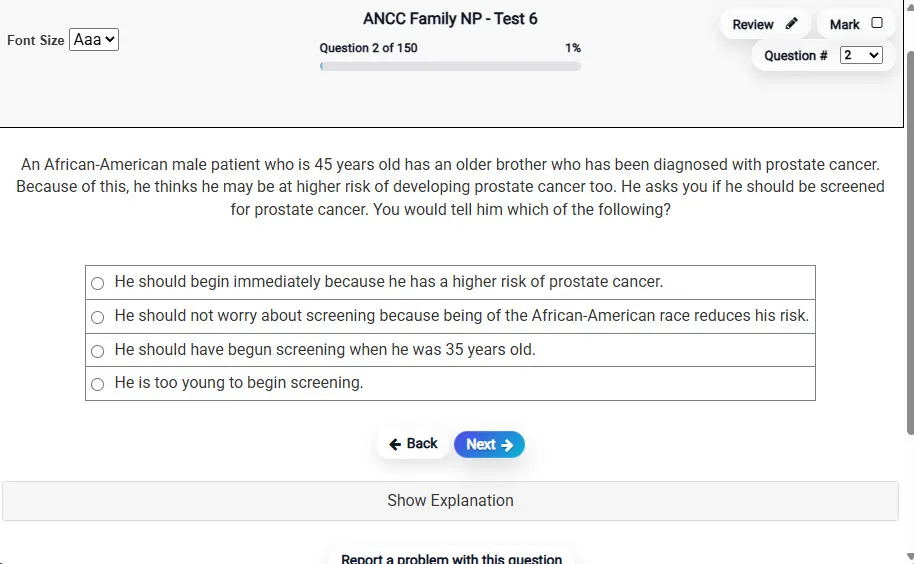
Answering a Question screen – Multiple-choice item view with navigation controls and progress tracker.
Answering a Question Multiple-choice item view with navigation controls and progress tracker.

                           Detailed Explanation screen – 
                         Review mode showing chosen answer and rationale and references.
Detailed Explanation Review mode showing chosen answer and rationale and references.

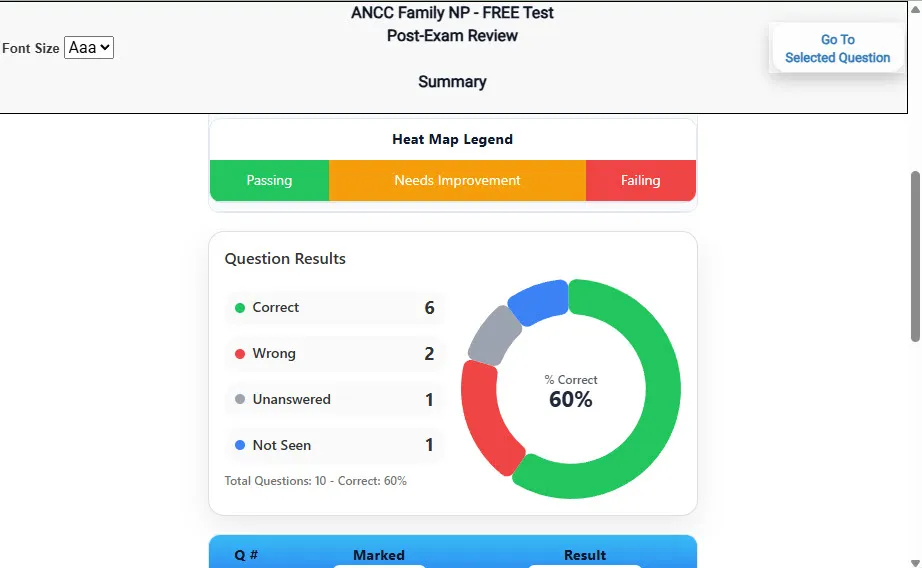
                           Review Summary 1 screen – 
                         Summary with counts for correct/wrong/unanswered and not seen items.
Review Summary 1 Summary with counts for correct/wrong/unanswered and not seen items.

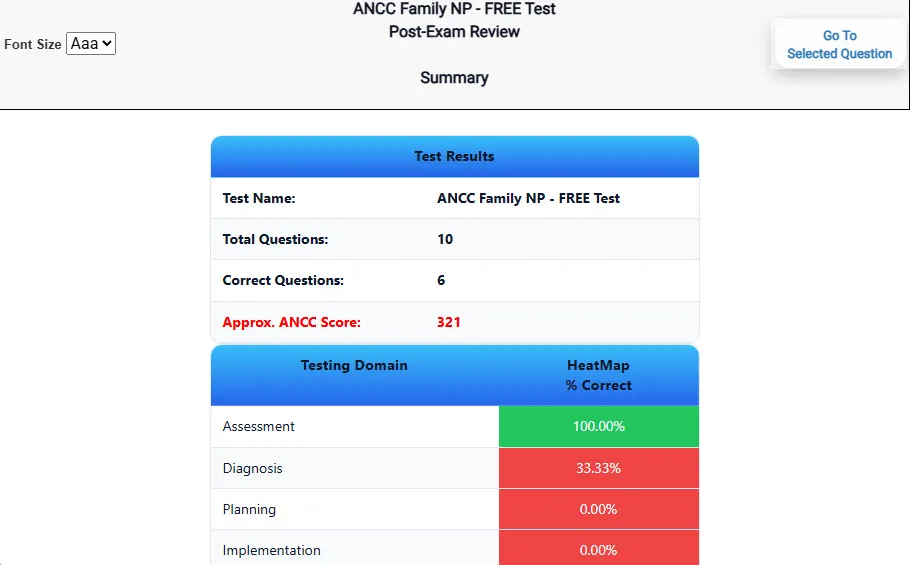
                           Review Summary 2 screen – 
                         Advanced summary with category/domain breakdown and performance insights.
Review Summary 2 Advanced summary with category/domain breakdown and performance insights.

What Each Screen Shows

Answer Question Screen

  • Clean multiple-choice interface with progress bar.
  • Mark for review feature.
  • Matches real test pacing.

Detailed Explanation

  • Correct answer plus rationale.
  • Key concepts and guidelines highlighted.
  • Move between questions to fill knowledge gaps.

Review Summary 1

  • Overall results with total questions and scaled score.
  • Domain heatmap shows strengths and weaknesses.
  • Quick visual feedback on study priorities.

Review Summary 2

  • Chart of correct, wrong, unanswered, not seen.
  • Color-coded results for easy review.
  • Links back to missed items.

Top 10 Reasons to Use Exam Edge for your California High School Proficiency Examination Combined Exam Prep

  1. Focused on the California High School Proficiency Examination Combined Exam

    Our practice tests are built specifically for the CHSPE Combined exam — every question mirrors the real topics, format, and difficulty so you're studying exactly what matters.

  2. Real Exam Simulation

    We match the per-question time limits and pressure of the actual CHSPE exam, so test day feels familiar and stress-free.

  3. 20 Full Practice Tests & 3,000 Unique Questions

    You'll have more than enough material to master every CHSPE Combined concept — no repeats, no fluff.

  4. Lower Cost Than a Retake

    Ordering 5 practice exams costs less than retaking the California High School Proficiency Examination Combined exam after a failure. One low fee could save you both time and money.

  5. Flexible Testing

    Need to step away mid-exam? Pick up right where you left off — with your remaining time intact.

  6. Instant Scoring & Feedback

    See your raw score and an estimated California High School Proficiency Examination Combined score immediately after finishing each practice test.

  7. Detailed Explanations for Every Question

    Review correct and incorrect answers with clear, step-by-step explanations so you truly understand each topic.

  8. Trusted & Accredited

    We're fully accredited by the Better Business Bureau and uphold the highest standards of trust and transparency.

  9. Web-Based & Always Available

    No software to install. Access your CHSPE Combined practice exams 24/7 from any computer or mobile device.

  10. Expert Support When You Need It

    Need extra help? Our specialized tutors are highly qualified and ready to support your CHSPE exam prep.


Pass the California High School Proficiency Examination Combined Exam with Realistic Practice Tests from Exam Edge

Preparing for your upcoming California High School Proficiency Examination Combined ( Combined ) Certification Exam can feel overwhelming — but the right practice makes all the difference. Exam Edge gives you the tools, structure, and confidence to pass on your first try. Our online practice exams are built to match the real CHSPE Combined exam in content, format, and difficulty.

  • 📝 20 California High School Proficiency Examination Combined Practice Tests: Access 20 full-length exams with 150 questions each, covering every major California High School Proficiency Examination Combined topic in depth.
  • Instant Online Access: Start practicing right away — no software, no waiting.
  • 🧠 Step-by-Step Explanations: Understand the reasoning behind every correct answer so you can master CHSPE Combined exam concepts.
  • 🔄 Retake Each Exam Up to 4 Times: Build knowledge through repetition and track your improvement over time.
  • 🌐 Web-Based & Available 24/7: Study anywhere, anytime, on any device.
  • 🧘 Boost Your Test-Day Confidence: Familiarity with the CHSPE format reduces anxiety and helps you perform under pressure.

These California High School Proficiency Examination Combined practice exams are designed to simulate the real testing experience by matching question types, timing, and difficulty level. This approach helps you get comfortable not just with the exam content, but also with the testing environment, so you walk into your exam day focused and confident.

Exam Edge CHSPE Reviews


California High School Proficiency Examination Combined Aliases Test Name

Here is a list of alternative names used for this exam.

  • California High School Proficiency Examination Combined
  • California High School Proficiency Examination Combined test
  • California High School Proficiency Examination Combined Certification Test
  • CHSPE Combined test
  • CHSPE
  • CHSPE Combined
  • Combined test
  • California High School Proficiency Examination Combined ( Combined )
  • California High School Proficiency Examination Combined certification