This is the content of the pop-over!

CCI RCES (RCES) Practice Tests & Test Prep by Exam Edge


CCI Registered Cardiac Electrophysiology Specialist  product image
(4.6)
Based on 37 Reviews

  • Real Exam Simulation: Timed questions and matching content build comfort for your CCI RCES test day.
  • Instant, 24/7 Access: Web-based CCI Registered Cardiac Electrophysiology Specialist practice exams with no software needed.
  • Clear Explanations: Step-by-step answers and explanations for your CCI exam to strengthen understanding.
  • Boosted Confidence: Reduces anxiety and improves test-taking skills to ace your CCI Registered Cardiac Electrophysiology Specialist (RCES).

Featured on

CCI Registered Cardiac Electrophysiology Specialist Online Practice Test Bundles

BEST VALUE
10 practice tests

$99.50

$399.50

SAVE $300

Only $9.95 per test!

  • 100% Pass Guarantee
  • 10 online practice tests
  • 100 questions per test
  • Bonus: 100 Flash Cards + Study Guide
  • Instant access
  • Detailed Explanations
  • Practice tests never expire
  • Timed, untimed, or study guide mode
5 practice tests

$69.75

$199.75

SAVE $130

Only $13.95 per test!

  • 5 online practice tests
  • 100 questions per test
  • Bonus: 100 Flash Cards + Study Guide
  • Instant access
  • Detailed Explanations
  • Practice tests never expire
  • Timed, untimed, or study guide mode
1 practice test

$39.95

  • 1 online practice test
  • 100 questions per test
  • Instant access
  • Detailed Explanations
  • Practice tests never expire
  • Timed, untimed, or study guide mode
Quick Select
Tap to choose a bundle

** All Prices are in US Dollars (USD) **


CCI RCES (RCES) Resources

Jump to the section you need most.

Understanding the exact breakdown of the CCI Registered Cardiac Electrophysiology Specialist test will help you know what to expect and how to most effectively prepare. The CCI Registered Cardiac Electrophysiology Specialist has 130 multiple-choice questions . The exam will be broken down into the sections below:

CCI Registered Cardiac Electrophysiology Specialist Exam Blueprint
Domain Name % Number of
Questions
Conducting Pre-Procedural Activities 11% 14
Conducting Intra-procedural Activities 22% 28
Conducting Post-Procedural Activities 3% 4
Performing Diagnostic Studies 28% 36
Performing Therapeutic Procedures 33% 42
Communicating With Patients and the Health Care Team 4% 5

CCI Registered Cardiac Electrophysiology Specialist Study Tips by Domain

  • Verify correct patient/procedure/site and consent before any sedation or vascular access; red flag: proceeding with an incomplete consent or mismatched identifiers/time-out elements.
  • Assess anticoagulation/antiplatelet status (e.g., warfarin INR, DOAC timing, heparin bridging plan) and communicate the lab’s target ACT strategy; common trap: failing to document the last DOAC dose and arriving without a hold plan.
  • Review pre-procedure imaging and device history (echo/CT/MRI, prior ablation maps, CIED make/model/last interrogation) to anticipate anatomy and equipment needs; red flag: not identifying an ICD/CRT before electrosurgery planning.
  • Confirm baseline rhythm, conduction status, and key labs (K+, Mg2+, Hgb/platelets, renal function) and correct abnormalities pre-case; priority rule: replete low potassium/magnesium to reduce peri-procedural ventricular ectopy.
  • Perform sedation/anesthesia readiness checks (NPO status, airway risk, allergies, OSA history) and ensure resuscitation equipment/meds are immediately available; contraindication cue: deep sedation without a documented airway plan or backup.
  • Prepare room and sterile field with planned catheters, sheaths, mapping system setup, radiation protection, and emergency backups (pericardiocentesis kit/defib pads); common trap: starting without verifying patch placement and system impedance for 3D mapping.
  • Maintain strict sterile technique and verify time-out elements (patient ID, procedure, laterality, allergies) before first puncture—red flag: a break in sterility or missing prophylactic antibiotic timing should prompt an immediate pause.
  • Continuously monitor hemodynamics and rhythm (ECG, arterial/venous pressure, SpO2) and communicate trends promptly—common trap: attributing hypotension solely to sedation and missing tamponade or vagal response.
  • Set up and validate EP recording/mapping system integrity (calibration, filter settings, catheter connections, signal labeling) before critical measurements—priority rule: confirm true intracardiac signals vs noise/artifact prior to acting on intervals.
  • Manage anticoagulation per lab protocol (e.g., heparin dosing and ACT checks at defined intervals) during left-sided work—threshold cue: if ACT is below target, treat as a thromboembolic risk and correct before continuing ablation/mapping.
  • Support safe catheter manipulation and energy delivery (RF/cryo) with lesion monitoring (temperature, impedance, power, contact/position) and stop criteria—red flag: sudden impedance rise/steam pop risk requires immediate cessation and reassessment.
  • Recognize and initiate first-response actions for acute complications (tamponade, stroke symptoms, airway compromise, coronary/AV block) while escalating per chain of command—contraindication cue: new high-grade AV block during septal ablation should prompt immediate stop and readiness for pacing.
  • Perform immediate post-procedure assessment with priority to ABCs and hemodynamics; red flag: hypotension with rising heart rate after sheath removal suggests bleeding until proven otherwise.
  • Monitor access sites (femoral/venous, arterial, or alternative) for hematoma, oozing, bruit, or distal ischemia; common trap: removing pressure too early after anticoagulation reversal/closure-device deployment.
  • Obtain and review post-procedure ECG/telemetry for new AV block, bundle-branch block, or ventricular ectopy; priority rule: escalating conduction delay after ablation or device work warrants immediate provider notification.
  • Manage anticoagulation/antiplatelet plans and reversal per orders and institutional protocols; red flag: restarting DOAC/warfarin without confirming hemostasis and renal function increases rebleed risk.
  • Recognize and respond to complications such as pericardial effusion/tamponade, stroke/TIA, or pneumothorax; threshold cue: new chest pain, dyspnea, or muffled heart sounds requires urgent echo and rapid escalation.
  • Provide discharge/transfer education and handoff using procedure-specific details (lesion set, device settings, complications, meds); common trap: omitting activity restrictions and when to seek care (e.g., enlarging groin swelling, syncope, fever, neurologic symptoms).
  • Verify indication and patient prep for EP diagnostics (e.g., NPO status, anticoagulation plan, allergies, pregnancy status) before starting—red flag: proceeding without a documented anticoagulation strategy when transseptal access may be needed.
  • Set up and validate recording system fidelity (filter settings, gain, sweep speed, channel labels, timing markers)—common trap: over-filtering that obscures low-amplitude His/PV potentials and leads to misinterpretation.
  • Perform baseline intracardiac measurements (AH, HV, PR/QRS/QT, sinus node function) and document at stable rhythm—priority rule: repeat measurements after sedation or autonomic changes if intervals shift.
  • Use programmed stimulation (atrial/ventricular pacing, extrastimuli, burst pacing) to assess inducibility and mechanism—red flag: diagnosing AVNRT/AVRT without confirming reproducible initiation/termination criteria and VA linking behavior.
  • Localize arrhythmia substrate with mapping (activation, entrainment, pace mapping, electrogram characteristics) and correlate with surface ECG—common trap: trusting a single map point in the presence of catheter instability or far-field signals.
  • Apply pharmacologic/physiologic maneuvers (isoproterenol, adenosine, vagal maneuvers) to unmask latent pathways or clarify mechanism—contraindication cue: avoid adenosine in severe reactive airway disease and be prepared for prolonged AV block with pacing backup.
  • For catheter ablation, confirm ACT targets before and during left-sided work (commonly ≥300 seconds for AF) — red flag: proceeding with transseptal/LA ablation without documented therapeutic anticoagulation.
  • During device implantation (PPM/ICD/CRT), maintain strict sterile technique and timely antibiotic prophylaxis — common trap: missing pre-incision antibiotic timing, which increases CIED infection risk.
  • For cardioversion/defibrillation support, verify synchronized mode for tachyarrhythmias with a pulse — red flag: delivering unsynchronized shock on an organized rhythm, risking R-on-T VF.
  • When managing temporary pacing or overdrive pacing, set a safe output margin (capture threshold + safety factor) and monitor for loss of capture — priority rule: treat intermittent capture as an urgent stability issue, not a nuisance alarm.
  • For complex ablation near AV node/His (e.g., AVNRT, para-Hisian foci), pre-brief backup pacing and stop-energy criteria — contraindication cue: continued energy delivery despite PR prolongation or junctional rhythm suggesting impending AV block.
  • During VT ablation or ICD testing considerations, ensure immediate availability of external defibrillation and hemodynamic support — common trap: inadequate rescue plan for unstable induced VT/VF (pads not on, sedation/airway not ready).
  • Use closed-loop communication for all critical orders (drug, energy, pacing settings)—repeat back and document; red flag: ambiguous phrases like “give the usual” during unstable rhythms.
  • Perform a pre-procedure time-out with the full team confirming patient identity, procedure/site/side, anticoagulation status, and allergies; common trap: forgetting to state last DOAC/warfarin dose and INR/ACT targets.
  • Explain anticipated sensations and safety steps to the patient (e.g., sedation expectations, possible cardioversion/defib shocks, need to remain still); red flag: proceeding when the patient cannot restate key risks/plan due to inadequate consent or comprehension.
  • Escalate changes in hemodynamics or neurologic status immediately using a structured format (SBAR)—include rhythm, BP, oxygenation, and recent meds; priority rule: new hypotension after sheath placement is a “stop and call” event.
  • Coordinate with anesthesia/nursing on sedation depth, airway concerns, and pain control before ablation or cardioversion; contraindication cue: deepening sedation without confirming NPO status or OSA/airway risk increases adverse events.
  • Provide clear handoff to recovery/ICU including sheaths removed/remaining, access-site status, anticoagulation plan, device settings/temporary pacing needs, and post-op restrictions; common trap: omitting vascular closure method and required bedrest time.


Built to Fit Into Your Busy Life

Everything you need to prepare with confidence—without wasting a minute.

Three Study Modes

Timed, No Time Limit, or Explanation mode.

Actionable Analytics

Heatmaps and scaled scores highlight weak areas.

High-Yield Rationales

Concise explanations emphasize key concepts.

Realistic Interface

Matches the feel of the actual exam environment.

Accessible by Design

Clean layout reduces cognitive load.

Anytime, Anywhere

Web-based access 24/7 on any device.
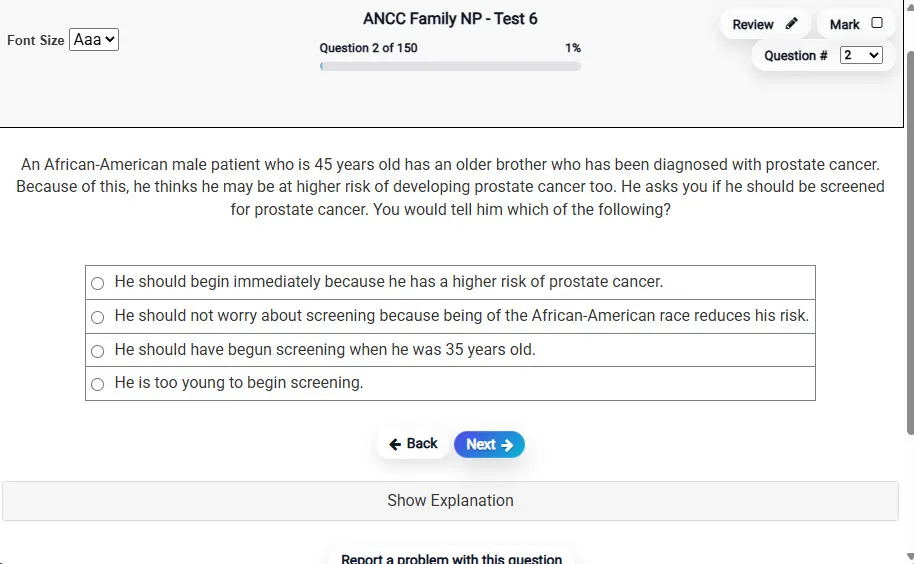
Answering a Question screen – Multiple-choice item view with navigation controls and progress tracker.
Answering a Question Multiple-choice item view with navigation controls and progress tracker.

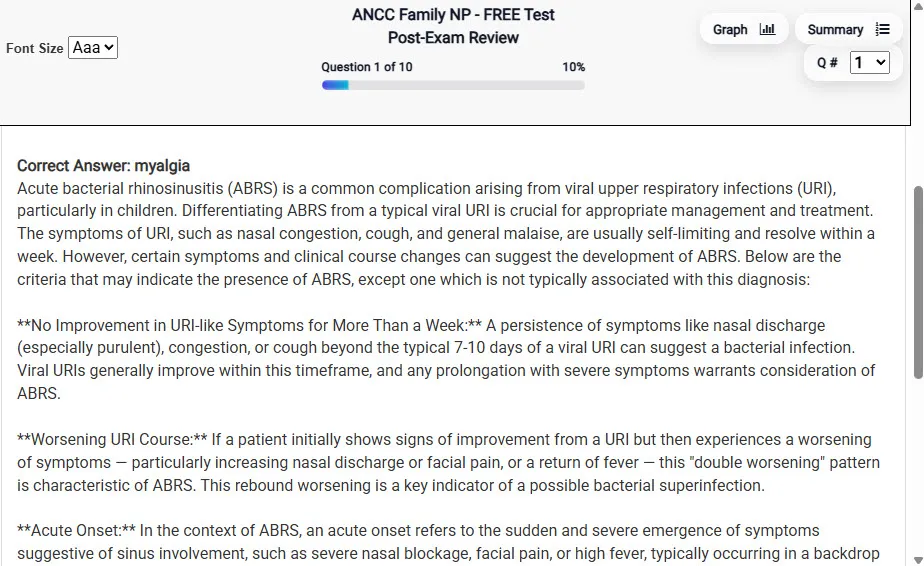
                           Detailed Explanation screen – 
                         Review mode showing chosen answer and rationale and references.
Detailed Explanation Review mode showing chosen answer and rationale and references.

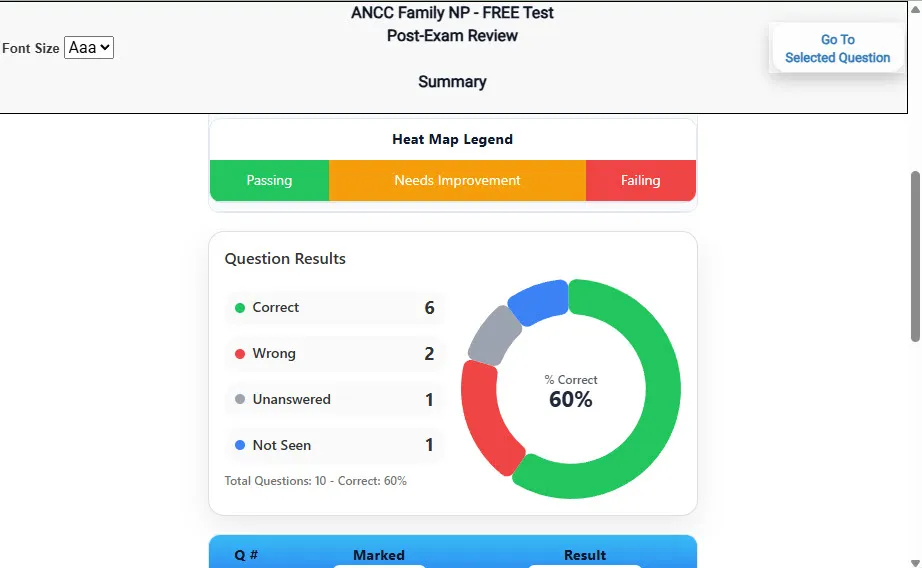
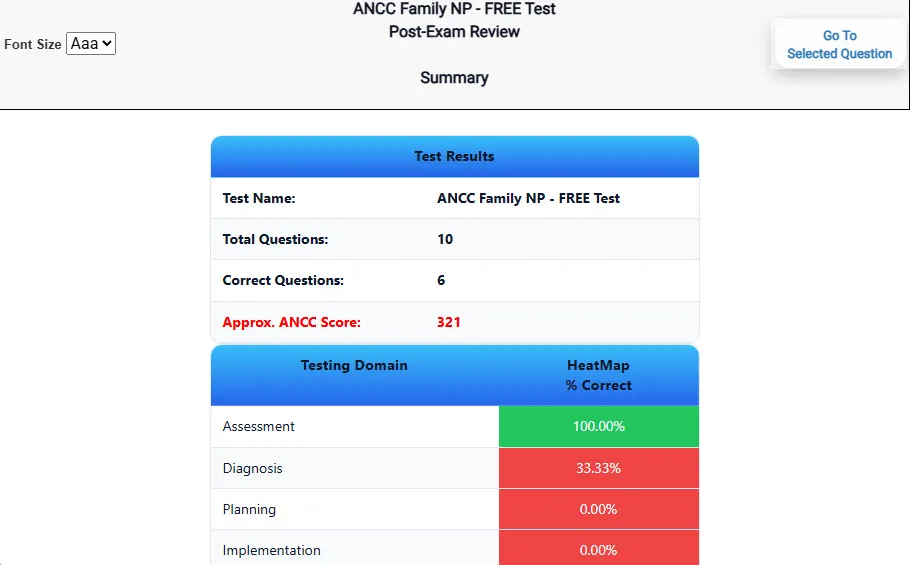
                           Review Summary 1 screen – 
                         Summary with counts for correct/wrong/unanswered and not seen items.
Review Summary 1 Summary with counts for correct/wrong/unanswered and not seen items.

                           Review Summary 2 screen – 
                         Advanced summary with category/domain breakdown and performance insights.
Review Summary 2 Advanced summary with category/domain breakdown and performance insights.

What Each Screen Shows

Answer Question Screen

  • Clean multiple-choice interface with progress bar.
  • Mark for review feature.
  • Matches real test pacing.

Detailed Explanation

  • Correct answer plus rationale.
  • Key concepts and guidelines highlighted.
  • Move between questions to fill knowledge gaps.

Review Summary 1

  • Overall results with total questions and scaled score.
  • Domain heatmap shows strengths and weaknesses.
  • Quick visual feedback on study priorities.

Review Summary 2

  • Chart of correct, wrong, unanswered, not seen.
  • Color-coded results for easy review.
  • Links back to missed items.

Top 10 Reasons to Use Exam Edge for your CCI Registered Cardiac Electrophysiology Specialist Exam Prep

  1. Focused on the CCI Registered Cardiac Electrophysiology Specialist Exam

    Our practice tests are built specifically for the CCI RCES exam — every question mirrors the real topics, format, and difficulty so you're studying exactly what matters.

  2. Real Exam Simulation

    We match the per-question time limits and pressure of the actual CCI exam, so test day feels familiar and stress-free.

  3. 10 Full Practice Tests & 1,000 Unique Questions

    You'll have more than enough material to master every CCI RCES concept — no repeats, no fluff.

  4. Lower Cost Than a Retake

    Ordering 5 practice exams costs less than retaking the CCI Registered Cardiac Electrophysiology Specialist exam after a failure. One low fee could save you both time and money.

  5. Flexible Testing

    Need to step away mid-exam? Pick up right where you left off — with your remaining time intact.

  6. Instant Scoring & Feedback

    See your raw score and an estimated CCI Registered Cardiac Electrophysiology Specialist score immediately after finishing each practice test.

  7. Detailed Explanations for Every Question

    Review correct and incorrect answers with clear, step-by-step explanations so you truly understand each topic.

  8. Trusted & Accredited

    We're fully accredited by the Better Business Bureau and uphold the highest standards of trust and transparency.

  9. Web-Based & Always Available

    No software to install. Access your CCI RCES practice exams 24/7 from any computer or mobile device.

  10. Expert Support When You Need It

    Need extra help? Our specialized tutors are highly qualified and ready to support your CCI exam prep.


Pass the CCI Registered Cardiac Electrophysiology Specialist Exam with Realistic Practice Tests from Exam Edge

Preparing for your upcoming CCI Registered Cardiac Electrophysiology Specialist (RCES) Certification Exam can feel overwhelming — but the right practice makes all the difference. Exam Edge gives you the tools, structure, and confidence to pass on your first try. Our online practice exams are built to match the real CCI RCES exam in content, format, and difficulty.

  • 📝 10 CCI Registered Cardiac Electrophysiology Specialist Practice Tests: Access 10 full-length exams with 100 questions each, covering every major CCI Registered Cardiac Electrophysiology Specialist topic in depth.
  • Instant Online Access: Start practicing right away — no software, no waiting.
  • 🧠 Step-by-Step Explanations: Understand the reasoning behind every correct answer so you can master CCI RCES exam concepts.
  • 🔄 Retake Each Exam Up to 4 Times: Build knowledge through repetition and track your improvement over time.
  • 🌐 Web-Based & Available 24/7: Study anywhere, anytime, on any device.
  • 🧘 Boost Your Test-Day Confidence: Familiarity with the CCI format reduces anxiety and helps you perform under pressure.

These CCI Registered Cardiac Electrophysiology Specialist practice exams are designed to simulate the real testing experience by matching question types, timing, and difficulty level. This approach helps you get comfortable not just with the exam content, but also with the testing environment, so you walk into your exam day focused and confident.


Exam Edge CCI (cardio) Reviews


Thank you for your services. I purchase the test prep for CCI Certified Cardiographic Technician and it was a big help. I passed my board exam the first time with a score of a 739. Thanks again, I will be using your services for my CCI CRAT boards here soon.

David, TN

Love all the different tests with rationale to test questions.

carlyle , alpharetta, Georgia

This is the go-to for RCS, CCI board review practice test. I failed two times and passed on my third attempt with the help of Exam Edge. I was not paid for this review, I just want to help others make the right decision in board preparation. Exam Edge has a great series of questions related to the R ...
Read More
Jason P,

Exam Edge is a great resource for people trying to study for their board exams. This is the second time I have used Exam Edge's services, and it gave me the confidence for when the time came for me to sit for the exams. I passed my CCI Cardiographic Technician and Rhythm Analysis Technician exams.

Amanda K, Ohio

"Thank you so much, Exam Edge!!! I just left Pearson Vue, Miami........ with 759! I couldn't have done it without your practice tests!"

AJR, Miami FL

I feel the practice exams prepared me very well for the real thing. I have test anxiety, so I purchased a set of 10 tests. I finished 6 of 10 tests and still passed with a nice score. I like the way your test are designed and how they make you actually learn physics and not just memorize the answers ...
Read More
Sherry B, Allen County, Indiana


CCI Registered Cardiac Electrophysiology Specialist Aliases Test Name

Here is a list of alternative names used for this exam.

  • CCI Registered Cardiac Electrophysiology Specialist
  • CCI Registered Cardiac Electrophysiology Specialist test
  • CCI Registered Cardiac Electrophysiology Specialist Certification Test
  • CCI RCES test
  • CCI (cardio)
  • CCI (cardio) RCES
  • RCES test
  • CCI Registered Cardiac Electrophysiology Specialist (RCES)
  • CCI Registered Cardiac Electrophysiology Specialist certification