This is the content of the pop-over!

Lightning Deal Alert – 12% Off Ends at Midnight!

Strike while the savings are hot! Use promo code FlashSale at checkout for 12% off any Exam Edge test or bundle. Hurry—the clock is ticking!

CCI CRNFA (CRNFA ) Practice Tests & Test Prep by Exam Edge


CCI Certified Registered Nurse First Assistant  product image
(4.4)
Based on 20 Reviews

  • Real Exam Simulation: Timed questions and matching content build comfort for your CCI CRNFA test day.
  • Instant, 24/7 Access: Web-based CCI Certified Registered Nurse First Assistant practice exams with no software needed.
  • Clear Explanations: Step-by-step answers and explanations for your CCI exam to strengthen understanding.
  • Boosted Confidence: Reduces anxiety and improves test-taking skills to ace your CCI Certified Registered Nurse First Assistant (CRNFA ).

Featured on

CCI Certified Registered Nurse First Assistant Online Practice Test Bundles

BEST VALUE
10 practice tests

$99.50

$399.50

SAVE $300

Only $9.95 per test!

  • 100% Pass Guarantee
  • 10 online practice tests
  • 100 questions per test
  • Bonus: 100 Flash Cards + Study Guide
  • Instant access
  • Detailed Explanations
  • Practice tests never expire
  • Timed, untimed, or study guide mode
5 practice tests

$69.75

$199.75

SAVE $130

Only $13.95 per test!

  • 5 online practice tests
  • 100 questions per test
  • Bonus: 100 Flash Cards + Study Guide
  • Instant access
  • Detailed Explanations
  • Practice tests never expire
  • Timed, untimed, or study guide mode
1 practice test

$39.95

  • 1 online practice test
  • 100 questions per test
  • Instant access
  • Detailed Explanations
  • Practice tests never expire
  • Timed, untimed, or study guide mode
Quick Select
Tap to choose a bundle

** All Prices are in US Dollars (USD) **


CCI CRNFA (CRNFA ) Resources

Jump to the section you need most.

Understanding the exact breakdown of the CCI Certified Registered Nurse First Assistant test will help you know what to expect and how to most effectively prepare. The CCI Certified Registered Nurse First Assistant has multiple-choice questions . The exam will be broken down into the sections below:

CCI Certified Registered Nurse First Assistant Exam Blueprint
Domain Name % Number of
Questions
Basic Sciences 13% 13
Assessment Techniques 17% 17
Intraoperative Techniques 50% 50
General Knowledge/Skills 10% 10
Professional Practice 10% 10

CCI Certified Registered Nurse First Assistant Study Tips by Domain

  • Apply surgical anatomy precisely (fascia planes, neurovascular bundles, organ pedicles); red flag: proceeding when landmarks are distorted by obesity, prior surgery, or tumor—pause and re-identify before cutting.
  • Use wound-healing physiology to guide technique (hemostasis → inflammation → proliferation → remodeling); common trap: assuming skin appearance equals tensile strength—fascia is weakest at ~5–7 days and needs secure closure.
  • Interpret acid–base and oxygenation basics (PaCO2 drives respiratory pH, lactate suggests hypoperfusion); priority rule: unexplained tachycardia/hypotension plus rising ETCO2 or falling SpO2 warrants immediate check for bleeding, embolus, or ventilation issue.
  • Integrate microbiology/sterility principles (skin flora, biofilm, inoculum size); red flag: a break in sterile technique is not “minor”—replace contaminated item/drape immediately to reduce SSI risk.
  • Understand electrosurgery physics (current density, dispersive pad contact, capacitive coupling); common trap: placing the return electrode over scar/bony prominence or on poorly perfused tissue—increases burn risk.
  • Use fluid/thermal physiology (third spacing, hypothermia effects on coagulopathy and infection); priority rule: core temp <36°C should trigger active warming and warmed fluids unless contraindicated.
  • Perform a head-to-toe preoperative assessment with focused review of allergies, anticoagulants/antiplatelets, implants, and last oral intake; red flag: undocumented latex or antibiotic allergy can drive intraoperative anaphylaxis risk.
  • Trend baseline vital signs and cardiopulmonary status (including airway exam and O2 needs) to anticipate positioning and anesthetic considerations; common trap: ignoring baseline hypotension or OSA history leads to missed postoperative respiratory compromise planning.
  • Verify skin integrity at planned pressure points and surgical site condition (rashes, infection, edema) before prepping; priority rule: any active infection or open lesion near the incision is a stop-and-escalate finding.
  • Assess neurovascular status of the operative extremity (pulses, cap refill, motor/sensory) and document preop baseline; red flag: new numbness/weakness preop must be communicated before tourniquet or regional block.
  • Review pertinent labs/diagnostics (H&H, platelets, INR/aPTT, electrolytes, glucose, ECG as indicated) and reconcile with procedural bleeding risk; threshold cue: unexpected elevated INR or thrombocytopenia requires provider notification before incision.
  • Complete intraoperative reassessments tied to position, tourniquet time, fluid/blood loss, temperature, and urine output when applicable; common trap: failing to reassess after re-positioning increases risk of pressure injury and peripheral nerve compression.
  • Maintain sterile field continuously—red flag: any break in sterility (torn glove, contaminated instrument, nonsterile reach) requires immediate correction and documentation per facility policy.
  • Positioning and padding are intraoperative priorities—common trap: focusing only on the surgical site and missing pressure points, nerve stretch (ulnar, peroneal), or ocular protection in prone cases.
  • Support hemostasis proactively using suction, sponges, and energy devices as directed—red flag: unexplained tachycardia/hypotension, increasing suction canister volume, or saturating sponges suggests occult bleeding and demands prompt escalation.
  • Provide effective retraction and exposure while protecting tissue—common trap: excessive force or prolonged static retraction leading to nerve/skin injury, ischemia, or tissue desiccation (use intermittent release and keep tissues moist).
  • Perform instrument and sponge counts with the team and respond to discrepancies—priority rule: a count discrepancy is resolved before closure/ending the case, and imaging is obtained per policy if the item is not found.
  • Assist with wound closure (layer identification, suture handling, dressing application) and specimen management—red flag: mislabeled specimens or missing laterality/number of samples requires an immediate stop to verify before leaving the OR.
  • Maintain strict sterile technique and speak up immediately for any break (e.g., wet/strikethrough contamination, reaching over sterile field)—common trap is assuming it’s “probably OK” when a correction can still be made.
  • Positioning and padding are patient-safety priorities: verify pressure-point protection, neutral alignment, and secure lines/tubes before draping—red flag is prolonged pressure at ulnar nerve, peroneal nerve, or eyes in prone cases.
  • Perform and document counts per policy (sponges/sharps/instruments) and escalate any discrepancy without delay—priority rule: closure should not proceed with an unresolved count.
  • Use electrosurgery safely: confirm correct settings, proper return electrode placement on well-perfused muscle, and remove pooling prep solutions—contraindication/red flag is activation near oxygen-rich fields or metal implants without precautions.
  • Anticipate hemostasis needs and communicate promptly: recognize concerning blood loss trends, maintain clear suction/field exposure, and request additional hemostatic agents early—common trap is waiting until hypotension/tachycardia is evident.
  • Manage specimens with accuracy: label at the field, verify patient/site/source, and communicate special handling (fresh, frozen, cultures) immediately—red flag is any unlabeled or “later” labeled specimen, which risks misidentification.
  • Follow CCI-aligned professional boundaries: the RNFA functions under surgeon direction and facility privileges—red flag if asked to independently diagnose, prescribe, or alter the operative plan without authorization.
  • Prioritize documentation that proves continuity of care (pre-op verification, intra-op actions, counts, specimens, dressings, handoff)—common trap is charting late or omitting rationale for key interventions (e.g., tourniquet times, drains, wound classification).
  • Use time-out and site-marking standards every time (patient, procedure, site/side, implants, imaging, antibiotics)—threshold: any discrepancy requires a hard stop and resolution before incision.
  • Maintain sterile technique and speak up using escalation pathways—red flag is “minor” breaks (reaching over sterile field, wet strike-through, glove tear) not corrected and documented per policy.
  • Protect patient rights and confidentiality (HIPAA/PHI) throughout perioperative care—common trap is discussing cases in public areas or including identifiable details in teaching/photos without documented consent.
  • Practice within evidence-based safety frameworks (AORN/WHO, facility policies, reporting culture)—priority rule: report near-misses and adverse events promptly; don’t “fix and forget” without notifying the team and completing required reports.


Built to Fit Into Your Busy Life

Everything you need to prepare with confidence—without wasting a minute.

Three Study Modes

Timed, No Time Limit, or Explanation mode.

Actionable Analytics

Heatmaps and scaled scores highlight weak areas.

High-Yield Rationales

Concise explanations emphasize key concepts.

Realistic Interface

Matches the feel of the actual exam environment.

Accessible by Design

Clean layout reduces cognitive load.

Anytime, Anywhere

Web-based access 24/7 on any device.
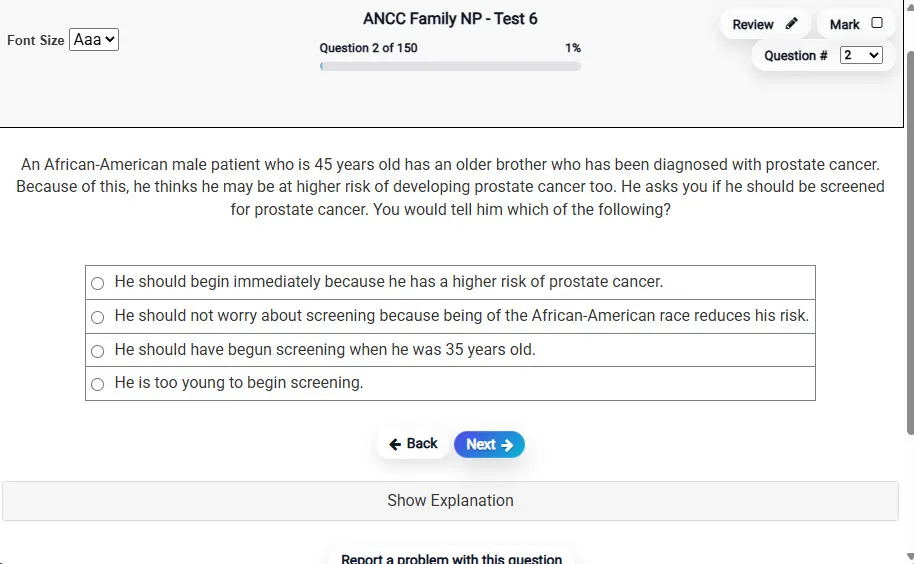
Answering a Question screen – Multiple-choice item view with navigation controls and progress tracker.
Answering a Question Multiple-choice item view with navigation controls and progress tracker.

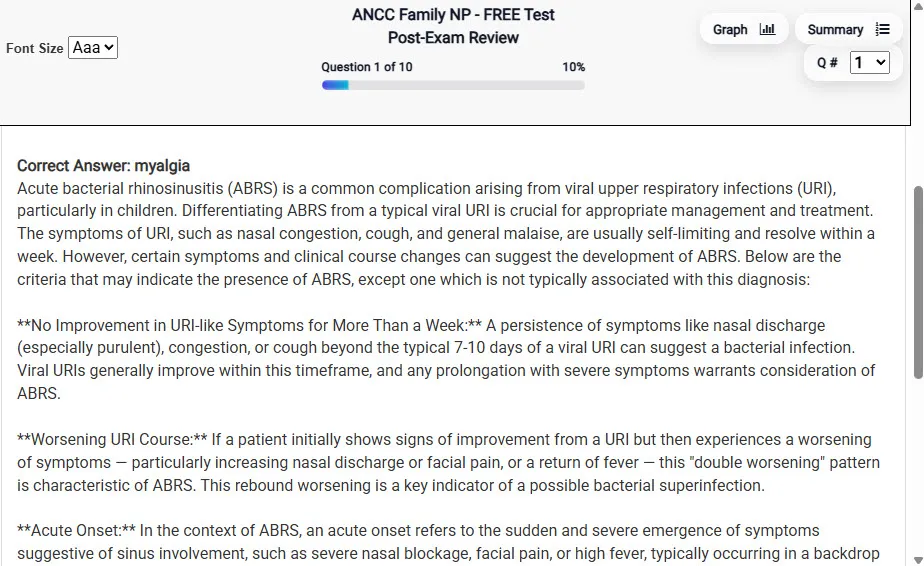
                           Detailed Explanation screen – 
                         Review mode showing chosen answer and rationale and references.
Detailed Explanation Review mode showing chosen answer and rationale and references.

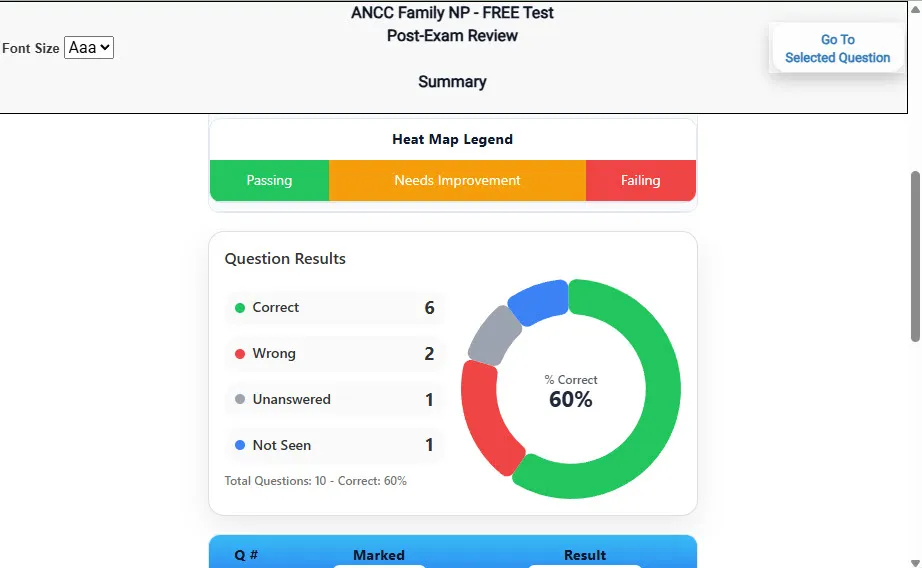
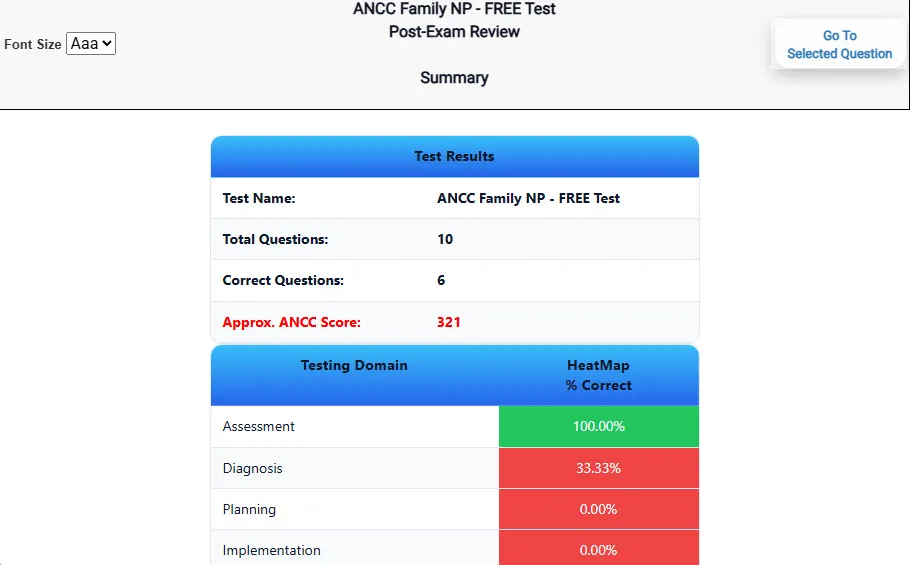
                           Review Summary 1 screen – 
                         Summary with counts for correct/wrong/unanswered and not seen items.
Review Summary 1 Summary with counts for correct/wrong/unanswered and not seen items.

                           Review Summary 2 screen – 
                         Advanced summary with category/domain breakdown and performance insights.
Review Summary 2 Advanced summary with category/domain breakdown and performance insights.

What Each Screen Shows

Answer Question Screen

  • Clean multiple-choice interface with progress bar.
  • Mark for review feature.
  • Matches real test pacing.

Detailed Explanation

  • Correct answer plus rationale.
  • Key concepts and guidelines highlighted.
  • Move between questions to fill knowledge gaps.

Review Summary 1

  • Overall results with total questions and scaled score.
  • Domain heatmap shows strengths and weaknesses.
  • Quick visual feedback on study priorities.

Review Summary 2

  • Chart of correct, wrong, unanswered, not seen.
  • Color-coded results for easy review.
  • Links back to missed items.

Top 10 Reasons to Use Exam Edge for your CCI Certified Registered Nurse First Assistant Exam Prep

  1. Focused on the CCI Certified Registered Nurse First Assistant Exam

    Our practice tests are built specifically for the CCI CRNFA exam — every question mirrors the real topics, format, and difficulty so you're studying exactly what matters.

  2. Real Exam Simulation

    We match the per-question time limits and pressure of the actual CCI exam, so test day feels familiar and stress-free.

  3. 10 Full Practice Tests & 1,000 Unique Questions

    You'll have more than enough material to master every CCI CRNFA concept — no repeats, no fluff.

  4. Lower Cost Than a Retake

    Ordering 5 practice exams costs less than retaking the CCI Certified Registered Nurse First Assistant exam after a failure. One low fee could save you both time and money.

  5. Flexible Testing

    Need to step away mid-exam? Pick up right where you left off — with your remaining time intact.

  6. Instant Scoring & Feedback

    See your raw score and an estimated CCI Certified Registered Nurse First Assistant score immediately after finishing each practice test.

  7. Detailed Explanations for Every Question

    Review correct and incorrect answers with clear, step-by-step explanations so you truly understand each topic.

  8. Trusted & Accredited

    We're fully accredited by the Better Business Bureau and uphold the highest standards of trust and transparency.

  9. Web-Based & Always Available

    No software to install. Access your CCI CRNFA practice exams 24/7 from any computer or mobile device.

  10. Expert Support When You Need It

    Need extra help? Our specialized tutors are highly qualified and ready to support your CCI exam prep.


Pass the CCI Certified Registered Nurse First Assistant Exam with Realistic Practice Tests from Exam Edge

Preparing for your upcoming CCI Certified Registered Nurse First Assistant (CRNFA ) Certification Exam can feel overwhelming — but the right practice makes all the difference. Exam Edge gives you the tools, structure, and confidence to pass on your first try. Our online practice exams are built to match the real CCI CRNFA exam in content, format, and difficulty.

  • 📝 10 CCI Certified Registered Nurse First Assistant Practice Tests: Access 10 full-length exams with 100 questions each, covering every major CCI Certified Registered Nurse First Assistant topic in depth.
  • Instant Online Access: Start practicing right away — no software, no waiting.
  • 🧠 Step-by-Step Explanations: Understand the reasoning behind every correct answer so you can master CCI CRNFA exam concepts.
  • 🔄 Retake Each Exam Up to 4 Times: Build knowledge through repetition and track your improvement over time.
  • 🌐 Web-Based & Available 24/7: Study anywhere, anytime, on any device.
  • 🧘 Boost Your Test-Day Confidence: Familiarity with the CCI format reduces anxiety and helps you perform under pressure.

These CCI Certified Registered Nurse First Assistant practice exams are designed to simulate the real testing experience by matching question types, timing, and difficulty level. This approach helps you get comfortable not just with the exam content, but also with the testing environment, so you walk into your exam day focused and confident.


Exam Edge CCI Reviews


I wanted to Thank You for an excellent product. I used your exam edge exclusively to study for my CNOR exam and passed with flying colors. I even purchased another set of exams to help my friend!

Julie, Illinois


CCI Certified Registered Nurse First Assistant Aliases Test Name

Here is a list of alternative names used for this exam.

  • CCI Certified Registered Nurse First Assistant
  • CCI Certified Registered Nurse First Assistant test
  • CCI Certified Registered Nurse First Assistant Certification Test
  • CCI CRNFA test
  • CCI
  • CCI CRNFA
  • CRNFA test
  • CCI Certified Registered Nurse First Assistant (CRNFA )
  • Certified Registered Nurse First Assistant certification