This is the content of the pop-over!

Lightning Deal Alert – 12% Off Ends at Midnight!

Strike while the savings are hot! Use promo code FlashSale at checkout for 12% off any Exam Edge test or bundle. Hurry—the clock is ticking!

CBASE Combined (CBASE) Practice Tests & Test Prep by Exam Edge


CBASE College Basic Academic Subjects Examination   product image
(5.0)
Based on 34 Reviews

  • Real Exam Simulation: Timed questions and matching content build comfort for your CBASE Combined test day.
  • Instant, 24/7 Access: Web-based CBASE College Basic Academic Subjects Examination practice exams with no software needed.
  • Clear Explanations: Step-by-step answers and explanations for your CBASE exam to strengthen understanding.
  • Boosted Confidence: Reduces anxiety and improves test-taking skills to ace your CBASE College Basic Academic Subjects Examination (CBASE).

Featured on

CBASE College Basic Academic Subjects Examination Online Practice Test Bundles

BEST VALUE
20 practice tests

$174.00

$799.00

SAVE $625

Only $8.70 per test!

  • 100% Pass Guarantee
  • 20 online practice tests
  • 180 questions per test
  • Bonus: 100 Flash Cards + Study Guide
  • Instant access
  • Detailed Explanations
  • Practice tests never expire
  • Timed, untimed, or study guide mode
MOST POPULAR
10 practice tests

$99.50

$399.50

SAVE $300

Only $9.95 per test!

  • 10 online practice tests
  • 180 questions per test
  • Bonus: 100 Flash Cards + Study Guide
  • Instant access
  • Detailed Explanations
  • Practice tests never expire
  • Timed, untimed, or study guide mode
5 practice tests

$69.75

$199.75

SAVE $130

Only $13.95 per test!

  • 5 online practice tests
  • 180 questions per test
  • Bonus: 100 Flash Cards
  • Instant access
  • Detailed Explanations
  • Practice tests never expire
  • Timed, untimed, or study guide mode
1 practice test

$39.95

  • 1 online practice test
  • 180 questions per test
  • Instant access
  • Detailed Explanations
  • Practice tests never expire
  • Timed, untimed, or study guide mode
Quick Select
Tap to choose a bundle

** All Prices are in US Dollars (USD) **


CBASE Combined (CBASE) Resources

Jump to the section you need most.

Understanding the exact breakdown of the CBASE College Basic Academic Subjects Examination test will help you know what to expect and how to most effectively prepare. The CBASE College Basic Academic Subjects Examination has multiple-choice questions . The exam will be broken down into the sections below:

CBASE College Basic Academic Subjects Examination Exam Blueprint
Domain Name
English  
     Reading and Literature  
     Writing  
Mathematics  
     General Mathematics Proficiency  
     Algebra  
     Geometry  
Science  
     Laboratory and Field Work  
     Fundamental Concepts  
Social Studies  
     History  
     Social Sciences  

CBASE College Basic Academic Subjects Examination Study Tips by Domain

  • Prioritize context-clue vocabulary and denotation vs. connotation; red flag: choosing an answer that “sounds formal” but contradicts nearby modifiers (e.g., however, although).
  • Identify an author’s purpose and tone using specific word choices; common trap: confusing tone (attitude) with mood (reader feeling) or theme (message).
  • Track main idea and supporting details across paragraphs; priority rule: the best main-idea choice must cover most of the passage without adding a new claim.
  • Use sentence-level grammar to resolve errors in agreement, pronoun reference, and modifiers; red flag: an underlined pronoun with more than one possible antecedent.
  • Apply punctuation and sentence-boundary rules (comma splice, run-on, fragments); threshold cue: if two complete sentences are joined with only a comma, it’s wrong unless there’s a coordinating conjunction.
  • Revise for clarity and organization in short passages; common trap: picking the “most detailed” revision when it actually breaks coherence or shifts tense/person inconsistently.
  • Actively identify the passage’s central claim/theme and purpose (inform, argue, narrate) before answering; red flag: choosing an option that is true in general but not supported by the text.
  • Use context clues for vocabulary-in-context (connotation, tone, nearby examples) rather than memorized definitions; common trap: picking the most familiar meaning instead of the meaning that fits the sentence.
  • For inference questions, require at least two textual clues that point to the conclusion; red flag: answers that introduce new information or go beyond what the author implies.
  • Track tone and point of view (1st/3rd person, limited/omniscient, narrator reliability) and how they shape meaning; common trap: confusing the author’s view with a character’s or narrator’s.
  • Analyze literary devices (imagery, symbolism, irony, figurative language) by tying them to effect on meaning or mood; red flag: answers that merely label a device without explaining its function in the passage.
  • When comparing two passages, focus on how evidence and structure differ (e.g., example vs. statistic, chronological vs. problem–solution); priority rule: the best choice addresses both texts, not just one.
  • Start with a clear thesis and match every body paragraph to it; red flag: paragraphs that summarize sources without stating a controlling point.
  • Use an intro-body-conclusion structure with topic sentences that preview the paragraph’s claim; common trap: opening with a vague hook but never defining the issue.
  • Maintain consistent verb tense and point of view (1st/3rd person) throughout; red flag: shifting from “one/they” to “you” mid-essay.
  • Prioritize sentence clarity over length by avoiding comma splices and run-ons; quick check: if two complete sentences are joined by only a comma, fix with a period, semicolon, or conjunction.
  • Support claims with specific evidence (examples, brief quotations, or data) and explain the “so what”; common trap: dropping a fact and moving on without connecting it to the claim.
  • Edit for mechanics that affect meaning—agreement, pronoun reference, and punctuation; red flag: unclear “it/this/they” pronouns that could refer to more than one noun.
  • Prioritize number sense and estimation (fractions, decimals, percents) to sanity-check answers—red flag: an estimate and a computed result that differ by a factor of 10 usually signals a place-value error.
  • Algebra fluency: isolate variables, handle exponents/radicals, and solve linear/quadratic equations—common trap: distributing a negative sign incorrectly (e.g., −(a−b) ≠ −a−b).
  • Functions and graphs: interpret slope/intercepts, rate of change, and function notation—priority rule: identify what the axes represent before computing slope to avoid swapping Δx and Δy.
  • Geometry basics: perimeter/area/volume, Pythagorean theorem, and angle relationships—common trap: mixing up radius vs. diameter in circle formulas (use C=2πr, A=πr2).
  • Data, probability, and statistics: mean/median/mode, simple probability, and reading tables/graphs—red flag: using the mean when an outlier-skewed distribution calls for the median.
  • Word problems and modeling: translate units, set up proportions, and define variables clearly—priority rule: track units every step (e.g., miles/hour vs. feet/second) because unit mismatch is a frequent CBASE-style error.
  • Set up unit conversions with dimensional analysis (unit fractions) so units cancel; red flag: if units don’t cancel cleanly, your setup is wrong.
  • Translate word problems into equations/inequalities by defining variables and labeling what is asked; common trap: answering an intermediate value instead of the final quantity requested.
  • Use estimation and reasonableness checks (order of magnitude, bounds) before choosing an option; priority rule: eliminate answers that violate obvious constraints (e.g., negative length, probability > 1).
  • Work comfortably with ratios, rates, and percent change (new = old(1 ± r)); common trap: confusing percent of a number with percent increase/decrease from the original.
  • Interpret tables, charts, and graphs by reading scales and units first; red flag: nonzero or uneven axes can make trends look larger/smaller than they are.
  • Apply basic number and arithmetic rules (fractions, signed numbers, exponents) with correct order of operations; common trap: distributing powers incorrectly (e.g., (a+b)2 ≠ a2+b2).
  • Rearrange linear equations/inequalities carefully and remember to reverse the inequality when multiplying or dividing by a negative number — this is a common scoring trap.
  • When solving systems, pick substitution for a variable already isolated and elimination when coefficients align; red flag: forgetting to distribute a negative across parentheses.
  • For quadratics, first check if it factors over integers before using the quadratic formula; priority rule: always set the equation to 0 to interpret roots correctly.
  • Use exponent and radical rules precisely (e.g., aman=am+n, (am)n=amn); red flag: simplifying x1/2+x1/2 incorrectly as x.
  • In rational expressions, state domain restrictions from the original denominators before canceling factors; common trap: canceling across addition (e.g., (x+1)/(x+2) cannot be reduced).
  • For functions, distinguish evaluation from solving (f(3) vs. f(x)=3) and track transformations (shifts, stretches, reflections); red flag: assuming every inverse exists without checking one-to-one behavior.
  • Memorize core formulas and use units consistently: triangle area (½bh), circle measures (C = 2πr, A = πr²)—red flag: mixing radius and diameter is a frequent trap.
  • For parallel lines cut by a transversal, match angle pairs (corresponding, alternate interior, same-side interior)—priority rule: use a diagram marking equal angles before writing equations.
  • In triangles, apply the Pythagorean Theorem only to right triangles and use special right-triangle ratios (45-45-90, 30-60-90)—common trap: assuming a triangle is right without a right-angle mark or given condition.
  • Use triangle congruence correctly (SSS, SAS, ASA, AAS, HL)—red flag: SSA is not a valid congruence test unless it reduces to HL in right triangles.
  • With similarity, set up proportional side ratios in the same order and square the scale factor for areas—common trap: applying the linear scale factor directly to area or volume.
  • In coordinate geometry, use slope to test parallel (equal slopes) and perpendicular (negative reciprocal slopes) lines, and use the distance and midpoint formulas accurately—red flag: sign errors in slope (rise/run) often flip conclusions.
  • Designing investigations: identify the independent/dependent variables, constants, and a testable hypothesis; red flag—concluding causation from correlation or from an observational study.
  • Measurement and data: use SI units, significant figures, and proper graph choice (scatter for relationships, bar for categories); common trap—mixing units or drawing a best-fit line through outliers.
  • Scientific reasoning: distinguish hypotheses, theories, and laws and what each can/can’t claim; priority rule—a theory is well-supported and not a “guess.”
  • Biology essentials: relate cell structure to function (membrane transport, organelles) and basics of genetics/ecology; red flag—confusing mitosis vs. meiosis or genotype vs. phenotype.
  • Chemistry essentials: interpret atomic structure, bonding, reactions, and pH/solutions; common trap—misreading coefficients as changing subscripts or forgetting conservation of mass.
  • Physics/Earth science essentials: apply energy, force/motion, waves, and Earth systems (plate tectonics, weather/climate); threshold cue—if net force is zero then acceleration must be zero even if velocity is not.
  • Identify variables and controls clearly: the independent variable is what you change, the dependent variable is what you measure, and constants stay fixed—red flag: calling the control group the “independent variable.”
  • Prioritize lab safety: know PPE (goggles, gloves, apron) and proper disposal procedures—common trap: flushing chemicals or putting broken glass in regular trash.
  • Use measurement correctly: read meniscus at eye level in graduated cylinders and report with appropriate significant figures—red flag: over-reporting precision beyond the instrument’s scale.
  • Distinguish accuracy vs. precision when interpreting data; a result can be precise but inaccurate due to systematic error—priority rule: check calibration and controls before blaming random error.
  • Maintain clear field/lab records: date/time, units, conditions, and labeled tables/graphs are essential—common trap: missing units or axis labels, which can invalidate conclusions.
  • Evaluate experimental design and conclusions: correlation does not imply causation, and sample size/replication matter—red flag: drawing broad causal claims from one trial or an uncontrolled observation.
  • Master place value, operations, and sign rules—common trap: treating subtraction or division as commutative (e.g., swapping order changes the result).
  • Use fraction/decimal/percent conversions fluently—red flag: forgetting that “of” means multiply and that percent must be divided by 100.
  • Apply order of operations precisely (PEMDAS)—common trap: doing addition before multiplication or mishandling a leading negative (e.g., −32 ≠ (−3)2).
  • Handle ratios, rates, and proportional reasoning—priority rule: keep units consistent and label them; a unit mismatch is usually the error.
  • Interpret basic graphs/tables and number lines—red flag: confusing slope with y-intercept or reading axes in the wrong direction/scale.
  • Estimate and check reasonableness—common trap: accepting an answer with impossible magnitude (e.g., a percentage over 100% when the context doesn’t allow it).
  • Read the question stem first to identify the task (cause/effect, comparison, interpretation) before reading the passage or graphic—common trap: answering a familiar fact instead of the asked relationship.
  • For U.S. history items, anchor events in broad eras (colonial, early republic, Civil War/Reconstruction, Progressive, WWII/Cold War, post–Cold War) and use sequence logic—red flag: choices that invert chronology.
  • In civics/government, distinguish powers (enumerated, reserved, concurrent) and levels (local/state/federal)—priority rule: when a conflict is described, ask whether it is a federalism, separation-of-powers, or rights issue.
  • For economics, separate micro vs. macro and identify the variable that shifts (supply vs. demand, price vs. quantity)—common trap: mixing movement along a curve with a shift of the curve.
  • In geography and maps/graphs, check units, scale, and direction before interpreting patterns—red flag: conclusions drawn from absolute counts when the prompt implies rates or per-capita comparisons.
  • In sociology/psychology concepts (groups, norms, socialization, development), look for the definition-level cue words in the options—common trap: choosing a related term (e.g., stereotype vs. prejudice vs. discrimination) without matching the behavior described.
  • Build timelines to track sequence, cause, and effect; a red flag is choosing an answer that fits the era’s theme but is out of chronological order.
  • Distinguish primary vs. secondary sources and author perspective; common trap: treating a later summary as eyewitness evidence.
  • Use contextualization (what else was happening politically, economically, socially); priority rule: don’t apply modern values to judge historical decisions (“presentism”).
  • Know key U.S. civic documents and what they do (e.g., Constitution vs. Declaration); red flag: mixing ideals (Declaration) with legal powers/structure (Constitution).
  • Connect major turning points to specific outcomes (wars, amendments, landmark movements); common trap: selecting a broad “trend” answer when the question asks for a direct consequence.
  • Read maps, charts, and demographic tables as historical evidence; threshold cue: always confirm units, scale, and time period before inferring a change.
  • Distinguish correlation from causation in research scenarios—red flag: claiming “X causes Y” from a simple association without ruling out confounders.
  • Apply basic principles of survey design—common trap: using leading/loaded questions or non-representative samples and then generalizing to the whole population.
  • Interpret tables/graphs accurately—priority rule: check units, scale, and denominators (e.g., per capita vs totals) before comparing groups or trends.
  • Use core economic reasoning with scarcity, opportunity cost, and incentives—red flag: ignoring trade-offs when evaluating policy choices.
  • Differentiate key political concepts (power, authority, legitimacy; democratic vs authoritarian systems)—common trap: assuming elections alone equal democracy without civil liberties and rule of law.
  • Recognize how culture, socialization, and institutions shape behavior—priority cue: separate individual-level explanations from structural causes when analyzing social issues.


Built to Fit Into Your Busy Life

Everything you need to prepare with confidence—without wasting a minute.

Three Study Modes

Timed, No Time Limit, or Explanation mode.

Actionable Analytics

Heatmaps and scaled scores highlight weak areas.

High-Yield Rationales

Concise explanations emphasize key concepts.

Realistic Interface

Matches the feel of the actual exam environment.

Accessible by Design

Clean layout reduces cognitive load.

Anytime, Anywhere

Web-based access 24/7 on any device.
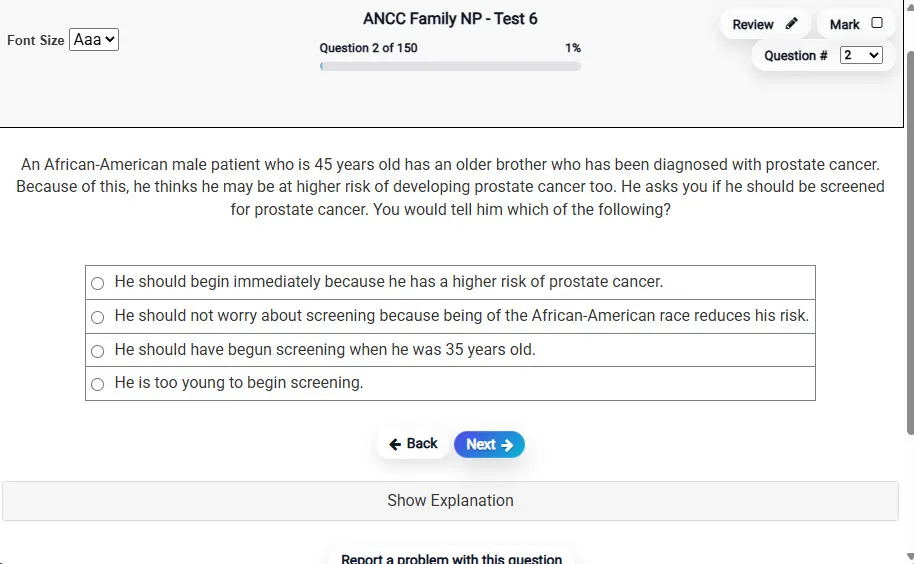
Answering a Question screen – Multiple-choice item view with navigation controls and progress tracker.
Answering a Question Multiple-choice item view with navigation controls and progress tracker.

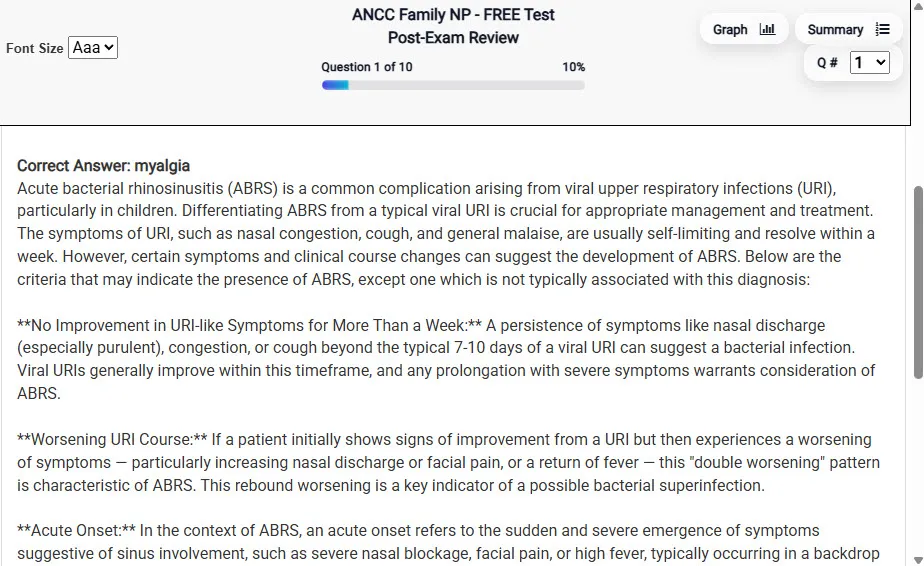
                           Detailed Explanation screen – 
                         Review mode showing chosen answer and rationale and references.
Detailed Explanation Review mode showing chosen answer and rationale and references.

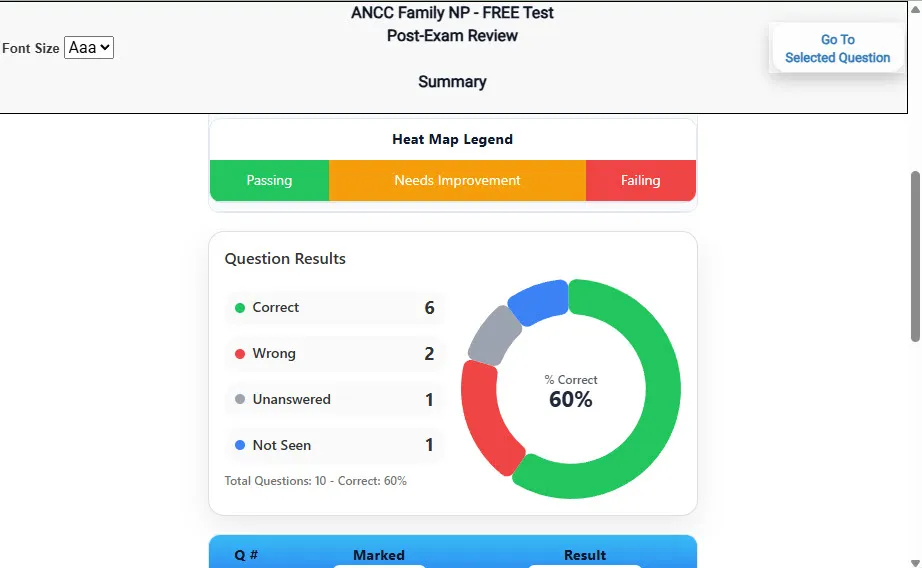
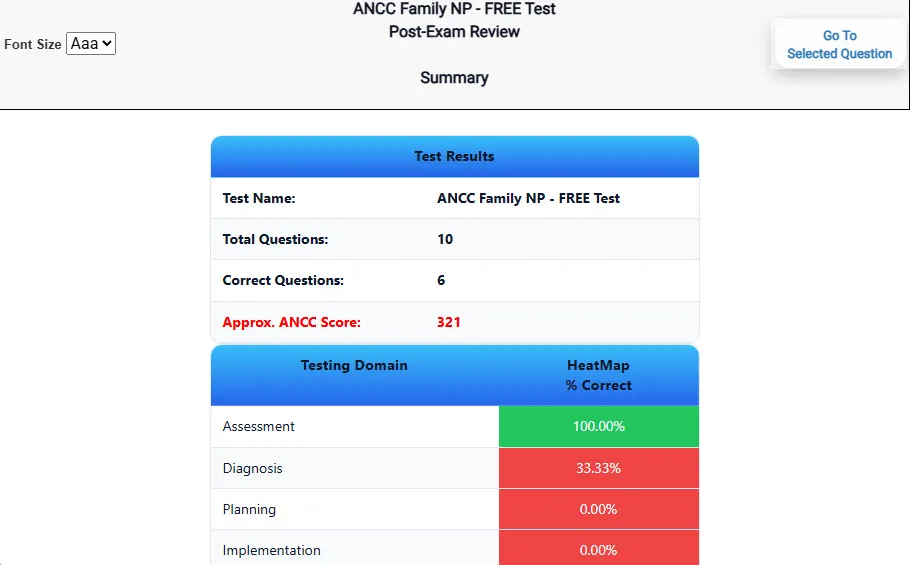
                           Review Summary 1 screen – 
                         Summary with counts for correct/wrong/unanswered and not seen items.
Review Summary 1 Summary with counts for correct/wrong/unanswered and not seen items.

                           Review Summary 2 screen – 
                         Advanced summary with category/domain breakdown and performance insights.
Review Summary 2 Advanced summary with category/domain breakdown and performance insights.

What Each Screen Shows

Answer Question Screen

  • Clean multiple-choice interface with progress bar.
  • Mark for review feature.
  • Matches real test pacing.

Detailed Explanation

  • Correct answer plus rationale.
  • Key concepts and guidelines highlighted.
  • Move between questions to fill knowledge gaps.

Review Summary 1

  • Overall results with total questions and scaled score.
  • Domain heatmap shows strengths and weaknesses.
  • Quick visual feedback on study priorities.

Review Summary 2

  • Chart of correct, wrong, unanswered, not seen.
  • Color-coded results for easy review.
  • Links back to missed items.

Top 10 Reasons to Use Exam Edge for your CBASE College Basic Academic Subjects Examination Exam Prep

  1. Focused on the CBASE College Basic Academic Subjects Examination Exam

    Our practice tests are built specifically for the CBASE Combined exam — every question mirrors the real topics, format, and difficulty so you're studying exactly what matters.

  2. Real Exam Simulation

    We match the per-question time limits and pressure of the actual CBASE exam, so test day feels familiar and stress-free.

  3. 20 Full Practice Tests & 3,600 Unique Questions

    You'll have more than enough material to master every CBASE Combined concept — no repeats, no fluff.

  4. Lower Cost Than a Retake

    Ordering 5 practice exams costs less than retaking the CBASE College Basic Academic Subjects Examination exam after a failure. One low fee could save you both time and money.

  5. Flexible Testing

    Need to step away mid-exam? Pick up right where you left off — with your remaining time intact.

  6. Instant Scoring & Feedback

    See your raw score and an estimated CBASE College Basic Academic Subjects Examination score immediately after finishing each practice test.

  7. Detailed Explanations for Every Question

    Review correct and incorrect answers with clear, step-by-step explanations so you truly understand each topic.

  8. Trusted & Accredited

    We're fully accredited by the Better Business Bureau and uphold the highest standards of trust and transparency.

  9. Web-Based & Always Available

    No software to install. Access your CBASE Combined practice exams 24/7 from any computer or mobile device.

  10. Expert Support When You Need It

    Need extra help? Our specialized tutors are highly qualified and ready to support your CBASE exam prep.


Pass the CBASE College Basic Academic Subjects Examination Exam with Realistic Practice Tests from Exam Edge

Preparing for your upcoming CBASE College Basic Academic Subjects Examination (CBASE) Certification Exam can feel overwhelming — but the right practice makes all the difference. Exam Edge gives you the tools, structure, and confidence to pass on your first try. Our online practice exams are built to match the real CBASE Combined exam in content, format, and difficulty.

  • 📝 20 CBASE College Basic Academic Subjects Examination Practice Tests: Access 20 full-length exams with 180 questions each, covering every major CBASE College Basic Academic Subjects Examination topic in depth.
  • Instant Online Access: Start practicing right away — no software, no waiting.
  • 🧠 Step-by-Step Explanations: Understand the reasoning behind every correct answer so you can master CBASE Combined exam concepts.
  • 🔄 Retake Each Exam Up to 4 Times: Build knowledge through repetition and track your improvement over time.
  • 🌐 Web-Based & Available 24/7: Study anywhere, anytime, on any device.
  • 🧘 Boost Your Test-Day Confidence: Familiarity with the CBASE format reduces anxiety and helps you perform under pressure.

These CBASE College Basic Academic Subjects Examination practice exams are designed to simulate the real testing experience by matching question types, timing, and difficulty level. This approach helps you get comfortable not just with the exam content, but also with the testing environment, so you walk into your exam day focused and confident.

Exam Edge CBASE Reviews


CBASE College Basic Academic Subjects Examination Aliases Test Name

Here is a list of alternative names used for this exam.

  • CBASE College Basic Academic Subjects Examination
  • CBASE College Basic Academic Subjects Examination test
  • CBASE College Basic Academic Subjects Examination Certification Test
  • CBASE Combined test
  • CBASE
  • CBASE CBASE
  • CBASE test
  • CBASE College Basic Academic Subjects Examination (CBASE)
  • College Basic Academic Subjects Examination certification