This is the content of the pop-over!

Lightning Deal Alert – 12% Off Ends at Midnight!

Strike while the savings are hot! Use promo code FlashSale at checkout for 12% off any Exam Edge test or bundle. Hurry—the clock is ticking!

CAHSEE Language Arts ( Language Arts) Practice Tests & Test Prep by Exam Edge


California High School English Language Arts Exit Examination  product image
(5.0)
Based on 28 Reviews

  • Real Exam Simulation: Timed questions and matching content build comfort for your CAHSEE Language Arts test day.
  • Instant, 24/7 Access: Web-based California High School English Language Arts Exit Examination practice exams with no software needed.
  • Clear Explanations: Step-by-step answers and explanations for your CHSPE exam to strengthen understanding.
  • Boosted Confidence: Reduces anxiety and improves test-taking skills to ace your California High School English Language Arts Exit Examination ( Language Arts).

Featured on

California High School English Language Arts Exit Examination Online Practice Test Bundles

BEST VALUE
10 practice tests

$99.50

$399.50

SAVE $300

Only $9.95 per test!

  • 100% Pass Guarantee
  • 10 online practice tests
  • 100 questions per test
  • Bonus: 100 Flash Cards + Study Guide
  • Instant access
  • Detailed Explanations
  • Practice tests never expire
  • Timed, untimed, or study guide mode
5 practice tests

$69.75

$199.75

SAVE $130

Only $13.95 per test!

  • 5 online practice tests
  • 100 questions per test
  • Bonus: 100 Flash Cards + Study Guide
  • Instant access
  • Detailed Explanations
  • Practice tests never expire
  • Timed, untimed, or study guide mode
1 practice test

$39.95

  • 1 online practice test
  • 100 questions per test
  • Instant access
  • Detailed Explanations
  • Practice tests never expire
  • Timed, untimed, or study guide mode
Quick Select
Tap to choose a bundle

** All Prices are in US Dollars (USD) **


CAHSEE Language Arts ( Language Arts) Resources

Jump to the section you need most.

Understanding the exact breakdown of the California High School English Language Arts Exit Examination test will help you know what to expect and how to most effectively prepare. The California High School English Language Arts Exit Examination has multiple-choice questions . The exam will be broken down into the sections below:

California High School English Language Arts Exit Examination Exam Blueprint
Domain Name % Number of
Questions
Reading  
     Word Analysis - Fluency Systematic Vocabulary Development  
     Reading Comprehension  
Literary Response and Analysis  
     Structural Features of Literature  
     Narrative Analysis of Grade-Level-Appropriate Text  
     Literary Criticism  
Writing  
     Writing Strategies  
     Organization and Focus  
     Research and Technology  

California High School English Language Arts Exit Examination Study Tips by Domain

  • Read the question first, then skim for where the answer must be found; red flag: choosing an option that is true in general but not supported by the passage.
  • For main idea, look for what most paragraphs contribute to rather than a single striking detail; common trap: picking a topic (too broad) or a detail (too narrow) as the thesis.
  • When asked for inference, require at least two text clues that point the same way; red flag: an inference that depends on outside knowledge or speculation about what happens next.
  • Use context to determine word meaning and tone, checking nearby contrast words (however, although) and examples; common trap: defaulting to the most familiar dictionary definition.
  • Track pronoun and reference words (this, that, which, they) to the exact noun they replace; red flag: misreading an argument because the referent shifts across sentences.
  • In paired details questions (evidence/support), select the quote that directly proves the claim, not just relates to the topic; priority rule: eliminate evidence that could support multiple answer choices.
  • Use context clues plus word structure to infer meaning; red flag: choosing a definition that fits the topic but not the sentence’s grammar or tone.
  • Apply common Greek/Latin roots and affixes (e.g., “bio-”, “-logy”, “pre-”, “-tion”) to decode unfamiliar academic words; trap: ignoring how a prefix can reverse meaning (e.g., “in-”/“un-”).
  • Watch for multiple-meaning words and idioms in passages; priority rule: pick the meaning that matches nearby clues, not the most familiar dictionary sense.
  • Use knowledge of word families and morphology (analyze/analysis/analytical) to track meaning across forms; red flag: treating a noun form as if it carries the same nuance as the verb.
  • For fluency-related questions, focus on phrasing and punctuation cues that affect meaning; common trap: reading a complex sentence without noticing appositives or nonessential clauses set off by commas.
  • Distinguish denotation vs. connotation and choose words that match the author’s attitude; red flag: missing signal words (e.g., “however,” “despite”) that shift the tone and the best vocabulary choice.
  • Identify the author’s central claim or main idea and choose the option that is broad enough to cover the whole passage—red flag: an answer that repeats a vivid detail from one paragraph.
  • Use context to interpret words and phrases (including figurative language) and pick meanings that fit the passage’s tone—common trap: selecting a dictionary definition that doesn’t match how the word is used.
  • Make inferences only when they are supported by multiple clues in the text—priority rule: if you can’t point to a specific line or detail as evidence, it’s likely an overreach.
  • Track text structure (cause/effect, compare/contrast, problem/solution, chronology) to answer questions about relationships among ideas—red flag: confusing a correlation described in the passage with a stated cause.
  • Answer evidence questions by rereading the relevant lines and checking that the choice matches exactly what is stated or implied—common trap: an option with true-sounding information that is not in the passage.
  • Summarize the passage in your own words, keeping key points and omitting minor examples—threshold: a good summary should capture the “who/what and why” without introducing new information.
  • Identify theme by linking it to repeated conflicts or choices, not by quoting a moral; red flag: a “theme” that is just the plot summary.
  • Support interpretations with specific textual evidence (key lines, actions, patterns); common trap: using broad statements like “this shows” with no quoted or paraphrased proof.
  • Analyze characterization through what a character says/does and how others respond; cue: don’t confuse a character trait with a one-time emotion or reaction.
  • Track how setting and mood shape meaning (time, place, social context); red flag: treating setting as backdrop without explaining its effect on conflict or theme.
  • Recognize author’s purpose and tone using diction and imagery; common trap: calling tone “happy” or “sad” without pointing to the language that creates it.
  • Explain how literary devices (symbolism, irony, figurative language) contribute to overall meaning; cue: if you can’t state the effect (“so what?”), you haven’t analyzed the device.
  • Identify how plot is structured (exposition → rising action → climax → falling action → resolution); red flag: confusing the story’s main conflict with a single event in the plot.
  • Distinguish types of conflict (internal vs. external; character vs. self/society/nature/technology/character); common trap: labeling any disagreement as “character vs. character” without evidence.
  • Analyze characterization (direct vs. indirect through actions, dialogue, thoughts, others’ reactions); priority rule: cite a specific line or action rather than relying on personal impressions.
  • Recognize point of view (1st person, 3rd limited, 3rd omniscient) and its effect on reliability; red flag: assuming the narrator’s opinion equals the author’s viewpoint.
  • Track setting (time, place, social context) and how it shapes mood or choices; common trap: summarizing where/when without explaining how the setting drives conflict or theme.
  • Identify structural devices (flashback, foreshadowing, framing, parallel plots) and their purpose; test cue: if a passage hints at later events, name “foreshadowing” and state the likely outcome it signals.
  • Identify the narrative arc (exposition → rising action → climax → resolution) and cite the exact turning point; red flag: picking the most dramatic moment instead of the plot’s true pivot.
  • Analyze how a character changes (or stays static) by tracking motivations, decisions, and consequences across key scenes; common trap: describing traits without linking them to actions in the text.
  • Determine point of view (1st, 3rd limited, 3rd omniscient) and explain one concrete effect on what the reader knows; red flag: confusing the author’s opinion with the narrator’s perspective.
  • Interpret theme as a complete statement (not one word) and support it with two separate story details; priority rule: if evidence only fits one scene, the theme claim is too narrow.
  • Explain how setting (time, place, social context) shapes conflict or character choices; common trap: listing setting details without showing impact on events.
  • Distinguish explicit vs. implicit information and make an inference that is anchored in a quoted detail; red flag: “could be” speculation that contradicts what the text actually states.
  • State a defensible thesis about how a literary element (e.g., irony, symbolism, point of view) shapes meaning; red flag: plot summary without an interpretive claim earns little credit.
  • Support each critical claim with specific textual evidence (short quotes or precise paraphrase); common trap: vague references like “the author shows” without a cited moment.
  • Analyze author’s purpose and how diction and tone create it; priority rule: explain the effect of word choice, not just label the tone.
  • Distinguish between theme and topic and express theme as a complete statement; red flag: single-word themes (e.g., “love”) are too broad to count as analysis.
  • Evaluate how characters’ motivations and conflicts drive the central idea; common trap: describing traits without linking them to the text’s message.
  • Address counter-interpretations briefly and refute with evidence; practical cue: if two answers seem plausible, choose the one best supported by the passage’s most explicit details.
  • Write a clear thesis or controlling idea in the first paragraph and keep every body paragraph tied back to it; red flag: a prompt that asks for two tasks (e.g., explain and evaluate) — address both.
  • Use a simple, consistent organization (e.g., claim → reason → evidence) with transitions that signal logic; common trap: listing examples without explaining how they prove the point.
  • Support claims with specific details (facts, quotations, or concrete examples) rather than generalities; priority rule: when you cite a quote, follow with one sentence of interpretation, not just a restatement.
  • Maintain a formal, consistent tone and avoid slang or second-person “you” unless the task explicitly calls for it; red flag: sudden shifts from past to present tense within the same paragraph.
  • Use sentence variety and correct grammar/punctuation to prevent run-ons and fragments; common trap: comma splices — fix by adding a conjunction, using a semicolon, or splitting into two sentences.
  • End with a conclusion that synthesizes (not repeats) the main points and answers the prompt directly; red flag: introducing a brand-new reason or example in the final sentence.
  • Use a clear purpose and audience from the first sentence; red flag: introductions that start with a vague “hook” but never state a claim or controlling idea.
  • Plan before drafting (quick outline with 2–3 main points) to prevent repetition; common trap: adding new, unrelated ideas in the last paragraph.
  • Support assertions with specific evidence (examples, facts, or text references when relevant); red flag: paragraphs built mostly on opinions like “I think” without concrete details.
  • Revise for coherence by checking transitions and logical order; priority rule: each paragraph should connect back to the main claim with an explicit link sentence.
  • Edit for sentence boundaries and clarity; common trap: run-ons and comma splices—read aloud and fix any place you naturally pause.
  • Proofread last for conventions (spelling, capitalization, punctuation) and consistency; red flag: shifting verb tense or pronouns (you/they/I) mid-essay without a reason.
  • Write a thesis that directly answers the prompt and limits scope; red flag: a “theme statement” with no arguable claim or no link to the question.
  • Use a clear organizational plan (e.g., logical order or strongest-to-weakest) and signal it early; common trap: listing ideas in the order you thought of them.
  • Start each body paragraph with a topic sentence that supports the thesis; red flag: paragraphs that open with evidence or plot summary before stating the point.
  • Maintain focus by keeping every sentence tied to the paragraph’s claim; priority rule: if a detail doesn’t prove the point, cut it—don’t “fill space.”
  • Use transitions to show relationships (cause/effect, contrast, sequence) rather than just “first/next”; common trap: abrupt jumps that make the reader infer the connection.
  • Write an ending that synthesizes the argument instead of repeating the introduction; red flag: introducing a new reason, example, or topic in the final sentences.
  • Evaluate source credibility by checking author qualifications, publication date, and domain type; red flag: anonymous pages or undated articles presented as “facts.”
  • Use multiple sources to confirm claims and note where they agree or diverge; common trap: relying on a single website that repeats the same information across linked pages.
  • Integrate quotations, paraphrases, and summaries with clear attribution; priority rule: when in doubt, cite to avoid plagiarism.
  • Use effective search strategies (keywords, phrase searches, and filters) to narrow results; red flag: searching broad single words that pull irrelevant or biased sources.
  • Track research notes with complete bibliographic details (author, title, URL, access date) as you go; common trap: trying to recreate citations after writing the draft.
  • Present findings using appropriate technology (slides, documents, or charts) with readable design; contraindication: cluttered visuals or tiny fonts that obscure the main claim.


Built to Fit Into Your Busy Life

Everything you need to prepare with confidence—without wasting a minute.

Three Study Modes

Timed, No Time Limit, or Explanation mode.

Actionable Analytics

Heatmaps and scaled scores highlight weak areas.

High-Yield Rationales

Concise explanations emphasize key concepts.

Realistic Interface

Matches the feel of the actual exam environment.

Accessible by Design

Clean layout reduces cognitive load.

Anytime, Anywhere

Web-based access 24/7 on any device.
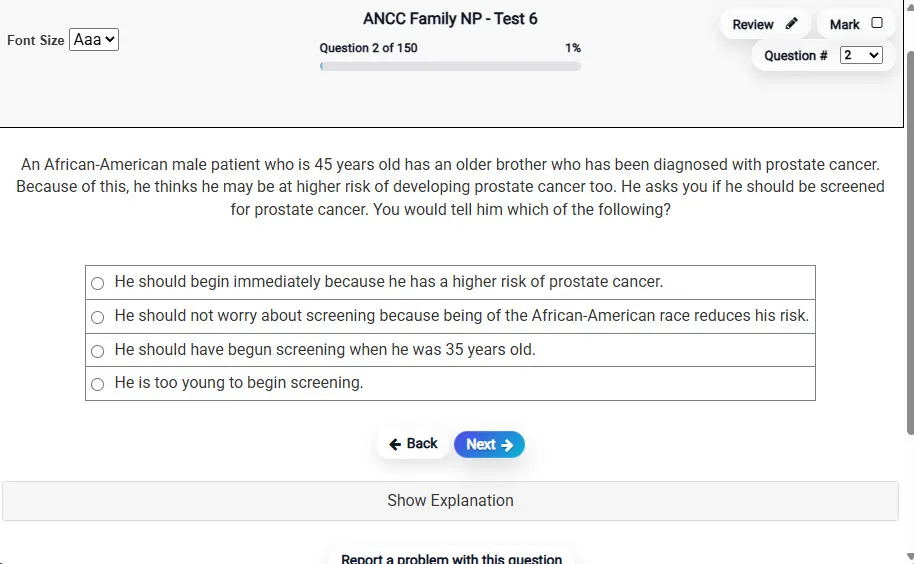
Answering a Question screen – Multiple-choice item view with navigation controls and progress tracker.
Answering a Question Multiple-choice item view with navigation controls and progress tracker.

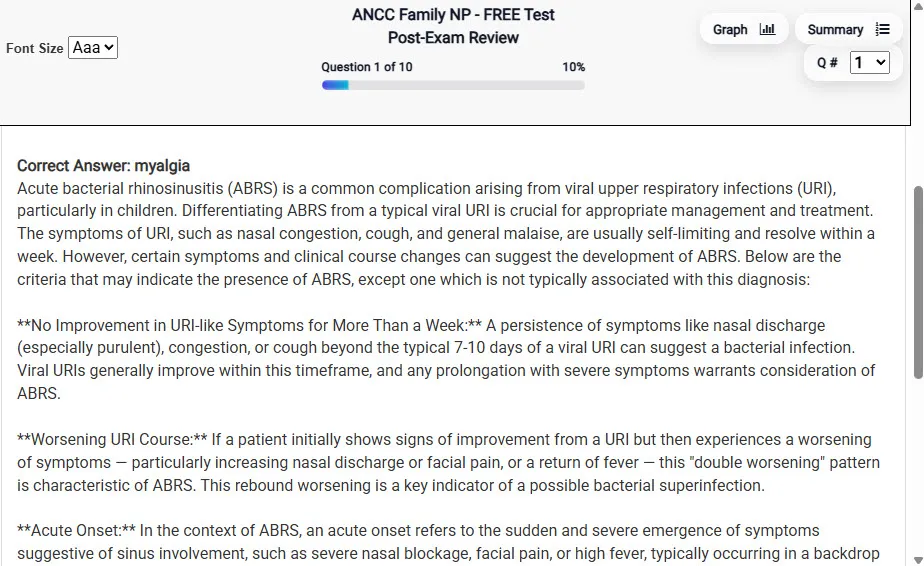
                           Detailed Explanation screen – 
                         Review mode showing chosen answer and rationale and references.
Detailed Explanation Review mode showing chosen answer and rationale and references.

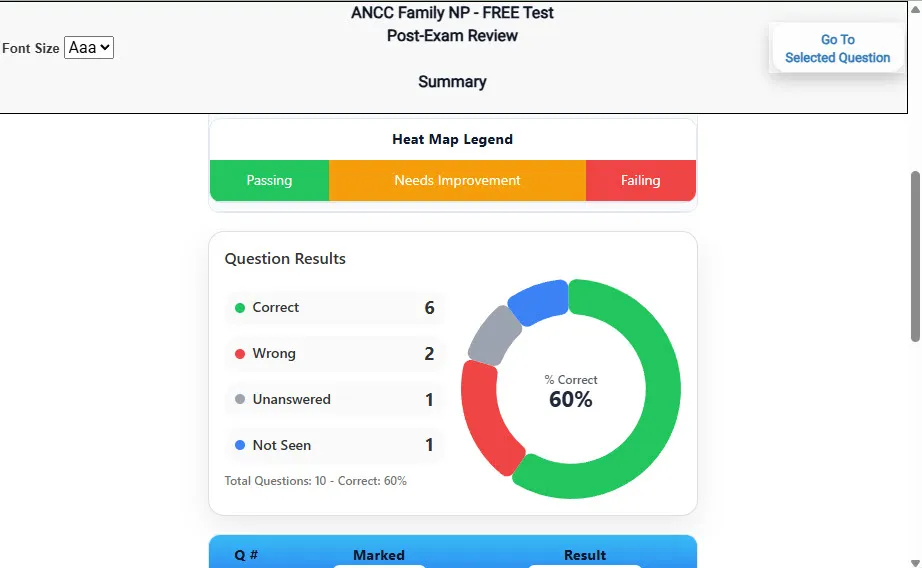
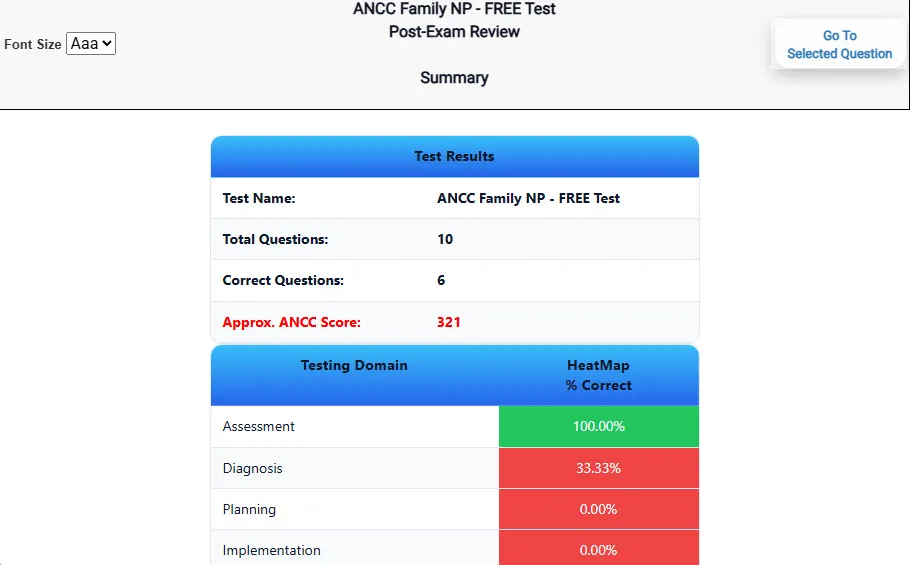
                           Review Summary 1 screen – 
                         Summary with counts for correct/wrong/unanswered and not seen items.
Review Summary 1 Summary with counts for correct/wrong/unanswered and not seen items.

                           Review Summary 2 screen – 
                         Advanced summary with category/domain breakdown and performance insights.
Review Summary 2 Advanced summary with category/domain breakdown and performance insights.

What Each Screen Shows

Answer Question Screen

  • Clean multiple-choice interface with progress bar.
  • Mark for review feature.
  • Matches real test pacing.

Detailed Explanation

  • Correct answer plus rationale.
  • Key concepts and guidelines highlighted.
  • Move between questions to fill knowledge gaps.

Review Summary 1

  • Overall results with total questions and scaled score.
  • Domain heatmap shows strengths and weaknesses.
  • Quick visual feedback on study priorities.

Review Summary 2

  • Chart of correct, wrong, unanswered, not seen.
  • Color-coded results for easy review.
  • Links back to missed items.

Top 10 Reasons to Use Exam Edge for your California High School English Language Arts Exit Examination Exam Prep

  1. Focused on the California High School English Language Arts Exit Examination Exam

    Our practice tests are built specifically for the CAHSEE Language Arts exam — every question mirrors the real topics, format, and difficulty so you're studying exactly what matters.

  2. Real Exam Simulation

    We match the per-question time limits and pressure of the actual CHSPE exam, so test day feels familiar and stress-free.

  3. 10 Full Practice Tests & 1,000 Unique Questions

    You'll have more than enough material to master every CAHSEE Language Arts concept — no repeats, no fluff.

  4. Lower Cost Than a Retake

    Ordering 5 practice exams costs less than retaking the California High School English Language Arts Exit Examination exam after a failure. One low fee could save you both time and money.

  5. Flexible Testing

    Need to step away mid-exam? Pick up right where you left off — with your remaining time intact.

  6. Instant Scoring & Feedback

    See your raw score and an estimated California High School English Language Arts Exit Examination score immediately after finishing each practice test.

  7. Detailed Explanations for Every Question

    Review correct and incorrect answers with clear, step-by-step explanations so you truly understand each topic.

  8. Trusted & Accredited

    We're fully accredited by the Better Business Bureau and uphold the highest standards of trust and transparency.

  9. Web-Based & Always Available

    No software to install. Access your CAHSEE Language Arts practice exams 24/7 from any computer or mobile device.

  10. Expert Support When You Need It

    Need extra help? Our specialized tutors are highly qualified and ready to support your CHSPE exam prep.


Pass the California High School English Language Arts Exit Examination Exam with Realistic Practice Tests from Exam Edge

Preparing for your upcoming California High School English Language Arts Exit Examination ( Language Arts) Certification Exam can feel overwhelming — but the right practice makes all the difference. Exam Edge gives you the tools, structure, and confidence to pass on your first try. Our online practice exams are built to match the real CAHSEE Language Arts exam in content, format, and difficulty.

  • 📝 10 California High School English Language Arts Exit Examination Practice Tests: Access 10 full-length exams with 100 questions each, covering every major California High School English Language Arts Exit Examination topic in depth.
  • Instant Online Access: Start practicing right away — no software, no waiting.
  • 🧠 Step-by-Step Explanations: Understand the reasoning behind every correct answer so you can master CAHSEE Language Arts exam concepts.
  • 🔄 Retake Each Exam Up to 4 Times: Build knowledge through repetition and track your improvement over time.
  • 🌐 Web-Based & Available 24/7: Study anywhere, anytime, on any device.
  • 🧘 Boost Your Test-Day Confidence: Familiarity with the CHSPE format reduces anxiety and helps you perform under pressure.

These California High School English Language Arts Exit Examination practice exams are designed to simulate the real testing experience by matching question types, timing, and difficulty level. This approach helps you get comfortable not just with the exam content, but also with the testing environment, so you walk into your exam day focused and confident.

Exam Edge CAHSEE Reviews


Hi Just wanted to say that my son took and passed the new CHSPE first time with a score averaging over 400 which was almost identical to his Exam Edge practice score! Thanks again!!

niall , San Fran, CA


California High School English Language Arts Exit Examination Aliases Test Name

Here is a list of alternative names used for this exam.

  • California High School English Language Arts Exit Examination
  • California High School English Language Arts Exit Examination test
  • California High School English Language Arts Exit Examination Certification Test
  • CAHSEE Language Arts test
  • CAHSEE
  • CAHSEE Language Arts
  • Language Arts test
  • California High School English Language Arts Exit Examination ( Language Arts)
  • California High School English Language Arts Exit Examination certification