This is the content of the pop-over!

Lightning Deal Alert – 12% Off Ends at Midnight!

Strike while the savings are hot! Use promo code FlashSale at checkout for 12% off any Exam Edge test or bundle. Hurry—the clock is ticking!

CAHSEE Combined (Combined ) Practice Tests & Test Prep by Exam Edge


California High School Exit Examination  Combined  product image
(5.0)
Based on 29 Reviews

  • Real Exam Simulation: Timed questions and matching content build comfort for your CAHSEE Combined test day.
  • Instant, 24/7 Access: Web-based California High School Exit Examination Combined practice exams with no software needed.
  • Clear Explanations: Step-by-step answers and explanations for your CHSPE exam to strengthen understanding.
  • Boosted Confidence: Reduces anxiety and improves test-taking skills to ace your California High School Exit Examination Combined (Combined ).

Featured on

California High School Exit Examination Combined Online Practice Test Bundles

BEST VALUE
10 practice tests

$99.50

$399.50

SAVE $300

Only $9.95 per test!

  • 100% Pass Guarantee
  • 10 online practice tests
  • 180 questions per test
  • Bonus: 100 Flash Cards + Study Guide
  • Instant access
  • Detailed Explanations
  • Practice tests never expire
  • Timed, untimed, or study guide mode
5 practice tests

$69.75

$199.75

SAVE $130

Only $13.95 per test!

  • 5 online practice tests
  • 180 questions per test
  • Bonus: 100 Flash Cards + Study Guide
  • Instant access
  • Detailed Explanations
  • Practice tests never expire
  • Timed, untimed, or study guide mode
1 practice test

$39.95

  • 1 online practice test
  • 180 questions per test
  • Instant access
  • Detailed Explanations
  • Practice tests never expire
  • Timed, untimed, or study guide mode
Quick Select
Tap to choose a bundle

** All Prices are in US Dollars (USD) **


CAHSEE Combined (Combined ) Resources

Jump to the section you need most.

Understanding the exact breakdown of the California High School Exit Examination Combined test will help you know what to expect and how to most effectively prepare. The California High School Exit Examination Combined has multiple-choice questions . The exam will be broken down into the sections below:

California High School Exit Examination Combined Exam Blueprint
Domain Name
Math  
     Number Sense (NS)  
     Statistics - Data Analysis Probability (PS)  
     Algebra and Functions (AF)  
     Measurement and Geometry (MG)  
     Mathematical Reasoning (MR)  
     Algebra I (1A)  
Reading  
     Word Analysis - Fluency Systematic Vocabulary Development  
     Reading Comprehension  
Literary Response and Analysis  
     Narrative Analysis of Grade-Level-Appropriate Text  
     Literary Criticism  
Writing  
     Writing Strategies  
     Organization and Focus  
     Research and Technology  

California High School Exit Examination Combined Study Tips by Domain

  • Prioritize multi-step problems by writing down givens/unknowns first; red flag: skipping units or labels often leads to a correct calculation but wrong answer choice.
  • Check reasonableness with estimation (order of magnitude, bounds) before selecting an option; common trap: picking an answer that violates obvious constraints (e.g., negative length, probability > 1).
  • Translate words to symbols carefully (e.g., “at least” means ≥, “no more than” means ≤); red flag: reversing inequality when dividing by a negative.
  • Show key intermediate steps on scratch work even for multiple choice; priority rule: if you can eliminate 2+ options quickly via substitution or sign checks, do that before full computation.
  • Use proportional reasoning for percent change, rates, and scale; common trap: confusing percent of the original vs. percent increase/decrease (base value matters).
  • When graphing or interpreting graphs, verify intercepts, slope direction, and scale marks; red flag: assuming the grid is 1-unit increments when the axis labels indicate otherwise.
  • Convert flexibly among fractions, decimals, and percents (e.g., 3/8 = 0.375 = 37.5%)—red flag: rounding too early can change the final answer.
  • Apply order of operations with integers, fractions, and exponents; common trap: treating −32 as (+9) instead of −9 unless parentheses are used.
  • Use estimation to check reasonableness of results; priority rule: if an answer is wildly off-scale, re-check placement of the decimal point.
  • Work with ratios and rates (unit rate, speed, cost per item) and scale factors; red flag: mixing units (minutes vs hours, inches vs feet) without converting first.
  • Solve basic proportion and percent problems (percent increase/decrease, part/whole); common trap: using the wrong base when the problem says “of” or “increase from”.
  • Compare and order real numbers (including negatives and absolute value) on a number line; red flag: forgetting that a number with greater absolute value can be smaller if it’s negative.
  • When summarizing data, choose the right center/spread: use median and IQR for skewed sets or with outliers; red flag—using the mean when a single extreme value is present.
  • Know sample vs. population: sample statistics (x¯, s) estimate population parameters (μ, σ); common trap—treating a small, biased sample as representative.
  • Interpret graphs carefully (histograms, box plots, scatterplots): check scale and labels first; red flag—concluding “trend” from a scatterplot with no clear pattern or with an outlier driving the fit.
  • For probability, distinguish independent vs. dependent events: use multiplication for independent events and conditional probability for dependent; common trap—forgetting to adjust probabilities “without replacement.”
  • Use counting methods correctly: fundamental counting principle vs. permutations/combinations; red flag—order matters (permutation) but you use a combination formula.
  • Recognize that correlation is not causation and quantify association when asked (e.g., positive/negative, strong/weak); common trap—claiming one variable causes the other just because r is large.
  • Solve linear equations/inequalities and check by substitution; red flag: when multiplying or dividing by a negative in an inequality, you must reverse the inequality sign.
  • Work with functions using f(x) notation (evaluate, interpret, and find inputs/outputs); common trap: confusing f(x + 2) with f(x) + 2.
  • Graph linear functions from slope-intercept form and identify slope as rate of change; priority rule: a negative slope means the line decreases left to right even if the y-intercept is positive.
  • Simplify and factor polynomials, including using the distributive property and common factors; red flag: sign errors when factoring out a negative (e.g., −3x + 6 = −3(x − 2)).
  • Use exponent rules and recognize when they do not apply; common trap: (a + b)2 is not a2 + b2.
  • Translate between words, tables, and algebraic expressions (including proportional relationships); red flag: mixing up a constant difference (linear) with a constant ratio (proportional).
  • Convert units before computing (e.g., inches to feet, cm to m)—red flag: mixed units in the same problem almost always cause wrong area/volume.
  • Use perimeter for boundary length and area for covering surface—common trap: adding side lengths when the question asks for square units (or vice versa).
  • For circles, distinguish circumference (2πr) from area (πr2)—priority rule: if given diameter, convert to radius (r = d/2) first.
  • Apply angle facts (vertical angles equal, linear pair sums to 180°, triangle interior sums to 180°)—red flag: diagrams not to scale, so rely on relationships, not looks.
  • Use Pythagorean theorem only for right triangles—common trap: forgetting to square-root at the end or using it when no right angle is indicated.
  • For volume and surface area, match formulas to the solid (prism/cylinder/cone/sphere)—contraindication: confusing surface area (square units) with volume (cubic units).
  • Translate word problems into equations/inequalities by defining the variable with units; red flag: mixing units (e.g., dollars vs. cents) without converting.
  • Use estimation to sanity-check results before finalizing; common trap: accepting an answer that violates context (negative people, fractional tickets, etc.).
  • When comparing quantities, decide whether to use absolute difference or percent change; priority rule: percent change needs the correct original (starting) value as the denominator.
  • Handle ratios/rates with consistent labeling (e.g., miles per hour vs. hours per mile); red flag: flipping the rate and getting an answer with the wrong units.
  • Set up multi-step problems by writing each step as an equation and tracking what is known/unknown; common trap: performing operations out of order when parentheses are implied by the situation.
  • For graphs and tables, identify the independent/dependent variables and read scale carefully; red flag: misreading intervals (each tick may represent 2, 5, or 10) and doubling/halving the slope.
  • Solve one-step and multi-step linear equations/inequalities and remember to flip the inequality sign only when multiplying or dividing by a negative number—a common trap is distributing a negative without changing all signs.
  • Graph linear equations in slope-intercept form (y = mx + b) and treat slope as “rise over run”; red flag: confusing b (y-intercept) with the x-intercept.
  • Convert between standard form (Ax + By = C) and slope-intercept form carefully, isolating y; practical cue: check for arithmetic slips when moving terms across the equals sign.
  • Solve systems of two linear equations by substitution or elimination; priority rule: align like terms before adding/subtracting, and watch for no-solution (parallel lines) or infinite-solution (same line) cases.
  • Work with exponents and radicals using the correct laws (e.g., a^m ⋅ a^n = a^(m+n)); red flag: adding exponents when you should be distributing them, like (ab)^n = a^n b^n.
  • Factor and expand polynomials (GCF, difference of squares, simple trinomials) to solve quadratics by factoring; common trap: setting factors equal to zero before moving all terms to one side.
  • Identify the passage’s central idea and supporting details; red flag: answers that rely on one vivid detail but ignore the overall point.
  • Make inferences only from text evidence; common trap: choosing an option that “could be true” but isn’t supported by a specific line or event.
  • Use context to determine word meaning and tone; priority rule: reread the full sentence and nearby sentences before using prior knowledge.
  • Track author’s purpose and perspective (inform, persuade, entertain); red flag: confusing narrator/character opinions with the author’s message.
  • Interpret text structure (cause/effect, compare/contrast, problem/solution) and transitions; common trap: missing a shift signaled by words like “however,” “therefore,” or “in contrast.”
  • Answer questions by returning to the passage for proof; threshold cue: when two choices seem right, select the one with the clearest, most direct textual support.
  • Use context clues (definition, synonym, antonym, example) to infer word meaning; red flag: choosing an answer that sounds right but contradicts the sentence’s tone.
  • Apply knowledge of prefixes, roots, and suffixes (e.g., un-, pre-, -tion, -less) to decode unfamiliar words; common trap: confusing a root’s meaning with a look-alike word.
  • Distinguish denotation vs. connotation to match the author’s intended meaning; priority rule: pick the choice that fits both meaning and emotional “shade.”
  • Recognize figurative language (idioms, similes, metaphors) and interpret it nonliterally; red flag: selecting a literal interpretation when the phrase is clearly idiomatic.
  • Use structural clues (signal words, punctuation like dashes/parentheses, and appositives) to identify embedded definitions; common trap: ignoring a nearby restatement that directly defines the term.
  • For fluency, read for accurate phrasing and implied meaning (pauses at commas, emphasis from italics/quotations) to support interpretation; red flag: misreading a clause that flips meaning with words like “however” or “although.”
  • Identify the passage’s main idea and the author’s purpose; red flag: choosing a “true detail” that’s too narrow as the main idea.
  • Use context to infer meaning of unfamiliar words and phrases; common trap: picking a definition that fits the word in isolation but not the sentence’s tone and logic.
  • Make valid inferences supported by multiple clues; priority rule: if you can’t point to specific lines or details, it’s likely an unsupported leap.
  • Distinguish fact, opinion, and interpretation in informational texts; red flag: treating a judgment word (e.g., “best,” “should”) as a verifiable claim.
  • Analyze text structure (cause/effect, compare/contrast, problem/solution, chronology) to answer questions; common trap: missing signal words (however, therefore, similarly) that change relationships.
  • Interpret author’s tone and rhetorical choices (word choice, examples, figurative language); contraindication: confusing tone (attitude) with mood (reader’s feeling).
  • Identify a text’s theme and support it with specific evidence (key events, repeated images, turning points) — red flag: summarizing the plot instead of stating an arguable theme.
  • Analyze character development by linking traits/motives to actions and outcomes; common trap: describing a character as “nice” or “mean” without citing what they do or say.
  • Recognize how setting (time/place/mood) shapes conflict and meaning — cue: if the setting could be swapped with no change, you haven’t analyzed its impact.
  • Interpret figurative language and literary devices (symbolism, irony, imagery) in context; red flag: choosing a device and defining it without explaining how it affects meaning.
  • Determine point of view and its effect on reliability and bias; common trap: confusing first-person narration with author opinion.
  • Compare/contrast texts or elements (two characters, two poems, etc.) using a clear basis and textual support — priority rule: state the comparison point first, then cite evidence for both sides.
  • Track plot structure (exposition → rising action → climax → resolution) and flag any answer that names events out of order as a common trap.
  • Infer theme from repeated conflicts, choices, and outcomes; red flag: selecting a theme that is just a plot summary or a single character’s opinion.
  • Analyze characterization by citing what a character says, does, thinks, and how others react; priority rule: prefer evidence-based inferences over “I think” impressions.
  • Identify point of view (first, third-limited, third-omniscient) and how it shapes what readers know; common trap: confusing the narrator with the author’s beliefs.
  • Use context (setting, tone, word choice, imagery) to interpret mood and meaning; red flag: picking an interpretation that contradicts the passage’s tone cues.
  • Connect cause-and-effect in character motivation and conflict (internal vs. external); priority cue: if an answer ignores a stated motive or consequence, eliminate it.
  • Identify the author’s purpose and central claim, then cite one concrete text detail that proves it—red flag: answers that paraphrase the plot without evaluating meaning.
  • Track how literary devices (imagery, symbolism, irony, tone) shape theme; common trap: naming a device without explaining its effect on the reader.
  • Distinguish speaker/narrator from author and note point of view (1st/3rd, limited/omniscient); red flag: assuming the narrator’s opinion is the author’s.
  • Analyze characterization using STEAL (speech, thoughts, effects on others, actions, looks) and connect traits to conflict/resolution; priority rule: use direct quotes or specific actions, not labels like “nice”.
  • Evaluate structure (plot arc, pacing, flashbacks, foreshadowing) and how it builds meaning; common trap: describing events in order rather than explaining why the structure matters.
  • When comparing works or passages, focus on one shared idea and one key difference supported by evidence; red flag: listing similarities without a clear evaluative claim.
  • Address the prompt exactly by stating a clear thesis in the introduction and returning to it in the conclusion; red flag: a well-written essay that answers a different question earns limited credit.
  • Organize with a logical plan (e.g., claim → reason → evidence) and use transitions to show relationships; common trap: listing ideas without linking words (because, therefore, however) reads like fragments of thought.
  • Support points with specific details (examples, facts, or brief quotations/paraphrases) and explain how each detail proves the claim; red flag: vague support (“many people,” “a lot,” “stuff”) with no explanation.
  • Maintain consistent verb tense, pronoun reference, and point of view throughout; common trap: shifting from “one” to “you” or past to present without a reason.
  • Use varied sentence structures and correct punctuation to avoid run-ons and fragments; priority rule: when in doubt, separate independent clauses with a period or semicolon rather than a comma splice.
  • Revise for conventions—spelling, capitalization, and agreement—and proofread the final copy; red flag: repeated basic errors (its/it’s, there/their/they’re, subject–verb disagreement) can noticeably lower the score even if ideas are strong.
  • Use a clear thesis and keep every paragraph tied to it; red flag: a “topic” sentence that lists ideas without making a claim.
  • Plan a logical structure (e.g., problem–solution, cause–effect, compare–contrast) and use transitions; common trap: jumping between points so the reader can’t follow the line of reasoning.
  • Support assertions with specific evidence (facts, examples, quotes, details) and explain how it proves your point; priority rule: evidence without commentary is scored as weak development.
  • Write focused paragraphs with a topic sentence, 2–4 supporting sentences, and a concluding link back; red flag: introducing a new main idea in the conclusion.
  • Maintain consistent point of view and verb tense; common trap: shifting from “one”/“you” to “I” or past to present without purpose.
  • Revise for clarity and concision by cutting repetition and fixing run-ons/comma splices; practical cue: if a sentence has two complete thoughts, add a conjunction with a comma or use a semicolon/period.
  • Write a clear thesis or controlling idea in the first paragraph; red flag: an introduction that summarizes the topic but never takes a position.
  • Organize by a logical plan (chronological, cause/effect, compare/contrast) and keep it consistent; common trap: switching patterns mid-essay without transitions.
  • Use topic sentences that tie each body paragraph back to the thesis; red flag: paragraphs that start with a detail but don’t explain its purpose.
  • Include purposeful transitions (e.g., “however,” “as a result,” “for example”) to show relationships; common trap: listing points with “also” repeatedly.
  • Stay on prompt and address every task in it; priority rule: if the prompt asks for two reasons or examples, provide both—missing one weakens focus.
  • End with a conclusion that reinforces the thesis and significance without adding new evidence; red flag: introducing a brand-new argument in the last sentence.
  • Distinguish credible sources from unreliable ones by checking author credentials, publication date, and evidence—red flag: anonymous pages, outdated stats, or claims with no citations.
  • Use effective search strategies (keywords, quotes for exact phrases, and narrowing terms)—common trap: searching full questions and accepting the first hit without cross-checking.
  • Integrate information from multiple sources and note where they agree or conflict—priority rule: resolve contradictions by favoring primary sources and data over opinion.
  • Avoid plagiarism by paraphrasing in your own words and citing the source even when not quoting—red flag: copying sentence structure with only a few synonym swaps.
  • Match the citation details to the source type (book, article, website) and include key elements like author, title, and date—common trap: missing dates or using a URL alone as a “citation.”
  • Use technology to draft, revise, and edit efficiently (spellcheck, track changes, and formatting tools)—contraindication: relying on spellcheck to fix homophones (e.g., “their/there/they’re”).


Built to Fit Into Your Busy Life

Everything you need to prepare with confidence—without wasting a minute.

Three Study Modes

Timed, No Time Limit, or Explanation mode.

Actionable Analytics

Heatmaps and scaled scores highlight weak areas.

High-Yield Rationales

Concise explanations emphasize key concepts.

Realistic Interface

Matches the feel of the actual exam environment.

Accessible by Design

Clean layout reduces cognitive load.

Anytime, Anywhere

Web-based access 24/7 on any device.
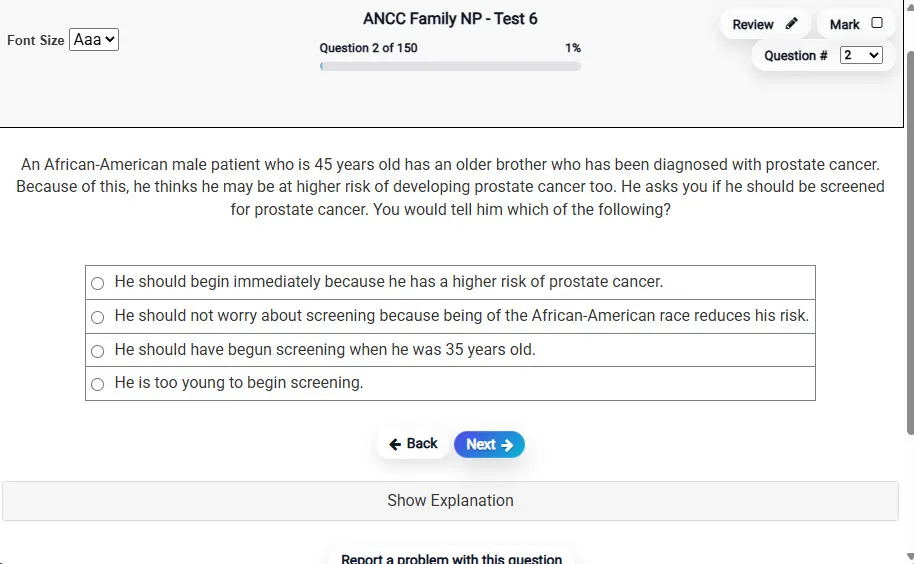
Answering a Question screen – Multiple-choice item view with navigation controls and progress tracker.
Answering a Question Multiple-choice item view with navigation controls and progress tracker.

                           Detailed Explanation screen – 
                         Review mode showing chosen answer and rationale and references.
Detailed Explanation Review mode showing chosen answer and rationale and references.

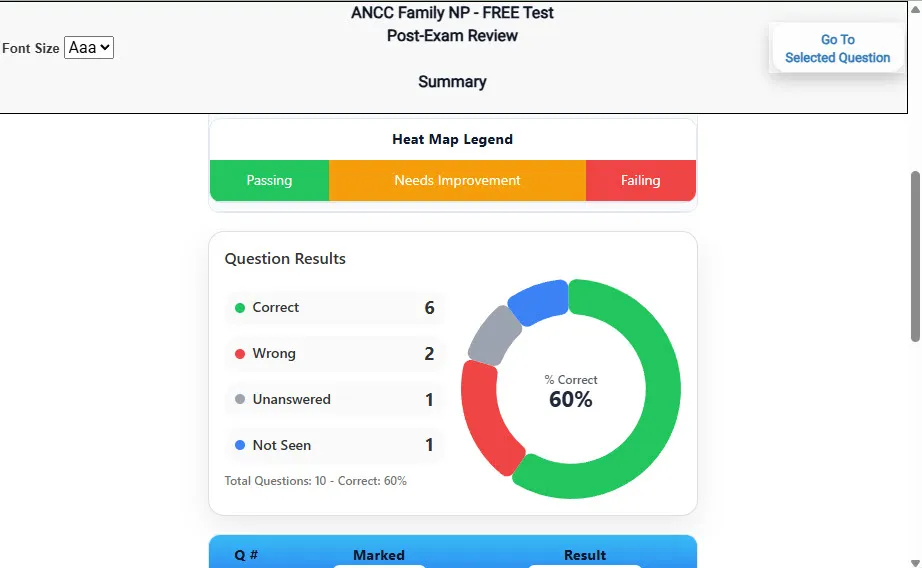
                           Review Summary 1 screen – 
                         Summary with counts for correct/wrong/unanswered and not seen items.
Review Summary 1 Summary with counts for correct/wrong/unanswered and not seen items.

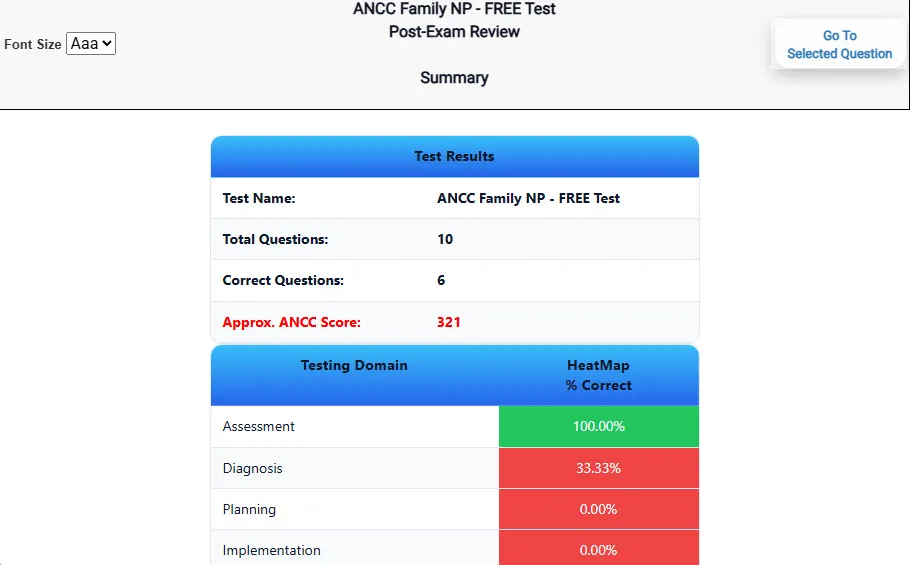
                           Review Summary 2 screen – 
                         Advanced summary with category/domain breakdown and performance insights.
Review Summary 2 Advanced summary with category/domain breakdown and performance insights.

What Each Screen Shows

Answer Question Screen

  • Clean multiple-choice interface with progress bar.
  • Mark for review feature.
  • Matches real test pacing.

Detailed Explanation

  • Correct answer plus rationale.
  • Key concepts and guidelines highlighted.
  • Move between questions to fill knowledge gaps.

Review Summary 1

  • Overall results with total questions and scaled score.
  • Domain heatmap shows strengths and weaknesses.
  • Quick visual feedback on study priorities.

Review Summary 2

  • Chart of correct, wrong, unanswered, not seen.
  • Color-coded results for easy review.
  • Links back to missed items.

Top 10 Reasons to Use Exam Edge for your California High School Exit Examination Combined Exam Prep

  1. Focused on the California High School Exit Examination Combined Exam

    Our practice tests are built specifically for the CAHSEE Combined exam — every question mirrors the real topics, format, and difficulty so you're studying exactly what matters.

  2. Real Exam Simulation

    We match the per-question time limits and pressure of the actual CHSPE exam, so test day feels familiar and stress-free.

  3. 10 Full Practice Tests & 1,800 Unique Questions

    You'll have more than enough material to master every CAHSEE Combined concept — no repeats, no fluff.

  4. Lower Cost Than a Retake

    Ordering 5 practice exams costs less than retaking the California High School Exit Examination Combined exam after a failure. One low fee could save you both time and money.

  5. Flexible Testing

    Need to step away mid-exam? Pick up right where you left off — with your remaining time intact.

  6. Instant Scoring & Feedback

    See your raw score and an estimated California High School Exit Examination Combined score immediately after finishing each practice test.

  7. Detailed Explanations for Every Question

    Review correct and incorrect answers with clear, step-by-step explanations so you truly understand each topic.

  8. Trusted & Accredited

    We're fully accredited by the Better Business Bureau and uphold the highest standards of trust and transparency.

  9. Web-Based & Always Available

    No software to install. Access your CAHSEE Combined practice exams 24/7 from any computer or mobile device.

  10. Expert Support When You Need It

    Need extra help? Our specialized tutors are highly qualified and ready to support your CHSPE exam prep.


Pass the California High School Exit Examination Combined Exam with Realistic Practice Tests from Exam Edge

Preparing for your upcoming California High School Exit Examination Combined (Combined ) Certification Exam can feel overwhelming — but the right practice makes all the difference. Exam Edge gives you the tools, structure, and confidence to pass on your first try. Our online practice exams are built to match the real CAHSEE Combined exam in content, format, and difficulty.

  • 📝 10 California High School Exit Examination Combined Practice Tests: Access 10 full-length exams with 180 questions each, covering every major California High School Exit Examination Combined topic in depth.
  • Instant Online Access: Start practicing right away — no software, no waiting.
  • 🧠 Step-by-Step Explanations: Understand the reasoning behind every correct answer so you can master CAHSEE Combined exam concepts.
  • 🔄 Retake Each Exam Up to 4 Times: Build knowledge through repetition and track your improvement over time.
  • 🌐 Web-Based & Available 24/7: Study anywhere, anytime, on any device.
  • 🧘 Boost Your Test-Day Confidence: Familiarity with the CHSPE format reduces anxiety and helps you perform under pressure.

These California High School Exit Examination Combined practice exams are designed to simulate the real testing experience by matching question types, timing, and difficulty level. This approach helps you get comfortable not just with the exam content, but also with the testing environment, so you walk into your exam day focused and confident.

Exam Edge CAHSEE Reviews


Hi Just wanted to say that my son took and passed the new CHSPE first time with a score averaging over 400 which was almost identical to his Exam Edge practice score! Thanks again!!

niall , San Fran, CA


California High School Exit Examination Combined Aliases Test Name

Here is a list of alternative names used for this exam.

  • California High School Exit Examination Combined
  • California High School Exit Examination Combined test
  • California High School Exit Examination Combined Certification Test
  • CAHSEE Combined test
  • CAHSEE
  • CAHSEE Combined
  • Combined test
  • California High School Exit Examination Combined (Combined )
  • California High School Exit Examination Combined certification