This is the content of the pop-over!

Lightning Deal Alert – 12% Off Ends at Midnight!

Strike while the savings are hot! Use promo code FlashSale at checkout for 12% off any Exam Edge test or bundle. Hurry—the clock is ticking!

Assessment of Teaching Assistant Skills ATAS Practice Tests


NYSTCE ATAS  product image
(4.9)
Based on 17 Reviews

  • Real Exam Simulation: Timed questions and matching content build comfort for your NYSTCE ATAS Combined test day.
  • Instant, 24/7 Access: Web-based NYSTCE ATAS practice exams with no software needed.
  • Clear Explanations: Step-by-step answers and explanations for your NYSTCE exam to strengthen understanding.
  • Boosted Confidence: Reduces anxiety and improves test-taking skills to ace your NYSTCE ATAS (95).

Featured on

NYSTCE ATAS Online Practice Test Bundles

BEST VALUE
30 practice tests

$238.50

$1,198.50

SAVE $960

Only $7.95 per test!

  • 100% Pass Guarantee
  • 30 online practice tests
  • 100 questions per test
  • Bonus: 100 Flash Cards + Study Guide
  • Instant access
  • Detailed Explanations
  • Practice tests never expire
  • Timed, untimed, or study guide mode
MOST POPULAR
15 practice tests

$149.25

$599.25

SAVE $450

Only $9.95 per test!

  • 15 online practice tests
  • 100 questions per test
  • Bonus: 100 Flash Cards + Study Guide
  • Instant access
  • Detailed Explanations
  • Practice tests never expire
  • Timed, untimed, or study guide mode
5 practice tests

$69.75

$199.75

SAVE $130

Only $13.95 per test!

  • 5 online practice tests
  • 100 questions per test
  • Bonus: 100 Flash Cards
  • Instant access
  • Detailed Explanations
  • Practice tests never expire
  • Timed, untimed, or study guide mode
1 practice test

$39.95

  • 1 online practice test
  • 100 questions per test
  • Instant access
  • Detailed Explanations
  • Practice tests never expire
  • Timed, untimed, or study guide mode
Quick Select
Tap to choose a bundle

** All Prices are in US Dollars (USD) **


NYSTCE ATAS Combined (95) Resources

Jump to the section you need most.

Understanding the exact breakdown of the NYSTCE ATAS test will help you know what to expect and how to most effectively prepare. The NYSTCE ATAS has 100 multiple-choice questions . The exam will be broken down into the sections below:

NYSTCE ATAS Exam Blueprint
Domain Name % Number of
Questions
Reading 27% 27
     Understand the meaning of general vocabulary words  
     Understand the stated main idea of a reading passage  
     Understand the sequence of ideas in a reading passage  
     Interpret textual and graphic information  
Writing 27% 27
     Understand the standard use of verbs  
     Understand the standard use of pronouns and modifiers  
     Understand standard sentence structure and punctuation  
     Understand the standard use of capitalization and spelling  
Mathematics 27% 27
     Understand number concepts  
     Understand the addition and subtraction of whole numbers  
     Understand multiplication and division of whole numbers  
     Understand operations involving fractions - decimals percents  
Instructional Support 19% 19
     Understand classroom instruction related to reading  
     Understand classroom instruction related to writing  
     Understand classroom instruction related to mathematics  

NYSTCE ATAS Study Tips by Domain

  • When a question asks for the “main idea” of a passage, eliminate choices that are too narrow (a single detail) or too broad (bigger than the text supports); a red flag is an answer that introduces a new topic not discussed.
  • For inference questions, anchor your choice to at least two clues in the text; a common trap is selecting an option that “sounds right” but isn’t supported by specific wording or actions.
  • On vocabulary-in-context items, reread the full sentence and the surrounding lines, then test each option for fit; reject meanings that match only a familiar definition but contradict the passage’s tone or logic.
  • For author’s purpose or point of view, look for loaded word choice, level of formality, and what the author emphasizes or omits; a red flag is an option that describes the topic rather than the author’s stance toward it.
  • When identifying text structure (cause/effect, compare/contrast, chronology, problem/solution), use signal words as a threshold check (e.g., “because,” “however,” “first/then,” “issue/solution”); don’t rely on a single keyword if the paragraph’s organization doesn’t match.
  • For evidence-based questions (“Which sentence best supports…”), select the line that directly proves the claim, not just one that repeats similar words; a priority rule is to choose the most specific evidence over a general statement.
  • Prioritize organization before polishing: ensure a clear thesis and topic sentences in each paragraph; red flag—paragraphs that introduce new ideas without tying back to the main claim.
  • Match tone and register to audience/purpose (academic, professional, or informal); common trap—using conversational slang or contractions in formal essays unless explicitly appropriate.
  • Use evidence and explanation, not just examples: follow a point–evidence–analysis pattern; red flag—quoting/paraphrasing without stating how it proves the point.
  • Maintain sentence clarity by avoiding run-ons and comma splices; quick threshold—if two complete sentences are joined by only a comma, fix with a period, semicolon, or conjunction.
  • Control grammar and usage in frequent-error areas (subject–verb agreement, pronoun reference, tense consistency); priority rule—correct errors that change meaning before minor style tweaks.
  • Revise for concision and redundancy: cut filler phrases (“in order to,” “due to the fact that”); common trap—wordy openings that delay the thesis past the first paragraph.
  • Prioritize place value and base-ten reasoning: if a student says 0.4 > 0.35 because “4 is bigger than 35,” treat it as a red flag for comparing decimals without aligning place values or using equivalent fractions.
  • Watch for fraction operation traps: when a student adds numerators and denominators (e.g., 1/4 + 1/4 = 2/8), intervene with a priority rule to use common denominators or visual models before symbolic procedures.
  • Use ratio/proportion carefully: if a student cross-multiplies in a non-proportional situation (e.g., comparing rates with different units), flag it as a contraindication and require unit analysis before setting up an equation.
  • In algebra, enforce inverse operations and equality: a common trap is “moving terms across the equals sign changes the sign” without justification; cue students to apply the same operation to both sides and check by substitution.
  • For geometry and measurement, set a threshold for unit consistency: if area/perimeter problems mix inches and feet or omit squared units, treat it as an automatic error and require conversion and labeling before computing.
  • In statistics, distinguish center from spread and sample from population: a red flag is claiming “higher average means more consistent,” so cue students to compare variability (range/IQR/SD) and note when conclusions exceed the data set.
  • Use frequent, low-stakes checks for understanding (e.g., quick oral prompts, exit tickets) and reteach immediately if fewer than about 80% of students show mastery—a common trap is waiting for a unit test to discover misconceptions.
  • When selecting accommodations, match them to the documented need (e.g., extended time for processing, read-aloud when decoding is not being assessed); red flag: giving modifications that change the construct being measured.
  • Apply positive behavior supports by defining and explicitly teaching 2–4 observable expectations, then reinforcing them consistently; trap: using vague rules like “be good” that can’t be measured or taught.
  • Differentiate support by adjusting one variable at a time (task length, scaffolds, grouping, or pacing) and monitor impact; priority rule: change the environment/instruction before escalating to punitive consequences.
  • Communicate with families using specific, timely examples and a clear next step (what the student will do and what adults will do); red flag: contacting home only for problems instead of pairing concerns with an action plan.
  • Maintain student safety and confidentiality by following mandated reporting procedures for suspected abuse/neglect immediately and sharing student information only on a need-to-know basis; contraindication: investigating on your own before reporting.


Built to Fit Into Your Busy Life

Everything you need to prepare with confidence—without wasting a minute.

Three Study Modes

Timed, No Time Limit, or Explanation mode.

Actionable Analytics

Heatmaps and scaled scores highlight weak areas.

High-Yield Rationales

Concise explanations emphasize key concepts.

Realistic Interface

Matches the feel of the actual exam environment.

Accessible by Design

Clean layout reduces cognitive load.

Anytime, Anywhere

Web-based access 24/7 on any device.
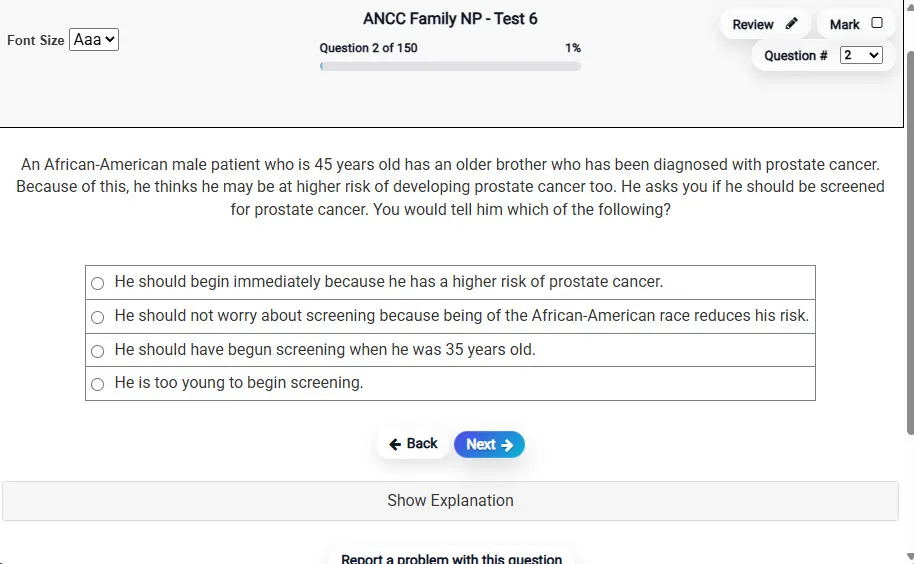
Answering a Question screen – Multiple-choice item view with navigation controls and progress tracker.
Answering a Question Multiple-choice item view with navigation controls and progress tracker.

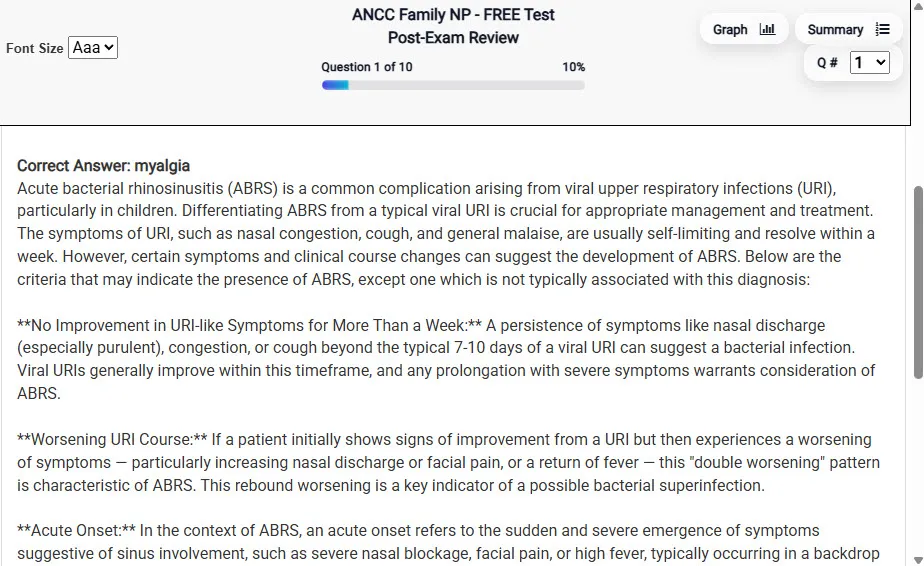
                           Detailed Explanation screen – 
                         Review mode showing chosen answer and rationale and references.
Detailed Explanation Review mode showing chosen answer and rationale and references.

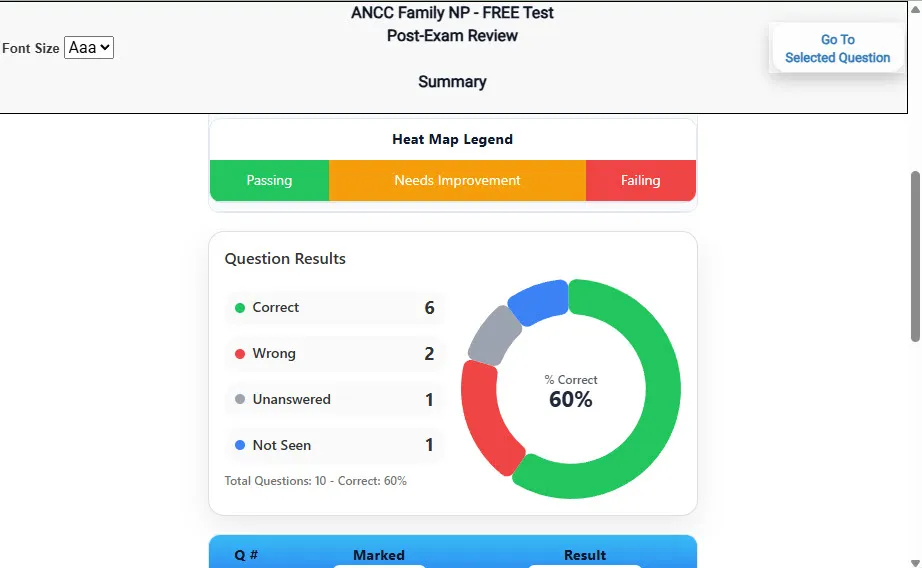
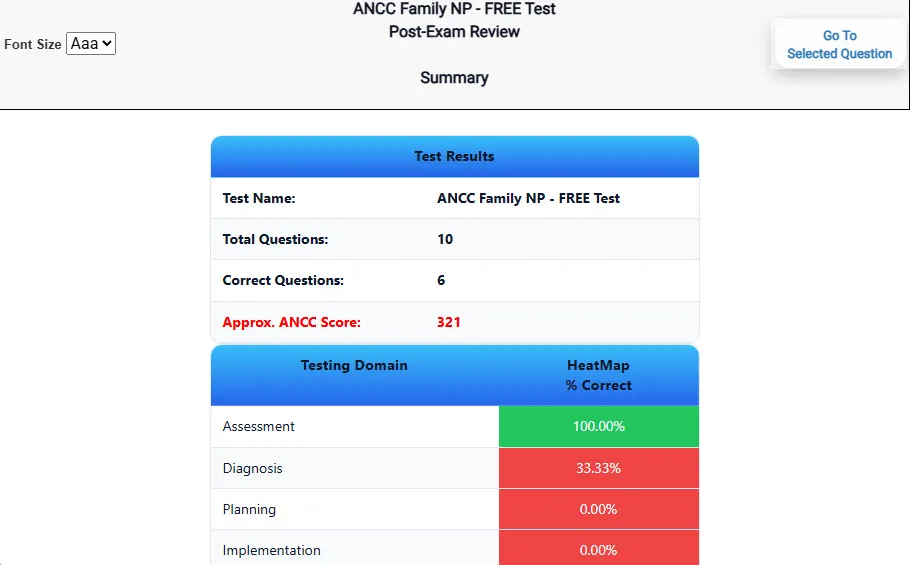
                           Review Summary 1 screen – 
                         Summary with counts for correct/wrong/unanswered and not seen items.
Review Summary 1 Summary with counts for correct/wrong/unanswered and not seen items.

                           Review Summary 2 screen – 
                         Advanced summary with category/domain breakdown and performance insights.
Review Summary 2 Advanced summary with category/domain breakdown and performance insights.

What Each Screen Shows

Answer Question Screen

  • Clean multiple-choice interface with progress bar.
  • Mark for review feature.
  • Matches real test pacing.

Detailed Explanation

  • Correct answer plus rationale.
  • Key concepts and guidelines highlighted.
  • Move between questions to fill knowledge gaps.

Review Summary 1

  • Overall results with total questions and scaled score.
  • Domain heatmap shows strengths and weaknesses.
  • Quick visual feedback on study priorities.

Review Summary 2

  • Chart of correct, wrong, unanswered, not seen.
  • Color-coded results for easy review.
  • Links back to missed items.

Top 10 Reasons to Use Exam Edge for your NYSTCE ATAS Exam Prep

  1. Focused on the NYSTCE ATAS Exam

    Our practice tests are built specifically for the NYSTCE ATAS Combined exam — every question mirrors the real topics, format, and difficulty so you're studying exactly what matters.

  2. Real Exam Simulation

    We match the per-question time limits and pressure of the actual NYSTCE exam, so test day feels familiar and stress-free.

  3. 30 Full Practice Tests & 3,000 Unique Questions

    You'll have more than enough material to master every NYSTCE ATAS Combined concept — no repeats, no fluff.

  4. Lower Cost Than a Retake

    Ordering 5 practice exams costs less than retaking the NYSTCE ATAS exam after a failure. One low fee could save you both time and money.

  5. Flexible Testing

    Need to step away mid-exam? Pick up right where you left off — with your remaining time intact.

  6. Instant Scoring & Feedback

    See your raw score and an estimated NYSTCE ATAS score immediately after finishing each practice test.

  7. Detailed Explanations for Every Question

    Review correct and incorrect answers with clear, step-by-step explanations so you truly understand each topic.

  8. Trusted & Accredited

    We're fully accredited by the Better Business Bureau and uphold the highest standards of trust and transparency.

  9. Web-Based & Always Available

    No software to install. Access your NYSTCE ATAS Combined practice exams 24/7 from any computer or mobile device.

  10. Expert Support When You Need It

    Need extra help? Our specialized tutors are highly qualified and ready to support your NYSTCE exam prep.


Pass the NYSTCE ATAS Exam with Realistic Practice Tests from Exam Edge

Preparing for your upcoming NYSTCE ATAS (95) Certification Exam can feel overwhelming — but the right practice makes all the difference. Exam Edge gives you the tools, structure, and confidence to pass on your first try. Our online practice exams are built to match the real NYSTCE ATAS Combined exam in content, format, and difficulty.

  • 📝 30 NYSTCE ATAS Practice Tests: Access 30 full-length exams with 100 questions each, covering every major NYSTCE ATAS topic in depth.
  • Instant Online Access: Start practicing right away — no software, no waiting.
  • 🧠 Step-by-Step Explanations: Understand the reasoning behind every correct answer so you can master NYSTCE ATAS Combined exam concepts.
  • 🔄 Retake Each Exam Up to 4 Times: Build knowledge through repetition and track your improvement over time.
  • 🌐 Web-Based & Available 24/7: Study anywhere, anytime, on any device.
  • 🧘 Boost Your Test-Day Confidence: Familiarity with the NYSTCE format reduces anxiety and helps you perform under pressure.

These NYSTCE ATAS practice exams are designed to simulate the real testing experience by matching question types, timing, and difficulty level. This approach helps you get comfortable not just with the exam content, but also with the testing environment, so you walk into your exam day focused and confident.

Exam Edge ATAS Reviews


NYSTCE ATAS Aliases Test Name

Here is a list of alternative names used for this exam.

  • NYSTCE ATAS
  • NYSTCE ATAS test
  • NYSTCE ATAS Certification Test
  • NYSTCE ATAS Combined test
  • ATAS
  • ATAS 95
  • 95 test
  • NYSTCE ATAS (95)
  • NYSTCE certification