This is the content of the pop-over!

Lightning Deal Alert – 12% Off Ends at Midnight!

Strike while the savings are hot! Use promo code FlashSale at checkout for 12% off any Exam Edge test or bundle. Hurry—the clock is ticking!

ASHA Speech-Language Pathology (ASHA) Practice Tests & Test Prep by Exam Edge


ASHA Speech-Language Pathology  product image
(4.4)
Based on 22 Reviews

  • Real Exam Simulation: Timed questions and matching content build comfort for your ASHA Speech-Language Pathology test day.
  • Instant, 24/7 Access: Web-based ASHA Speech-Language Pathology practice exams with no software needed.
  • Clear Explanations: Step-by-step answers and explanations for your ASHA exam to strengthen understanding.
  • Boosted Confidence: Reduces anxiety and improves test-taking skills to ace your ASHA Speech-Language Pathology (ASHA).

Featured on

ASHA Speech-Language Pathology Online Practice Test Bundles

BEST VALUE
15 practice tests

$149.25

$599.25

SAVE $450

Only $9.95 per test!

  • 100% Pass Guarantee
  • 15 online practice tests
  • 120 questions per test
  • Bonus: 100 Flash Cards + Study Guide
  • Instant access
  • Detailed Explanations
  • Practice tests never expire
  • Timed, untimed, or study guide mode
MOST POPULAR
10 practice tests

$99.50

$399.50

SAVE $300

Only $9.95 per test!

  • 10 online practice tests
  • 120 questions per test
  • Bonus: 100 Flash Cards + Study Guide
  • Instant access
  • Detailed Explanations
  • Practice tests never expire
  • Timed, untimed, or study guide mode
5 practice tests

$69.75

$199.75

SAVE $130

Only $13.95 per test!

  • 5 online practice tests
  • 120 questions per test
  • Bonus: 100 Flash Cards
  • Instant access
  • Detailed Explanations
  • Practice tests never expire
  • Timed, untimed, or study guide mode
1 practice test

$39.95

  • 1 online practice test
  • 120 questions per test
  • Instant access
  • Detailed Explanations
  • Practice tests never expire
  • Timed, untimed, or study guide mode
Quick Select
Tap to choose a bundle

** All Prices are in US Dollars (USD) **


ASHA Speech-Language Pathology (ASHA) Resources

Jump to the section you need most.

Understanding the exact breakdown of the ASHA Speech-Language Pathology test will help you know what to expect and how to most effectively prepare. The ASHA Speech-Language Pathology has 120 multiple-choice questions . The exam will be broken down into the sections below:

ASHA Speech-Language Pathology Exam Blueprint
Domain Name % Number of
Questions
Basic Human Communication Processes 17% 20
Phonological and Language Disorders 19% 23
Speech Disorders 13% 16
Neurogenic Disorders 19% 23
Audiology/Hearing 5% 6
Clinical Management 19% 23
Professional Issues/Psychometrics/Research 8% 10

ASHA Speech-Language Pathology Study Tips by Domain

  • Auditory system: distinguish conductive vs sensorineural pathways (outer/middle vs inner ear/CN VIII)—red flag if a case mixes air-bone gap findings with true neural signs.
  • Speech production: map respiration, phonation, resonance, and articulation to likely breakdown sites—common trap is attributing hypernasality to articulation when velopharyngeal dysfunction is the priority suspect.
  • Language processing: separate form/content/use and receptive vs expressive demands—priority rule is to judge performance relative to linguistic load (e.g., sentence complexity) before labeling a disorder.
  • Neuroanatomy basics: relate cortical/subcortical regions (e.g., perisylvian network, cerebellum, basal ganglia) to communication roles—red flag when symptoms suggest diffuse vs focal involvement (e.g., attention/executive deficits driving “language” errors).
  • Typical development: know major milestones for speech sound acquisition and early language growth—common trap is over-pathologizing errors that are developmentally typical for age or dialectal variation.
  • Swallowing/airway protection fundamentals: understand oral, pharyngeal, esophageal phases and coordination with respiration—contraindication cue is coughing/wet voice after thin liquids, which warrants instrumental evaluation considerations rather than bedside-only conclusions.
  • Differentiate disorder types: phonological (pattern-based) vs articulation (sound-specific) vs childhood apraxia of speech (motor planning) — red flag for CAS is inconsistent errors with vowel distortions and prosodic disruption, so avoid relying on one standardized score alone.
  • Use intelligibility and stimulability to set priorities — treat sounds/patterns that most improve intelligibility first, and a common trap is targeting later-developing sounds when a broader phonological process (e.g., stopping, fronting) is driving reduced clarity.
  • Identify and interpret phonological processes with age expectations — red flag is persistence of typically eliminated processes (e.g., final consonant deletion) beyond expected ages or emergence of atypical processes, which warrants broader language/hearing/structural screening.
  • Plan evidence-based phonology intervention: minimal pairs for contrasts, multiple oppositions for phoneme collapse, cycles for multiple processes — priority rule is choose an approach that matches the error system rather than drilling isolated sounds.
  • Assess language across form, content, and use (morphology/syntax, semantics, pragmatics) using multiple measures (sample + standardized) — common trap is over-interpreting a single composite score without corroborating functional language impacts in context.
  • Consider bilingual/multidialectal differences vs disorders using language exposure history and dynamic assessment — red flag is treating a difference (e.g., dialectal tense marking) as impairment, so document patterns across languages and response to mediated learning.
  • Differentiate dysarthria vs. apraxia of speech: dysarthria shows consistent weakness-based errors with abnormal rate/respiration, while AOS shows inconsistent errors and groping—red flag is calling inconsistent sound errors “dysarthria.”
  • For stuttering, document core behaviors (repetitions, prolongations, blocks) plus secondary behaviors and impact; priority rule is functional communication burden can justify treatment even when %SS is low.
  • In voice assessment, include perceptual, acoustic (e.g., jitter/shimmer), and aerodynamic data plus stimulability; contraindication is initiating intensive voice therapy without ENT laryngeal visualization when red flags exist (e.g., persistent hoarseness >3 weeks, pain, hemoptysis).
  • For resonance disorders, separate hypernasality vs. nasal emission vs. cul-de-sac; common trap is treating suspected VPI with oral-motor exercises instead of referring for structural/velopharyngeal management.
  • Motor speech treatment planning should match subsystem deficits (respiration/phonation/articulation/prosody) and severity; practical cue is using AMRs/SMRs to flag rate/coordination issues and avoiding solely articulation drills when intelligibility is driven by prosody/phonation.
  • In articulation/phonetic speech sound errors (non-phonological), test stimulability and consider distortion-specific methods (e.g., /r/, lisps); red flag is labeling a single-sound distortion as a phonological disorder and overgeneralizing minimal pairs.
  • Differentiate aphasia types by hallmark signs (e.g., fluent output with poor comprehension suggests Wernicke’s)—red flag: calling it “global aphasia” without documenting both severely impaired comprehension and expression.
  • In dysarthria, match perceptual features to likely subsystem involvement (e.g., strained-strangled voice and hyperadduction suggests spastic)—common trap: labeling severity without an intelligibility measure and functional impact statement.
  • For apraxia of speech (AOS), prioritize motor-planning markers (inconsistent errors, groping, disrupted prosody)—red flag: mistaking consistent phonological patterns for AOS and skipping a language assessment for co-occurring aphasia.
  • For cognitive-communication disorders (e.g., TBI, dementia), link deficits to participation and safety (attention, memory, executive function)—priority rule: address decision-making capacity and caregiver training early when reduced insight or poor carryover is present.
  • In dysphagia management, use instrumental assessment (VFSS/FEES) when bedside signs are inconclusive—contraindication cue: do not recommend thin liquids or unrestricted diets when there are overt aspiration signs, recurrent pneumonia, or unexplained weight loss.
  • For AAC in neurogenic conditions (stroke, ALS, MS), plan for progression, access, and message needs—common trap: selecting a device without confirming reliable access method (e.g., switch/eye gaze) and training communication partners.
  • When reviewing an audiogram, treat any air–bone gap ≥10 dB as a conductive component and check for masking needs (red flag: assuming symmetric thresholds means no masking).
  • Use tympanometry to interpret middle-ear status: Type B with normal ear canal volume suggests effusion, while Type B with large volume suggests perforation/PE tube (common trap: ignoring ear canal volume).
  • For speech audiometry, expect SRT to agree with PTA within ~7–10 dB; large discrepancies are a reliability red flag or suggest nonorganic loss.
  • In pediatric hearing, prioritize early identification and referral for amplification/early intervention when permanent loss is suspected (priority rule: do not delay services while “watching and waiting” for missed developmental milestones).
  • With suspected noise-induced hearing loss, look for a 3–6 kHz notch and counsel on hearing protection (common trap: attributing high-frequency loss solely to aging without exposure history).
  • Know when to refer to audiology/ENT: sudden sensorineural loss, unilateral/asymmetric SNHL, otalgia/otorrhea, or tinnitus with neurologic signs are urgent red flags requiring medical evaluation.
  • Use an ICF-based clinical reasoning chain (impairment → activity/participation → contextual factors) when selecting goals; red flag: goals that target only test scores without functional impact or caregiver priorities.
  • Write measurable goals with condition, criterion, and timeframe (e.g., “80% accuracy across 3 sessions”); common trap: vague targets like “increase intelligibility” without operational definitions.
  • Select intervention approaches that match diagnosis and stage of recovery (e.g., restorative vs compensatory) and document skilled need; red flag: providing repetitive practice without an evidence-based rationale for cueing hierarchy or progression.
  • Plan dosing (frequency, intensity, duration) and service delivery (individual/group/telepractice) based on evidence and feasibility; priority rule: justify departures from typical dosage and document barriers (fatigue, scheduling, access).
  • Implement ongoing data-based decision-making with clear mastery and discharge criteria; common trap: continuing treatment despite plateau without revising targets, approach, or referring back to medical/interdisciplinary team.
  • Ensure safety and contraindications are addressed during sessions (positioning, aspiration risk, cognitive/behavioral safety) and document adverse events; red flag: initiating oral trials or complex tasks without current swallow status/medical clearance or appropriate supervision.
  • Apply ASHA Code of Ethics and Scope of Practice to case vignettes—red flag: dual relationships or “friendly” gifts that could be viewed as a conflict of interest.
  • Use informed consent and confidentiality correctly (HIPAA/FERPA context)—common trap: sharing de-identified details that are still identifiable in small schools/clinics.
  • Interpret test scores with psychometric limits in mind—priority rule: don’t diagnose from a single score when confidence intervals or standard error of measurement suggest overlap with typical performance.
  • Differentiate reliability vs. validity vs. sensitivity/specificity—red flag: assuming a highly reliable test is automatically valid for the specific population (e.g., bilingual clients) or purpose (screening vs. diagnosis).
  • Select and critique research using evidence-based practice (EBP)—common trap: treating correlation as causation or overgeneralizing findings from small, non-random samples.
  • Handle clinical documentation, billing, and supervision ethically—red flag: “upcoding,” billing for missed sessions, or counting observation-only hours as direct supervision when requirements aren’t met.


Built to Fit Into Your Busy Life

Everything you need to prepare with confidence—without wasting a minute.

Three Study Modes

Timed, No Time Limit, or Explanation mode.

Actionable Analytics

Heatmaps and scaled scores highlight weak areas.

High-Yield Rationales

Concise explanations emphasize key concepts.

Realistic Interface

Matches the feel of the actual exam environment.

Accessible by Design

Clean layout reduces cognitive load.

Anytime, Anywhere

Web-based access 24/7 on any device.
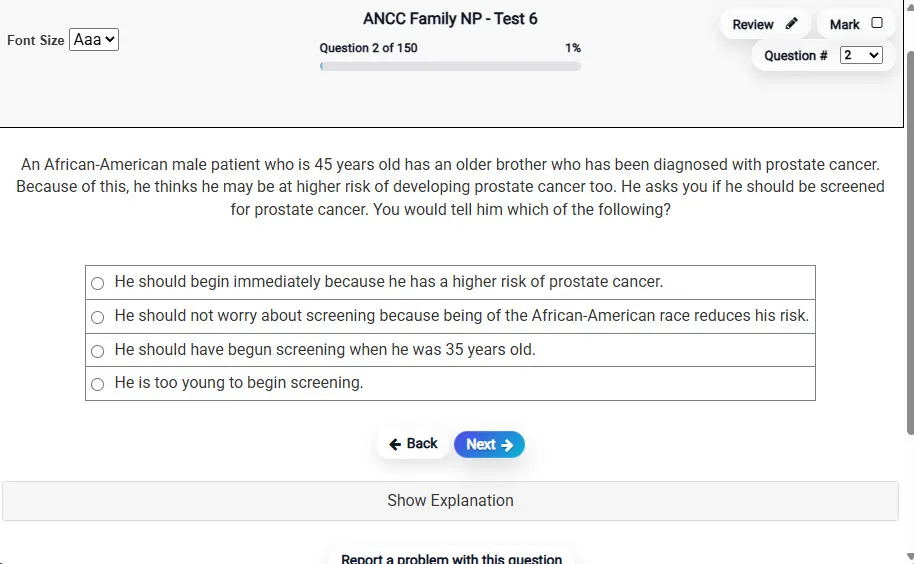
Answering a Question screen – Multiple-choice item view with navigation controls and progress tracker.
Answering a Question Multiple-choice item view with navigation controls and progress tracker.

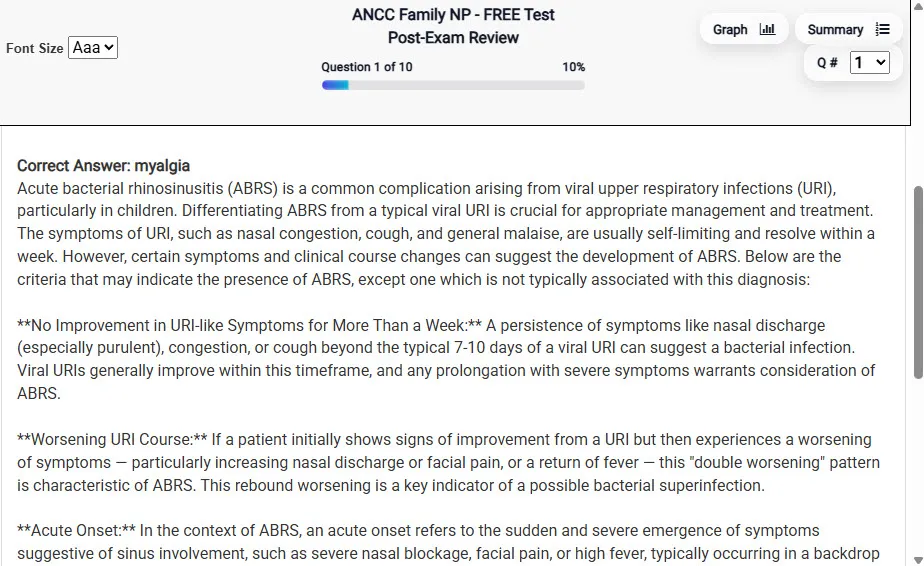
                           Detailed Explanation screen – 
                         Review mode showing chosen answer and rationale and references.
Detailed Explanation Review mode showing chosen answer and rationale and references.

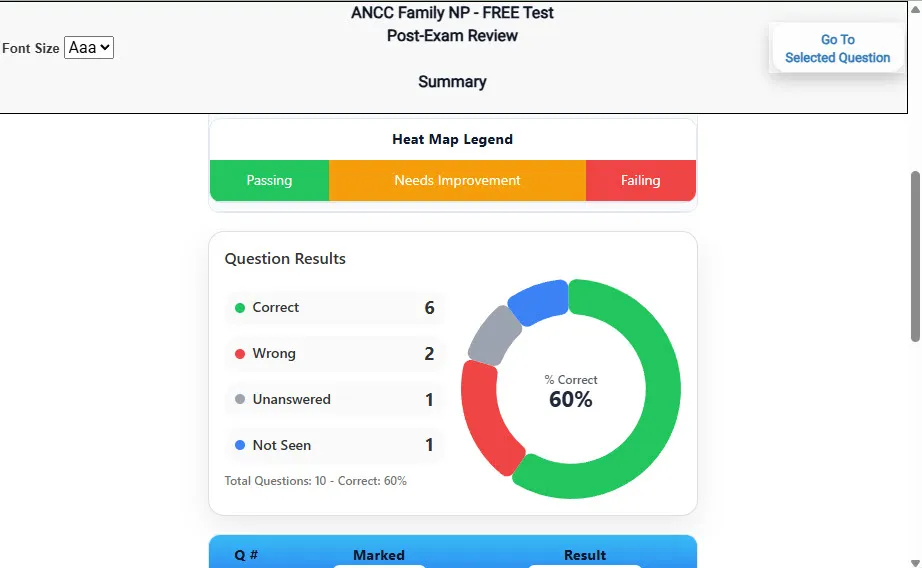
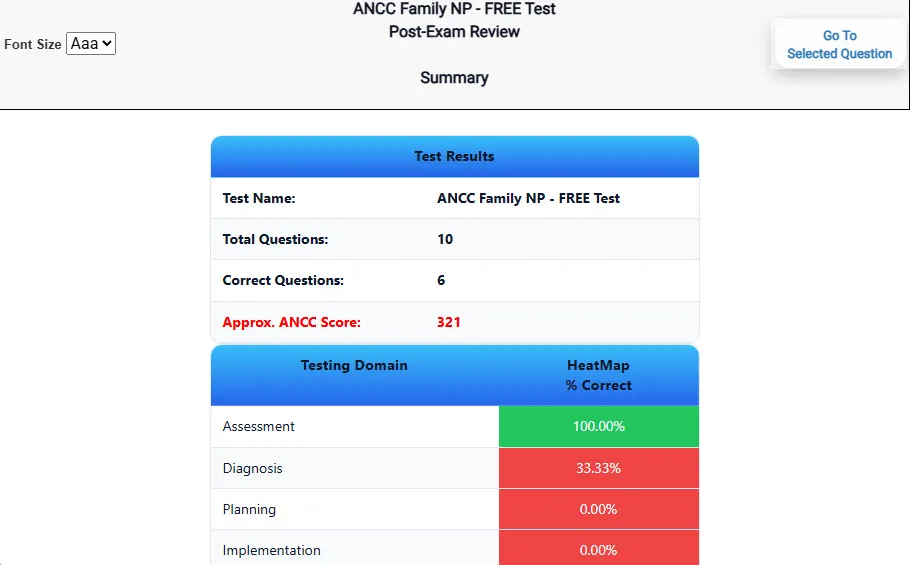
                           Review Summary 1 screen – 
                         Summary with counts for correct/wrong/unanswered and not seen items.
Review Summary 1 Summary with counts for correct/wrong/unanswered and not seen items.

                           Review Summary 2 screen – 
                         Advanced summary with category/domain breakdown and performance insights.
Review Summary 2 Advanced summary with category/domain breakdown and performance insights.

What Each Screen Shows

Answer Question Screen

  • Clean multiple-choice interface with progress bar.
  • Mark for review feature.
  • Matches real test pacing.

Detailed Explanation

  • Correct answer plus rationale.
  • Key concepts and guidelines highlighted.
  • Move between questions to fill knowledge gaps.

Review Summary 1

  • Overall results with total questions and scaled score.
  • Domain heatmap shows strengths and weaknesses.
  • Quick visual feedback on study priorities.

Review Summary 2

  • Chart of correct, wrong, unanswered, not seen.
  • Color-coded results for easy review.
  • Links back to missed items.

Top 10 Reasons to Use Exam Edge for your ASHA Speech-Language Pathology Exam Prep

  1. Focused on the ASHA Speech-Language Pathology Exam

    Our practice tests are built specifically for the ASHA Speech-Language Pathology exam — every question mirrors the real topics, format, and difficulty so you're studying exactly what matters.

  2. Real Exam Simulation

    We match the per-question time limits and pressure of the actual ASHA exam, so test day feels familiar and stress-free.

  3. 15 Full Practice Tests & 1,800 Unique Questions

    You'll have more than enough material to master every ASHA Speech-Language Pathology concept — no repeats, no fluff.

  4. Lower Cost Than a Retake

    Ordering 5 practice exams costs less than retaking the ASHA Speech-Language Pathology exam after a failure. One low fee could save you both time and money.

  5. Flexible Testing

    Need to step away mid-exam? Pick up right where you left off — with your remaining time intact.

  6. Instant Scoring & Feedback

    See your raw score and an estimated ASHA Speech-Language Pathology score immediately after finishing each practice test.

  7. Detailed Explanations for Every Question

    Review correct and incorrect answers with clear, step-by-step explanations so you truly understand each topic.

  8. Trusted & Accredited

    We're fully accredited by the Better Business Bureau and uphold the highest standards of trust and transparency.

  9. Web-Based & Always Available

    No software to install. Access your ASHA Speech-Language Pathology practice exams 24/7 from any computer or mobile device.

  10. Expert Support When You Need It

    Need extra help? Our specialized tutors are highly qualified and ready to support your ASHA exam prep.


Pass the ASHA Speech-Language Pathology Exam with Realistic Practice Tests from Exam Edge

Preparing for your upcoming ASHA Speech-Language Pathology (ASHA) Certification Exam can feel overwhelming — but the right practice makes all the difference. Exam Edge gives you the tools, structure, and confidence to pass on your first try. Our online practice exams are built to match the real ASHA Speech-Language Pathology exam in content, format, and difficulty.

  • 📝 15 ASHA Speech-Language Pathology Practice Tests: Access 15 full-length exams with 120 questions each, covering every major ASHA Speech-Language Pathology topic in depth.
  • Instant Online Access: Start practicing right away — no software, no waiting.
  • 🧠 Step-by-Step Explanations: Understand the reasoning behind every correct answer so you can master ASHA Speech-Language Pathology exam concepts.
  • 🔄 Retake Each Exam Up to 4 Times: Build knowledge through repetition and track your improvement over time.
  • 🌐 Web-Based & Available 24/7: Study anywhere, anytime, on any device.
  • 🧘 Boost Your Test-Day Confidence: Familiarity with the ASHA format reduces anxiety and helps you perform under pressure.

These ASHA Speech-Language Pathology practice exams are designed to simulate the real testing experience by matching question types, timing, and difficulty level. This approach helps you get comfortable not just with the exam content, but also with the testing environment, so you walk into your exam day focused and confident.

Exam Edge ASHA Reviews


ASHA Speech-Language Pathology Aliases Test Name

Here is a list of alternative names used for this exam.

  • ASHA Speech-Language Pathology
  • ASHA Speech-Language Pathology test
  • ASHA Speech-Language Pathology Certification Test
  • ASHA
  • ASHA ASHA
  • ASHA test
  • ASHA Speech-Language Pathology (ASHA)
  • Speech-Language Pathology certification