This is the content of the pop-over!

Lightning Deal Alert – 12% Off Ends at Midnight!

Strike while the savings are hot! Use promo code FlashSale at checkout for 12% off any Exam Edge test or bundle. Hurry—the clock is ticking!

ARRT® Limited Scope in Radiography (LSPR) Practice Tests & Test Prep by Exam Edge


ARRT Limited Scope of Practice in Radiography  product image
(4.9)
Based on 22 Reviews

  • Real Exam Simulation: Timed questions and matching content build comfort for your ARRT Limited Scope in Radiography test day.
  • Instant, 24/7 Access: Web-based ARRT Limited Scope of Practice in Radiography practice exams with no software needed.
  • Clear Explanations: Step-by-step answers and explanations for your ARRT exam to strengthen understanding.
  • Boosted Confidence: Reduces anxiety and improves test-taking skills to ace your ARRT Limited Scope of Practice in Radiography (LSPR).

Featured on

ARRT Limited Scope of Practice in Radiography Online Practice Test Bundles

BEST VALUE
10 practice tests

$99.50

$399.50

SAVE $300

Only $9.95 per test!

  • 100% Pass Guarantee
  • 10 online practice tests
  • 100 questions per test
  • Bonus: 100 Flash Cards + Study Guide
  • Instant access
  • Detailed Explanations
  • Practice tests never expire
  • Timed, untimed, or study guide mode
5 practice tests

$69.75

$199.75

SAVE $130

Only $13.95 per test!

  • 5 online practice tests
  • 100 questions per test
  • Bonus: 100 Flash Cards + Study Guide
  • Instant access
  • Detailed Explanations
  • Practice tests never expire
  • Timed, untimed, or study guide mode
1 practice test

$39.95

  • 1 online practice test
  • 100 questions per test
  • Instant access
  • Detailed Explanations
  • Practice tests never expire
  • Timed, untimed, or study guide mode
Quick Select
Tap to choose a bundle

** All Prices are in US Dollars (USD) **


ARRT Limited Scope in Radiography (LSPR) Resources

Jump to the section you need most.

Understanding the exact breakdown of the ARRT Limited Scope of Practice in Radiography test will help you know what to expect and how to most effectively prepare. The ARRT Limited Scope of Practice in Radiography has multiple-choice questions . The exam will be broken down into the sections below:

ARRT Limited Scope of Practice in Radiography Exam Blueprint
Domain Name % Number of
Questions
Radiation Protection 22.5% 23
Equipment Operation and Quality Control 11.0% 11
Image Acquisition and Evaluation 22.5% 23
Image Procedures 29% 29
Patient Care and Education 15.0% 15

ARRT Limited Scope of Practice in Radiography Study Tips by Domain

  • Apply ALARA with a concrete priority rule: time, distance, shielding—never compensate for a “quick” exam by skipping shielding when it won’t obscure anatomy.
  • Verify beam limitation before exposure: collimate to the area of clinical interest and align the light field to the IR; red flag—routine wide fields increase dose and scatter and often fail QC review.
  • Select technique to minimize dose while maintaining diagnostic quality: use the highest practical kVp with appropriate mAs for the part; common trap—repeating due to underexposure from “low everything” increases total dose.
  • Use protective shielding appropriately: place gonadal or fetal shielding only when it does not obscure required anatomy; contraindication—do not shield if it covers the region of interest or interferes with AEC sensing.
  • Manage special populations: if pregnancy is known or suspected, confirm exam necessity, use the lowest reasonable dose, and document communication; red flag—proceeding without clarification when LMP status is uncertain.
  • Protect staff and bystanders: keep nonessential persons out of the room and ensure anyone who must remain wears lead protection and stands at maximum feasible distance; common trap—allowing a holder to stand in the primary beam.
  • Perform and document required QC at the facility-defined frequency before clinical use; red flag: skipping checks after tube/CR-DR service or software updates.
  • Verify correct use of grids and alignment (grid ratio, centering, SID) to prevent cutoff; common trap: using a focused grid at the wrong SID or off-centering with mobile exams.
  • Set appropriate technique factors using the chart (kVp/mAs, AEC if applicable) and confirm backup time; red flag: repeated “dose creep” from routinely increasing mAs to avoid noise.
  • Check collimator light field, PBL/positive beam limitation, and field congruence; priority rule: stop and report if light and x-ray fields are visibly mismatched or shutters drift.
  • Confirm detector/IR selection and proper exposure indicator (EI) behavior for the system in use; common trap: wrong exam menu or processing algorithm causing misleading EI and poor contrast.
  • Apply safe warm-up/operation practices for the x-ray tube and manage heat load; red flag: back-to-back high-mAs exposures triggering rotor/anode overheating warnings or automatic shutdown.
  • Before exposure, verify patient ID using two identifiers and confirm the ordered view/site/side; red flag: any mismatch or absent laterality marker requires a stop-and-clarify.
  • Select kVp/mAs and SID appropriate to the exam while minimizing repeats; common trap: increasing mAs to “fix” underpenetration when kVp is actually too low.
  • Use accurate positioning, IR placement, and collimation to include required anatomy with proper alignment; red flag: cut-off anatomy or rotation means the image is non-diagnostic even if exposure looks acceptable.
  • Assess exposure indicators and image appearance for quantum mottle vs. saturation; priority rule: do not “dose creep” by routinely using higher technique just to make images look smoother.
  • Evaluate for motion and apply immobilization or breathing instructions as needed; common trap: repeating without changing the cause (e.g., not shortening exposure time for tremors or inability to hold still).
  • Confirm correct anatomical side markers and image orientation on every image; red flag: post-processing markers or missing markers can invalidate the study and may require repeat per facility policy.
  • Verify the order, correct body part/side, and required views before positioning; red flag: any laterality mismatch between requisition, markers, and patient statement must be resolved before exposure.
  • Select projections that best demonstrate the anatomy of interest and immobilize to prevent motion; common trap: accepting a rotated or motion-blurred image instead of repeating immediately while the patient is still positioned.
  • Use correct anatomic landmarking and centering for each view; priority rule: if anatomy is clipped (e.g., missing joint space or apices), adjust collimation/centering and repeat rather than trying to “salvage” with post-processing.
  • Apply appropriate markers on every exposure and place them where they do not obscure critical anatomy; red flag: adding digital markers after the fact may be noncompliant for many facilities and is a frequent audit finding.
  • Adapt routine procedures for trauma or limited mobility using cross-table or modified positions; contraindication: never force a painful extremity into a standard position when a safe alternative view can answer the clinical question.
  • Perform image evaluation in-room for positioning, anatomy inclusion, and artifacts before releasing the patient; common trap: overlooking external artifacts (jewelry, ECG leads, clothing snaps) that mandate removal and repeat if they obscure the area of interest.
  • Verify patient identity with at least two identifiers and match the order to the correct exam/site; red flag: discrepancies in name/DOB or laterality require stopping and re-verifying before positioning.
  • Screen for pregnancy risk in patients of childbearing potential and follow facility policy for documentation and escalation; common trap: proceeding based on verbal “not pregnant” without the required attestation or supervisor notification.
  • Assess for mobility limits, pain, and fall risk before transfers and positioning, using assist devices and help as needed; priority rule: if you can’t move the patient safely with available support, don’t attempt the transfer alone.
  • Use clear, simple instructions and confirm understanding (especially for breath-holds and motion control); red flag: patients who are hard-of-hearing, confused, or non-English-speaking need an alternate communication plan before exposure.
  • Recognize and respond to adverse events (vasovagal episode, contrast reaction if applicable in your setting) by stopping the exam and activating the appropriate response; contraindication: do not leave an unstable patient unattended on the table.
  • Maintain infection control with hand hygiene and correct PPE, and clean/disinfect contact surfaces between patients; common trap: forgetting high-touch items (sponges, immobilizers, detector covers) that can transmit pathogens.


Built to Fit Into Your Busy Life

Everything you need to prepare with confidence—without wasting a minute.

Three Study Modes

Timed, No Time Limit, or Explanation mode.

Actionable Analytics

Heatmaps and scaled scores highlight weak areas.

High-Yield Rationales

Concise explanations emphasize key concepts.

Realistic Interface

Matches the feel of the actual exam environment.

Accessible by Design

Clean layout reduces cognitive load.

Anytime, Anywhere

Web-based access 24/7 on any device.
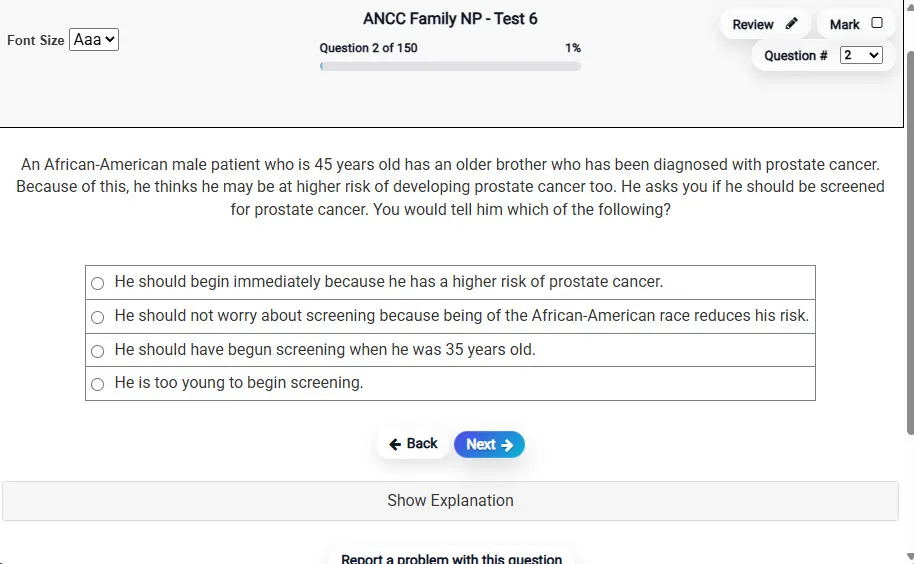
Answering a Question screen – Multiple-choice item view with navigation controls and progress tracker.
Answering a Question Multiple-choice item view with navigation controls and progress tracker.

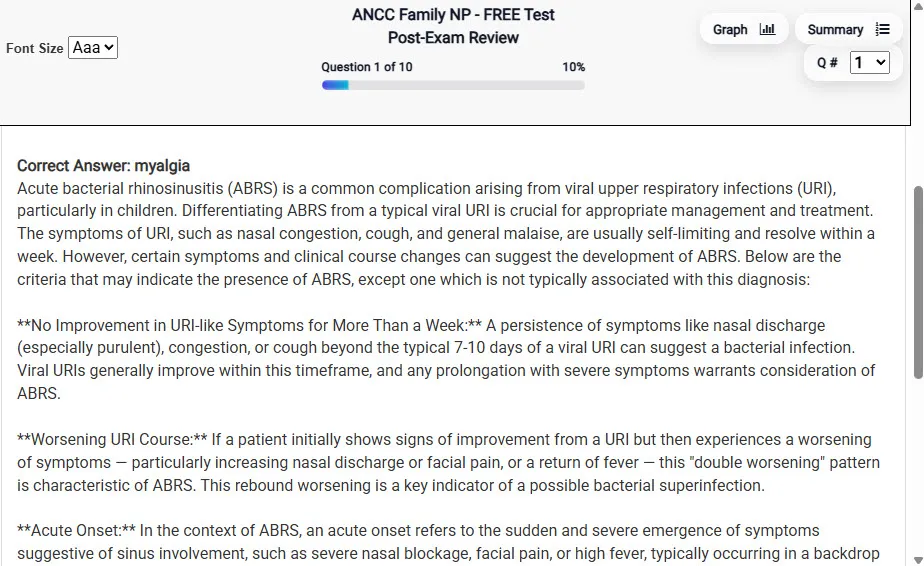
                           Detailed Explanation screen – 
                         Review mode showing chosen answer and rationale and references.
Detailed Explanation Review mode showing chosen answer and rationale and references.

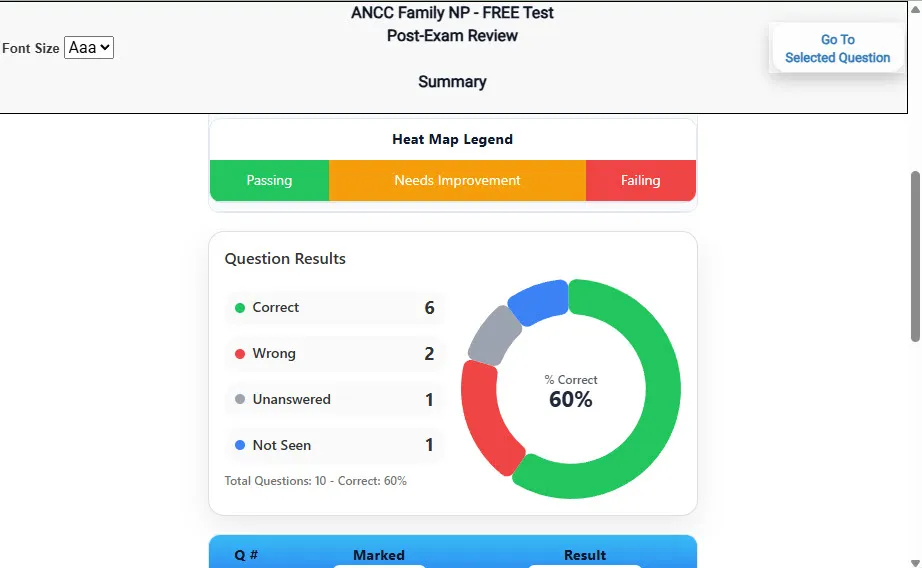
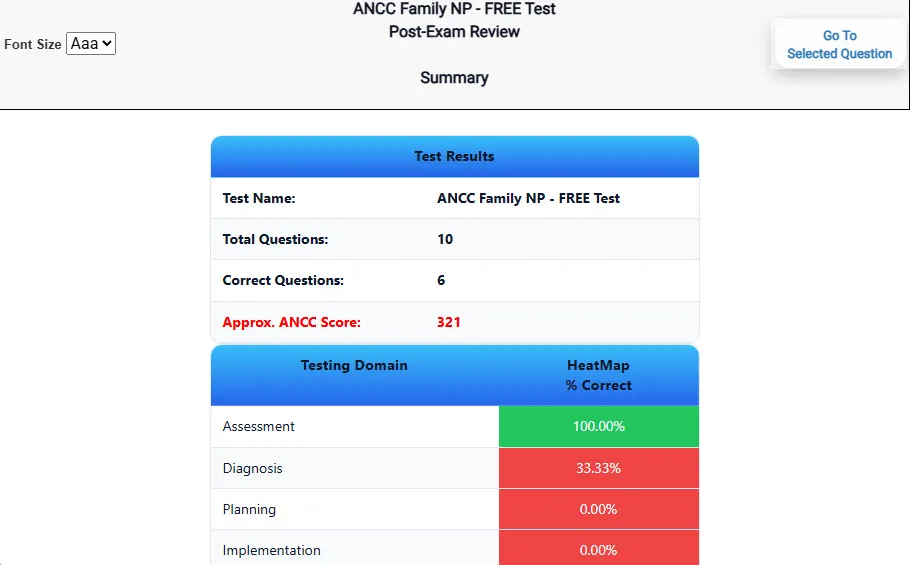
                           Review Summary 1 screen – 
                         Summary with counts for correct/wrong/unanswered and not seen items.
Review Summary 1 Summary with counts for correct/wrong/unanswered and not seen items.

                           Review Summary 2 screen – 
                         Advanced summary with category/domain breakdown and performance insights.
Review Summary 2 Advanced summary with category/domain breakdown and performance insights.

What Each Screen Shows

Answer Question Screen

  • Clean multiple-choice interface with progress bar.
  • Mark for review feature.
  • Matches real test pacing.

Detailed Explanation

  • Correct answer plus rationale.
  • Key concepts and guidelines highlighted.
  • Move between questions to fill knowledge gaps.

Review Summary 1

  • Overall results with total questions and scaled score.
  • Domain heatmap shows strengths and weaknesses.
  • Quick visual feedback on study priorities.

Review Summary 2

  • Chart of correct, wrong, unanswered, not seen.
  • Color-coded results for easy review.
  • Links back to missed items.

Top 10 Reasons to Use Exam Edge for your ARRT Limited Scope of Practice in Radiography Exam Prep

  1. Focused on the ARRT Limited Scope of Practice in Radiography Exam

    Our practice tests are built specifically for the ARRT Limited Scope in Radiography exam — every question mirrors the real topics, format, and difficulty so you're studying exactly what matters.

  2. Real Exam Simulation

    We match the per-question time limits and pressure of the actual ARRT exam, so test day feels familiar and stress-free.

  3. 10 Full Practice Tests & 1,000 Unique Questions

    You'll have more than enough material to master every ARRT Limited Scope in Radiography concept — no repeats, no fluff.

  4. Lower Cost Than a Retake

    Ordering 5 practice exams costs less than retaking the ARRT Limited Scope of Practice in Radiography exam after a failure. One low fee could save you both time and money.

  5. Flexible Testing

    Need to step away mid-exam? Pick up right where you left off — with your remaining time intact.

  6. Instant Scoring & Feedback

    See your raw score and an estimated ARRT Limited Scope of Practice in Radiography score immediately after finishing each practice test.

  7. Detailed Explanations for Every Question

    Review correct and incorrect answers with clear, step-by-step explanations so you truly understand each topic.

  8. Trusted & Accredited

    We're fully accredited by the Better Business Bureau and uphold the highest standards of trust and transparency.

  9. Web-Based & Always Available

    No software to install. Access your ARRT Limited Scope in Radiography practice exams 24/7 from any computer or mobile device.

  10. Expert Support When You Need It

    Need extra help? Our specialized tutors are highly qualified and ready to support your ARRT exam prep.


Pass the ARRT Limited Scope of Practice in Radiography Exam with Realistic Practice Tests from Exam Edge

Preparing for your upcoming ARRT Limited Scope of Practice in Radiography (LSPR) Certification Exam can feel overwhelming — but the right practice makes all the difference. Exam Edge gives you the tools, structure, and confidence to pass on your first try. Our online practice exams are built to match the real ARRT Limited Scope in Radiography exam in content, format, and difficulty.

  • 📝 10 ARRT Limited Scope of Practice in Radiography Practice Tests: Access 10 full-length exams with 100 questions each, covering every major ARRT Limited Scope of Practice in Radiography topic in depth.
  • Instant Online Access: Start practicing right away — no software, no waiting.
  • 🧠 Step-by-Step Explanations: Understand the reasoning behind every correct answer so you can master ARRT Limited Scope in Radiography exam concepts.
  • 🔄 Retake Each Exam Up to 4 Times: Build knowledge through repetition and track your improvement over time.
  • 🌐 Web-Based & Available 24/7: Study anywhere, anytime, on any device.
  • 🧘 Boost Your Test-Day Confidence: Familiarity with the ARRT format reduces anxiety and helps you perform under pressure.

These ARRT Limited Scope of Practice in Radiography practice exams are designed to simulate the real testing experience by matching question types, timing, and difficulty level. This approach helps you get comfortable not just with the exam content, but also with the testing environment, so you walk into your exam day focused and confident.


Exam Edge ARRT Reviews


Hi, I just wanted to say thank you ! The tests really helped me prepare for the advanced level MRI ARRT Registry exam. 

Anthony , California

Thank you! I had tried to pass this exam before I found your site and was never able to do it. After your practice exams, I was able to pass on the next attempt!

Jane, PA

Thank you for being a great tool site for my VI certification exam. It helped me prepare for "battle". Practice makes perfect, alright.

Noel , NY

Sorry, but it didn't help me.

MARIA , Austin, Texas

Great practice for taking the MRI registry..the test gave me a baseline on the knowledge I have and the knowledge I need to study more on before taking the exam. It helped with the verbiage used for the questions.

DEBORA , Allen, Texas

Like MRI in Practice.

keith , Silver Spring , MD


ARRT Limited Scope of Practice in Radiography Aliases Test Name

Here is a list of alternative names used for this exam.

  • ARRT Limited Scope of Practice in Radiography
  • ARRT Limited Scope of Practice in Radiography test
  • ARRT Limited Scope of Practice in Radiography Certification Test
  • ARRT Limited Scope in Radiography test
  • ARRT
  • ARRT LSPR
  • LSPR test
  • ARRT Limited Scope of Practice in Radiography (LSPR)
  • Limited Scope of Practice in Radiography certification