This is the content of the pop-over!

Lightning Deal Alert – 12% Off Ends at Midnight!

Strike while the savings are hot! Use promo code FlashSale at checkout for 12% off any Exam Edge test or bundle. Hurry—the clock is ticking!

AAMA CMA Practice Tests & Exam Prep Questions


AAMA Certified Medical Assistant   product image
(4.5)
Based on 22 Reviews

  • Real Exam Simulation: Timed questions and matching content build comfort for your AAMA CMA test day.
  • Instant, 24/7 Access: Web-based AAMA Certified Medical Assistant practice exams with no software needed.
  • Clear Explanations: Step-by-step answers and explanations for your AAMA exam to strengthen understanding.
  • Boosted Confidence: Reduces anxiety and improves test-taking skills to ace your AAMA Certified Medical Assistant (CMA).

Featured on

AAMA Certified Medical Assistant Online Practice Test Bundles

BEST VALUE
20 practice tests

$174.00

$799.00

SAVE $625

Only $8.70 per test!

  • 100% Pass Guarantee
  • 20 online practice tests
  • 100 questions per test
  • Bonus: 100 Flash Cards + Study Guide
  • Instant access
  • Detailed Explanations
  • Practice tests never expire
  • Timed, untimed, or study guide mode
MOST POPULAR
10 practice tests

$99.50

$399.50

SAVE $300

Only $9.95 per test!

  • 10 online practice tests
  • 100 questions per test
  • Bonus: 100 Flash Cards + Study Guide
  • Instant access
  • Detailed Explanations
  • Practice tests never expire
  • Timed, untimed, or study guide mode
5 practice tests

$69.75

$199.75

SAVE $130

Only $13.95 per test!

  • 5 online practice tests
  • 100 questions per test
  • Bonus: 100 Flash Cards
  • Instant access
  • Detailed Explanations
  • Practice tests never expire
  • Timed, untimed, or study guide mode
1 practice test

$39.95

  • 1 online practice test
  • 100 questions per test
  • Instant access
  • Detailed Explanations
  • Practice tests never expire
  • Timed, untimed, or study guide mode
Quick Select
Tap to choose a bundle

** All Prices are in US Dollars (USD) **


AAMA CMA (CMA) Resources

Jump to the section you need most.

Understanding the exact breakdown of the AAMA Certified Medical Assistant test will help you know what to expect and how to most effectively prepare. The AAMA Certified Medical Assistant has multiple-choice questions . The exam will be broken down into the sections below:

AAMA Certified Medical Assistant Exam Blueprint
Domain Name % Number of
Questions
Anatomy and Physiology 11% 11
Medical Office Management - General Office Procedures 10% 10
Medical Office Management - Bookkeeping 4% 4
Medical Office Management - Insurance Processings 4% 4
Medical Procedures 12% 12
Patient Examination 12% 12
Phlebotomy 11% 11
Diagnostic Testing: ECG and other Lab Procedures 12% 12
Medical Terminology 12% 12
Pharmacology 12% 12

AAMA Certified Medical Assistant Study Tips by Domain

  • Know body planes/directions (anterior vs posterior, medial vs lateral, proximal vs distal)—common trap: mixing up plantar vs palmar or superficial vs deep on positioning questions.
  • Match homeostasis to vital-sign control (hypothalamus/thermoregulation, medulla/respiration)—red flag: sudden confusion + low glucose points to endocrine/metabolic issues, not musculoskeletal.
  • Heart blood flow sequence (vena cavae→RA→RV→pulmonary arteries→lungs→pulmonary veins→LA→LV→aorta)—priority rule: anything that bypasses lungs is an oxygenation risk.
  • Lung mechanics and gas exchange basics (alveoli, diaphragm, tidal volume)—common trap: thinking inhalation is passive; in normal breathing, inhalation is active and exhalation is passive.
  • Renal/urinary anatomy (nephron, ureter vs urethra, bladder)—red flag: flank pain + fever suggests upper-tract involvement, not just cystitis.
  • Musculoskeletal landmarks and function (major bones, joints, muscle actions)—contraindication cue: acute swelling/deformity after injury means immobilize and refer rather than perform range-of-motion testing.
  • HIPAA/privacy: verify identity with at least two identifiers before releasing PHI, and never discuss patient details in public areas (red flag: caller asking for results without documented authorization).
  • Telephone etiquette: prioritize emergent symptoms (e.g., chest pain, shortness of breath, stroke signs) for immediate escalation to the provider/EMS (trap: placing urgent clinical calls on hold or routing only to voicemail).
  • Scheduling: use a triage-based template (acute vs. routine, procedure time blocks) and document cancellations/no-shows with the office policy followed consistently (red flag: double-booking without provider approval).
  • Medical records handling: maintain accurate, timely documentation and secure storage; only release records with a valid signed authorization and required elements completed (trap: faxing to an unverified number or leaving charts unattended).
  • Professional communication: apply closed-loop messaging for provider instructions (read back critical orders, confirm completion) and document date/time, sender, and action taken (red flag: undocumented verbal requests).
  • Safety and compliance: follow OSHA Bloodborne Pathogens practices in front-office exposure scenarios (e.g., handling specimens, cleaning spills) and use proper incident reporting immediately (trap: delaying an exposure report beyond policy timelines).
  • Maintain a clear audit trail for every transaction (source document → journal entry → ledger → financial report); red flag: correcting errors without documentation or using white-out.
  • Reconcile bank statements monthly by matching deposits, checks, and electronic payments to the check register; common trap: ignoring outstanding checks or deposits in transit and forcing the balance.
  • Use internal controls to separate duties (receiving payments, posting, and depositing should not be one person when avoidable); priority rule: two-person verification for daily cash counts and deposits.
  • Post patient payments accurately by payment type (cash/check/card) and date, then batch and deposit the same day; red flag: holding cash in a drawer overnight or combining deposits from different days.
  • Track accounts receivable with aging reports (e.g., 0–30, 31–60, 61–90, 90+ days) and follow a consistent collection timeline; common trap: writing off balances without a documented adjustment reason and authorization.
  • Document adjustments distinctly from payments (contractual write-offs, refunds, NSF checks) and require approval for non-routine entries; contraindication: posting a refund without verifying the original payment and current account balance.
  • Verify coverage before nonemergent services by confirming member ID, effective dates, and required referrals/authorizations; red flag: assuming a plan is active because the patient presents an insurance card.
  • Code and document to medical necessity—match ICD-10-CM to CPT/HCPCS and include supporting notes; common trap: “rule out” diagnoses on outpatient claims can trigger denials.
  • Submit clean claims promptly and track payer filing limits (often 90–180 days); priority rule: correct patient demographics and payer ID first because small errors cause rejections, not denials.
  • Understand coordination of benefits (COB) and always bill primary before secondary; red flag: collecting/filing the wrong order when the patient has dual coverage (e.g., spouse plan plus own plan).
  • Handle denials systematically—distinguish rejection vs denial, correct and resubmit vs appeal, and meet appeal deadlines; common trap: appealing when the claim was never accepted due to a clearinghouse error.
  • Collect patient responsibility correctly by applying copays at time of service and posting deductibles/coinsurance after EOB/ERA; red flag: waiving copays routinely can violate payer contracts and trigger audits.
  • Use aseptic technique for all minor procedures (hand hygiene, clean-to-dirty field, sterile supplies); red flag: reaching over or contaminating a sterile field means you must replace contaminated items.
  • Before assisting with any procedure, verify the “right patient, right procedure, right site” and confirm consent is documented; common trap: proceeding when consent is verbal only or the form is unsigned/undated.
  • For wound care and dressing changes, cleanse from the least contaminated area outward and change gloves when moving to a dirtier step; priority rule: stop and report if you see increasing erythema, purulent drainage, or wound dehiscence.
  • When assisting with injections, know which routes CMAs typically may perform per policy and state law (e.g., IM, SQ, ID) and document lot/expiration for vaccines; contraindication cue: do not administer if an allergy or anaphylaxis history is identified.
  • During vital procedures like specimen collection, labeling must occur immediately at the bedside with two identifiers; red flag: any unlabeled or mismatched specimen is rejected—do not guess or relabel later.
  • For assisting with office-based procedures (e.g., suture removal, cast care, ear irrigation), monitor for vasovagal reactions and have the patient seated/lying as indicated; common trap: continuing despite dizziness, pallor, or bradycardia instead of stopping and alerting the provider.
  • Verify patient identity with at least two identifiers and confirm the chief complaint in the patient’s words; red flag: performing an exam after only calling the patient’s name in the waiting room.
  • Obtain vital signs using correct technique (proper cuff size, arm at heart level, patient seated/rested); common trap: documenting a blood pressure from an over-clothing cuff or immediately after exertion.
  • Use standard positions/draping and provide a chaperone per policy for sensitive exams; priority rule: document chaperone presence/refusal and stop if the patient withdraws consent.
  • Apply infection control before, during, and after the exam (hand hygiene, PPE, cleaning of stethoscope/otoscope); red flag: moving from a dirty to clean site without changing gloves or sanitizing hands.
  • Assist with focused assessments (e.g., visual acuity, hearing, ROM) and report abnormal findings promptly; threshold cue: sudden chest pain, shortness of breath, or neuro deficit requires immediate escalation rather than routine documentation.
  • Accurately document findings and patient tolerance in the medical record (objective descriptors, units, and time); common trap: charting subjective conclusions (e.g., “patient faking”) instead of observable facts.
  • Verify patient identity with at least two identifiers and label tubes in the patient’s presence; red flag: pre-labeling tubes or labeling away from the bedside is a common AAMA compliance trap.
  • Follow order of draw to prevent additive carryover (e.g., blood cultures → light blue → serum → green → lavender → gray); priority rule: a wrong order can falsely alter results like potassium or calcium.
  • Apply the tourniquet no longer than 1 minute and release once blood flow is established; red flag: prolonged tourniquet time causes hemoconcentration and can skew labs (e.g., protein, Hct).
  • Choose appropriate sites and avoid contraindications; contraindication: do not draw above an active IV infusion or from an arm with mastectomy/lymph node dissection unless explicitly authorized.
  • Prevent hemolysis by using correct needle gauge, allowing alcohol to dry, and gentle inversion of tubes (do not shake); common trap: forcing blood through a needle into a tube can hemolyze and invalidate potassium/LDH.
  • Manage complications promptly and document per policy; priority rule: if the patient becomes syncopal, stop the draw, remove the needle, and place the patient in a safe position (supine with legs elevated) before resuming any care.
  • For a standard 12-lead ECG, place V1 at the 4th intercostal space (ICS) right sternal border and V2 at the 4th ICS left sternal border—a common trap is placing them too high, which can falsely suggest anterior changes.
  • Before recording, verify patient identifiers and have the patient still, warm, and relaxed; red flag: shaky baseline or 60-cycle artifact often means muscle tension or poor electrode contact rather than true dysrhythmia.
  • Confirm correct limb lead placement (RA, LA, RL, LL) and avoid placing limb electrodes on the torso unless protocol allows; common trap: reversed arm leads can invert P/QRS/T and mimic ischemia.
  • When performing waived point-of-care tests (e.g., glucose, urine dip), follow the manufacturer’s timing exactly; red flag: reading a reagent strip late can cause false positives (especially leukocytes/nitrites).
  • Use quality control for CLIA-waived kits as required (new lot, new shipment, per policy) and document lot/expiration; priority rule: do not report patient results if QC is out of range.
  • Maintain specimen integrity—label at the bedside with two identifiers and correct date/time; red flag: hemolyzed or improperly stored samples can invalidate potassium and many chemistry results.
  • Build terms from word parts: prefix + root + suffix; red flag—don’t confuse hypo- (low) with hyper- (high) when documenting vitals or lab values.
  • Use correct singular/plural and spelling for body structures; common trap—ileum (small intestine) vs ilium (pelvis) can lead to charting the wrong site.
  • Know directional and positional terms (anterior/posterior, medial/lateral, proximal/distal); priority rule—clarify laterality (right/left) before preparing labels, orders, or instructions.
  • Interpret common abbreviations carefully (BID, TID, PRN, qhs, NPO); red flag—avoid unsafe abbreviations like “U” for units or trailing zeros (e.g., 1.0) because they increase medication-error risk.
  • Differentiate diagnostic vs therapeutic terms (biopsy, excision, ablation, cauterization); common trap—don’t assume “negative” means “bad” because in many tests it indicates absence of disease.
  • Use correct medical suffixes for conditions and procedures (e.g., -itis, -ectomy, -ostomy, -algia); red flag—mixing up -ectomy (removal) with -otomy (incision) can misstate what was performed.
  • Apply the “rights” of medication administration (patient, drug, dose, route, time, documentation, reason, response) — red flag: any mismatch between the order, label, and MAR means stop and verify before giving.
  • Convert dosages accurately (mg?g, mcg?mg, mL?L) and calculate weight-based doses — common trap: misplaced decimals (e.g., trailing zero, missing leading zero) that can cause 10× errors.
  • Recognize high-alert look-alike/sound-alike meds and use tall-man/verification steps — priority rule: when a name or package looks similar, confirm generic name and concentration before preparation.
  • Screen for allergies, contraindications, and interactions at every administration — red flag: new rash, wheeze, facial swelling, or hypotension after a dose suggests anaphylaxis and requires immediate escalation.
  • Know key routes and timing considerations (PO with/without food, IM/SC sites, topical/ophthalmic/otic technique) — common trap: improper site selection or needle angle leading to ineffective dosing or injury.
  • Handle controlled substances and refills per policy (secure storage, counts, documentation) — red flag: early refill requests, lost prescriptions, or inconsistent pill counts indicate possible diversion and must be reported per office procedure.


Built to Fit Into Your Busy Life

Everything you need to prepare with confidence—without wasting a minute.

Three Study Modes

Timed, No Time Limit, or Explanation mode.

Actionable Analytics

Heatmaps and scaled scores highlight weak areas.

High-Yield Rationales

Concise explanations emphasize key concepts.

Realistic Interface

Matches the feel of the actual exam environment.

Accessible by Design

Clean layout reduces cognitive load.

Anytime, Anywhere

Web-based access 24/7 on any device.
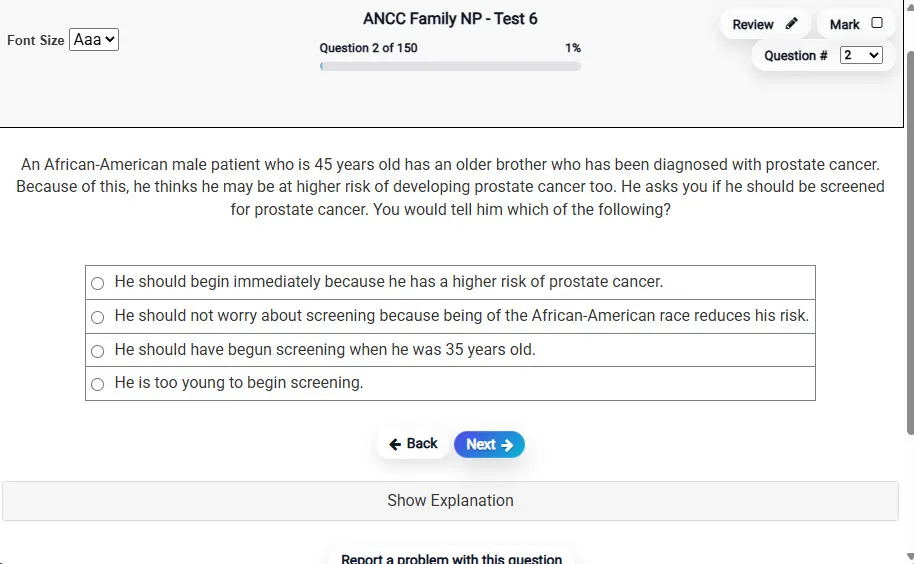
Answering a Question screen – Multiple-choice item view with navigation controls and progress tracker.
Answering a Question Multiple-choice item view with navigation controls and progress tracker.

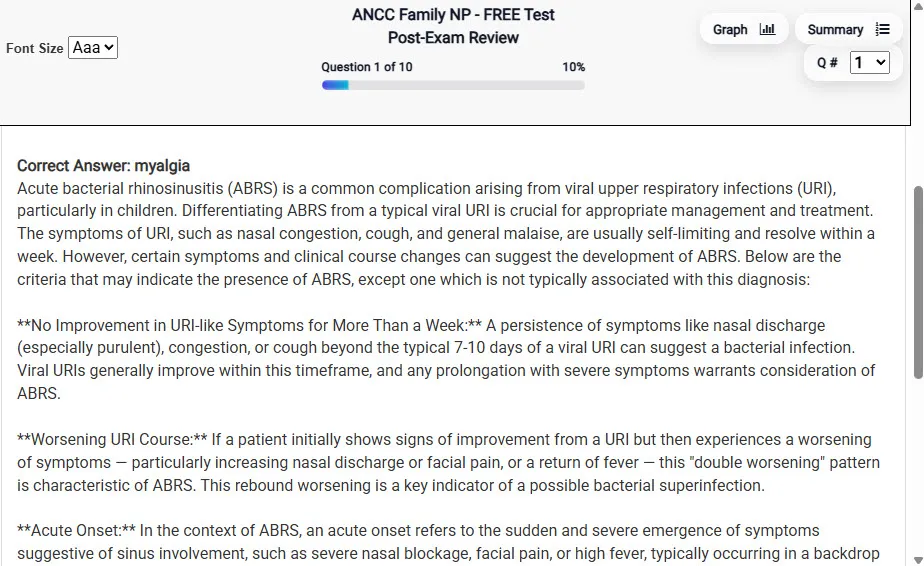
                           Detailed Explanation screen – 
                         Review mode showing chosen answer and rationale and references.
Detailed Explanation Review mode showing chosen answer and rationale and references.

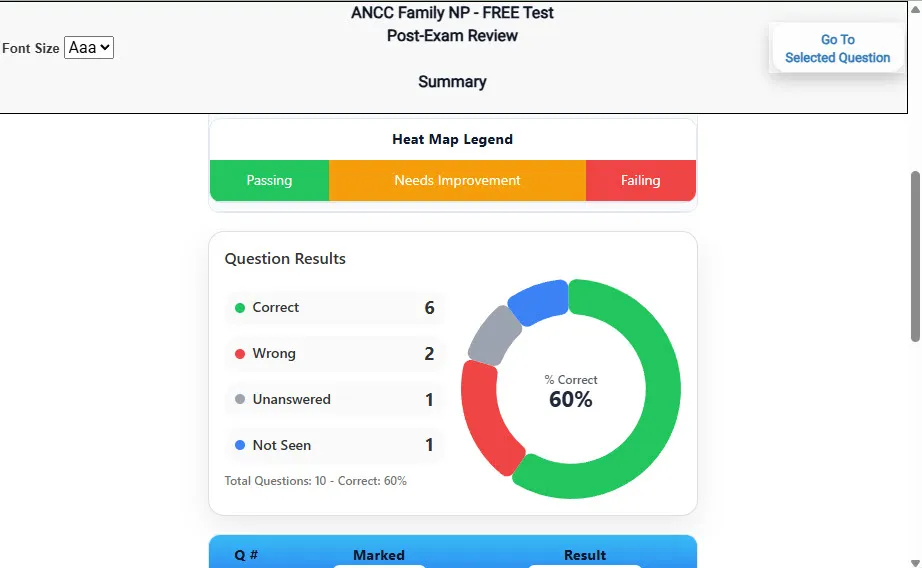
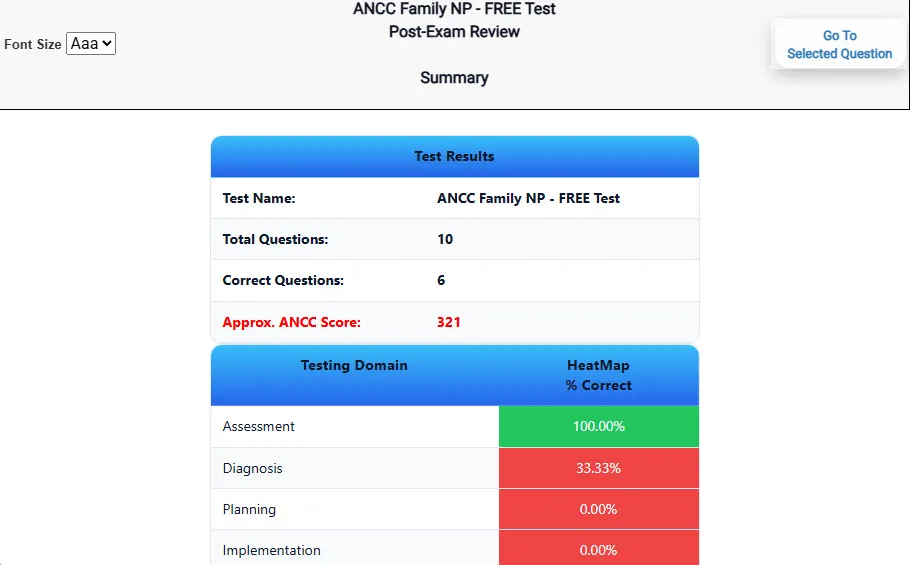
                           Review Summary 1 screen – 
                         Summary with counts for correct/wrong/unanswered and not seen items.
Review Summary 1 Summary with counts for correct/wrong/unanswered and not seen items.

                           Review Summary 2 screen – 
                         Advanced summary with category/domain breakdown and performance insights.
Review Summary 2 Advanced summary with category/domain breakdown and performance insights.

What Each Screen Shows

Answer Question Screen

  • Clean multiple-choice interface with progress bar.
  • Mark for review feature.
  • Matches real test pacing.

Detailed Explanation

  • Correct answer plus rationale.
  • Key concepts and guidelines highlighted.
  • Move between questions to fill knowledge gaps.

Review Summary 1

  • Overall results with total questions and scaled score.
  • Domain heatmap shows strengths and weaknesses.
  • Quick visual feedback on study priorities.

Review Summary 2

  • Chart of correct, wrong, unanswered, not seen.
  • Color-coded results for easy review.
  • Links back to missed items.

Top 10 Reasons to Use Exam Edge for your AAMA Certified Medical Assistant Exam Prep

  1. Focused on the AAMA Certified Medical Assistant Exam

    Our practice tests are built specifically for the AAMA CMA exam — every question mirrors the real topics, format, and difficulty so you're studying exactly what matters.

  2. Real Exam Simulation

    We match the per-question time limits and pressure of the actual AAMA exam, so test day feels familiar and stress-free.

  3. 20 Full Practice Tests & 2,000 Unique Questions

    You'll have more than enough material to master every AAMA CMA concept — no repeats, no fluff.

  4. Lower Cost Than a Retake

    Ordering 5 practice exams costs less than retaking the AAMA Certified Medical Assistant exam after a failure. One low fee could save you both time and money.

  5. Flexible Testing

    Need to step away mid-exam? Pick up right where you left off — with your remaining time intact.

  6. Instant Scoring & Feedback

    See your raw score and an estimated AAMA Certified Medical Assistant score immediately after finishing each practice test.

  7. Detailed Explanations for Every Question

    Review correct and incorrect answers with clear, step-by-step explanations so you truly understand each topic.

  8. Trusted & Accredited

    We're fully accredited by the Better Business Bureau and uphold the highest standards of trust and transparency.

  9. Web-Based & Always Available

    No software to install. Access your AAMA CMA practice exams 24/7 from any computer or mobile device.

  10. Expert Support When You Need It

    Need extra help? Our specialized tutors are highly qualified and ready to support your AAMA exam prep.


Pass the AAMA Certified Medical Assistant Exam with Realistic Practice Tests from Exam Edge

Preparing for your upcoming AAMA Certified Medical Assistant (CMA) Certification Exam can feel overwhelming — but the right practice makes all the difference. Exam Edge gives you the tools, structure, and confidence to pass on your first try. Our online practice exams are built to match the real AAMA CMA exam in content, format, and difficulty.

  • 📝 20 AAMA Certified Medical Assistant Practice Tests: Access 20 full-length exams with 100 questions each, covering every major AAMA Certified Medical Assistant topic in depth.
  • Instant Online Access: Start practicing right away — no software, no waiting.
  • 🧠 Step-by-Step Explanations: Understand the reasoning behind every correct answer so you can master AAMA CMA exam concepts.
  • 🔄 Retake Each Exam Up to 4 Times: Build knowledge through repetition and track your improvement over time.
  • 🌐 Web-Based & Available 24/7: Study anywhere, anytime, on any device.
  • 🧘 Boost Your Test-Day Confidence: Familiarity with the AAMA format reduces anxiety and helps you perform under pressure.

These AAMA Certified Medical Assistant practice exams are designed to simulate the real testing experience by matching question types, timing, and difficulty level. This approach helps you get comfortable not just with the exam content, but also with the testing environment, so you walk into your exam day focused and confident.


Exam Edge AAMA Reviews


Thank you so much for the tests that helped me pass my CMA exam! They really helped me learn as much as I did and go into that exam with confidence.

Kathleen , Pittsburgh PA


AAMA Certified Medical Assistant Aliases Test Name

Here is a list of alternative names used for this exam.

  • AAMA Certified Medical Assistant
  • AAMA Certified Medical Assistant test
  • AAMA Certified Medical Assistant Certification Test
  • AAMA CMA test
  • AAMA
  • AAMA CMA
  • CMA test
  • AAMA Certified Medical Assistant (CMA)
  • Certified Medical Assistant certification