
This is the content of the pop-over!

AACN CCRN-E (CCRN-E) Practice Tests & Test Prep by Exam Edge


AACN Adult Acute/Critical Care/Tele-ICU Nursing Certification  product image
(4.9)
Based on 17 Reviews

  • Real Exam Simulation: Timed questions and matching content build comfort for your AACN CCRN-E test day.
  • Instant, 24/7 Access: Web-based AACN Adult Acute/Critical Care/Tele-ICU Nursing Certification practice exams with no software needed.
  • Clear Explanations: Step-by-step answers and explanations for your AACN exam to strengthen understanding.
  • Boosted Confidence: Reduces anxiety and improves test-taking skills to ace your AACN Adult Acute/Critical Care/Tele-ICU Nursing Certification (CCRN-E).

Featured on

AACN Adult Acute/Critical Care/Tele-ICU Nursing Certification Online Practice Test Bundles

BEST VALUE
20 practice tests

$174.00

$799.00

SAVE $625

Only $8.70 per test!

  • 100% Pass Guarantee
  • 20 online practice tests
  • 100 questions per test
  • Bonus: 100 Flash Cards + Study Guide
  • Instant access
  • Detailed Explanations
  • Practice tests never expire
  • Timed, untimed, or study guide mode
MOST POPULAR
10 practice tests

$99.50

$399.50

SAVE $300

Only $9.95 per test!

  • 10 online practice tests
  • 100 questions per test
  • Bonus: 100 Flash Cards + Study Guide
  • Instant access
  • Detailed Explanations
  • Practice tests never expire
  • Timed, untimed, or study guide mode
5 practice tests

$69.75

$199.75

SAVE $130

Only $13.95 per test!

  • 5 online practice tests
  • 100 questions per test
  • Bonus: 100 Flash Cards
  • Instant access
  • Detailed Explanations
  • Practice tests never expire
  • Timed, untimed, or study guide mode
1 practice test

$39.95

  • 1 online practice test
  • 100 questions per test
  • Instant access
  • Detailed Explanations
  • Practice tests never expire
  • Timed, untimed, or study guide mode
Quick Select
Tap to choose a bundle

** All Prices are in US Dollars (USD) **


AACN CCRN-E (CCRN-E) Resources

Jump to the section you need most.

Understanding the exact breakdown of the AACN Adult Acute/Critical Care/Tele-ICU Nursing Certification test will help you know what to expect and how to most effectively prepare. The AACN Adult Acute/Critical Care/Tele-ICU Nursing Certification has multiple-choice questions . The exam will be broken down into the sections below:

AACN Adult Acute/Critical Care/Tele-ICU Nursing Certification Exam Blueprint
Domain Name % Number of
Questions
Clinical Judgment 80% 40
     Cardiovascular 20% 10
     Pulmonary 18% 9
     Endocrine 5% 2
     Hematology/Immunology 2% 1
     Neurology 12% 6
     Gastrointestinal 6% 3
     Renal 6% 3
     Multisystem 8% 4
     Behavioral/Psychosocial 4% 2
Professional Caring And Ethical Practice 20% 10
     Advocacy /Moral Agency 3% 1
     Caring Practices 4% 2
     Collaboration 4% 2
     Systems Thinking 2% 1
     Response to Diversity 2% 1
     Clinical Inquiry 2% 1
     Facilitation of Learning 3% 1

AACN Adult Acute/Critical Care/Tele-ICU Nursing Certification Study Tips by Domain

  • Prioritize ABCs with a rapid differential (shock, hypoxia, stroke, sepsis) and treat first, then diagnose—a common trap is chasing labs or imaging while the airway or perfusion is unstable.
  • Trend data, don’t snapshot it: compare vitals, urine output, mental status, and ventilator/pressors over time; red flag is a rising lactate or falling UOP (<0.5 mL/kg/hr) despite “normal” BP.
  • Recognize silent deterioration—new confusion, cool mottled skin, narrow pulse pressure, or increasing vasopressor requirement; common trap is attributing acute delirium to “ICU psych” without evaluating hypoxia, sepsis, or withdrawal.
  • Validate alarms and waveforms before acting: check arterial line leveling/damping, ECG lead placement, and SpO2 signal quality; red flag is treating a number (e.g., hypotension) without confirming it matches the patient.
  • Escalate using closed-loop communication with a clear ask (e.g., “Concern for septic shock—need cultures, broad-spectrum antibiotics within 1 hour, and fluids/pressors”); priority rule is early time-sensitive therapy beats perfect certainty.
  • Reassess after every intervention (fluid bolus, vent change, sedation, diuretic) and document response; contraindication cue is worsening oxygenation or crackles after fluids suggesting fluid intolerance and need to pivot strategy.
  • Differentiate shock types quickly (cardiogenic vs distributive vs hypovolemic vs obstructive) because the wrong first move is a common trap—e.g., aggressive fluids in cardiogenic shock can worsen pulmonary edema.
  • In acute coronary syndrome, prioritize early 12-lead ECG and serial troponins; a red flag is ongoing ischemic pain with hypotension/bradycardia suggesting inferior/RV MI where nitrates are contraindicated.
  • For atrial fibrillation with rapid ventricular response, treat based on stability; a priority rule is synchronized cardioversion for instability (hypotension, ischemia, pulmonary edema) rather than “trying a drip first.”
  • Manage post-cardiac surgery and invasive lines with strict vigilance; a key cue is tamponade signs (rising CVP, narrowing pulse pressure, muffled heart sounds, decreasing chest tube output) requiring urgent escalation.
  • When titrating vasoactive drips (e.g., norepinephrine, epinephrine, vasopressin, dobutamine), follow hemodynamic targets and trend markers; a red flag is new ectopy or rising lactate despite higher doses—reassess perfusion and cause.
  • Recognize and treat malignant dysrhythmias and electrolyte drivers; a common trap is ignoring QT-prolonging meds in hypokalemia/hypomagnesemia—correct K/Mg promptly to reduce torsades risk.
  • Escalate oxygenation support based on trajectory, not just the current SpO2—increasing work of breathing, accessory muscle use, or rising PaCO2 are red flags even with “acceptable” saturation.
  • When using high-flow nasal cannula or NIV, reassess early and frequently (e.g., within 30–60 minutes) for failure—worsening tachypnea, persistent hypoxemia, or declining mental status is a priority cue to prepare for intubation.
  • For suspected pulmonary embolism, don’t anchor on a normal chest X-ray—unexplained dyspnea with pleuritic pain, tachycardia, or sudden hypoxemia is a common trap that should prompt urgent risk stratification and anticoagulation readiness.
  • In COPD exacerbation, avoid over-oxygenation—a rising PaCO2 with somnolence after increasing FiO2 is a red flag for CO2 retention and should prompt titration and consideration of NIV.
  • With ARDS or severe hypoxemia, prioritize lung-protective ventilation cues—plateau pressure >30 cm H2O or worsening compliance is a threshold that signals need to adjust tidal volume/PEEP and consider proning.
  • Prevent ventilator-associated complications by bundling daily readiness-to-wean checks with aspiration precautions—missed sedation interruptions or poor oral care are common traps that prolong ventilation and increase VAP risk.
  • In DKA/HHS, start isotonic fluids first, then insulin after confirming K+ ≥3.3 mEq/L; red flag: starting insulin with severe hypokalemia can trigger lethal dysrhythmias.
  • For IV insulin infusions, target a gradual glucose fall (~50–75 mg/dL/hr) and anticipate a dextrose add-on when glucose reaches ~200 mg/dL (DKA) or ~300 mg/dL (HHS); common trap: stopping insulin as glucose normalizes before the anion gap/ketosis resolves.
  • Treat symptomatic hypoglycemia immediately (e.g., 25 g IV dextrose or IM/IN glucagon if no IV); priority rule: in a patient on long-acting insulin/sulfonylureas, monitor for recurrent lows after initial correction.
  • Suspect thyroid storm with hyperthermia, severe tachycardia, and altered mental status; priority sequence: beta-blocker, thionamide, then iodine at least 1 hour later—trap: giving iodine before a thionamide can worsen hormone release.
  • For myxedema coma, give IV levothyroxine and stress-dose steroids while supporting ventilation and rewarming; red flag: aggressive external rewarming may precipitate vasodilation and cardiovascular collapse.
  • In adrenal crisis, treat first with IV hydrocortisone and isotonic fluids (often with dextrose) and correct hyperkalemia; common trap: delaying steroids while waiting for cortisol/ACTH results in an unstable patient.
  • Suspect heparin-induced thrombocytopenia when platelets fall ≥50% from baseline 5–10 days after heparin exposure (or sooner with prior exposure)—red flag: new thrombosis with thrombocytopenia; stop all heparin (including flushes) and start a non-heparin anticoagulant.
  • During blood transfusion, any new fever, chills, back pain, dyspnea, hypotension, or hives is a stop-the-line cue—STOP transfusion, keep IV open with normal saline, and notify provider/blood bank; common trap: restarting after symptoms improve.
  • For neutropenia (ANC <500/µL), prioritize infection prevention and early sepsis recognition—red flag: fever ≥38.0°C (100.4°F) requires immediate cultures and broad-spectrum antibiotics without delay.
  • Act quickly on disseminated intravascular coagulation cues (oozing from lines, falling platelets/fibrinogen, rising PT/aPTT, elevated D-dimer)—priority rule: treat the underlying cause and transfuse blood products based on active bleeding/procedures, not labs alone.
  • Monitor anticoagulants with the right test and timing—common trap: using INR to titrate heparin; cue: heparin is followed with aPTT or anti-Xa per protocol, while warfarin is guided by INR with bleeding risk rising sharply as INR climbs.
  • Recognize anaphylaxis/acute immune reactions (wheezing, stridor, hypotension, angioedema) as an emergency—priority rule: give IM epinephrine promptly and support airway/oxygenation; contraindication trap: delaying epinephrine in favor of antihistamines alone.
  • Trend neuro status with consistent tools (GCS, pupillary size/reactivity, motor drift) and treat any acute change as emergent—red flag: a new unilateral blown pupil or sudden drop in GCS suggests herniation until proven otherwise.
  • Manage intracranial pressure (ICP) using head midline, HOB 30°, normoxia/normocapnia, and clustered care—common trap: over-hyperventilating drops PaCO2 too low and can worsen cerebral ischemia.
  • Prioritize cerebral perfusion pressure (CPP) by balancing MAP support with ICP control—priority rule: hypotension is a secondary brain injury, so avoid permissive hypotension in acute neuro compromise.
  • Differentiate seizure activity (including nonconvulsive) from sedation effects and metabolic causes—red flag: unexplained tachycardia, eye deviation, or subtle twitching in an encephalopathic patient warrants EEG consideration.
  • For acute ischemic stroke, protect airway, keep glucose controlled, and avoid unnecessary BP lowering—common trap: aggressively treating hypertension can reduce cerebral perfusion in the penumbra unless directed for thrombolysis/hemorrhage protocols.
  • Prevent secondary complications: aspiration, DVT, pressure injury, and delirium with early mobility and swallow screening—contraindication cue: do not perform a bedside swallow until the patient is alert and able to manage secretions.
  • Suspect upper GI bleed with melena, hematemesis, or rising BUN/Cr ratio; red flag is hemodynamic instability despite fluids—prioritize large-bore IV access, type & cross, and serial H/H.
  • Acute pancreatitis priorities include aggressive isotonic fluids and pain control; common trap is relying on amylase alone—trend lipase and monitor for hypocalcemia, ARDS, and hypotension.
  • Fulminant hepatic failure can present with altered mentation and rising INR; red flag is worsening encephalopathy—protect airway, avoid sedatives when possible, and monitor glucose closely.
  • For enteral nutrition, verify tube placement per policy and assess aspiration risk; priority rule is hold feeds with hemodynamic instability/escalating vasopressors or uncontrolled emesis.
  • Ischemic bowel often presents with pain out of proportion to exam and lactate elevation; red flag is metabolic acidosis with abdominal pain—notify provider emergently and anticipate CTA/OR.
  • High-output ostomy or severe diarrhea can rapidly cause hypovolemia and electrolyte loss; common trap is replacing volume without electrolytes—monitor Na+, K+, Mg2+, and strict I&O.
  • Recognize emergent hyperkalemia patterns (peaked T waves, widened QRS, new bradyarrhythmias) and treat in priority order: stabilize myocardium (IV calcium) then shift K+ (insulin/dextrose, β-agonist) then remove it (diuretics/dialysis)—don’t delay for lab repeats if ECG changes are present.
  • For acute kidney injury, verify true oliguria (<0.5 mL/kg/hr for ≥6 hr) and correct reversible causes first (hypovolemia, obstruction, nephrotoxins)—a common trap is giving loop diuretics to “fix” AKI without addressing perfusion or post-renal blockage.
  • In CRRT/IHD, watch for circuit clotting and access dysfunction (rising return pressures, frequent alarms, dark/slow effluent)—red flag: sudden loss of ultrafiltration with hemodynamic instability suggests access or filter failure requiring immediate troubleshooting.
  • Prevent dialysis disequilibrium by avoiding overly rapid solute removal in high BUN/new dialysis starts; monitor for headache, nausea, restlessness, seizures—priority is to slow or stop dialysis and support airway/neurologic status.
  • Manage fluid balance with daily weights and strict I&O; a >1 kg/day gain generally indicates fluid retention and raises concern for pulmonary edema—contraindication cue: avoid aggressive fluids in oliguric patients with crackles/increasing oxygen needs.
  • Renally dose and time medications around dialysis (e.g., give dialyzable antibiotics after HD when indicated) and avoid nephrotoxins when alternatives exist—common trap: continuing ACEi/ARB/NSAIDs during hypotension or evolving AKI, worsening renal perfusion.
  • Recognize early shock by trending MAP < 65 mmHg or lactate ≥ 2 mmol/L with rising vasopressor needs—red flag: “normal” BP in a chronically hypertensive patient may still mean poor perfusion.
  • Apply sepsis bundles promptly (cultures, broad-spectrum antibiotics, fluids, vasopressors) and reassess after each step—common trap: delaying antibiotics for imaging or line placement.
  • Watch for evolving MODS using trajectories (urine output < 0.5 mL/kg/hr, rising creatinine, bilirubin, INR, decreasing platelets) rather than single labs—red flag: subtle mentation change as the first sign of organ hypoperfusion.
  • Balance fluid resuscitation with lung protection; new crackles, increasing FiO2/PEEP needs, or worsening CXR after large volumes suggests fluid intolerance—priority rule: switch to vasopressors when hypotension persists despite appropriate initial fluids.
  • Prevent and detect ICU delirium and weakness (daily sedation assessment, early mobility, sleep hygiene)—common trap: assuming agitation is “pain only” and escalating sedatives without addressing hypoxia, withdrawal, or infection.
  • Identify and mitigate iatrogenic harm across systems (stress ulcer/DVT prophylaxis, glycemic control, device-associated infection prevention)—red flag: escalating pressors with an unaddressed source (e.g., obstructed Foley, tension pneumothorax, bleeding).
  • Screen every ICU patient for delirium at least once per shift (e.g., CAM-ICU) and treat reversible causes first; red flag: new agitation or somnolence is delirium until proven otherwise.
  • Use pain-first management (CPOT/BPS if nonverbal) before sedatives; common trap: escalating propofol/benzodiazepines when uncontrolled pain or withdrawal is the driver.
  • Choose the lightest effective sedation with a clear daily goal (e.g., RASS −2 to 0 unless contraindicated); priority rule: deep sedation increases delirium and ventilator days unless there’s a specific indication (e.g., severe ARDS paralysis, refractory ICP).
  • Prevent and manage alcohol/benzo withdrawal proactively (CIWA when appropriate, history from family, thiamine before glucose); red flag: autonomic instability + tremor/hallucinations within 6–48 hours of last drink/benzo.
  • Apply least-restrictive safety measures first and reassess restraint need frequently; common trap: using restraints without addressing triggers (hypoxia, urinary retention, lines, sleep deprivation) or without adequate documentation/monitoring.
  • Support patient/family coping with structured communication (teach-back, realistic goals, consistency across team); red flag: sudden conflict, decisional fatigue, or mistrust often signals unmet information needs or unmanaged symptoms.
  • Protect patient autonomy with informed consent and right-to-refuse—red flag: sedation, delirium, or hypoxia may invalidate capacity and requires a surrogate/POA pathway.
  • Escalate potential abuse, neglect, or unsafe discharge plans immediately per policy—common trap: documenting “patient states feels unsafe” without notifying case management/social work and the provider.
  • Safeguard confidentiality (HIPAA) in Tele-ICU workflows—red flag: discussing identifiable data in non-secure channels or leaving patient charts open/visible during remote rounds.
  • Address end-of-life goals early and consistently with the team—priority rule: when code status/advance directives conflict with orders, clarify and reconcile before a deterioration event.
  • Use professional boundaries and therapeutic communication—common trap: accepting gifts, sharing personal contact info, or engaging in social media interactions with patients/families.
  • Recognize and act on moral distress and ethical conflict using AACN resources (e.g., ethics consult)—red flag: “futile care” concerns with ongoing invasive support without revisiting goals of care.
  • Use AACN synergy principles to match patient/family needs with resources and escalate when capacity is unsafe—red flag: repeated missed assessments or delayed interventions due to staffing.
  • Protect patient autonomy with informed consent and clear alternatives (including no treatment) using teach-back—common trap: assuming consent is valid when the patient is hypoxic, delirious, or newly sedated.
  • Activate chain-of-command early for unresolved safety concerns (e.g., rapidly deteriorating patient, inappropriate discharge/transfer)—priority rule: “document, notify, escalate, and re-assess” rather than waiting for the next round.
  • Advocate for ethical symptom management at end of life, separating proportional palliative sedation from intent to hasten death—red flag: escalating opioids/benzodiazepines without documented symptom targets and monitoring.
  • Safeguard rights and dignity in restraints/securement by using least-restrictive measures and time-limited orders with ongoing assessment—common trap: treating restraint orders as “set and forget” during agitation or weaning sedation.
  • Address moral distress and ethical conflict with structured consults (ethics, palliative, social work) and debriefing—contraindication: silently complying with a plan you believe is harmful without voicing concerns through appropriate channels.
  • Prioritize analgesia and comfort before escalating sedation in mechanically ventilated patients; red flag: treating agitation with sedatives alone can mask pain, hypoxia, or delirium.
  • Use a structured delirium screen and bundle-based prevention (sleep, mobility, sensory aids); common trap: assuming confusion is “ICU psychosis” without ruling out hypoxemia, infection, or withdrawal.
  • Protect skin and lines with disciplined turning, off-loading, and device rotation; red flag: occiput, sacrum, and device-related pressure injuries in proned or edematous patients can develop within hours.
  • Prevent ventilator-associated complications with meticulous oral care and aspiration precautions; common trap: missing cuff-leak/position issues when secretions increase or oxygenation worsens.
  • Communicate and preserve dignity with consistent reorientation, privacy, and family engagement per AACN patient- and family-centered care; red flag: fragmented messaging across shifts increases anxiety and nonadherence.
  • Maintain safety with high-reliability checks (alarms, tubing trace, medication double-checks) during transfers and tele-ICU handoffs; common trap: “set-and-forget” monitoring leading to missed deterioration.
  • Use closed-loop communication for critical changes (e.g., new hypotension, rising lactate) and require read-back of verbal/phone orders—red flag: orders carried out without confirmation in Tele-ICU handoffs.
  • Escalate early using a defined chain of command when goals of care conflict with current treatments—common trap: delaying palliative consult until after repeated nonbeneficial resuscitations.
  • Run daily interprofessional rounds with a standardized checklist (VTE prophylaxis, stress-ulcer prophylaxis, lines/tubes, mobility, sedation targets)—priority rule: every central line and Foley must have an explicit ongoing indication.
  • Coordinate sedation/analgesia with respiratory therapy for ventilator synchrony and spontaneous awakening/breathing trials—contraindication cue: hold SBT if escalating vasopressors or active myocardial ischemia.
  • Partner with pharmacy to reconcile high-alert drips (vasopressors, insulin, anticoagulants) and align titration parameters—red flag: conflicting MAP or glucose targets across notes/orders.
  • During transitions (ED/OR to ICU, ICU to step-down), use SBAR including active problems, pending studies, and contingency plans—common trap: missing “if/then” instructions for arrhythmias, bleeding, or ventilator alarms.
  • Use a “system-level” lens for recurring harm (e.g., CLABSI, falls, pressure injuries) and escalate patterns through unit-based governance; red flag: treating repeat events as isolated staff errors.
  • In Tele-ICU workflows, verify closed-loop communication for high-risk changes (pressor escalation, new arrhythmia, neuro decline); common trap: assuming the bedside team saw the same trending data you did.
  • Prioritize early recognition of deterioration using trends over single values (MAP, lactate, urine output, mentation) and trigger rapid response/ICU consult per policy; red flag: “normal” vitals with rising O2 needs or increasing work of breathing.
  • Match resources to acuity (staffing, skill mix, monitoring capability, device availability) and advocate for reallocation when risk rises; common trap: accepting unsafe assignments because the unit is “busy” without documenting and escalating.
  • Standardize high-alert medication safety (vasopressors, insulin, anticoagulants, sedation) with double-checks and pump-library compliance; red flag: bypassing guardrails during emergent titrations.
  • Coordinate transitions of care with structured handoff (diagnosis, devices/lines, drips, goals, contingencies) and reconcile orders across settings; common trap: missed time-sensitive therapies after transfer (DVT prophylaxis, antibiotics, glucose checks).
  • Perform rapid cultural assessment (language, decision-maker, health beliefs) and use a qualified medical interpreter for anything beyond basic needs—red flag: relying on family members to translate consent or high-stakes ICU decisions.
  • Respect diverse family structures and visitation expectations while maintaining ICU safety—common trap: applying one-size-fits-all “policy only” responses instead of negotiating a patient-centered plan with clear boundaries.
  • Screen for health literacy and numeracy before teaching (ask-tell-ask, teach-back)—priority rule: if teach-back fails, simplify and repeat rather than documenting “patient noncompliant.”
  • Assess pain and distress with culturally appropriate tools and observe nonverbal cues—red flag: assuming “stoic” patients don’t need analgesia or sedation adjustments.
  • Integrate spiritual/religious practices into the care plan when safe (diet, modesty, prayer, end-of-life rituals)—contraindication cue: accommodate unless it conflicts with immediate life-saving interventions, then explain the rationale and revisit promptly.
  • Address implicit bias and inequities in escalation of care (consults, restraints, sedation, withdrawal of life support)—common trap: differing recommendations based on race, language, disability, or socioeconomic status rather than objective clinical criteria.
  • Use an evidence hierarchy to answer a clinical question—systematic reviews/clinical guidelines generally outweigh single-center studies; red flag: changing a high-risk protocol based on one small observational paper.
  • Write a focused PICOT question (Population, Intervention, Comparison, Outcome, Time) before searching; common trap: a vague question that yields unmanageable search results and weak conclusions.
  • When appraising studies, prioritize internal validity (randomization, allocation concealment, blinding) and effect size with confidence intervals; red flag: statistically significant p-values with clinically trivial benefit.
  • Apply evidence with patient-specific modifiers (hemodynamics, organ dysfunction, goals of care) and unit resources; contraindication cue: adopting guideline dosing without renal/hepatic adjustment in the ICU.
  • Track outcomes with clear metrics (e.g., VAP rate, CLABSI, delirium days, LOS) and predefine a baseline period; common trap: declaring success without a comparison timeframe or run chart.
  • For practice changes, include safety monitoring and stop rules (e.g., unexpected hypotension/bleeding/increased adverse events); red flag: rolling out broadly without a pilot and feedback loop from bedside staff.
  • Use teach-back for all high-risk topics (e.g., anticoagulants, insulin, heart failure plan) and document the patient’s own words; red flag: nodding/yes-saying without being able to state the dose, timing, and hold parameters.
  • Time education to physiologic readiness (pain controlled, off escalating vasopressors, delirium improving) and keep sessions brief; common trap: attempting complex discharge teaching during acute hypoxia, severe dyspnea, or active delirium.
  • For ventilated or dysarthric patients, use AACN-aligned communication supports (yes/no signals, picture/letter boards, writing) and verify comprehension; red flag: interpreting agitation as “noncompliance” when it reflects unmet needs or inability to communicate.
  • Prioritize safety-critical self-management skills before discharge/transfer (med changes, device care, follow-up triggers); priority rule: teach “when to call/return” using explicit thresholds (e.g., worsening dyspnea, chest pain, bleeding, fever) rather than vague instructions.
  • Involve family/caregivers early when the patient has cognitive impairment or complex regimens and confirm they can demonstrate skills (e.g., trach/PEG care, glucose checks); common trap: assuming availability or competence without a return demonstration.
  • Adapt teaching to health literacy and language needs using qualified interpreters and plain-language materials; red flag: using family as interpreters for consent/medication teaching or relying on dense printouts without confirming understanding.


Built to Fit Into Your Busy Life

Everything you need to prepare with confidence—without wasting a minute.

Three Study Modes

Timed, No Time Limit, or Explanation mode.

Actionable Analytics

Heatmaps and scaled scores highlight weak areas.

High-Yield Rationales

Concise explanations emphasize key concepts.

Realistic Interface

Matches the feel of the actual exam environment.

Accessible by Design

Clean layout reduces cognitive load.

Anytime, Anywhere

Web-based access 24/7 on any device.
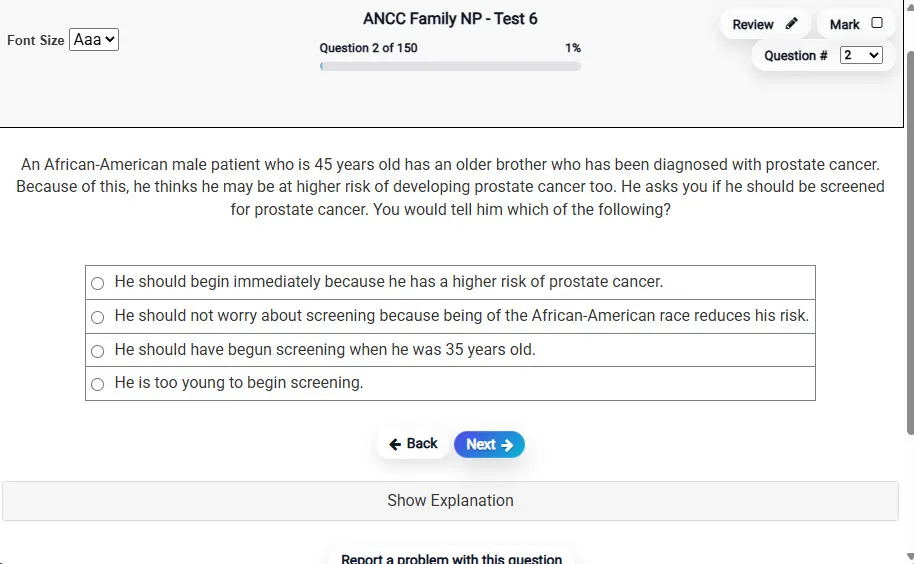
Answering a Question screen – Multiple-choice item view with navigation controls and progress tracker.
Answering a Question Multiple-choice item view with navigation controls and progress tracker.

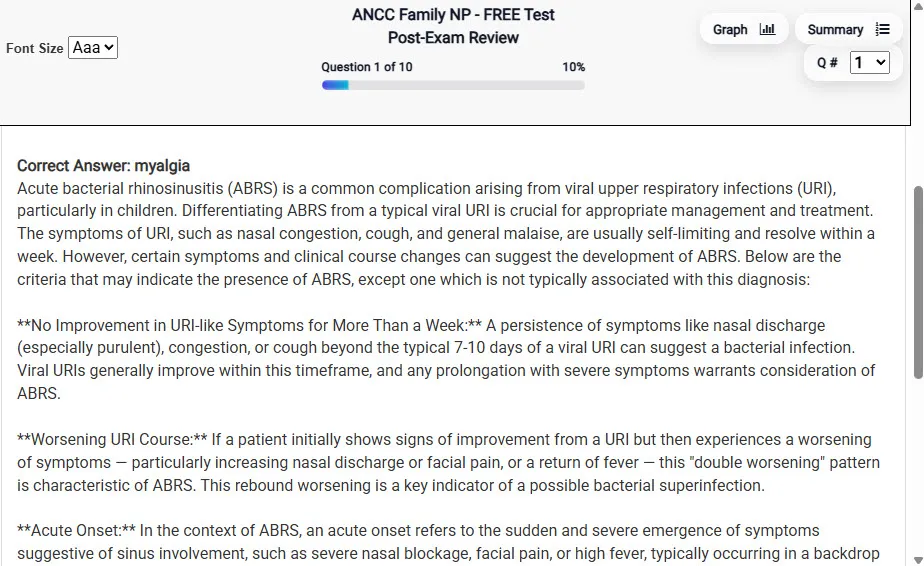
                           Detailed Explanation screen – 
                         Review mode showing chosen answer and rationale and references.
Detailed Explanation Review mode showing chosen answer and rationale and references.

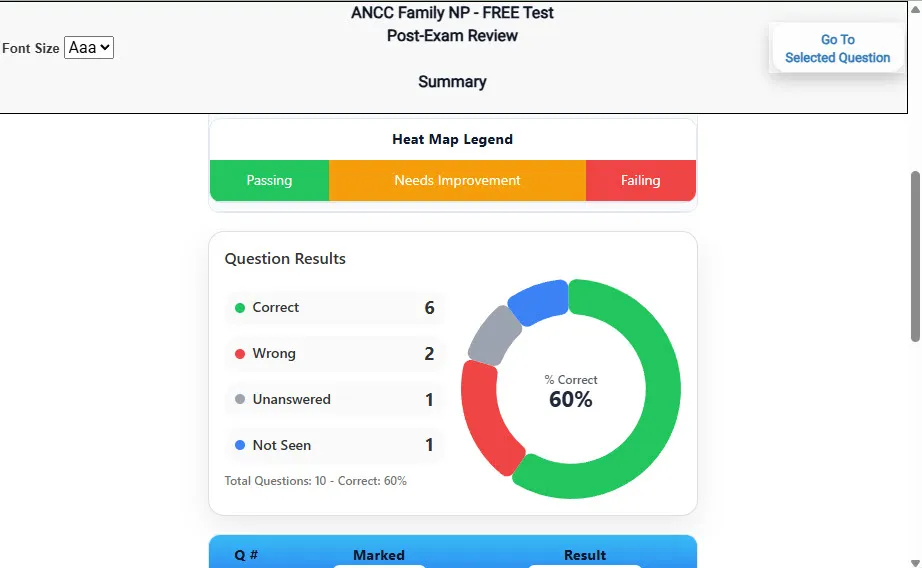
                           Review Summary 1 screen – 
                         Summary with counts for correct/wrong/unanswered and not seen items.
Review Summary 1 Summary with counts for correct/wrong/unanswered and not seen items.

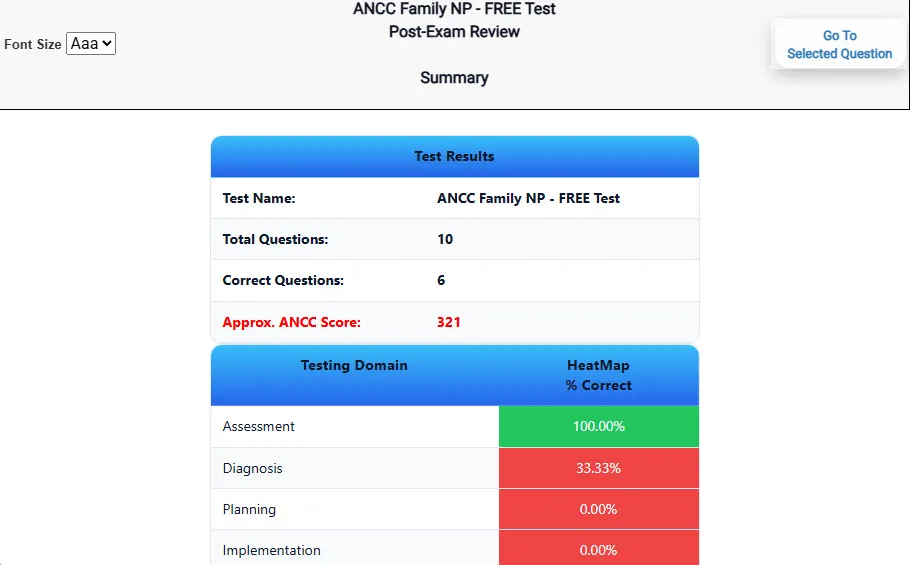
                           Review Summary 2 screen – 
                         Advanced summary with category/domain breakdown and performance insights.
Review Summary 2 Advanced summary with category/domain breakdown and performance insights.

What Each Screen Shows

Answer Question Screen

  • Clean multiple-choice interface with progress bar.
  • Mark for review feature.
  • Matches real test pacing.

Detailed Explanation

  • Correct answer plus rationale.
  • Key concepts and guidelines highlighted.
  • Move between questions to fill knowledge gaps.

Review Summary 1

  • Overall results with total questions and scaled score.
  • Domain heatmap shows strengths and weaknesses.
  • Quick visual feedback on study priorities.

Review Summary 2

  • Chart of correct, wrong, unanswered, not seen.
  • Color-coded results for easy review.
  • Links back to missed items.

Top 10 Reasons to Use Exam Edge for your AACN Adult Acute/Critical Care/Tele-ICU Nursing Certification Exam Prep

  1. Focused on the AACN Adult Acute/Critical Care/Tele-ICU Nursing Certification Exam

    Our practice tests are built specifically for the AACN CCRN-E exam — every question mirrors the real topics, format, and difficulty so you're studying exactly what matters.

  2. Real Exam Simulation

    We match the per-question time limits and pressure of the actual AACN exam, so test day feels familiar and stress-free.

  3. 20 Full Practice Tests & 2,000 Unique Questions

    You'll have more than enough material to master every AACN CCRN-E concept — no repeats, no fluff.

  4. Lower Cost Than a Retake

    Ordering 5 practice exams costs less than retaking the AACN Adult Acute/Critical Care/Tele-ICU Nursing Certification exam after a failure. One low fee could save you both time and money.

  5. Flexible Testing

    Need to step away mid-exam? Pick up right where you left off — with your remaining time intact.

  6. Instant Scoring & Feedback

    See your raw score and an estimated AACN Adult Acute/Critical Care/Tele-ICU Nursing Certification score immediately after finishing each practice test.

  7. Detailed Explanations for Every Question

    Review correct and incorrect answers with clear, step-by-step explanations so you truly understand each topic.

  8. Trusted & Accredited

    We're fully accredited by the Better Business Bureau and uphold the highest standards of trust and transparency.

  9. Web-Based & Always Available

    No software to install. Access your AACN CCRN-E practice exams 24/7 from any computer or mobile device.

  10. Expert Support When You Need It

    Need extra help? Our specialized tutors are highly qualified and ready to support your AACN exam prep.


Pass the AACN Adult Acute/Critical Care/Tele-ICU Nursing Certification Exam with Realistic Practice Tests from Exam Edge

Preparing for your upcoming AACN Adult Acute/Critical Care/Tele-ICU Nursing Certification (CCRN-E) Certification Exam can feel overwhelming — but the right practice makes all the difference. Exam Edge gives you the tools, structure, and confidence to pass on your first try. Our online practice exams are built to match the real AACN CCRN-E exam in content, format, and difficulty.

  • 📝 20 AACN Adult Acute/Critical Care/Tele-ICU Nursing Certification Practice Tests: Access 20 full-length exams with 100 questions each, covering every major AACN Adult Acute/Critical Care/Tele-ICU Nursing Certification topic in depth.
  • Instant Online Access: Start practicing right away — no software, no waiting.
  • 🧠 Step-by-Step Explanations: Understand the reasoning behind every correct answer so you can master AACN CCRN-E exam concepts.
  • 🔄 Retake Each Exam Up to 4 Times: Build knowledge through repetition and track your improvement over time.
  • 🌐 Web-Based & Available 24/7: Study anywhere, anytime, on any device.
  • 🧘 Boost Your Test-Day Confidence: Familiarity with the AACN format reduces anxiety and helps you perform under pressure.

These AACN Adult Acute/Critical Care/Tele-ICU Nursing Certification practice exams are designed to simulate the real testing experience by matching question types, timing, and difficulty level. This approach helps you get comfortable not just with the exam content, but also with the testing environment, so you walk into your exam day focused and confident.


Exam Edge AACN Reviews


Today, I sat for and passed the PCCN Exam! I purchased and completed all 20 of your practice tests, and I just want to say thank you for providing this resource to study, and for helping me to build the stamina and confidence to complete all those questions in a timely manner! Thanks again! Kristen

Kristen, NJ

Thank you very much for making this such great review test material. It boosted my confidence in passing the PCCN (been out of nursing school for 18 years). I just took the test today and I did it.

Vicky , Arizona

Checking in was so impersonal and harsh. The exam room was freezing cold, difficult to concentrate. The computer screen height was so high that I had to tilt my head way back to see it! I left there freezing cold, and with a horrible crook in my neck. I shall drive the distance next time to find a m ...
Read More
Darlene , North Chesterfield, Virginia


AACN Adult Acute/Critical Care/Tele-ICU Nursing Certification Aliases Test Name

Here is a list of alternative names used for this exam.

  • AACN Adult Acute/Critical Care/Tele-ICU Nursing Certification
  • AACN Adult Acute/Critical Care/Tele-ICU Nursing Certification test
  • AACN Adult Acute/Critical Care/Tele-ICU Nursing Certification Certification Test
  • AACN CCRN-E test
  • AACN
  • AACN CCRN-E
  • CCRN-E test
  • AACN Adult Acute/Critical Care/Tele-ICU Nursing Certification (CCRN-E)
  • Adult Acute/Critical Care/Tele-ICU Nursing Certification certification